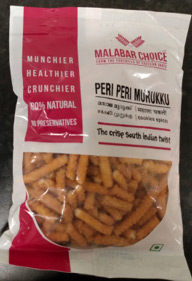
Presence of milk in a batch of Malabar Choice Peri Peri Murukku.
Alert Summary Dated Tuesday, September 30th 2025.
Allergy Alert Notification: 2025.A34. Allergen: Milk. Product Identification: Malabar Choice Peri Peri Murukku; pack size: 150g. Batch Code: DFE 09; best before date: APR 2026. Country Of Origin: India.
Message: Milk protein was detected in the above batch of Malabar Choice Peri Peri Murukku. Milk is not declared on the list of ingredients. This may make the batch unsafe for consumers who are allergic to or intolerant of milk and therefore, these consumers should not eat the implicated batch. The affected batch is being recalled.
Scientific facts published by Local Authority Waters Programme (LAWPRO). See HERE.
Water Quality in River Suir in Thurles only 33% satisfactory down from 61% in 2010-2012 which equals a relative drop of 46% in about 12 years.
Almost no aquatic life.Samples taken down stream of Thurles Bridge in town centre (Barry’s Bridge) on 11/09/24, result in no invertebrates typical of clean water such as Mayflies or Stoneflies – essential food for trout and salmon.
A few water shrimps (Gammarus), some biting Midge larvae (Simuliium) Extensive Cladophora algae.
Current data raises a harsh question: if our drinking water is so delicately balanced, how much “extra load” can rivers accept without tipping into crisis?
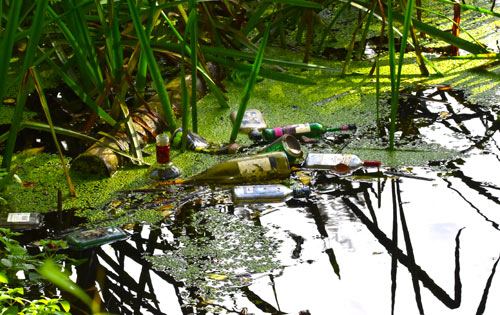
A small sample of floating bottles, River Suir, Thurles town centre. Pic: G. Willoughby. (Image taken Sept. 29th 2025)
Slurry Spreading: Tipperary’s Silent Pollution.
Hypocrisy is very much alive and well in Ireland, with the strict promotion of standards loudly proclaimed, yet quietly ignored when it comes to agriculture.
If an individual is caught illegally dumping a mattress or a bag of household rubbish, the law comes down hard. The penalties are steep: on-the-spot fines, €4,000 if convicted in the District Court, and up to €130,000 on indictment for more serious offences. Add to that the local authority’s investigation and legal costs, plus extra charges for continuing offences, and the message is crystal clear — thesepolluters will pay.
But here is the contradiction: when sewage or agricultural slurry is allowed to seep into our rivers, with the blessing of Tipperary Co. Council itself, the penalty is nothing, zero, zilch, no costs, no fines, no legal prosecution, and no accountability.
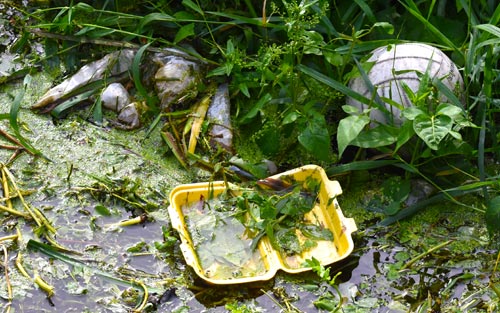
Just a small sample of the discarded litter at Barry’s Bridge, in River Suir, Thurles Town centre. Pic: G. Willoughby. (Image taken Sept. 29th 2025)
This double standard undermines public trust, punishes the ordinary citizen while shielding powerful interests, and leaves communities to live with the consequences — polluted drinking water, fish kills, and waterways turned into toxic drains. The rules are strict when it suits, yet curiously silent when the polluter is a farmer or an industry player with political influence.
Until agricultural slurry is treated as seriously as other forms of dumping, Tipperary and the rest of Ireland will continue to suffer the hidden, silent pollution that seeps into every stream and spring water well.
Tipperary was renowned for its rivers and lakes, the Suir winding through Thurles, the Shannon and its tributaries, and countless smaller streams supporting fish, wildlife, and local communities. Yet these waters are under increasing pressure, largely from the way slurry is managed on farms.
Slurry, a liquid mix of animal waste, provides a quick nitrogen boost to grass, making it popular among farmers. But its environmental costs are severe. Being liquid; slurry runs off easily during rainfall, carrying nutrients into rivers and lakes, triggering algal blooms, oxygen depletion and fish kills. Strong odours signal ammonia emissions, while heavy tankers compact soils, further increasing runoff.
By contrast, traditional dung releases nutrients slowly and enriches the soil with organic matter, improving structure, fertility, and biodiversity. Though slower to handle, it poses far less risk to water quality.
Evidence from EPA and Local Water Authorities The EPA’s 2023 report shows that many Irish rivers are failing to reach “good ecological status,” often due to nutrient pollution. In Tipperary, seven public water supplies, including Borrisokane, Nenagh, and Roscrea, are on the EPA’s Remedial Action List, meaning urgent improvements are needed. Dr. Fran Igoe from LAWPRO reports that water quality satisfaction in Tipperary has dropped from 61% to 33% over a 12 year period, with rivers around Thurles and Templemore particularly badly affected.
Voices from the Field Local anglers and fishing clubs have become strongly outspoken. Mr Joe O’Donoghue of Ormond Anglers says, “It’s doing untold damage to the river – the ecosystem is disappearing. Fly life we used to see in the evenings … it’s gone.” Inland Fisheries Ireland has prosecuted companies in Tipperary for slurry-related pollution. Ms Lynda Connor, regional director, states: “Ensuring clean and healthy water is not just a responsibility, but a necessity for the survival of fish and the ecosystems they thrive in.” Now the leading question “So why has Inland Fisheries Ireland not prosecuted Tipperary County Council for permitting sewage to flow into the River Suir?
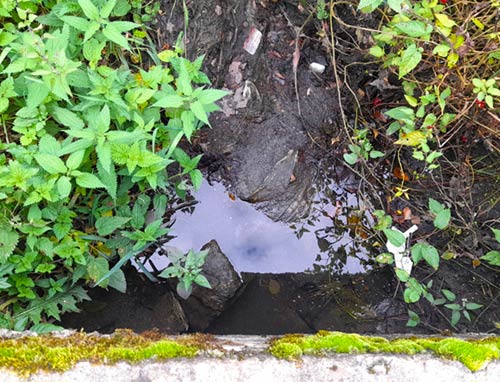
Mixed effluent flowing from a pipe on the river walk close to the rear of Thurles shopping centre. Pic: G. Willoughby (Image taken Sept. 29th 2025)
Time for Action. Tipperary as a county can no longer rely on excuses. The County Council, Uisce Éireann, and the Department of Agriculture must now act together and this will require:
Enforcement of slurry regulations with inspections and severe penalties.
Support for farmers to adopt safer alternatives, including dung use and low-emission spreading technologies.
An investment in water infrastructure, buffer zones, and monitoring.
An engagement with stakeholders such as anglers, environmental groups, and local communities in oversight and planning.
Short-term gains from slurry can no longer be allowed to outweigh the long-term damage to rivers, drinking water, and local ecosystems. Tipperary’s waters deserve decisive action now, before more fish die, more rivers are polluted, and the county’s natural heritage is irreversibly harmed.
Now regarding my last communication, which further updated details of the 12 year old River Suir pollution problem in Thurles; seven emails in total were sent 10 days ago, on Friday September 19th 2025 to:-
(1)Ms Sinead Carr(CE Tipperary Co. Council), [sinead.carr@tipperarycoco.ie]; ) Result: No Reply or acknowledgementreceivedto date.
(2)Ms Sharon Scully, (Thurles Municipal District Admin)[sharon.scully@tipperarycoco.ie]; Result: No Reply or acknowledgementreceived to date.
(3)Mr Darragh O’Brien (darragh.obrien@oireachtas.ie) (Minister for Climate, Energy and the Environment & Minister for Transport). Result: Correspondence acknowledged. (Ref: HPLG-MBO-03271-2025). Reply “Your correspondence is currently receiving attention and a further reply will issue as soon as possible”.
(4)Mr Alan Dillon (alan.dillon@oireachtas.ie) (Minister of State with responsibility for Small Businesses and Retail and Minister of State with responsibility for Circular Economy). Result: No Reply or acknowledgementreceived to date.
(5) Mr Timmy Dooley (timmy.dooley@oireachtas.ie) (Minister of State with responsibility for Fisheries, Minister of State with responsibility for the Marine). Result: Correspondence acknowledged. (Ref: CCAE-MOSD-00280-2025). Reply:“I would like to acknowledge your recent correspondence regarding Pollution of the River Suir. The contents of your email have been noted and I will bring this to the Minister’s attention and we will respond accordingly”.
(6)Environmental Complaints section EPA[E.Complaints@epa.ie], Result: Reply received as shown hereunder.
(7)Mr Robert O’Brien(A/Executive Scientist, Environment & Climate Action, Tipperary County Council, Civic Offices, Clonmel, Co. Tipperary).[robert.obrien@tipperarycoco.ie]. Result: Reply received as shown hereunder.
Hello George, You are correct to highlight the seriousness of the pollution of our rivers and the priority that must be given to public health and safety. Any immediate actions that could have been taken are completed. To address the overall issue and root cause will require a longer-term approach. The consultative process is not intended to be a talking shop, but this pilot study ensures accountability, coordination and long-term protection of the river and community. I appreciate this can be frustrating but reversing water quality decline often takes years to be realised. Any information you request must be formally applied for under the Freedom of Information Act 2014. Regards……….
The Food Safety Authority of Ireland (FSAI) today welcomes EU-wide research published by the European Food Safety Authority on citizen’s awareness of EU food safety. The 2025 Eurobarometer on food safety, the first to be commissioned since 2022, focused on a range of topics including concerns about food safety, trust in sources of information on food risks, and personal interest in food safety.
When asked about factors affecting food purchases, consumers in Ireland ranked cost (66%) as the most important consideration, with nutrient content (51%) and food safety (48%) following close behind. Notably, these results are higher overall than the average top concerns across the whole EU of cost (60%), nutrient content (39%) and food safety (46%).
Other findings from the Eurobarometer specific to Ireland include:
Pesticide residues in food (35%); microplastics found in food (35%); and additives like colours, preservatives or flavourings used in food or drinks (33%) ranked as the top three food safety concerns.
A strong majority of consumers in Ireland (84% of men and 82% of women) would change their food preparation or consumption behaviour if they were made aware of a foodborne disease outbreak news story, with 87% of those aged 15-24 stating they would do so.
Scientists and consumer organisations are the most trusted sources of information on food safety in Ireland, while social media is trusted far less.
When asked for their reasons for not engaging with the EU food safety system, consumers in Ireland (46%) responded; “I take it for granted that the food sold is safe”.
Mr. Greg Dempsey, Chief Executive, FSAI said, “With the ongoing high cost of living, it is understandable that Irish consumers report cost as the main factor when purchasing food. However, from a food safety perspective, it is encouraging that Irish consumers consider food safety as one of the three most important factors when buying food. Over 1,000 consumers in Ireland participated in this survey, with 90% agreeing that regulations are in place to ensure the food we eat is safe, and 83% trusting national authorities as a source of information on food risk, a figure well above the EU average of 70%. These findings highlight the continued confidence consumers in Ireland place in our regulatory system, and the importance of keeping that trust through rigorous enforcement and guidance. 75% of people in Ireland surveyed said they have a personal interest in food safety. This is very positive. Food safety extends from the farm to the table, with consumers playing an important role in the food safety chain. How we handle, prepare, store and cook food in our home is just as important as how it is managed in a food business. The FSAI, together with the food inspectorate, continues to work closely with food businesses across Ireland to uphold food safety regulations and raise compliance throughout the industry,” Mr Dempsey concluded.
University Hospital Limerick (UHL) is set to open 96 additional beds in the coming days, in what health officials say marks the first step in a long-term plan to ease chronic overcrowding at the Mid West Region’s main hospital.
University Hospital Limerick (UHL).
The €96 million development, which has been under construction over the past three years, will deliver 96 single en-suite rooms, all of which are new bed stock. It is understood the unit will be fully staffed once it becomes operational next week.
This is the first of three 96-bed blocks planned for the UHL campus, with the second expected to open in 2027 and the third in the 2030s.
UHL has consistently been ranked the country’s most overcrowded hospital. This morning, figures from the Irish Nurses and Midwives Organisation (INMO) recorded 86 patients waiting on trolleys across the hospital’s emergency department and wards, while on the previous day, the figure stood at 118.
The hospital has come under repeated scrutiny from the Health Information and Quality Authority (HIQA), which has found UHL to be understaffed and posing significant risks to patient safety. Inspections reported that patient dignity and privacy were routinely compromised in the overcrowded emergency department.
Public concern over safety at UHL intensified following the death of 16-year-old Ms Aoife Johnston in December 2022. An independent review by former Chief Justice Frank Clarke concluded her death was “almost certainly avoidable” after she waited 13.5 hours for life-saving medication. The report warned that without urgent action to address staffing and capacity, further avoidable deaths would remain an “inevitable” risk.
The emergency department at UHL is the only 24-hour facility serving the Mid West region-covering North Tipperary, Limerick, Clare, and parts of Cork and Kerry – since a controversial reconfiguration of services by Fianna Fáil government, back in 2009. Campaign groups, including families bereaved at the hospital, continue to call for additional emergency departments to be established in the region.
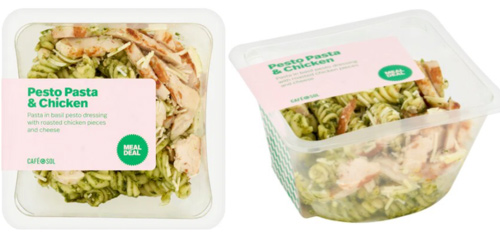
Food Safety Authority of Ireland recall a batch of Café Sol Pesto Pasta & Chicken, due to the presence of Listeria monocytogenes
Alert Summary dated Thursday, September 25th 2025.
Category 1: For Action Alert Notification: 2025.50 Product Identification: Pesto Pasta & Chicken; pack size: 224g Batch Code: Use by date: 25/09/2025 Country Of Origin: Ireland
Message: Freshways is recalling the above batch of Café Sol Pesto Pasta & Chicken due to the presence of Listeria monocytogenes. Recall notices will be displayed at point-of-sale.
Nature Of Danger: Symptoms of Listeria monocytogenes infection can include mild flu-like symptoms, or gastrointestinal symptoms such as nausea, vomiting and diarrhoea. In rare cases, the infection can be more severe, causing serious complications. Some people are more vulnerable to Listeria monocytogenes infections, including pregnant women, babies, and people with weakened immune systems, including the elderly. The incubation period (time between initial infection and first symptoms appearing) is on average 3 weeks but can range between 3 and 70 days.
Action Required: Manufacturers, Wholesalers, Distributors, Caterers & Retailers. Retailers: Same are requested to remove the implicated batch from sale and display recall notices at point-of-sale. Wholesalers/Distributors: Same are requested to contact their affected customers and recall the implicated batch and provide a point-of-sale recall notice to their retailer customers. Consumers: Consumers are advised not to eat the implicated batch.
This website uses cookies to improve your experience. We'll assume you're ok with this, but you can opt-out if you wish.AcceptRead More
Privacy & Cookies Policy
Privacy Overview
This website uses cookies to improve your experience while you navigate through the website. Out of these, the cookies that are categorized as necessary are stored on your browser as they are essential for the working of basic functionalities of the website. We also use third-party cookies that help us analyze and understand how you use this website. These cookies will be stored in your browser only with your consent. You also have the option to opt-out of these cookies. But opting out of some of these cookies may affect your browsing experience.
Necessary cookies are absolutely essential for the website to function properly. This category only includes cookies that ensures basic functionalities and security features of the website. These cookies do not store any personal information.
Any cookies that may not be particularly necessary for the website to function and is used specifically to collect user personal data via analytics, ads, other embedded contents are termed as non-necessary cookies. It is mandatory to procure user consent prior to running these cookies on your website.







Recent Comments