Message: Macroom Buffalo Cheese Products Ltd. is recalling the above batch of its Mozzarella, Bocconcini and Burrata products due to the presence of Listeria monocytogenes. Recall notices will be displayed at point-of-sale.
Nature Of Danger: In healthy people, symptoms of Listeria monocytogenes infection can include mild flu-like symptoms, or gastrointestinal symptoms such as nausea, vomiting, and diarrhoea. However, in people who are more vulnerable, the infection can be severe and can lead to serious complications. People who are more vulnerable to Listeria monocytogenes infections include pregnant women, infants, older adults, and people with weakened immune systems. The incubation period (time between initial infection and first symptoms appearing) is, on average, 3 weeks but can range between 3 and 70 days.
Wholesalers/Distributors: Same are requested to contact their affected customers and recall/withdraw the implicated batch and provide a point-of-sale recall notice to their retailer customers. Retailers: Same are requested to remove the implicated batch from sale and display recall notices at point-of-sale. Caterers: should not use the implicated batch. Consumers: Consumers are advised not to eat the implicated batch.
A midge-borne livestock virus previously reported mainly in Africa and Japan has now reached Europe.
During summer 2026, the Shamonda virus; or a closely related European variant, was identified in cattle in France, Germany, Switzerland, Liechtenstein, the Netherlands and Austria. Scientists expect further spread to be possible while blood-feeding Culicoides midges* remain active.
* A Culicoides midge is a tiny biting fly, usually only 1–3 millimetres long. Female midges feed on the blood of cattle and other animals and can carry viruses from one animal to another, much like mosquitoes. They are especially active during warm, damp conditions and around dusk; some species transmit livestock diseases such as Shamonda and the already identified bluetongue virus.
Plausible routes for entry into Europe include infected midges being transported long distances by wind or inadvertently through trade and transport, or the movement of an infected animal.
In adult cattle, infection generally causes short-lived illness, including: High fever. Diarrhoea and appetite loss. Lethargy. A sudden, sometimes severe, reduction in milk yield.
Although most adult cattle appear to recover, affected dairy farms could face lost production, veterinary expenses and additional monitoring costs. The greatest concern involves pregnant animals. The virus can cross the placenta and has been detected in aborted bovine foetuses in Switzerland. Shamonda and related viruses may cause abortion, stillbirth or calves with serious limb, spinal and brain abnormalities when infection occurs during a vulnerable stage of pregnancy. Researchers are still determining how frequently this happens with the European variant.
The virus is thought to spread mainly through biting midges; not through ordinary direct contact between cattle. There is currently no specific treatment or vaccine, although sick animals can receive supportive veterinary care. Reducing exposure to midges may lower the risk but cannot provide complete protection.
Farmers should watch closely for clusters of fever, diarrhoea or abrupt milk loss and contact their veterinarian immediately. Early blood sampling is important because the virus may remain detectable in adult cattle for only a short time. Abortions, stillbirths and malformed calves should also be investigated.
There is currently no evidence that Shamonda virus causes disease in humans. It has not been identified as a food-safety threat from milk or meat.
The situation is evolving, and the virus’s origin, complete geographic distribution and long-term reproductive impact remain uncertain. Farmers should follow updates from their veterinarian and national animal-health authority rather than relying on social-media rumours.
The Stench of Neglect: River Suir in Thurles Suffocates in Waste.
A Waterway Left to Fester: Apparent Pollution, Institutional Neglect and an Inexcusable Failure to Act.
The early images in the video immediately below are visually consistent with sewage-contaminated water, inadequately treated wastewater, detergent-bearing grey-water, or another organic effluent. The foam could indicate surfactants, while the grey colour and sludge may indicate suspended solids and decomposing organic matter. It does not resemble clean surface-water run-off.
However, a photograph alone cannot conclusively identify the slowly flowing substance in a river now almost static. Proper investigation should include samples from the suspected discharge point and locations upstream and downstream. Relevant analyses include dissolved oxygen, BOD, COD, ammonia, orthophosphate, suspended solids, E. coli, conductivity and surfactants. EPA material confirms that BOD, dissolved oxygen, ammonia, nitrate and phosphorus are central indicators of organic contamination, and that pollution-incident sampling should cover downstream, discharge-point and upstream locations.EPA sampling procedure
This slide-show above, however, presents a disgusting and deeply alarming picture; grey, foaming liquid and foul-looking sludge accumulating in what should be a living watercourse. Its exact composition must now be determined by laboratory testing, but its visible condition is wholly incompatible with the clean, healthy river environment the public is entitled to expect.
This river is neither a sewer nor a dumping ground. If analysis confirms an unlawful discharge, its source must be stopped, the damage remediated and every available enforcement power used.
Continued neglect after documented notification would be indefensible, a betrayal of the waterway, its wildlife and the community these authorities and representatives are supposed to serve.
Reminder
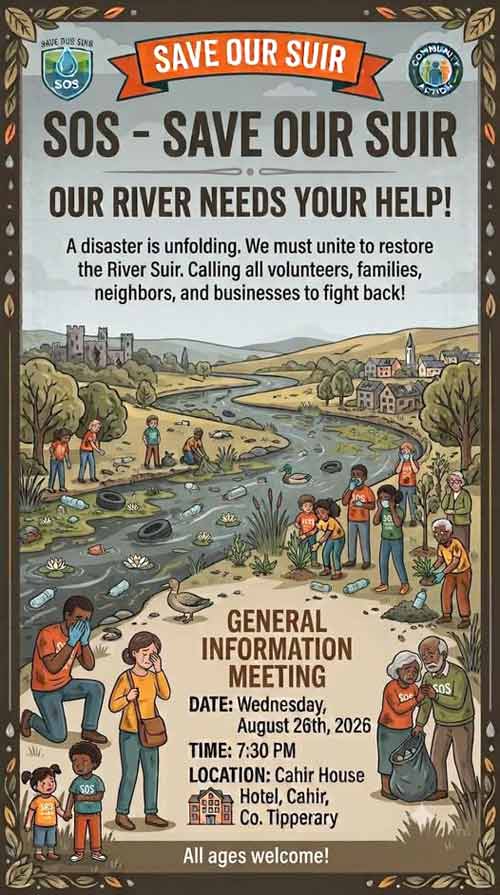
We can confirm that the above public meeting will take place, as stated above.
Thirteen years of warnings As stated in a recent post on Thurles.Info, the deterioration of the River Suir cannot credibly be described as “sudden” or “unforeseeable”. For more than a decade, residents, anglers and environmental campaigners have raised concerns about pollution, excessive vegetation, restricted flow, sediment, litter and neglect. These concerns were documented in “River Suir Crisis—Thirteen Years of Warnings, But Still No Coordinated Action”.
Now, 13 yearslater; the Minister of State Mr Kevin “Boxer” Moran recently visited sections of the Suir in Thurles and Holycross following representations from Independent TD Michael Lowry. It was stated that the Office of Public Works would support an application by Tipperary County Council under the enhanced Minor Flood Mitigation Works Scheme. However, I can confirm from recent discussions with varying responsible bodies, that they are not aware of any recent communication. Support for an application is welcome, but it is not a restoration programme. The public has not been shown the precise work proposed, the scientific evidence supporting it, the environmental assessments required, the anticipated cost and timetable or the body responsible for delivery and monitoring.
Political videos, visits and announcements by politicians and councillors cannot substitute for accountable work. Councillor Micheál Lowry, Deputy Michael Lowry and every other representative addressing the issue must be judged by measurable results. The same standard must apply to Tipperary County Council officials. [ Which begs the question; “Where were all the other local elected councillors when a recent promotional video, capturedby Mr Lowry TD, was uploaded unto social media.” ]
The missing ingredient for the River Suir is not more talk, it is delivery.We need clear answers:
► What works will be carried out? ► When will they begin? ► Who is responsible for delivery? ► Has the funding application now been submitted? ► What section of the river will be prioritised first? ► How will pollution and damaging discharges be reduced? ► How will progress be measured and reported publicly?
The recent tuberculosis outbreak at Ballintemple National School in Cork is a reminder that, although TB has been dramatically reduced in Ireland, it has not disappeared.
The Health Service Executive has confirmed that three children at the school have been diagnosed with tuberculosis and have begun anti-TB treatment. Around 220 pupils and members of staff are being screened, with screening due to take place at St Finbarr’s Hospital. Family members of the affected children are also being offered screening, while public-health officials work with the school to establish the source of the infections.
For many younger people, tuberculosis may seem like a disease belonging to another era. For previous generations of Irish people, however, TB; commonly known then as consumption, was one of the most feared diseases in the country. The scale of the old TB epidemic is difficult to comprehend today. Newly published figures from the Central Statistics Office show that 4,614 people died from tuberculosis in Ireland in 1922, giving a death rate of 153 per 100,000 people. TB was then more prevalent as a cause of death than heart disease. By 2023, the number of deaths had fallen to just 14.
Behind those statistics were thousands of families devastated by illness and bereavement. Poverty, overcrowded housing, poor nutrition and difficult living conditions all contributed to the spread and severity of the disease. Before modern drug treatment, people diagnosed with TB could spend months or even years in sanatoriums, separated from their families and communities. Treatment was largely based on rest, fresh air and good nutrition. It could help, but there was no guaranteed cure.
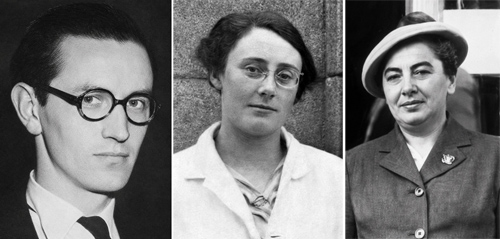
L to R:DrNoël Browne, Dr Dorothy Stopford Price, Dr Pearl Dunlevy.
The doctors and politicians who changed Ireland’s story. Ireland’s eventual victory over TB was not achieved by one person. It came through the combined efforts of doctors, nurses, scientists, public-health workers and politicians. One of the most important names wasDr Noël Browne TD, (RC and later Atheist). A doctor and former TB patient himself, Dr Dr Browne became Minister for Health in 1948 and made the fight against tuberculosis a major priority. His ministry expanded hospital and sanatorium provision and promoted improved diagnosis and treatment, including the expansion of X-ray screening. The arrival of effective anti-TB drugs, including streptomycin, added another powerful weapon against the disease.
But Browne’s story should be told alongside that of Dr Ms Dorothy Stopford Price, (C of I) one of Ireland’s great public-health pioneers. Dr Price became deeply involved in the fight against childhood TB and was instrumental in bringing the BCG vaccine to Ireland. Her work helped lay the foundations for wider vaccination programmes. Trinity College Dublin’s archival record describes her as instrumental in reducing childhood TB through the early introduction of BCG.
Another key figure was Dr Ms Pearl Dunlevy, (RC) who helped establish a major BCG programme in Dublin. From 1947, schoolchildren were tested and eligible children vaccinated, while BCG was also offered to newborns in Dublin hospitals. The programme was followed by a rapid fall in childhood TB deaths. The above people deserve to be remembered because their work demonstrates what determined public-health action can achieve, somewhat missing in recent governments.
The transformation has been extraordinary. The CSO’s new 101-year analysis shows TB deaths falling from 4,614 in 1922 to just 14 in 2023. The death rate fell from 153 per 100,000 people to less than one per 100,000, thus remaining one of the great successes in the history of Irish medicine.
But there is an important distinction: TB has not been completely eradicated. That is why the current Cork outbreak deserves attention without creating unnecessary alarm. Modern medicine gives us tools that previous generations could only dream about; effective treatment, contact tracing, screening, vaccination in appropriate circumstances and much better public-health surveillance. Screening the pupils and staff who may have been exposed is precisely the kind of preventative action that helped Ireland turn the tide against TB in the first place. The story of tuberculosis in Ireland is about far more than a disease. It is a story about poverty and housing, childhood, medicine, vaccination and the development of the Irish public-health system. It is also a story about the late individuals such as DrNoël Browne (1915 – 1997), – Dr Dorothy Stopford Price (1890 – 1954), Dr Pearl Dunlevy (1909 – 2002) and Dr James Deeny (1906 -1994), whose efforts helped change the course of the disease.
The Cork outbreak should therefore be seen in historical perspective. Ireland has travelled an extraordinary distance since the days when thousands died from consumption every year. But the lesson from that history is equally clear; infectious diseases must never be taken for granted. The work of the past generations brought TB from being one of Ireland’s greatest killers to a disease that can generally be treated successfully.
The responsibility of our generation is to make sure it stays that way.
Ireland’s national hospital waiting lists rose again last month (July 2026), with more than 990,870 patients recorded as waiting for an appointment or treatment.
The total increased by more than 9,500 patients compared with June 2026, according to figures published by the National Treatment Purchase Fund (NTPF).
Outpatient appointments continued to account for the largest share. More than 683,540 patients were waiting to attend an outpatient department for the first time at the end of July, up from approximately 673,750 one month earlier. Almost 36,000 additional patients were classified as suspended. These patients are temporarily unable or medically unfit to attend, or are receiving treatment through insourcing or outsourcing initiatives. They are not included in the principal waiting-list total.
This national increase came as separate figures showed progress in children’s spinal care. Children’s Health Ireland (CHI) reported that the number of children and young people waiting for spinal surgery had fallen to 199, compared with 231 at the end of July 2025. Since January, 229 procedures have been added to the surgical waiting list, while 279 spinal operations have been completed. Seven patients have waited between 12 and 15 months, two between 18 and 24 months, and one between 24 and 36 months. CHI’s spinal outpatient waiting list also declined to 431 patients, down 22.6% from 557 a year earlier. The average wait for a first outpatient appointment fell from 7.4 months to 3.9 months, with 99.5% of patients waiting less than a year.
CHI chief executive Ms Lucy Nugent said the figures demonstrated continued progress in reducing waiting times and helping children receive the care they need. The organisation is aiming to complete 540 spinal procedures by the end of 2026.
This website uses cookies to improve your experience. We'll assume you're ok with this, but you can opt-out if you wish.AcceptRead More
Privacy & Cookies Policy
Privacy Overview
This website uses cookies to improve your experience while you navigate through the website. Out of these, the cookies that are categorized as necessary are stored on your browser as they are essential for the working of basic functionalities of the website. We also use third-party cookies that help us analyze and understand how you use this website. These cookies will be stored in your browser only with your consent. You also have the option to opt-out of these cookies. But opting out of some of these cookies may affect your browsing experience.
Necessary cookies are absolutely essential for the website to function properly. This category only includes cookies that ensures basic functionalities and security features of the website. These cookies do not store any personal information.
Any cookies that may not be particularly necessary for the website to function and is used specifically to collect user personal data via analytics, ads, other embedded contents are termed as non-necessary cookies. It is mandatory to procure user consent prior to running these cookies on your website.





Recent Comments