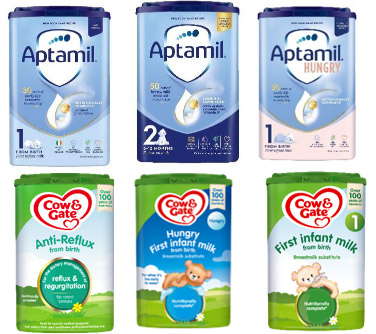
Danone recall specific batches of Aptamil and Cow & Gate infant formula and follow-on formula due to the possible presence of cereulide.
Alert Summary dated Friday, 6th February 2026.
Category 1: For Action. Alert Notification: 2026.05. Product Identification: Please see table below. Batch Code: Please see implicated expiry dates in the table below. Country Of Origin: Ireland.
Message: Danone is recalling the below specific batches of its Aptamil and Cow & Gate infant formula and follow-on formula sold in Ireland due to the possible presence of cereulide. Recall notices will be displayed at point-of-sale.
Please see Questions and Answers: Danone is advising customers to contact its Aptamil careline team on Tel: 1800 22 1234 (https://www.aptaclub.ie), or its Cow & Gate careline on Tel: 1800 570 570 (https://candgbabyclub.ie) if they have any queries regarding this recall.
In addition, Danone is recalling specific batches of its Aptamil and Cow & Gate infant formula and follow-on formula sold in the UK due to the possible presence of cereulide. The below batches may indirectly be distributed to Ireland from the UK.
Nature Of Danger: Cereulide toxin is produced by the bacterium Bacillus cereus. The toxin may be pre-formed in a food and is extremely heat resistant. Consumption of foods containing cereulide toxin can lead to nausea and severe vomiting. Symptoms can appear within five hours. The duration of illness is usually 6 to 24 hours.
Retailers: Same are requested to remove the implicated batches from sale and display recall notices at point-of-sale. Wholesalers/distributors: Same are requested to contact their affected customers and recall the implicated batches and provide a point-of-sale recall notice to their retailer customers. Consumers: Parents, guardians and caregivers are advised not to feed the implicated batches to infants or young children.
Contrary to what some consumers believe, a “Security Protected” label on a product is not a food-safety warning and it does not mean the food has been “tampered with” in the past or is unsafe.
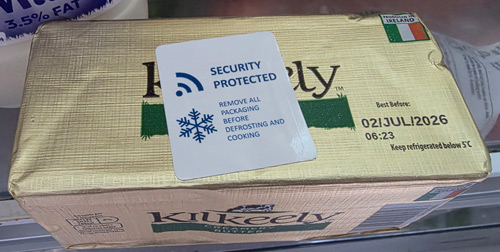
The sticker in the photo shown hereunder is exactly what it says on the wrapper “security protected” and is, over recent months, found on items like butter or meat. Same is a retail anti-theft security label or Electronic Article Surveillance (EAS) label.
“Security Protected” is the deterrent message retailers print on/over the tag so would-be shoplifters can see it at a glance. Loss-prevention groups explicitly note this wording is used on tags/labels as a visible warning.
Why butter and meat? Because same are high-theft, easy-to-conceal, relatively high-value grocery items (especially branded butter and premium cuts). Irish reporting has specifically noted security tagging spreading to staples like butter and meat in some stores and Irish retailers have described meat and other small, high-value groceries as common targets.
The label says “SECURITY PROTECTED” and includes a “signal/waves” style icon, used on retail security labels.
The small print says “REMOVE ALL PACKAGING BEFORE DEFROSTING AND COOKING”. That wording is common on meat/chilled security labels, because some EAS label types aren’t intended to go into heating/defrosting and retailers want the label/outer wrap removed first.
How it works. In plain terms the label contains a thin electronic element that can set off the exit gates within grocery outlets if it’s still active. At your checkout, it’s usually deactivated (often automatically as part of scanning in grocery setups).
Why you’re seeing it recently on butter/meat in Ireland: Irish stores have increasingly been tagging everyday groceries like butter and meat as an anti-shoplifting measure. Practical tip: you don’t need to do anything special—just pay as normal. If the alarm ever sounds on the way out, it’s typically because the label wasn’t deactivated properly, and staff can sort it quickly back at the till.
What happens if the sticker is removed in shop by a customer? If a customer removes it within the shop before paying, it can trigger suspicion immediately. That label is there as a theft-deterrent, so peeling it off on the shop floor looks like an attempt to defeat security. In Ireland, theft is defined as dishonestly appropriating property without consent, with intent to deprive. Also, any person may arrest without warrant someone they reasonably suspect is in the act of committing an arrestable offence (with conditions set out in law). Practically, most shops will simply detain/store-policy stop you, review CCTV, and/or call Gardaí if they believe something is happening.
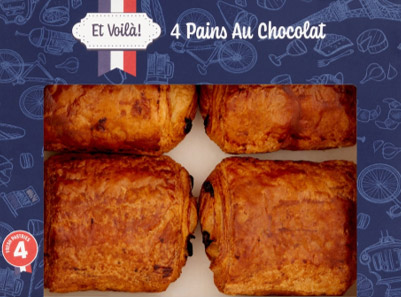
FSAI warn of recall of a batch of Et Voilá Pains au Chocolat due to the possible presence of metal pieces.
Alert Summary Dated Thursday, February 5th 2026.
Category 1: For Action Alert Notification: 2026.04 Product Identification: Et Voilá! Pains au Chocolat; pack size: 4 pack Batch Code: Best before date: 05/02/2026
Message: The above batch of Et Voilá! Pains au Chocolat 4 pack is being recalled due to the possible presence of metal pieces.
Recall notices will be displayed at point-of-sale in Tesco stores.
Action Required: Consumers and retailers: Retailers are requested to remove the implicated batch from sale and display a recall notice at point-of-sale.
Consumers: Consumers are advised not to eat the implicated batch.
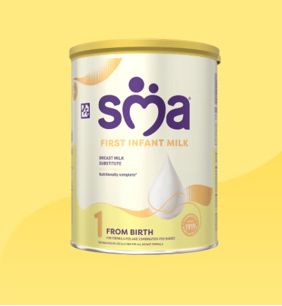
Recall of an additional batch of SMA First Infant Milk due to the possible presence of cereulide.
Alert Summary dated Tuesday, February 3rd 2026.
Category 1: For Action Alert Notification: 2026.01 (Update 5) Product Identification: SMA First Infant Milk; pack size: 800g Batch Code: 53390346AB; expiry date December 2027.
Message: Further to FSAI Food Alert 2026.01, FSAI Food Alert 2026.01 (Update 1), FSAI Food Alert 2026.01 (Update 2), FSAI Food Alert 2026.01 (Update 3) and FSAI Food Alert 2026.01 (Update 4), the above additional batch of SMA First Infant Milk is being recalled by Nestlé.
Recall notices will be displayed at point-of-sale.
For list of all affected batches and products – See HERE
Questions and answers. Nestlé is advising its customers that have purchased any of these batches to contact them via its online form, by sharing a photo of the product and the batch code: www.nestle.co.uk/en-gb/getintouch or by calling its careline on Tel: 1800 931 832.
Nature Of Danger: Cereulide toxin is produced by the bacterium Bacillus cereus. The toxin may be pre-formed in a food and is extremely heat resistant. Consumption of foods containing cereulide toxin can lead to nausea and severe vomiting. Symptoms can appear within five hours. The duration of illness is usually 6 to 24 hours.
Wholesalers/Distributors: Same are requested to contact their affected customers and recall the implicated batch and provide a point-of-sale recall notice to their retailer customers. Retailers: Same are requested to remove the implicated batch from sale and display recall notices at point-of-sale. Consumers: Parents, guardians and caregivers are advised not to feed the implicated batch to infants or young children.
Dáil Dining – Soup Up 50c, – Calamari Up €1.50, – Wine Heroically Holds the Line.
TDs and Senators have been hit with fresh price increases in the Dáil bar and Members’ restaurant, with higher charges for food introduced in November 2025, while the price of wine, in a brave display of stability, remained unchanged.
According to records released under FOI, the cost of a glass of the Oireachtas Merlot or Sauvignon Blanc is still €6.60, and the €25 bottle price (€60 in the Cashel Palace) also remains in place, proving that in uncertain times, some pillars of national life must not be disturbed.
Meanwhile, the food menu has not been so fortunate: Members’ Restaurant: Tough Choices, like whether to get Dessert and Soup. At lunchtime, soup is now €5.50, up from €5. On the afternoon menu: Deep fried Calamari (with Lemon and Garlic Aioli Rose – a Dip that is great with Chips), from €8 to €9.50. A prime beef burger has increased from €12 to €13.80. [Surprising increase move, what with all this cheap South American beef coming into Éire]. Desserts were repriced to €5.80, up from €5.00, offering options including, Mixed Berry Crumble, Strawberry Cheesecake,assorted Ice Cream, or Fresh Fruit Salad“for the health conscious you understand”.
Dail Bar.
A Soup, Main Course and Dessert now comes in at just over €25, roughly €3 above last year’s prices, but still comfortably below what most people might expect to pay for an equivalent three-course meal in nearby rural Tipperary or indeed in Dublin 2.
In the evening: A Chargrilled Sirloin or Rib-Eye Steak with Fries remains €20.50; this follows a €2.50 increase late last year. Grilled Lamb Cutlets (côtelettes d’agneau grillées) come in at €16 having been replaced by pan-roasted lamb rump (often called chump) at €18.50, (latter a tender, flavorful, and relatively inexpensive cut, that combines the succulence of roasting with the crispy, caramelized crust of pan-searing).
Members’ Bar: Modest Increases, with a few “Steep” surprises.
Evening menu increases included: Gourmet Beef Burger: €12 → €15 [again surprising increase, what with friends in Bord Bia, the Irish Food Board and Dawn Meats] House Chicken Caesar Salad: Possibly imported from the Netherlands, the UK, Brazil, or Thailand, €9 → €11.50. (Tough enough when one can buy a whole Chicken cooked and still hot in Dunnes Stores for €6.75).
Nevertheless, the ambience of the dining area remains reassuringly consistent: muted tones, soft seating, and that steady confidence of a place that rarely needs to check the prices on the street outside. It’s the kind of place where the calamari is deep-fried, the questions are lightly grilled, and accountability is strictly off-menu, while the décor continues to project polished wood, clean lines, and an overall feeling that someone else is picking up the Tab, emotionally, if not financially. In fact the room does what it says on the tin, while remaining dignified, understated and quietly insulated from the chaos of lunch with everyone beyond the M50 and the non-subsidised majority.
This website uses cookies to improve your experience. We'll assume you're ok with this, but you can opt-out if you wish.AcceptRead More
Privacy & Cookies Policy
Privacy Overview
This website uses cookies to improve your experience while you navigate through the website. Out of these, the cookies that are categorized as necessary are stored on your browser as they are essential for the working of basic functionalities of the website. We also use third-party cookies that help us analyze and understand how you use this website. These cookies will be stored in your browser only with your consent. You also have the option to opt-out of these cookies. But opting out of some of these cookies may affect your browsing experience.
Necessary cookies are absolutely essential for the website to function properly. This category only includes cookies that ensures basic functionalities and security features of the website. These cookies do not store any personal information.
Any cookies that may not be particularly necessary for the website to function and is used specifically to collect user personal data via analytics, ads, other embedded contents are termed as non-necessary cookies. It is mandatory to procure user consent prior to running these cookies on your website.






Recent Comments