For the benefit of the ordinary man in the street, what exactly is the EU–Mercosur deal?
The EU–Mercosur deal is a major trade agreement between the European Union and four South American countries, namely Brazil, Argentina, Paraguay and Uruguay(known together as Mercosur).
Its main purpose is to make trade between the two regions easier by: (1) Cutting or removing many tariffs (import taxes) on goods going both ways. (2) Opening up markets for EU cars, machinery, medicines and services in South America. (3) Giving Mercosur countries more access to the EU for products like beef, poultry, sugar and other agricultural goods. (4) Setting common rules on things like food safety, intellectual property, and government contracts, including environment and labour commitments, though critics say these may not be strong enough.
Supporterssay: It will boost trade and strengthen EU ties with South America. Opponents, especially Irish farmers, say: It will bring in cheaper agricultural imports produced under lower standards, thus harming rural economies, and could indirectly increase deforestation in South America.
The EU–Mercosur Agreement, now entering a contentious ratification phase across the European Union, represents one of the most far-reaching trade deals negotiated by the EU in decades. While the agreement promises tariff reductions, expanded market access and strategic benefits in South America, it also presents serious risks for Ireland’s agricultural sector, its environmental standards and long-term rural sustainability. For these reasons, Ireland is justified in maintaining a cautious, and in many respects critical, stance as the ratification process unfolds.
Politically, the agreement remains highly unstable. The European Parliament is deeply divided, with recent votes showing only a narrow margin between supporters and opponents. Key member states, including France, Poland, Austria, the Netherlands and Italy, have already expressed strong reservations. The European Commission has attempted to push the process forward, but the fact that ratification was paused earlier this year reflects the scale of political tension surrounding the deal. Ireland is far from isolated in its concerns.
From an Irish perspective, the most immediate threat arises in agriculture. The agreement would grant substantial additional market access for South American beef, poultry and sugar into the European Union. Even with quota limits, the increased volume of imports would land directly into the most sensitive areas of Irish farm production, particularly beef. Irish farmers compete in one of the most regulated, high-cost and environmentally scrutinised agricultural systems in the world. Allowing cheaper imports produced under lower labour, welfare and environmental standards risks undermining the viability of family farms that form the backbone of rural Ireland. The European Commission has floated an “emergency brake” to reimpose tariffs if imports surge, but farmers’ organisations in Ireland are unconvinced that such mechanisms would be swift, robust or transparent enough to prevent serious market disruption.
Environmental concerns deepen this opposition. Ireland, like all EU member states, is bound by stringent climate and biodiversity targets. Yet the Mercosur bloc includes regions facing chronic deforestation pressures, particularly in Brazil and parts of the Amazon basin. Critics fear that increased export incentives for beef, soy and other commodities could accelerate land-use change in sensitive ecosystems. Although the agreement contains sustainability clauses linked to the Paris Agreement, enforcement mechanisms remain weak. It would be inconsistent for Ireland, already struggling to meet its own climate commitments, to endorse a trade deal that may indirectly contribute to global environmental degradation.
A further issue is regulatory asymmetry. The EU maintains some of the highest standards in the world regarding food safety, traceability and animal welfare. While the agreement requires Mercosur exporters to meet EU standards at the border, there is limited assurance that production systems on the ground will adhere to equivalent requirements. This raises real concerns about fair competition and consumer confidence. Irish farmers and processors, who invest heavily in compliance, would face competitors who do not operate under the same regulatory burdens.
Ireland also has legitimate procedural concerns. The decision by some in the European Parliament to challenge the structure of the agreement before the Court of Justice highlights unresolved questions about democratic scrutiny. Attempts to rush ratification without adequate debate risk eroding public trust in EU trade policy at a time when transparency is essential.
Finally, the strategic argument advanced by the European Commission, that the deal is needed to diversify trade and secure access to raw materials, does not outweigh the potential social and economic consequences for Ireland’s rural communities. Diversification is important, but not at the expense of domestic sectors that have already absorbed significant pressures from climate policy, volatile markets and rising production costs.
For all these reasons, economic, environmental, regulatory and democratic, Ireland is justified in maintaining a firm, evidence-based opposition to the EU–Mercosur Agreement in its current form. Any trade deal of such scale must protect the interests of Irish farmers, uphold the integrity of EU environmental commitments and ensure equal standards for all producers supplying the European market. Until those conditions are met, Ireland’s stance is both prudent and necessary.
The Thurles Branch of St Vincent de Paul will hold their annual Church Gate Collection on the weekend of the 29th & 30th of this month, November 2025, at all the Churches in the Thurles parish.
Note Please: All donations, however small, will be greatly welcome thus enabling them to help families struggling at this time of year.
Calls Grow For Proper River Suir Maintenance As New Thurles Looped Walk Funding Announced.
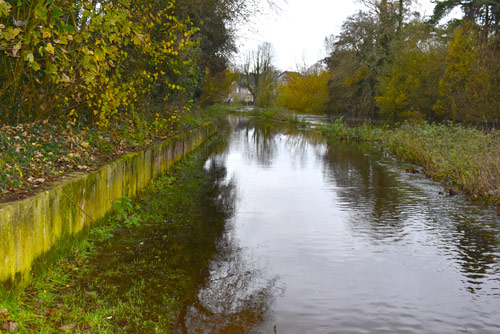
The announcement of €447,300 in funding to advance the long-planned 5km looped walk in Thurles has been met with cautious local optimism, tempered by renewed frustration over the ongoing flooding of existing walkways, attributed to years of inadequate maintenance of the River Suir.
Unserviceable river walkway from Emmet Street to rear of Thurles Shopping Centre. Pic: G. Willoughby.
The funding, secured through Thurles Lions Club as part of a wider €16.5 million national outdoor recreation investment, will facilitate the extension of the walking route from Thurles town centre along the N62 to the Lady’s Well stile entrance, before continuing via the Lady’s Well path and linking onto Mill Road. Local residents along Mill Road have already agreed to land access, enabling Tipperary County Council to progress plans for this new 1.8-metre concrete footpath, including boundary works, signage, landscaping and native hedging.
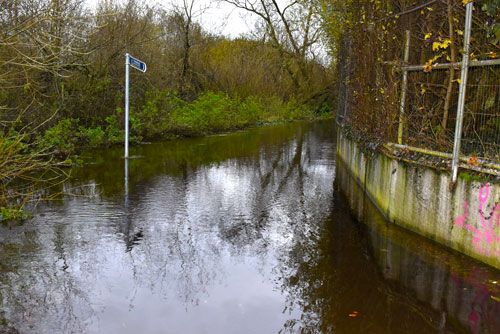
Unserviceable river walkway at rear of Thurles Shopping Centre and Lidl due to severe flooding. Pic: G. Willoughby.
The development has been broadly welcomed as a long-overdue safety upgrade on a corridor where pedestrian access has long been compromised by traffic and poor parking provision. Community groups note that, once completed, the upgraded route will deliver a safe, attractive town-to-country walking loop, encouraging recreation and improving local amenity.
However, the news arrives against a backdrop of persistent flooding on existing riverbank walkways in Thurles, flooding that residents argue is entirely avoidable.
Community members say the situation amounts to “putting the cart before the horse”, with recreational works prioritised ahead of essential river management. They warn that unless long-overdue maintenance of the River Suir is carried out, future flooding will continue to undermine the value of new infrastructure and pose an ongoing hazard to walkers.
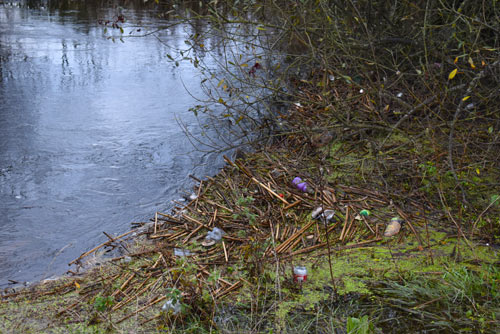
Trees permitted to grow in the riverbed catch floating cans, bottles and other debris, making the area unsightly. Pic: G. Willoughby.
Despite repeated warnings over a 13 year period, the River Suir, passing through Thurles has not received the maintenance required to prevent blockages and overflow. Earlier interventions focused instead on laying new tarmacadam surfaces along the riverbank just to use up funding intended for another failed project, rather than addressing the condition of the river channel itself. Those walkways now remain submerged following recent rainfall, highlighting what locals describe as a pattern of neglect and misplaced priorities, by both Tipperary County Council and Thurles Municipal District.
Residents question whether such future works, if and when eventually carried out, can proceed without damaging the same recently-laid footpaths that hug the river’s edge.
As the looped walk extension moves into detailed design and construction phases, local observers argue that investment in recreational infrastructure cannot continue to run ahead of essential river maintenance. Without addressing long-standing Suir management issues, they contend, further flooding is inevitable, undermining both public safety and the value of this significant new funding.
For now, while the community welcomes progress on the long-awaited 5km loop, many stress that meaningful improvement in local amenity depends on tackling the river itself, not just the paths that run alongside it.
€18,611 Per Bike? That’s One Expensive Two-Wheeler Area.
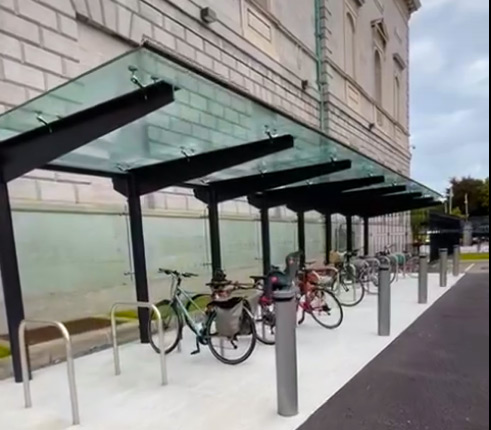
Bike Rack or Bank Vault? €336K Suggests the Wheels Were Secured Through Gold Bars.
Simon Harris faced a wave of criticism from the public after news broke about the €336,000 bike shed erected at Leinster House.
Dozens of emails accused the then Taoiseach and other politicians of wasting taxpayer money, with some suggesting the project symbolised everything wrong with government spending priorities.
Leinster House’s Deluxe Bike Hangar: While Taxpayers Wait In The Rain.
An internal audit later found that no value-for-money assessment was carried out before construction began. The controversy intensified after it emerged that a separate €190,000 was being spent on a fitness instructor for TDs.
Failure by OPW to plan “hot air” openings for Tipperary politicians.
Many correspondents expressed anger over what they saw as misplaced priorities, contrasting the bike shed’s cost with ongoing struggles faced by families of children with disabilities and survivors of State institutions. One disgruntled observer locally in Thurles was heard to quip that a section of the shed should open occasionally, to allow “hot air” to escape, from Tipperary politicians.
The Football Association of Ireland (FAI) has voted overwhelmingly to submit a motion to UEFA calling for the suspension of the Israel Football Association (IFA) from European football competitions.
The motion, passed by 74 votes to 7 with 2 abstentions, was adopted at an extraordinary general meeting of the FAI. It urges UEFA to remove Israel from participation in club and international competitions, citing alleged breaches of football governance and human rights obligations.
Grounds for the Motion: The proposal contends that the Israel Football Association:
Operates clubs in illegal settlements in the occupied West Bank, without the consent of the Palestinian Football Association — said to breach UEFA and FIFA statutes.
Has failed to uphold UEFA’s anti-racism and equality policies, contrary to Article 7bis of the UEFA Statutes.
UEFA has already decided that no European competition matches can take place in Israel due to ongoing security concerns. However, the FAI motion goes further, seeking to completely suspend Israel from all UEFA competitions.
Next Steps and Potential Outcomes: The FAI’s motion will now be transmitted to UEFA, where it may be considered by the organisation’s Executive Committee or Congress.
If acted upon, the suspension could see:
Israeli clubs removed from the Champions League, Europa League, and Conference League.
The Israeli national team barred from European Championship and World Cup qualifying campaigns conducted under UEFA.
No formal timetable for discussion or decision has been announced by UEFA.
Potential Consequences Analysts warn that the move could have wide-ranging implications: Sporting disruption: Fixtures involving Israeli clubs or national sides could be cancelled or restructured. Legal risk: The Israel Football Association could challenge any suspension before the Court of Arbitration for Sport (CAS), arguing that it is politically motivated. Diplomatic impact: UEFA could face political and commercial pressure from member governments and sponsors. Precedent: A ban on Israel could prompt demands for similar action in other politically charged situations, raising questions about consistency and governance in sport. Financial Context: – FAI’s Dependence on State Support.
This debate comes as the FAI continuestorely heavily on Irish Government and UEFA financial assistance.
In January 2020, the State, UEFA and Bank of Ireland agreed a €30 million rescue package to save the FAI from insolvency. This included €20 million in taxpayer funding through Irish government loans and grants.
In October 2025, the Government confirmed a further €3 million allocation in Budget 2026; same to support the development of League of Ireland academies.
This financial dependency has led some observers to ask who exactly initiated or influenced the FAI’s extraordinary meeting and subsequent vote and whether the association consulted adequately with its funding partners before taking a political position of such scale.
Broader Questions: While many within Irish football support calls for greater international accountability, others caution that the FAI, still emerging from years of financial crisis and governance reform, must act with care to avoid drawing itself into complex geopolitical disputes.
As UEFA weighs its response, the move has sparked debate not only about Israel’s role in European football, but also about the role of the Irish football authorities themselves, an organisation dependent on public funds now taking a stand on one of the most divisive issues in world sport.
This website uses cookies to improve your experience. We'll assume you're ok with this, but you can opt-out if you wish.AcceptRead More
Privacy & Cookies Policy
Privacy Overview
This website uses cookies to improve your experience while you navigate through the website. Out of these, the cookies that are categorized as necessary are stored on your browser as they are essential for the working of basic functionalities of the website. We also use third-party cookies that help us analyze and understand how you use this website. These cookies will be stored in your browser only with your consent. You also have the option to opt-out of these cookies. But opting out of some of these cookies may affect your browsing experience.
Necessary cookies are absolutely essential for the website to function properly. This category only includes cookies that ensures basic functionalities and security features of the website. These cookies do not store any personal information.
Any cookies that may not be particularly necessary for the website to function and is used specifically to collect user personal data via analytics, ads, other embedded contents are termed as non-necessary cookies. It is mandatory to procure user consent prior to running these cookies on your website.








Recent Comments