Local authorities play a vital role in protecting the environment and carried out over 205,000 inspections in 2021. The majority (70%) of these inspections relate to waste management.
Local authorities need to deploy and target resources more effectively in order to improve the quality of our air and water.
Local authorities need to increase the level of farm inspection and enforcement activity to reduce the impact of agricultural activities on water quality
There is a need for increased enforcement efforts by local authorities on the segregation of domestic and commercial waste and the management of construction & demolition waste, which is the largest waste stream in Ireland with over eight million tonnes produced annually.
In order to help protect human health from harmful air pollutants, local authorities should prioritise inspections of fuel sellers to ensure only approved fuels are sold nationwide.
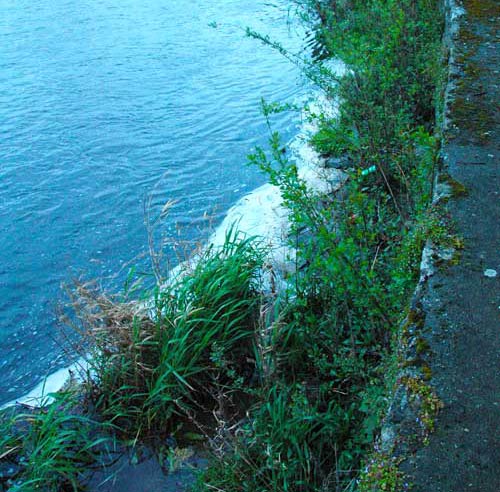
Polluted River Suir at ‘The Source’ building, central Thurles, Co Tipperary.
The Environmental Protection Agency(EPA) has today published its report on the environmental performance of local authorities in 2021. The report shows that the scale of environmental enforcement work carried out by local authorities is significant. In 2021, over 500 local authority staff handled almost 81,000 complaints and carried out over 205,000 environmental inspections.
Local authorities play a vital role in the protection of our environment and are responsible for enforcing much of our environmental protection legislation. The EPA’s Local Authority Performance Framework is crucial to ensuring a consistent national approach to the enforcement of environmental standards.
This is the first year of the revised Local Authority Performance Framework, which assesses the effectiveness of inspection activities in targeting key environmental issues. The assessment is based on 20 priorities, and measures how local authority actions deliver environmental outcomes – such as better segregation of household and commercial waste, cleaner air through controls on solid fuel sales and minimising risks to water quality from farming activities. Most importantly, there is an emphasis on assessing the follow-up and closure of issues detected so that real environmental improvements are achieved.
Commenting on the findings of the report, Dr Tom Ryan, Director of the EPA’s Office of Environmental Enforcement said: “Local authorities have a fundamental role to play in protecting the environment within their counties, and their performance in that role needs to improve. The EPA’s report shows that less than half of the 620 performance assessments undertaken across 20 national environmental enforcement priorities achieved the required standard in 2021. The local environmental challenges are great. The water quality in our rivers, lakes, estuaries and coastal waters is in decline and there are concerning localised issues that are impacting negatively on the air we breathe. The segregation of waste streams, which is so critical to supporting materials reuse in the development of a circular economy, is not as good as it needs to be.”
He further added: “Local authorities need to have a more strategic approach to addressing these issues within their counties so as to protect people’s right to the enjoyment of a healthy environment. While local authorities are engaged in a great deal of enforcement activity, they need to have a better focus on priority environmental issues and increase or escalate enforcement action where required.”
Our water quality is in decline with just over half of surface waters (rivers, lakes, estuaries and coastal waters) in satisfactory condition. Agriculture is one of the sectors that is impacting on our water quality. The science has identified areas where agricultural measures are required to prevent nutrients including nitrogen and phosphorus from leaking into our waterways. Local authorities must target farm inspections in these areas. The proper use of fertilisers and the correct management of slurry will benefit both the farmer and the environment.
Mr David Pollard, Programme Manager of the EPA’s Office of Environmental Enforcement said: “Local authorities continue to carry out extensive water quality monitoring, however, there is scope to make better use of this monitoring to target enforcement action aimed at improving water quality.”
Air and noise enforcement continues to have the lowest level of dedicated resources within local authorities. Better targeting and coordination of resources in this area is necessary to protect public health. It is crucial that local authorities tackle air pollution issues by making sure that only approved solid fuels are sold.
The scale of waste and litter enforcement carried out by local authorities is significant. However, the range of the waste priorities to be addressed is broad and few local authorities managed to cover the full scope in 2021. In particular, there is a need for increased enforcement efforts to improve segregation of domestic, commercial, construction and demolition waste in order to improve reuse and recycling of materials.
The Focus on Local Authority Environmental Enforcement – Performance Report 2021 report is available HERE.
According to the website Afloat.ie, Inland Fisheries Ireland (IFI) intend to progress plans to develop a new modern fish farm facility, to be located in Roscrea, Co Tipperary. The facility will be based on a ‘recirculating aquaculture system’ (RAS) technology and will shortly enter the design and planning permission phase.
We understand that recirculating aquaculture systems represent a new way to farm fish. Instead of the traditional method of growing fish outdoors, this system rears fish at high densities, in indoor tanks within a controlled environment.
This new fish farm is not expected to become operational until 2026.
We understand that IFI has placed a ‘Prior Information Notice’ (PIN) on the Official Journal of the European Union (OJEU).
“The fact is that no species has ever had such wholesale control over everything on earth, living or dead, as we now have. That lays upon us, whether we like it or not, an awesome responsibility. In our hands now lies not only our own future, but that of all other living creatures with whom we share the earth.” Quote by Sir David Attenborough, English broadcaster, Biologist, Natural Historian and Author, —— “Life on Earth“
St. Patrick’s Cemetery was consecrated 94 years ago, on May 11th, 1928, by Archbishop Dr. J.M. Harty. Of the persons of high rank and position present on that day were; J.M. Kennedy (Town Clerk, Irish Nationalist, Historian), W. Butler (Chairperson Urban District Council), and L. Scully (Chairman Burial Board).
St. Patrick’s Cemetery, Thurles, Co. Tipperary. Pic: G. Willoughby.
Prior to the above date, (95 years previous), the first interment had already taken place on August 1st, 1927; that of Mrs M. Gorman (R.I.P.), latter a resident of Athnid, Thurles, Co. Tipperary.
In that same period, immediately prior to its consecration, trees had been planted outlining the shape of a cross in St. Patrick’s cemetery, which today, with the exception of possibly one, all still survive, standing healthy almost 100 years later.
Recently, according to local press, Thurles councillor Mr Jim Ryan has asked Tipperary County Council to cut back or remove these trees in St. Patrick’s cemetery; the reason – “to prevent bird fouling”.
Councillor Ryan stated that he had received complaints from families visiting the graveyard, regarding visiting birds, which he declared were “causing huge grief”.
An unnamed spokesperson for Tipperary County Council stated that they were ‘disinclined‘ to remove healthy trees, [Tipperary County Council, removed 6 healthy 35 year old trees in Liberty Square, in 2021, as part of their ‘half-town centre upgrade’, sadly replacing them with trees not fit for any real purpose].
Without any previously known or highlighted complaints from families, within the last 94 yearswe wonder:-
Was this just another attempt to grab a newspaper headline by Councillors?
Should now numerous, 100 year old, healthy Yew (Taxus coniferous trees) and Lawson Cypress (Chamaecyparis lawsoniana) be cut down?
Should a giant micro net be thrown over St. Patrick’s Cemetery, thus prohibiting birds from obtaining items of food?
Should all the headstones, where birds also come to land, be totally removed?
Should we have a ‘Halloween fireworks display’ every evening, twice paid (using private donations and taxpayer money as is currently the case) to terrorise these feathered, God’s creatures, to drive them completely out of the area?
With data confirming the loss of around 600 million breeding birds in the EU since 1980; should we employ a member of staff and arm them with a shot gun to rid us of this imaginary nuisance?
Could those persons complaining, not instead, arm themselves with a pair of gloves; a bottle of water and a piece of kitchen towel or a rag, as most normal people do, when visiting their family graves?
After the massive downpours of rain, experienced over the past 14 days, today, I failed to find even one headstone showing evidence of bird faeces.
A 30.48cm (12 in) deep pothole existing for over 8 weeks at Loughtagalla, oppositethe Mace Supermarket, close to the Moyne Road junction in Thurles.
However, on returning home from the cemetery today, just a few metres further on, west of the cemetery entrance, (opposite the Mace Supermarket at Loughtagalla), I once again made the acquaintance of an eight week old, 30.48cm(12in) deep pothole, which failed to get a mention at that same Municipal District Council meeting.
The Daffodil [In Irish – Llus an chromchinn – Literal translation- Flower with bent head] is considered one of the most popular heralds of Irish springtime; its flaming yellow or snow white flowers waving from our rural and urban gardens and along the edges of our Irish roads.
Best planted in September, bulbs spend several months developing roots, before usually emerging in late January and early February; flowering between the end of February and on into April.
However, here in Thurles all of that has changed and for the second year in succession, we note that long established clumps of Daffodils have been appearing above ground, since mid-October last.
We also have reports of hellebores in bloom, same not due to show their lovely faces until mid-January.
The bisexual flowers of the Magnolia bush, [latter has both a functional male stamen and a female pistil], named after the French botanist Pierre Magnol, is a much awaited attraction at the beginning of each year. However, here in Thurles same is ready to bloom again for the 2nd time in just 12 months, almost 12 weeks before its correct flowering season.
Perhaps Thurles should host the 28th session of the UN Climate Change Conference [COP], as certainly Mother Nature here in Tipperary is taking an unexpected seasonal course and she appears to have lost her personal organizer or engagement book.
Although firework displays on Halloween night no doubt bring joy to many of our local residents; it is likely to be a night of terror and distress for our feathered friends, farm animals and household pets.
Here in Thurles, Co. Tipperary, following such a recent fireworks display, ducks on the river Suir and our flock of Pied Wagtails roosting on Liberty Square, are now only beginning to return to their old haunts.
Research has confirmed that firework displays cause wild birds to suffer significant distress, and researchers have recommended that in future displays should not take place in areas, with a large wildlife population.
It is unclear whether it is the noise that upsets them, or the flashing lights in the sky, or indeed a combination of both. However for example, researchers have confirmed that the heart rate of geese increases from 63 to 124 beats per minute, and their average body temperature increased by 3%, from 38C to 39C, when they are subjected to a firework display close to their usual haunts.
We are already aware that fireworks cause anxiety in our household pets, and farm animals; for example dogs and horses.
This website uses cookies to improve your experience. We'll assume you're ok with this, but you can opt-out if you wish.AcceptRead More
Privacy & Cookies Policy
Privacy Overview
This website uses cookies to improve your experience while you navigate through the website. Out of these, the cookies that are categorized as necessary are stored on your browser as they are essential for the working of basic functionalities of the website. We also use third-party cookies that help us analyze and understand how you use this website. These cookies will be stored in your browser only with your consent. You also have the option to opt-out of these cookies. But opting out of some of these cookies may affect your browsing experience.
Necessary cookies are absolutely essential for the website to function properly. This category only includes cookies that ensures basic functionalities and security features of the website. These cookies do not store any personal information.
Any cookies that may not be particularly necessary for the website to function and is used specifically to collect user personal data via analytics, ads, other embedded contents are termed as non-necessary cookies. It is mandatory to procure user consent prior to running these cookies on your website.





Recent Comments