3,600 new Irish citizens will attend at Citizenship Ceremonies in the Convention Centre, Dublin.
3,600 new Irish citizens will be granted Irish citizenship in three ceremonies all taking place today, Monday September 16th, at the Convention Centre in Dublin. The Ceremonies will see applicants from 143 countries around the world, who are residing across 32 counties on the island of Ireland, being conferred as Irish citizens.
This follows 14 such ceremonies held so far this year, with a total of 11,417 people attending and being conferred with Irish Citizenship. The Presiding Officer at the ceremonies is retired Justice Mr Paddy McMahon, who will administer the “Declaration of Fidelity” to the Irish Nation and Loyalty to the Irish State.
The Citizenship Division have introduced significant changes to speed up the applications process for applicants, including the introduction of an online digital application, online payments, and eVetting.
Over the last 2 years the Citizenship Division has gone from processing around 12,000 applications a year, to processing over 20,000 applications in 2023. Already in 2024 nearly 16,000 decisions have been made in the first half of this year.
Last year, the Citizenship Division more than doubled the number of ceremonies available to applicants, with 15 held over the course of the year. This was a significant increase on 6 Citizenship Ceremonies held in 2022.
Including today, September 16th, the total number of Ceremonies held so far this year is 17, surpassing the number of ceremonies hosted in 2023. Further Ceremonies are being planned for later in the year.
New Irish citizens will undertake to faithfully observe the laws of the Irish State and to respect its democratic values. These new Irish citizens are contributing to a diverse and inclusive workforce, bringing a range of skills and talents that enhance the overall capabilities of the labour market and the Irish economy.
A female tourist, understood to be aged in her 70’s, has sadly died following a fall, while walking at a popular tourist attraction in Co Tipperary.
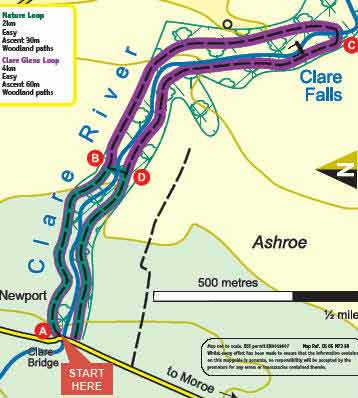
Gardaί and emergency services from Killaloe including the Tipperary Fire Brigade, quickly responded to the tragedy, which occurred in the Clare Glens, area near Newport in Tipperary, yesterday evening, Wednesday September 11th, at around 5:30pm.
Sadly the lady, who has not yet been named publically, was pronounced dead at the scene.
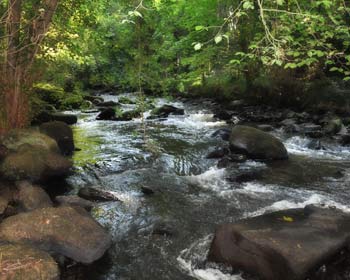
Clare River.
Gardai have confirmed that a coroner has since been notified and arrangements will now be made for a post-mortem examination to take place.
Back in January 2015 this extremely picturesque location, a popular visitor attraction for walkers, was the scene of a kayaking accident, when a 26 year old man, was injured while out with a group of friendsHe was treated in Limerick University Hospital for non-life threatening injuries, following a rescue operation which lasted some three and a half hours.
Thurles, Co. Tipperary continue in a cycle of spending large amounts of funding on projects that tick lots of boxes, but ultimately the town fails to maintain what it has already got and fails to fix longstanding important issues.
After spending, in or around some €10 million Euro on updating half of Liberty Square, ask yourself are traffic conditions any better? Motorists would confirm that conditions have become significantly much worse, with heavy goods vehicles (HGV’s) forced to traverse our medieval streets, with no progress being made with regards our long sought after “Thurles Ring Road”. Ask yourself why have all the business premises either moved or closed within the Liberty Square area of Thurles, and where is the promised increase in ‘footfall’, same now reduced by 60%, according to the few angry, remaining business owners.
Officialdom appears to “fix what isn’t broken”; the latest being a €3.4 million car park revamp near ‘The Source’ building, same only revamped some 8 years ago. Latter is just one example; as they simultaneously ignore what badly needs fixing, e.g. the river Suir in the centre of Thurles Town, same being just one example, which Thurles.Info has already highlighted, on numerous occasions, most recently on August 17th 2024 last, HERE.
But there are other amenities showing obvious decay, same directly highlighting officialdom’s utter neglect of town maintenance.
We have mentioned already the 8 year old re-vamped Town Park carpark, same now to be re-vamped, yet again, to become a Market area and Restaurant, as yet devoid of tenants, which will considerably reduce existing car parking spaces, while competing with existing local small businesses, same already struggling to operate just a few metres away in the Liberty Square town centre.
In recent weeks we have watched mature trees ripped out from this aforementioned Town Park carpark and re-sown close by, their bark extensively damaged by heavy machinery which was used to rip apart the tree heel mesh grills at their base. Two of these mature trees are unlikely to survive the coming winter.
New “Nature Signs” provided along the river walk, close to the junction of Emmet Street and Thomond Road, and only recently erected, have now been smashed by a very small group of “uncouth barbarians”, permitted to roam freely in the area. Of course no local residents nearby heard anything, as a large rock was used to pound the thick Plexiglas Perspex acrylic sheet, protecting its contents from weathering.
No Closed-Circuit Television Installed!
Signs are positioned nearby threatening CCTV (Closed-Circuit Television) being in operation. Yet again, no CCTV has ever existed, covering this area, and proof of same is the amount of damage caused by the afore mentioned small number of “uncouth barbarians”, with no arrests ever being made.
The area in the park known as the “Fitness Zone”, again, has been totally neglected, with the individual sectioned area’s poles either pulled up or broken off. Same poles are now rotten, having been only preserved using one basic coat of fence preservative some 8 years ago, before being then left uncapped due to its semicircle (circular half arc) construction.
Video, shown above, is undeniable proof of this very small section of our town, now depicting that which normally indicates an inner-city slum.
Witch Hazel ‘Diane’ is a broad-crowned deciduous shrub, but more compact than some, remaining generally pest-free. It displays broad ovate or rounded leaves, which initially emerge as green, before slowly turning into brilliant shades of red and yellow from late Summer, right through, until mid to late autumn.
Witch Hazel ‘Diane’. Pic: G. Willoughby.
Witch Hazel ‘Diane’ is a winter-flowering shrub, which produces dense clusters of slightly scented, red to copper-red flowers in mid and late winter. Each of its flower consists of ribbon-like, crinkled, strap-shaped petals with claret bases and a purple-red calyx.
It enjoys a sheltered site, in well drained, acid to neutral soil in your garden. It can be sown in full sun or partial shade and in its early years can be planted in a large pot. Slow growing; when fully mature it can achieve a height of 2.5m (8ft) with a spread of some 3m (10ft).
To obtain most joy from this most attractive of shrubs, position same close to a window, if possible, where early or late sun can reflect its light through its amazing foliage.
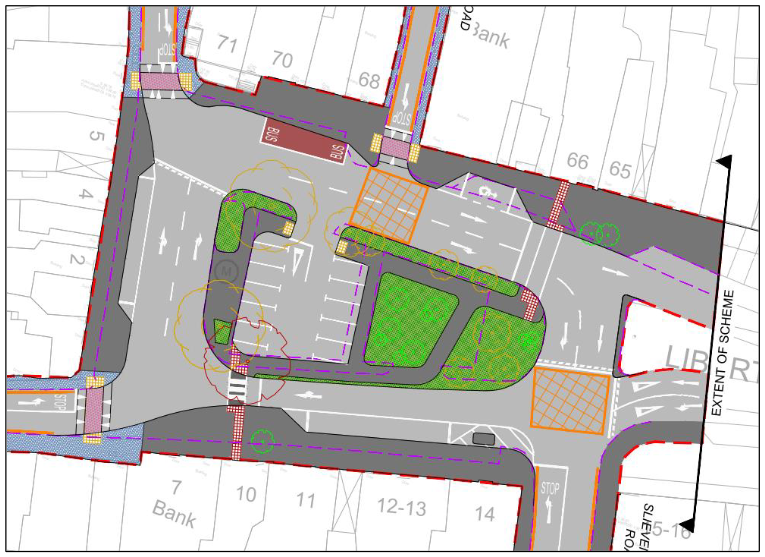
Some 20 submissions in total were forwarded to Tipperary Co. Council in reference to current plans submitted on the Phase 2 Liberty Square Public Realm Scheme. All submissions can be read in full by our readers, simply by accessing and scrolling down the page located at the LINK SHOWN HERE.
Proposed Liberty Square West Layout (Phase 2).
The closing time and date for all submissions closed at 4:30pm today, Friday August 30th, 2024.
No local resident consumers/shoppers made submissions or raised serious concerns about the planned designs for either Liberty Square or the several adjacent streets i.e. Rossa Street, Parnell Street, Nicholas Street (Cúchulainn Road) and Friar Street. Same have learned, from passed interactions with regards to such submissions sent to Tipperary Co. Council, that their opinions went unacknowledged and were rejected outright without discussion.
Parnell Street (formerly New Street)at the junction (right) withCúchulainn Road (formerly Nicholas Street).
In the main; Tipperary Co. Council now stand accused of failing to conduct detailed trials in respect of such planned changes to the town centre traffic flow and also of failing to fully consider the real impact of such proposed changes, on future ability of local businesses to continue to trade profitably.
Thurles.Info will be highlighting further failings, with regards Thurles planning issues, in the coming days.
This website uses cookies to improve your experience. We'll assume you're ok with this, but you can opt-out if you wish.AcceptRead More
Privacy & Cookies Policy
Privacy Overview
This website uses cookies to improve your experience while you navigate through the website. Out of these, the cookies that are categorized as necessary are stored on your browser as they are essential for the working of basic functionalities of the website. We also use third-party cookies that help us analyze and understand how you use this website. These cookies will be stored in your browser only with your consent. You also have the option to opt-out of these cookies. But opting out of some of these cookies may affect your browsing experience.
Necessary cookies are absolutely essential for the website to function properly. This category only includes cookies that ensures basic functionalities and security features of the website. These cookies do not store any personal information.
Any cookies that may not be particularly necessary for the website to function and is used specifically to collect user personal data via analytics, ads, other embedded contents are termed as non-necessary cookies. It is mandatory to procure user consent prior to running these cookies on your website.






Recent Comments