Met Éireann has confirmed that it will replace county-wide weather warnings with a new localised system from late 2026, marking a significant change to the national warning framework.
In a written reply to a Parliamentary Question by Laois Fine Gael TD Mr Willie Aird, the forecaster said it is developing a polygon-based system that will divide the country into sub-county zones. The new approach will allow warnings to be issued for specific areas rather than entire counties.
The forecaster said the new system will give more precise guidance to communities.
Noting that the current system is well established, robust and aligned with international best practice, Met Éireann added, “This enhanced localisation will provide clearer direction to those at risk and support more targeted emergency preparedness. The aim is to have this system in place later in 2026.”
Deputy Willie Aird has welcomed the proposed change, adding that the current system is too broad for Ireland’s varied landscape and island conditions and often results in warnings not reflecting the actual risk on the ground.
He said that during named storms and periods of wintry weather, Status Orange or Red alerts are sometimes issued for several counties even though only particular areas within those counties face severe conditions. Aird said this can lead to widespread school closures and disruption when the threshold for the higher‑level warning has only been reached in one part of a county.
“The new system will bring clarity. It will end the unnecessary disruption that blanket county warnings can cause while still giving clear safety information to the people who need it,” he said.
He pointed to the heavy snowfall in January 2025 as an example of where a more targeted approach would have been appropriate.
“High ground areas of Tipperary, Kilkenny, Clare, Kerry, Limerick and Laois were technically in red alert conditions with disruptive levels of snowfall, while lower lying parts of those counties had very different circumstances with mostly rain. A county-wide warning simply does not reflect that reality,” he said.
“People do not live their lives by county borders. Weather does not respect them either. This is a practical step that will help protect homes, businesses and lives,” concluded Deputy Aird.
Shannon-to-East Water Pipeline – Why Tipperary Communities Along the River Are Pushing Back.
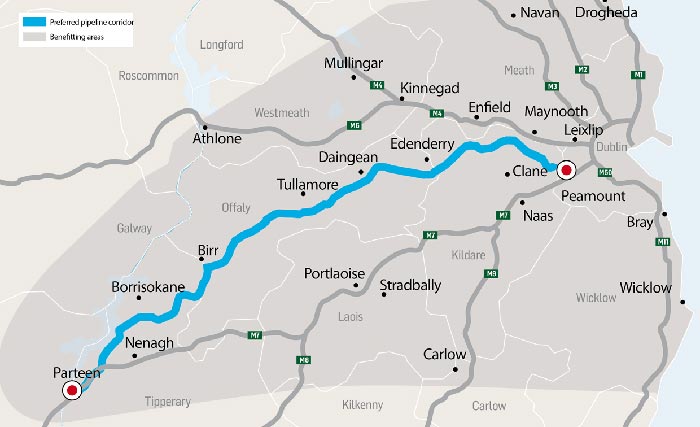
Objections are mounting in Ireland’s mid-west region over plans by Uisce Éireann to take more than 300 million litres of water a day from the River Shannon and pipe it to the Midlands, the east, and the greater Dublin Area. The utility lodged its planning application in December last for what it describes as the largest water infrastructure project in the State’s history; a 170km underground steel pipeline, linked to new treatment and storage infrastructure, designed to bolster supply for a region that includes almost half the population.
At the centre of the debate is a familiar national tension; how to secure reliable water for the country’s fastest-growing urban areas, without placing unacceptable pressure on the communities and ecosystems where that water is sourced. Uisce Éireann says the scheme is essential to reduce the greater Dublin Area’s dependence on existing sources and to provide resilience in the face of climate pressures and rising demand. It argues that leakage reduction is necessary, but not sufficient on its own, and that a major new supply route would help prevent restrictions and large-scale outages, while supporting much needed housing delivery and further economic growth.
Opponents, however, reject the idea that the Shannon must become the answer to the east’s water challenges. Community and environmental campaigners in the mid-west region contend the project is unnecessary, premature, and risky, especially during drought periods, when the Shannon system is under pressure too. Their core claim is straightforward; if leakage and inefficiencies were tackled more aggressively, particularly in the Irish capital, the scale of abstraction being proposed would not be needed. They also argue that long-term water security should come from a wider mix of measures, including demand management, smarter network operation, and exploring alternative sources, rather than relying on a single mega-project.
While Uisce Éireann states it will abstract a maximum of 2% of the long-term annual average flow at the Parteen Basin, critics say averages can be misleading. What matters most, they argue, is what happens during prolonged dry spells, exactly when Dublin’s demand spikes and river flows can be low. In those conditions, local groups fear that removing additional water upstream could reduce downstream availability and strain an already complex system balancing navigation, ecology, drinking water needs, and hydropower operations.
Environmental concerns are a major flashpoint. Local stakeholders warn of potential impacts on habitats and water quality, and they point to sensitivities around the Parteen Basin area and the broader Lough Derg–Shannon network. Angling and river-based recreation interests have also raised alarms, stressing that changing flows, even subtly, can affect fish migration patterns, spawning success, and the ecological health of tributaries and lake edges. In response, the utility maintains that modelling has focused heavily on low-flow and drought scenarios, and that statutory flow requirements and fish passage arrangements would remain protected under the proposal. It says it has submitted environmental assessment documentation as part of its application.
Cost is another source of contention. The project has been framed publicly as a multi-billion-euro investment, with estimates in the range of roughly €4.6 billion to nearly €6 billion in recent official statements, while critics warn the final bill could escalate significantly over time. For opponents, the price tag strengthens the case for exhausting cheaper, quicker measures first, especially leak repair, targeted upgrades, and region-by-region resilience projects, before committing to decades of debt and disruption. Supporters counter that, given the scale of the population and economic activity reliant on secure water in the east, claiming the long-term benefits justify the spend.
The planning process is now the arena where these arguments will be tested. The public consultation period is now closed, with local authority submissions due by 30th March. An Coimisiún Pleanála is required to decide within 48 weeks. If permission is granted, Uisce Éireann has indicated construction could begin in 2028, with completion within five years.
Whether the pipeline proceeds as proposed or is reshaped by conditions, the controversy highlights a bigger challenge Ireland cannot avoid: building a water system that is climate-ready, regionally fair, and environmentally credible, while restoring public confidence that “fixing leaks” and planning for growth are happening at the same time, not as competing priorities.
A “mini-tornado” gust sweeps through Thurles, Co. Tipperary.
Last Friday, a sudden burst of wind and rain cut across Thurles in County Tipperary; the kind of sharp, swirling gust locals working outdoors describe as a “mini-tornado”.
These incidents feel unusual when they arrive without warning, but Met Éireann estimates that Ireland experiences roughly ten tornado-type occurrences each year on average. The “mini-tornado” label is commonly used to distinguish the smaller Irish variety from the much larger tornadoes associated with the United States. Many Irish events are weak “landspouts” that can develop quickly along squall lines or briefly energetic cumulus clouds, and dissipate within minutes. Irish meteorologists also note these phenomena are more common than most people assume.
That’s how Friday’s gust behaved. One moment it was simply blustery; the next, wind and rain were swirling through open spaces, rattling cars, and sending loose debris skittering across the car park. (For context, “gale” conditions imply very strong winds on the Beaufort scale and feature in official warning thresholds.)
The same pulse of weather was also felt further north in the village of Loughmore, a reminder that these brief events can hopscotch across a small area.
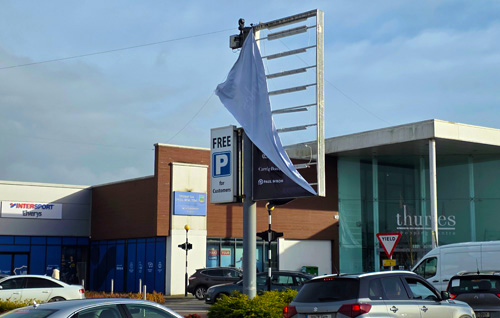
In Thurles, the most striking damage is captured in the photo above. A newly erected directional sign for Thurles Shopping Centre was left battered and half-shrouded. A marker meant to guide shoppers now wears torn material wrapped around its frame like a storm-tugged flag. This major short lived gale gusts funnelled itself between tall trees and buildings, striking the tall sign frame at an awkward angle, before turning its advertising data into a temporary ships sail.
EPA announces funding of €6.5m for new research to address climate and environmental policy needs.
EPA announces funding of €6.5 million for 24 new research projects in the areas of:
climate change,
the natural environment,
the green & circular economy and
the environment & human health.
The funding will address emerging research needs of policy makers in Ireland and respond to identified knowledge gaps for policy development and implementation.
In terms of building research capacity, the funding will support 148 research staff across 10 Higher Education Institutions and will have a wide reach through 34 collaborating organisations across the public and private sectors in three different countries.
Reflecting the cross-sectoral nature of environmental and climate policy, the EPA is working in partnership with Met Éireann and the Office of Public Works to co-fund a number of the research projects.
The Environmental Protection Agency (EPA) today announced new funding for environmental and climate research in Ireland, with funding of €6.5 million awarded for 24 new research projects. As well as addressing key knowledge gaps, these innovative projects will support the development of vital research capacity and expertise in strategically important areas.
Research plays a critical role in informing robust policy and decision-making as set out in Ireland’s Research and Innovation Strategy, Impact 2030. The EPA Research Programme has an established focus on policy-relevant research addressing identified knowledge gaps relevant to environmental and climate policy. The outcomes of the EPA Research Call 2025 will contribute to the evidence base for environmental policy in Ireland, strengthen connections between the research and policy communities and deliver positive environmental outcomes.
Projects that will receive EPA funding this year include topics such as:
Assessing impacts of national policies on climate targets
Use of technology in peatland monitoring
Impacts of dams and barriers on rivers and lakes
Streamlining Strategic Environmental Assessment (SEA) through the use of AI
Greening of laboratory analysis protocols and
Greater understanding of sources and sinks of methane
Announcing the funding awards, Dr Eimear Cotter, (EPA Deputy Director General) said: “We face complex challenges in becoming a resilient, competitive and sustainable society. Research, such as that funded through the EPA Research Call, will play a vital role in supporting robust policy- and decision-making while ensuring the protection of our environment and climate. The projects announced today will support targeted, policy‑relevant research and build connections with policy-makers and practitioners, and ultimately support more effective action. I congratulate the successful teams and look forward to seeing the positive impacts of their work.”
The latest EPA funding is significant in terms of further building environmental research capacity in Ireland. It will support 148 research staff across 10 Higher Education Institutions and will have a wider reach through 34 collaborating organisations across the public and private sectors in three different countries. University of Galway received the highest number of successful research awards in 2025.
Commenting on the announcement, Mr Aengus Parsons, (Vice-President for Research and Innovation (Acting) at University of Galway), said: “Our researchers are to be commended for their vision and dedication to addressing the urgent environmental challenges of our times. We thank the Environmental Protection Agency for this support, which strengthens our commitment to research and innovation around sustainable and resilient environments. I look forward to seeing these projects progress to impacts across climate policy, coastal risk, air quality, emissions reduction, peatland resilience, the bioeconomy, and water quality.”
Reflecting the importance of collaboration in addressing climate and environmental challenges, the EPA is working in partnership with Met Éireann and the Office of Public Works to co-fund a number of projects in areas including flood probability, flow statistics for our rivers and climate modelling.
The list of funded projects made under the EPA Research Call 2025 is available on the EPA website. The EPA Research Programme is a Government of Ireland initiative funded by the Department of the Environment, Climate and Communications. Details of the EPA Research Call 2026 will be made available on the EPA website.
A North Tipperary councillor has warned that Tipperary County Council must “come out strongly” with regard to its position on the proposed Shannon-to-Dublin water transfer scheme, as the multi-billion euro project moves through the planning process.
Uisce Éireann states the abstraction would be a maximum of 2% of the long-term average flow at Parteen Basin. The volume most commonly cited in public reporting is roughly 330–350 million litres per day(depending on the source and whether a rounded “up to” figure is used).
Cost estimates are varied. Uisce Éireann has referenced a preliminary indicative range in the €4.58bn–€5.96bn bracket, while other reporting has noted higher “worst-case” risk scenarios discussed in official correspondence.
“A legacy of a beautiful lake that’s destroyed” Speaking on local radio, Councillor Bugler said she fears the council will not oppose the project strongly enough when it finalises its submission. She said she raised her concerns directly with council Chief Executive Ms Sinéad Carr, warning against any temptation to prioritise potential local “community benefit” funding over environmental impact. She has urged the council not to “sell us out” and said she was worried about damage to Lough Derg for future generations.
Uisce Éireann has said it is proposing a “bespoke Community Benefit Scheme” linked to communities hosting construction and permanent infrastructure.
Criticism after Killaloe meeting. The councillor also criticised Uisce Éireann’s public engagement after a recent information meeting in Killaloe, saying she was dissatisfied with the answers provided on how the project would operate during low-flow or drought periods. In particular, she questioned how a 2% abstraction figure based on long-term averages would translate during dry spells and whether abstraction would be reduced or suspended, and what that would mean for the reliability of supply to Dublin and the wider region.
Proposed Tipperary – Dublin Pipeline.
“What turns this from local frustration into national hypocrisy is the scale of spending Ireland is willing to contemplate elsewhere. The Irish Government has backed the Water Supply Project for the Eastern and Midlands region, intended to bring a new long-term water source from the Shannon system towards the greater leaking Dublin area“. See Link Here
Ms Bugler further claimed that some representatives displayed limited familiarity with local water and wastewater infrastructure, including the source of supply for towns Ballina and Newport from the Mulcair River, and raised concerns about treatment levels at Ballina’s wastewater facility. These are allegations made by the councillor in media reports; Uisce Éireann has not, in the published material cited here, issued a point-by-point response to those specific claims.
Council submission in preparation. Meanwhile, Tipperary County Council is preparing its formal submission to the planning authority. Separate coverage has reported that consultants have been appointed to assist the council in drafting its response. With the application now before An Coimisiún Pleanála, we learn that stakeholders and members of the public can also make submissions as part of the statutory process, ahead of a decision on whether the project proceeds and, if so, under what conditions.
This website uses cookies to improve your experience. We'll assume you're ok with this, but you can opt-out if you wish.AcceptRead More
Privacy & Cookies Policy
Privacy Overview
This website uses cookies to improve your experience while you navigate through the website. Out of these, the cookies that are categorized as necessary are stored on your browser as they are essential for the working of basic functionalities of the website. We also use third-party cookies that help us analyze and understand how you use this website. These cookies will be stored in your browser only with your consent. You also have the option to opt-out of these cookies. But opting out of some of these cookies may affect your browsing experience.
Necessary cookies are absolutely essential for the website to function properly. This category only includes cookies that ensures basic functionalities and security features of the website. These cookies do not store any personal information.
Any cookies that may not be particularly necessary for the website to function and is used specifically to collect user personal data via analytics, ads, other embedded contents are termed as non-necessary cookies. It is mandatory to procure user consent prior to running these cookies on your website.







Recent Comments