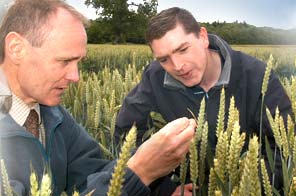
Training courses given by Teagasc for farmers in Tipperary, who are considering converting to organic farming, will take place later this month here in Thurles Co.Tipperary and across the country.
This follows a strong uptake of the Teagasc organic training courses held during the autumn of 2009.
Organic farming continuous to grow steadily here in Ireland with presently 1,532 organic operators cultivating some 48,911 hectares of land. Growth is expected to increase further due to strong demand for organic Irish produce, the suitability of many farms to organic conversion, and Department of Agriculture, Fisheries and Food Scheme incentives.
The new training courses are FETAC (Further Education and Training Awards Council) accredited to Level 5 standard and will be run for one day per week over a five-week period, commencing Monday, January 25. The courses involve both indoor sessions and visits to successful local organic farms.
Training topics over these five weeks will include the principles of organic production, organic standards and regulations, and the economics and market opportunities for produce. Admission is €200 per person or family and pre-booking is essential.
Six local authorities including North Tipperary and South Tipperary, have been testing drinking water after 210 tonnes of urea were spread on national roads in order to melt snow and ice during the recent cold spell.
This followed advice from the National Emergency Response Co-Ordination Committee (NERCC) who advised the National Roads Authority (NRA) to source 600 tonnes of Urea for use as a de-icer on an emergency basis.
Expressed Sequence Tags (EST’s) should reveal shortly if public supplies of drinking water have been contaminated.
Being solid, Urea is colourless, odorless, neither acidic nor alkaline, highly soluble in water and is widely used in fertilizers as a convenient source of nitrogen. Urea can be irritating to skin, eyes, and the respiratory tract. Repeated or prolonged contact with Urea in fertilizer form on the skin may cause dermatitis, however the substance is regarded as relatively non-toxic.
It is now feared that ice and snow, melted by the Urea, may have found its way into natural water sources, some of which may supply drinking water to households.
Alarms were first triggered at the Leixlip, Co Kildare’s water treatment plant last weekend when high levels of nitrates were detected in the water supply.
On Tuesday last, local authorities were contacted and asked to test drinking water in their areas to determine whether their supplies had become contaminated.
The Office of Public Works (OPW) invite you to a Public Information Day on the River Suir Catchment Flood Risk Assessment and Management Study. The purpose of the information day will be to gather feedback about public perception of flood risk and public experience of flooding. Feedback received will be used, together with further analysis, to select the preferred Flood Risk Management options for the Suir catchment area.
Details of the Public Information Day to be held in Thurles is as follows:-
The Source Library,Thurles, Tuesday 26th January 3pm-8pm.
The Source Library Thurles
Additional Public Information Days will also be held at the following locations and dates:-
Piltown GAA Complex Tuesday 19th January 3pm-8pm.
Clonmel Main Guard Building Thursday 21st January 3pm-8pm.
Waterford Central Library Weds 27th January 3pm-8pm.
So how can you, the public, get involved ?
Attend the Public Information and Consultation Day;
Aileen McSwiney, (Aileen.McSwiney@rpsgroup.com) Project Manager, RPS Consulting Engineers, in announcing the information day, stated: ‘It is in everybody’s interest to get involved from the early stages of this Study, to ensure that everyone has a say on a range of potential Flood Risk Management options for the Suir Catchment.’
Thurles Mayor Evelyn Nevin stated: ‘I hope that as many Thurles residents as possible will attend this Public Information and Consultation Day and communicate their perceptions’.
Councillor Gerard O’Brien (Solicitor) stated: ‘Feedback from the public is essential when finally selecting the preferred flood risk management options’
It’s snowing on the river Suir and at this time of year our bird life take a back seat because they don’t get a handout when they so need it.
Our feathered friends try to scratch an existence under every bush for a meal and with the current prevailing weather conditions there is a shortage of food, due to the freezing snow covered ground, so they do need some help from you.
When it gets cold, birds need energy in the form of seeds and fat to keep them warm. Giving them food and ensuring they eat enough of it will build them up and help them maintain necessary adequate fat supplies. For birds the food and water provided in gardens can be the difference between life and death.
When temperatures fall below freezing, birds struggle to find the food they need to survive the winter in healthy conditions, vital for breeding in spring.
View this high definition video shot by Brian Corbett yesterday, entitled “Snowing At River”, which highlights the extreme conditions experienced by bird life along the River Suir, here in snow bound Thurles.
During cold snaps birds are more likely to seek sanctuary in gardens and providing food like meal worms, fatballs, crushed peanuts, dried fruit, seeds and grain can help them survive.
Freezing weather is a potential death sentence for many birds but by feeding the birds in your garden you can help them survive the worst of this winter weather. Just a little water, food and shelter can turn a garden into a vital haven for birds in the freezing winter months.
Remember, feeding birds is an easy way to start teaching children about wildlife. Providing food and water brings them closer for us to marvel at their exciting behaviour and wonderful colours.
Please feed the birds, and they will reward you by reducing your garden insect pests come Springtime.
By now the Christmas decorations have been packed back into their boxes and the Christmas have been carefully carefully stored also. Problem now is what to do with your old Christmas Tree.
Not a problem folks as North and South Tipperary County Councils are both offering you the chance to recycle free of charge and your tree can be composted when you are finished with it.
Details are as follows:-
South Tipperary County Council Christmas Tree Recycling
Trees can be dropped off for recycling from the 6th January to the 15th January at the following locations.
This website uses cookies to improve your experience. We'll assume you're ok with this, but you can opt-out if you wish.AcceptRead More
Privacy & Cookies Policy
Privacy Overview
This website uses cookies to improve your experience while you navigate through the website. Out of these, the cookies that are categorized as necessary are stored on your browser as they are essential for the working of basic functionalities of the website. We also use third-party cookies that help us analyze and understand how you use this website. These cookies will be stored in your browser only with your consent. You also have the option to opt-out of these cookies. But opting out of some of these cookies may affect your browsing experience.
Necessary cookies are absolutely essential for the website to function properly. This category only includes cookies that ensures basic functionalities and security features of the website. These cookies do not store any personal information.
Any cookies that may not be particularly necessary for the website to function and is used specifically to collect user personal data via analytics, ads, other embedded contents are termed as non-necessary cookies. It is mandatory to procure user consent prior to running these cookies on your website.





Recent Comments