Ms Margaret Ryan(Asst. Librarian), Tipperary Co. Council Library Services, Nenagh reports: –
“As many of you may already be aware, Nenagh Library is the Europe Direct Information Centre (EDIC) for counties Tipperary, Limerick, Cork and Kerry.
On Thursday, September 26th, 2019 next, at 7:00pm, in Nenagh Library, [situated at O’Rahilly Street, Nenagh, Co. Tipperary], we will be holding a Citizens Dialogue on ‘Climate Change and Sustainability’, as part of our 2019 ‘Programme of Events’.
The title of this talk is ‘The Climate is Changing; How Can We?,’ with keynote speakers on the night, Ms Cara Augustenborg, (Environmental scientist), and Mr Gerard Kiely, (Head of the European Commission Representation in Ireland).
There will also be a panel discussion afterwards, with panellists Mr Paul Kenny(CEO Tipperary Energy Agency) and Mr Gregg Allen (Project Manager, Community Power, Templederry), which will be chaired by Mr Fran Curry of Tipp FM Radio.
We are urging everybody to support this event. This talk is an opportunity for people to find out what they can do to make a difference, to ask questions and learn the facts about climate change; to make their voices heard on what is undoubtedly the single greatest challenge of this generation.”
A survey recently conducted by Irish Business Against Litter (IBAL) indicates that only 16% of Irish waterways are presently clean to European standards. This survey found that while the majority of Irish towns are clean, its waterways are far from similar.
The business group studied 42 beaches, harbours and river areas around Ireland, revealing that only one in six were deemed as being ‘clean’, while 14% were classed as ‘littered or ‘heavily littered’.
These surveyed areas included in this report were monitored by the Environmental Education Unit of An Taisce over the course of the summer of 2019.
Thurles Not Included In IBAL Survey:
I should point out that Thurles town and the River Suir were not inspected as part of this survey. I am given to understand that because of limited government funding, Thurles remains excluded. I have been advised by IBAL that I should contact the Minister for Communications, Climate Action and Environment Mr Richard Bruton, TD and request that Thurles be included. [Note: A letter is currently winging its way, as we write.]
Pictured today on the west bank of the River Suir Thurles, close to the new foot bridge; litter waiting for the next flood to be borne away to the sea.
Mr Conor Horgan of IBAL said the survey was about protecting tourism and recreational assets, but was equally about overall global impact. He correctly stated, “The litter we encounter in these areas will eventually enter our seas and add to the already problem of marine litter, which is threatening our very survival.”
Thanks to the heroic work of the English natural historian and broadcaster Sir David Attenborough (CBE), same who has highlighted the potential impact of marine litter on our climate worldwide in his televised programmes; we no longer have an excuse, based on ignorance of the current situation. We are fully aware of the billions of kilos of discarded plastic to be found, in swirling convergences, in our planets oceans and growing more in extent rapidly.
Environmental Protection Agency Ireland (EPA)
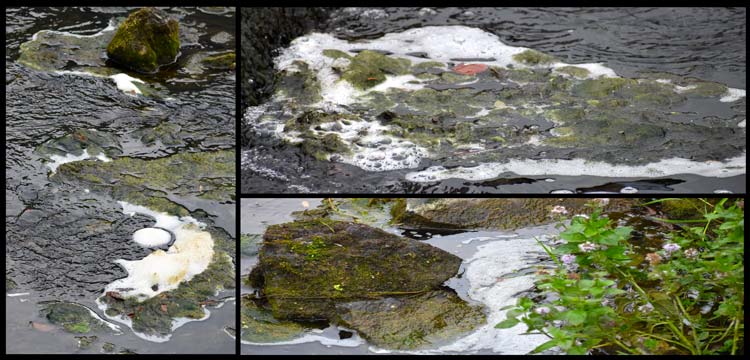
Just one week prior to the local County Council Elections in Thurles; latter which took place on Friday, May 24th of this year (2019), Tipperary County Council demonstrated further deficiencies in their inadequate and meagre attempt at cleaning the river Suir here in Thurles. The work, photographed by Thurles.Info, was reminiscent of someone going about with a stick beating the heads of weeds. They did however unlike other previous years, manage to remove much of the weeds and slime on view in the water, which was holding back a mysterious oily, foam-like substance. However, with the regrowth of slime, this oily, foam-like substance is once more being detained for all to see.
Pictures below were taken yesterday (September 4th 2019). Other photographs taken on the 11th of May 2019, prior to this half-hearted pre-election clean-up, were sent to the EPA in August.
Reply received from the EPA on August 28th 2019 reads:-
The Environmental Protection Agency (EPA) acknowledges receipt of your correspondence on 16/08/19 concerning the River Suir at Barry’s Bridge, Thurles, Co. Tipperary(Our Ref COM009271). Tipperary County Council is responsible for dealing with the environmental protection issues described in your correspondence. We have forwarded a copy of your correspondence to Tipperary County Council for their attention, action and direct reply to you. The referral of this correspondence closes our file on this issue. This is now a matter for Tipperary County Council to investigate and take the action as appropriate.
Furthermore, we recommend that you report any further issues in relation to this matter, preferably in writing to Tipperary County Council Environment Department.
If you have any questions in relation to this matter, please do not hesitate to contact me or one of my colleagues on 053-9160600.
Trusting this is of assistance to you. Yours sincerely, Cyrina Okoro (Office of Environmental Enforcement, Environmental Protection Agency, Johnstown Castle Estate, Co Wexford.)
“Quis custodiet ipsos custodes? – “Who will guard the guards themselves?”
Environmental Officials from Tipperary Co. Council have since been directly in touch with me, and for the second time this year same officials have asked – “Where in Thurles, is Barry’s Bridge“.
Time again to regain control of our historic town and to set up a new working Tidy Towns Group. Anyone interested please contact me?
Independent TD Mr Michael Lowry pictured here with protesting farmers outside the ABP beef processing plant in Nenagh, North Co.Tipperary.
Independent Tipperary TD Mr Michael Lowry has called on all parties involved in the escalating beef dispute, to find a resolution to this current impasse, which is creating havoc within the entire beef industry.
Taking to Thurles.Info this morning, Mr Lowry stated, “I fail to understand why the recent beef forum did not fully address the central issue; which was and remains the increase in price for beef producers. This ongoing saga is and always was, an issue regarding underpayments to these primary producers”.
“It is not sustainable to expect beef producers to continue to operate at a financial loss. It is also unethical to have a small and select group of processors controlling the beef producing industry, while creaming excess profits. There needs and must be, not just fairness, but equity and balance in relation to the distribution of profits within the industry,” continued Mr Lowry.
“I have requested the Minister of Agriculture, Mr Michael Creed, to again intervene in this crisis and to find a more equitable and indeed a final solution to this most contentious of farming issues. There is no doubt that beef producers are currently in a loss-making position and this situation cannot be allowed to continue. This current stance is not sustainable and its continued consequences are causing severe hardship amongst the farming community.” Mr Lowry concluded.
Meanwhile, farmers are maintaining their presence outside of meat plants here in Co. Tipperary, with unofficial protests resuming today at the ABP plants in both Cahir and Nenagh; despite the granting of High Court injunctions yesterday, against those farmers protesting.
The Environmental Protection Agency (EPA) published environmental data yesterday on Ireland’s national pollutant and transfer register.
This is a public register of pollutant releases and waste transfers from large industrial activities in Ireland. The information supports EU-wide reporting through the European Commission’s e-Register website which contains data reported annually by more than 34,000 industrial facilities across 33 European Countries.
Covering 91 pollutants from 417 large industrial facilities in Ireland, the data indicates trends across a number of key parameters.
Findings from the 2017 data include:
A 69% decrease in Hydrochlorofluorocarbon (HCFC) refrigerant gas emissions, showing the positive response to phase out and switch to a more environmentally-friendly bulk refrigerant by Irish Industry.
A 17% increase in 2017 in the recovery of hazardous waste within Ireland.
A 47 % increase (165,000 tonnes) in the quantity of hazardous waste sent abroad for recovery.
Patrick Geoghegan, EPA Senior Manager said: “The data on hazardous waste transfers indicates that the positive trend to send hazardous waste for recovery treatment, rather than disposal, continued in 2017. However, it also highlights that Ireland has not moved significantly towards self-sufficiency. A lack of domestic infrastructure and the often more favourable cost option of treatment and disposal abroad have meant that export continues to be a significant treatment route for Ireland’s hazardous waste.”
The pollutant release and transfer register provides greater transparency among stakeholders and incentivises industry to establish clean production techniques and pollution abatement equipment to reduce emissions.
New figures show that further measures will be needed to ensure that packaging recycling levels don’t stagnate.
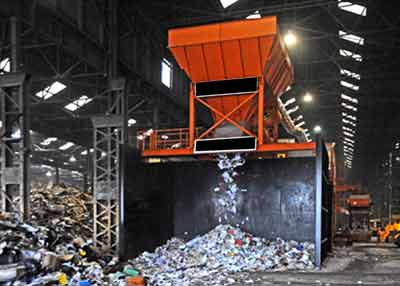
Waste Recycling Station
The Environmental Protection Agency (EPA) has today published information about waste packaging management in 2017. The figures indicate that the generation of waste packaging – including glass, paper, plastics and wood – remained high in 2017. In addition, while recycling rates were high for some waste streams, including glass and wood, recycling levels have levelled off over the last number of years.
Ms Mary Frances Rochford, (Programme Manager in the EPA’s Office of Environmental Sustainability), stated, “As a society we need to move to more sustainable consumption patterns which together can reduce waste, energy use and carbon emissions. The information published today shows that packaging waste continues to increase in line with economic growth. Of particular concern is both the level of plastic packaging in use and the fact that recycling rates appear to have plateaued in recent years, at around 34%. Ireland needs a step change in waste packaging management. Our figures indicate that there are challenges ahead in meeting future EU targets and the ambition of the EU Plastics strategy. Preventing this waste in the first place will be an important component of Ireland’s response if we are to achieve our goals.”
Key Data:
Ireland generated over 1m tonnes of waste packaging in 2017. Almost 217kg of waste packaging was generated per person, including 59kg of plastic packaging waste per person, a slight increase on 2016. In 2017, 66% of waste packaging generated was recycled, exceeding the current EU target (55%) and the 2025 target (65%). The packaging recycling target for 2030 (70%) will be challenging but is achievable. In 2017, 27% of waste packaging was plastic. Just over one third (34%) was recycled, exceeding the current EU target of 22.5%. This is, however, a long way short of future EU targets for 2025 (50%) and for 2030 (55%). Recovery rates for plastics were at 78% – this includes both recycling and incineration.
Mr Stephen Treacy, (EPA Senior Scientist) stated, “The EPA’s recent waste characterisation study, looking at the contents of household and commercial bins, showed that up to one third of the contents of our general waste bins could be diverted to recycling with better separation and treatment. Improved separation and lower levels of contaminated waste will help improve recycling rates, which is needed to put Ireland on track for a circular economy.”
The EPA today also published 2017 figures for Ireland’s recycling and recovery of waste electrical and electronic equipment (WEEE) and end-of-life vehicles (ELVs). This information is now available on the EPA website where you can also view details of Ireland’s progress towards EU waste recycling, recovery and diversion targets.
This website uses cookies to improve your experience. We'll assume you're ok with this, but you can opt-out if you wish.AcceptRead More
Privacy & Cookies Policy
Privacy Overview
This website uses cookies to improve your experience while you navigate through the website. Out of these, the cookies that are categorized as necessary are stored on your browser as they are essential for the working of basic functionalities of the website. We also use third-party cookies that help us analyze and understand how you use this website. These cookies will be stored in your browser only with your consent. You also have the option to opt-out of these cookies. But opting out of some of these cookies may affect your browsing experience.
Necessary cookies are absolutely essential for the website to function properly. This category only includes cookies that ensures basic functionalities and security features of the website. These cookies do not store any personal information.
Any cookies that may not be particularly necessary for the website to function and is used specifically to collect user personal data via analytics, ads, other embedded contents are termed as non-necessary cookies. It is mandatory to procure user consent prior to running these cookies on your website.






Recent Comments