Thursday, April 22nd next, is ‘World Earth Day’ and the Rediscovery Centre and the Natural History Museum of Ireland are offering a unique and free opportunity for primary school pupils.
This free 1 hour online event, for 3rd to 6th class pupils, takes place from 11:30 am to 12:30pm, as already stated on April 22nd. The session, entitled “Cool Fossils and Hot (Climate) Facts”, begins with a half hour exploration of Ice Age fossils from Ireland. Pupils will be enabled to learn about the Woolly Mammoth, Spotted Hyena, Giant Deer, Brown Bear and Grey Wolf.
The second half of this not-to-be missed session, invites pupils to learn about climate change. Pupils will be enabled to investigate how CO2 causes global warming, with the help of some fascinating experiments.
To take part in this event and to view its associated resources you can register via eventbrite.ie, by simply clicking HERE.
The theme for this year’s ‘World Earth Day’ is ‘Together, We Can Restore Our Earth’. For more information on ‘World Earth Day’ visit HERE.
The words “River Walk” should flash upon our inward eye, visions of tranquillity, a certain colourful exoticism or romantic allure. Alas, not so when we describe the Thurles River Walk, running southwest beside the River Suir in the heart of Thurles.
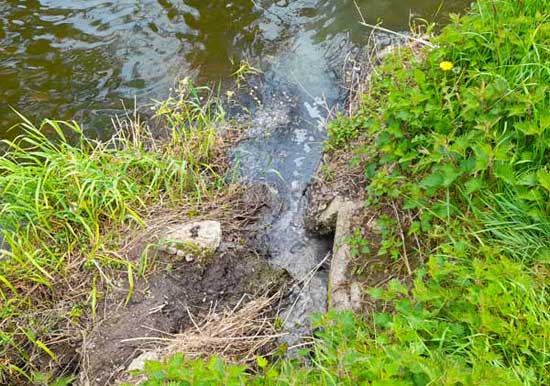
The stench from drains, each deliberately designed to flow into the river, from various nearby developments, ensured that walkers, today, kept to the well-trodden Slievenamon Road route.
If local residents, council officials or even politicians, wish to view this offensive run-off into the river, with the help of your nose you can find same, some 50 yards south of the new Thurles footbridge on the west side of the river bank walkway.
See picture above of what appears to be the overflow to a flooded sump, latter designed to collect undesirable liquids.
Even the delusional Jackie Cahill TD, last week; who soon will be responsible for bringing the World Cup to Semple Stadium, Thurles, thankfully, possibly because of the existing stench, kept his weekly concocted, fictitious and mendacious promotional video very short, when announcing €120,000 (amount €30,000 less than his annual salary & expenses) for an extension to this same walkway.
(Ah, yes you do possibly remember the above other J.C.; the guy who sent me the famous misspelt quote in relation to the “Double Ditch”:“Iv done more in 5 years than you have in youre life GEORGIE WILLOBY”. Stop emailing”. On €100,000 plus expenses J.C., we hope you have, but we greatly doubt it.).
Meanwhile, on the east side of Thurles town, the now derelict Munster hotel, situated close to a Medical Pharmacy; two Food Takeaways and two Dine-in Restaurants and opposite a most beautiful Cathedral; has allowed its underground cellar to flood to a depth of at least one metre. Owned by a member of Thurles Chamber of Commerce, we understand; the flood water now attracts water rats from the river to operate behind terraced houses in the area, while also collecting an abundance of litter. Here also we can expect to find a different, yet another unpleasant fragrance.
It would appear no one is in charge in the Thurles Municipal District presently. Maybe we need to have a public demonstration and a change in political direction, when we get this accursed Covid-19 under control.
EPA has started a 3-year project that will improve the level of air quality information available to the public and policy makers in Ireland. LIFE EMERALD is part funded by the European Commission LIFE funding programme.
The main objectives are: –
An operational 3-day ambient air quality forecast;
Near real-time mapping of the main air pollutants throughout the country and in our major cities and towns; and
Annual mapping of air pollutants across the country
The project will support Irish citizens in making decisions that positively benefit their health on a day-to-day basis.
The EPA has commenced work on a new 3-year EU part funded project entitled LIFE Emerald – “Emissions Modelling and Forecasting of Air in Ireland”. The project proposes to greatly improve publicly available air quality information and raise awareness around the topic of Irish air quality.
The LIFE EMERALD project will also improve Ireland’s ambient air quality management capabilities, by using an air quality modelling system to gain a better understanding of the factors contributing to poor air quality and develop a system that will provide better information to the public. The project will deliver the following: –
An operational 3-day ambient air quality forecasting system, which will inform the public of the predicted air quality in the coming days, allowing them to make decisions to better protect their health.
Near real-time (NRT) air quality maps, to provide more detailed information to the public, which will incorporate live data from the growing EPA ambient air quality network.
Annual air pollutant maps, which will allow for more detailed air pollution assessment.
On the commencement of the LIFE EMERALD Project EPA Director Dr. Micheál Lehane, has stated,
“LIFE EMERALD will help deliver the first operational national air quality forecast for Ireland. This will allow citizens to become much more informed on their own actions in response to forecast air quality. It will greatly strengthen our knowledge of air pollution nationally. We are delighted to receive the funding from the EU LIFE Programme to help us proceed with this project and we hope to deliver a greater understanding of Ireland’s air quality into the future.”
The EPA will manage the project in co-operation with its main project partners the Department of the Environment, Climate and Communications, the Health Service Executive, the Asthma Society of Ireland, University College Cork and the Belgian research institute VITO. The EPA will also consult and co-operate with other national stakeholders that have an interest in the area of air quality, such as the Irish Heart Foundation.
MsSarah O’Connor, CEO of the Asthma Society stated,
“Ireland has the highest incidence rate of asthma in Europe with one in ten children and one in thirteen adults developing the condition – with 890,000 people likely to develop asthma in their lifetimes. The Asthma Society of Ireland welcomes the opportunity to be part of the LIFE EMERALD Project as the link between clean air and improved human health is clear.”
Mr. Mark Murphy, the Advocacy Officer at Irish Heart Foundation, stated,
“At the Irish Heart Foundation, we welcome the EPA’s LIFE EMERALD project as it will help raise public awareness of the significant damage that air pollution does to cardiovascular health, and highlight what measures could be introduced to reduce the 1,300 premature annual deaths caused by air pollution, the majority of which are due to stroke or heart disease.’’
The project is scheduled to be completed by the end of 2023, with priority given to the provision of the air quality forecast in early 2023.
In 2020, greenhouse gas emissions from Irish power generation and industrial companies – covered by the EU Emissions Trading Scheme, fell by 6.4 per cent.
Emissions decreased by 8.4 % from the electricity generation sector, due to more renewable energy and less fossil fuels.
The overall decrease in industrial emissions is 3.5%, with the cement industry emissions decreasing and increases recorded for the dairy and pharmachem sectors.
Greenhouse gas emissions from aviation decreased by 63% compared to 2019, which reflects the significant impact of Covid-19.
The EPA, as the Competent Authority in Ireland for the EU Emissions Trading System (EU ETS), today released its preliminary analysis of greenhouse gas emissions in 2020. Emissions from Irish power generation and industrial companies fell by 6.4% (0.9 million tonnes) in 2020, to their lowest level since the EU ETS was introduced in 2005. This compares with a decrease of approximately 11-12% across Europe.
The decrease in emissions is due to the impact of lower production in some industrial sectors during the pandemic, combined with a significant drop in power generation emissions. Power generation emissions dropped by 8.4% as a result of the strong presence of renewable energy – mainly wind generation – and less use of fossil fuels, such as peat, in our energy mix. In contrast, emissions from the ESB coal-fired plant at Moneypoint increased by almost 27%, mainly due to increased demand for balance on the National Grid.
Aside from power generation, the decrease in industrial emissions collectively is 3.5%.
Cement industries recorded a 5.7% decrease overall.
The dairy processing industry showed a 4.0% increase.
Emissions from pharmachem industries increased by 10.9%.
Aviation emissions from flights within the European Economic Area reported to Ireland decreased by 63% compared to 2019, to 4.74 million tonnes. The only airline showing an increase in emissions in 2019 and 2020 specialises in air freight.
Dr. Maria Martin, EPA Senior Manager, stated: “We welcome the overall decrease in greenhouse gas emissions in 2020 from large industry and power generation. However, underlying this decrease are some contrasting trends. An increase in the use of renewables in the power generation sector – coupled with the impact of Covid-19 – leads to less emissions. There are, nevertheless, many companies in the industrial sectors, such as dairy processing and pharmachem, where emissions are increasing year on year.
A positive development is the fact that the price of carbon in the EU ETS has continued to rise from just under €31 per tonne at the end of 2020 to €43 per tonne currently. It is not yet clear if this will be sufficient and stable enough to drive emissions reductions.”
In Ireland, 105 major industrial and institutional sites were required to report their emissions for 2020, by March 31st 2021 in the Emissions Trading System. These include sites operating in the power generation, cement, lime, and oil refining sectors. Also included are large companies in sectors such as food & drink, pharmaceuticals and semi-conductors. Details of the verified emissions of greenhouse gases in 2020 are available on the EU’s website HERE. The data are not complete for all Member states. Analysis of the EU data can be found in Carbon Pulse HERE.
Further details about Emissions Trading are available on the EPA website HERE. Further information about Ireland’s overall greenhouse gas emissions is also available on their website and the EPA has developed useful infographics and published the detailed greenhouse gas inventory HERE.
Exquisite Sensory Garden at Two-Mile-Borris, Thurles, Co. Tipp.
A well designed sensory garden epitomises the adage that “gardening adds years to your life and life to your years”. Two-Mile-Borris village, near Thurles, in County Tipperary, is home to an exquisite sensory garden that provides enormous benefits both to its visitors and to the local community.
What is a Sensory Garden? A sensory garden is a garden that is designed to stimulate all five main senses (sight, sound, taste, touch and smell), and in doing so, has been shown to have many and diverse benefits for its visitors.
What are the benefits of a Sensory Garden? Sensory gardens are associated with multiple benefits, including having a positive impact on our cognition, physical fitness, creativity, mental health and well-being. In terms of cognition, building and caring for a sensory garden provides ample opportunities for young and old to acquire new knowledge and skills. Planting and playing in a sensory garden can also help to improve fine and gross motor skills.
When it comes to physical fitness, any gardener will tell you that gardens and exercise go hand in hand, whether you are digging, weeding or simply walking outdoors and enjoying the sunshine. A sensory garden, by virtue of its stimulating design, encourages movement, as visitors explore all that it has to offer by way of touch, taste, sight, sound and smell.
Sensory gardens and the role they can play in supporting mental health and well-being is widely recognised. Different sensory experiences can immediately lift our mood, helping us to feel calm or joy. The very act of sitting outdoors and taking in the sights and sounds that nature has to offer, can help alleviate our stress levels.
For children and adults with sensory processing needs and other special needs, sensory gardens are praised for their therapeutic benefits and the opportunities they provide for sensory stimulation, emotional regulation, language experiences and social skills development.
The Two-Mile-Borris sensory garden, in terms of creativity, is a place of magic and wonder for all visitors. The materials and plants have been purposely selected to stimulate our imaginations, in addition to our senses. Life size insects and fantastical structures provide wonderful opportunities for artistic expression and storytelling, both now and into the future.
Apart from the positive impact the Two-Mile-Borris sensory garden has had on the local villagers themselves; situated beside the local primary school it has now also become undeniably beneficial as an additional outdoor classroom. Indeed, under the supervision of Two-Mile-Borris Development Association, many of the wonderful sensory items within the garden have been either constructed or introduced into this area by the local school pupils themselves, thus making this area, “Their Special Place”.
Where can I learn more about Sensory Gardens? There is no one design for a sensory garden, but all five senses must be represented and there are certain plants and materials that you will typically find in a sensory garden because of their stimulating nature.
To find out more about sensory gardens why not visit this wonderful imaginative garden in Two-Mile-Borris and explore its selection of plants and materials that aim to stimulate touch, taste, sight, sound and smell. This garden, like all sensory gardens nationwide, has just three simple rules, (1)No dogs to avoid dog fouling; (2) No alcohol consumption; (3)No smoking.
Two-Mile-Borris Development Association are anxious to emphasise that their local village sensory garden was initially the brainchild of the late Ann Commins. Today it stands as a lasting memorial to her creativity, her total dedication and true community spirit. Thanks to the work of Liz & Philip Quinn, (Stonemad Sculpture Workshops), Holycross, Thurles, Co. Tipperary. A special thanks also to Development AssociationChairperson Michelle Maher-King & Treasurer Maeve Russell, for their editorial assistance and continued promotion of this truly remarkable village asset.
This website uses cookies to improve your experience. We'll assume you're ok with this, but you can opt-out if you wish.AcceptRead More
Privacy & Cookies Policy
Privacy Overview
This website uses cookies to improve your experience while you navigate through the website. Out of these, the cookies that are categorized as necessary are stored on your browser as they are essential for the working of basic functionalities of the website. We also use third-party cookies that help us analyze and understand how you use this website. These cookies will be stored in your browser only with your consent. You also have the option to opt-out of these cookies. But opting out of some of these cookies may affect your browsing experience.
Necessary cookies are absolutely essential for the website to function properly. This category only includes cookies that ensures basic functionalities and security features of the website. These cookies do not store any personal information.
Any cookies that may not be particularly necessary for the website to function and is used specifically to collect user personal data via analytics, ads, other embedded contents are termed as non-necessary cookies. It is mandatory to procure user consent prior to running these cookies on your website.





Recent Comments