On July 2nd last, 2024, members of Thurles Farmers Market had their first meeting, regarding the soon to be erected Thurles Market Quarter, same due to commence in an area close to Thurles Town Park. Those in attendance at this meeting included the Project Officer and the Market Quarter project designer.
Surprisingly, the contract for this Market Quarter project had already been signed; with construction work, we are informed, scheduled to begin next month, on August 6th. This new Town Park car park, which was only officially opened less than 8 years ago, is now again to undergo a major upheaval, with the new project expected to make this area unavailable for public use for the following 16 months, at a cost of €3.4 million in Rural Regeneration Funding, with little or no discussion or consultation with town residents or the business community.
Adding this project to the promised overdue upgrading of Liberty Square West and the overdue upgrading of Slievenamon Road, together with the traffic which will be generated by students returning to their various schools and the inability to find parking; businesses in the town square will surely trade with immense difficulty. People are now asking, what if any influence does Thurles Chamber of Commerce, the representative body for the business community in Thurles, have, regarding this matter?
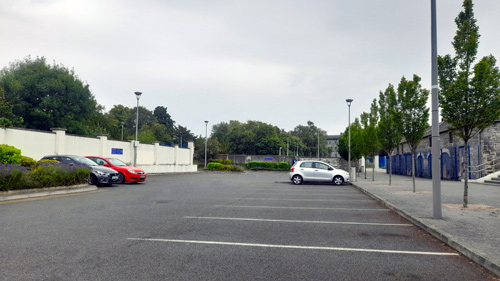
NewThurles Town Park car park which was constructed, landscaped & opened just 8 years ago. Pic: G. Willoughby.
In 2020 the district Council had sought a letter of support for the project from Thurles Farmers Market which they confirm was provided. However, later in 2021 Thurles Farmers Market had sought further information in relation to the proposed trading area and had expected to meet with the designers, prior to sanction of this project, but this meeting had never materialised.
New Café. Thurles Farmers Market, following their July 2nd meeting, have learned that the stone agricultural out building first erected in the great famine years, are to be refurbished and expanded by means of a glazed extension. When completed same is expected to accommodate an 83 seater café, for which an operator has yet to be located as a tenant. The building had been sought for leasing from the Co. Council, by the Thurles Famine Museum, prior to the latters forced closure by the local C of I Community, however, the request was found unsuitable by Thurles Municipal District Council officials. However, interesting to note that some 100 metres away yet another café style restaurant, run by the same Co. Council, remains closed, after several tenants vacated the space, same unable get a fair return on their initial investment.
The Market Quarter. The ‘Market Quarter’ itself will see a canopy erected over a section of this car park area which will be modified to allow access to water and electricity at a number of service points for future market days. The restructured area is expected to lose 16 car parking spaces to struggling businesses in the immediate area. The canopy, which will be cream in colour with no branding, cannot come lower than 4m from the ground due to the fact that cars are being parked under the canopy. The council says no trader or customer parking will be allowed under the canopy during Market events.
We learn Thurles Farmers Market are to be given some storage space, under the stairs, in this soon to be refurbished café, which again will be controlled by Tipperary Co. Council.
Now, with few spaces guaranteed available to park a motor vehicle, Thurles will surely be obliterated.
The ambiguity and inexactness start HERE. “The Town Centre First Plan will be driven by the local community and businesses.” Could this €3.4 million Rural Regeneration Funding not have been more wisely spent, e.g. the purchase of the now derelict eyesore, that is the Munster Hotel, Cathedral Street, demolished to provide accommodation for 3rd level students, attending our two 3rd level collages. One must ask; did any of our local councillors or their officials ever visit the Garden Centre, Restaurant & Farmer’s Market, known as Solas, situated on the Dublin Road, out of Portarlington, Co. Laois.
Note: No expensive giant umbrella here. These many trading stalls are made from attractive shipping containers where Traders can store their own produce etc, in each container when trading finishes. Imagine the air of contentment experienced here, when shopping, with free parking, (no €1.20 for limited parking here, that’s if you can find parking.).
Imagine the number of such containers you could purchase, using Rural Regeneration Funding of €3.4 million and the employment generated, not to mention the benefits gained through creating sustainable rural development and much needed countryside resurgence.
The waste of taxpayer funding by Tipperary Co. Council, assisted by the government, continues.
“The Town Centre First (TCF) policy aims to create town centres that function as viable, vibrant and attractive locations for people to live, work and visit, while also functioning as the service, social, cultural and recreational hub for the local community.” – See Town Centre First.
We learn this morning that the major upgrade of the N75, (Kickham Street), latter the main entry and exit route into and out of Thurles town (See Images) will now not go to tender, due to a lack of funding for the project from Transport Infrastructure Ireland.
To refresh our readers memories regarding this ongoing saga, please View Here and also View Here.
Meanwhile, here in Thurles, Co. Tipperary, other new serious concerns are being expressed by Thurles residents and local businesses, regarding the removal of parking spaces from within the Thurles town central area, due to a number of recent public announcements, none of which are being communicated by recently elected local representatives or Tipperary Co. Council officials.
The commitment that “The Town Centre First Plan will be driven by the local community and businesses as part of a Town Team, who will be supported by Town Regeneration Officers and technical expertise within each Local Authority”, appears to have been totally disregarded by council officials. See Town Centre First.
The announcements, raising such concerns, are emanating from Thurles Leisure Centre, and are as follows:
Tipperary County Council intend to now close the 49 space car park established in Thurles Town Park, beside The Source building, latter positioned at the entrance to Cathedral Street, with effect from August 6th 2024, until December 2025, (16 months). Same closure is to effect the installation of a canopy over the existing car park area, thus creating an event space and also to refurbish an existing Great Famine era farm shed, into an 83 seater restaurant with glass facade café. Under this completed development it is planned to remove 16 car parking spaces from this area.
The Department of Rural and Community Development approved funding of over €3 million for this Thurles Market Quarter Project, with undeclared substantial match funding element also provided by the taxpayer through Tipperary County Council.
Problems arose last December with regards to the leasing by Tipperary Co. Council, of the 100 space car park, behind the now derelict Thurles Munster Hotel, Cathedral Street, owned by Mr Martin Healy. Although it was announced on TippFM radio on March 5th, that a 12 month deal had been agreed between the owner and Tipperary Co. Council; the Council and the property owner are now believed to have failed to agree any such new leasing agreement, leaving any future ongoing access to this car park in doubt and uncertain from next September. People will also be aware that present management at the Mary Immaculate College (formerly St Patrick’s College), as is their right, no longer allow parking on the College avenue and grounds.
With 60% of parking removed from Liberty Square in the past 3 years; as many as 19 other car parking spaces are expected to be removed from the west end of Liberty Square, if and when work begins on that same long drawn out project, first begun on August 17th, 2020.
Some 40 car parking spaces are expected to be removed with the expected upgrade to take place on Slievenamon Road (N62), between Liberty Square and Thurles Shopping Centre Roundabout.
The car park provision, underneath ‘The Source’ building, has remained closed for the past number of years due to anti-social behaviour, which saw the low uncovered ceiling insulation torn down by idle hands, resulting in same being set alight, causing a small fire at this location, back in October of 2023. Both car parks within this immediate area, were intended for use by patrons of ‘The Source’ Arts Centre, including Thurles Library, the Thurles Town Park children’s play area, the Thurles Leisure Centre, local businesses and those attending daily religious services, in the nearby Cathedral of the Assumption on Cathedral Street, in the town.
It’s that time of year again and pretty soon we shall be meeting our townspeople who now reside in distant places; from London to Manchester, from New York to Houston Texas; some absent for nigh on 50 years or more. No sooner will we lay eyes upon them, then we’ll ask: “When are you going back?” and that’s the essential difference between an exile’s holiday and that of the unknown tourist from abroad.
My first memory of emigration was as a boy in the 1950s, going up from the Watery Mall to the railway station in Thurles, to meet my uncles, aunts and cousins, all coming back home for a couple of weeks. One of the reasons, at seven or eight years of age, I enjoyed their coming was because they were such lovely people; decent, down to earth plain souls, who had worked hard in order to be able to return for their holidays.
Old picture of Thurles Railway Station
They, during scarce times, would bring home comics, like Rupert Bear and give me chocolate and money for the pictures in Delahunty’s Cinema down the middle Mall (“The Wan Below) or McGrath’s Capitol Cinema (“The Wan Above”) or that spin in a motor car that they would hire out some days, to go to Holycross Abbey, to Killarney, or to visit my relatives in Co. Cavan.
The car was a scarce enough commodity in Thurles in the hungry days of the 1950’s. This was a world with no television, only that radio with the dry and wet battery we had purchased up in Donoghue’s electrical shop on Friar Street. But there was the Sunday ‘Coordeek’ (from the Irish ‘cuirdeach, meaning a house visitation) in my uncle Mick’s house in Fontenoy Terrace, where Mick, who worked on the Council, played the accordion and songs such as “Moon Behind The Hill“, “The Rose of Arranmore“, “Irene, Goodnight, Irene“, etc. I can clearly picture my father; John Joe Ryan (and a bed in Heaven to him, as the old folks say), in his white shirt, peaked cap and dark trousers, leaning up against the kitchen door in my uncle Pakie’s House in Cabra Terrace, Thurles, singing his perennially favourite party piece, “The Rose of Mooncoin“. It was only on my father’s death that I realised why I had hummed that Kilkenny hurling anthem every morning for years. My uncle, Danny who lived in Caterham, Surrey, UK and worked with British Rail, used to bring all the suitcases up to nearby Cabra Terrace from the station on a fine strong ‘High Nelly’, bicycle belonging to my father. It was a ritual he insisted upon. No taxis then for Danny Boy who, like his brother, Tommy in Caterham, was also an ex RAF man.
Then, for all, a quick visit to Bowes’ bar to quench the thirst caused by those hot summer days, after the train journey, before facing into the re-unions at home. I remember the joyful laughter and camaraderie and the rousing music of those days quite vividly still and the trips hither and yon in the leather upholstered motor car. I thought my uncles and aunts must have been all millionaires, and that England must be a great country entirely. But whatever envy I might have had in that respect, soon faded on the night before my relatives departed for England once more.
On the night of that “American Wake” we would be up above in Leahy’s Field not far from the Thurles Clonmel railway line, where kids put pennies on the railway tracks to be flattened by the wheels of the trains approaching from under Cabra Bridge. I recall my uncle Danny, a bit of a joker, always trying to get some folks not in the know about it, grabbing with their fists the electric wire fence for keeping the cattle in their place. But not on that particular evening, when a terrible loneliness would descend like a mist on the rich hay-scented fields, as I would sit on the wooden plank spanning the cart and hold the reins of ‘Jenny the Jennet’(pronounced jinnit), which I used to drive up and down from Cabra Terrace to Leahy’s Field.
It’s strange how some of the most defining moments of my life featured a field, and even on his death bed in 1990, my father lifted his eyes from the pillow of his bed in the Hospital of the Assumption, in Thurles, towards Semple Stadium and said quietly: “They’re all over in the field now”, Being himself an old Sarsfields hurler, ex hurley- maker and an ex steward, that field meant a lot to him.
Up in Leahy’s field, which was, at that moment in eternity, my whole world. I felt like bursting into tears at the terrible unfairness of the end of this wonderful idyll. I would miss my aunts and uncles and cousins. I would not really know why until many years later. Emigration, for those who did not wish to go, was definitely an evil and in all the homes of the terraces, roads, streets, avenues in Thurles and all over this land, there are similar bittersweet memories of our dearest summer visitors. But our hearts are in a hurry again for their coming and please God, come next summer God will be in his heaven sure as water runs and grass will grow. There will be dust on the roads again … and we will look forward to meeting our Ould Townies, the Real Ould Stock, once more. END
Tom Ryan, “Iona”, Rahealty, Thurles, Co. Tipperary.
Ireland can now enable spouses and partners of employment permit holders, already in the State, to work to fill vital gaps in the Irish workforce, such as in healthcare and construction.
The Government will begin to roll out a single permit to both work and live in Ireland, creating a smoother, more efficient system for applicants; thereby increasing Ireland’s attractiveness for the skills and talent the economy needs.
Ireland will work towards opting-in to the EU Single Permit Directive as a key part of the EU Skills and Talent Package, working with EU partners.
The Minister for Justice Mrs Helen McEntee TD and the Minister for Enterprise, Trade and Employment Mr Peter Burke TD, yesterday (Wednesday May 15th), announced that they have secured Government agreement for a number of key actions to increase the competitiveness of Ireland in attracting the skills and talent the Irish economy requires.
This will enable all eligible spouses and partners of employment permit holders to work, if they are already in the State and are granted permission to live in Ireland with their family member. Implementing a single permit will eventually allow Ireland to opt into the EU’s Single Permit Directive.
Both of these new measures should significantly enhance Ireland’s ability to compete internationally to attract talent, addressing skills shortages in the Irish economy, thus promoting economic growth.
Presently, applicants must apply to the Department of Enterprise, Trade and Employment for a work permit, before then applying to the Department of Justice to obtain a visa. By introducing one single permission/application, Ireland can reduce the cost and complexity for both the employer and applicant, thus ensuring that Ireland can respond more effectively and quickly to meet the skills needs of the economy.
Skills gaps affect all EU Member States, including Ireland. All EU Member States, except Ireland and Denmark, already operate a single permit for employment and residence. Other key partners, such as the UK and the US, also operate single application procedures and single permits. The currently operated process requiring separate applications, creates greater bureaucracy, risking placing Ireland at a competitive disadvantage in attracting skills and talent to the Irish economy.
By opting in to the Single Permit Directive, the Government will remove barriers in attracting key skills into Ireland, in important sectors such as healthcare and construction and reduce the cost and complexity of the current system.
Many spouses are skilled workers who have left significant jobs and employment oppertunities, in order to join their families within the Irish State, and who wish to continue their careers here in Ireland.
Currently, the ability to work without a permit was only provided to spouses and partners of Critical Skills Employment Permit holders. This has now been extended to include General Employment Permit holders and Intra-Corporate Transferee Permit holders who are already in the State and who have been granted permission to live in Ireland with their family member. Current and future permit holders, whose spouses or partners are not in the State, will still need to apply for family reunification after 12 months
This change will, it is hoped, have an immediate positive impact for the economy and for spouses and partners who wish to work in Ireland, assisting them to contribute to the economy through taxation, to further integrate and to provide for their families.
The Irish Self-Catering Federation (ISCF), the largest representative body for self-catering properties in Ireland, says tomorrow’s anticipated signing of the EU’s Regulation on short-term rental data collection and sharing in Brussels will have positive, long-term consequences for the sector in Tipperary.
Once signed and after official publication in the Official Journal of the European Union, EU Member States will have a 24-month period to establish the mechanisms for data exchanges, which are already being prepared with the support of the Commission.
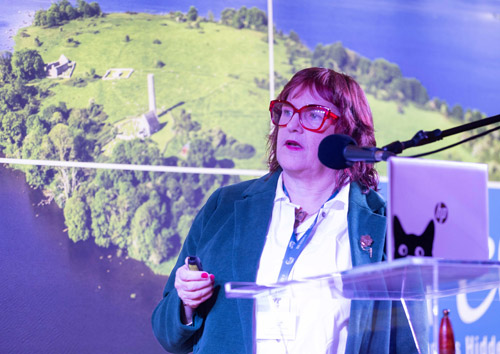
Ms Máire ní Mhurchú, (Chair of the ISCF) speaking at a recent Tourism Networking event in March last 2024.
By setting a data collection and sharing framework for the EU Member States, the EU Regulation harmonises registration requirements for short term lets when introduced by national authorities, clarify rules to ensure registration numbers are displayed and checked on online booking platforms, and streamlines data sharing between online platforms and public authorities.
Ms Máire ní Mhurchú, (Chairperson of the ISCF), who has travelled to the European Parliament for the signing process, says the EU Regulation will quantify the amount of available self-catering in Tipperary and will raise and maintain standards across the industry.
Ms ní Mhurchú says the move will also strengthen the sustainability of the sector by highlighting the economic important role played by small family-run businesses in rural communities.
The ISCF CEO is warning, however, that the implementation of the STTL Register must be accompanied by the introduction of clear planning guidelines around the development of glamping and other self-catering businesses, the absence of which she says is exacerbating the ongoing critical shortage of available bed nights in Ireland.
“The Register, adapted to the standards of the EU Regulation, will help to support the further development of the self-catering sector as making rural communities economically viable is core EU principle,” she explained. “For far too long in Ireland, hotel accommodation has been legislated for and promoted which is of little benefit to rural communities as such developments are only regarded as economically viable for large urban centres like Cork, Galway, Waterford, Limerick and Dublin as evidenced in the Saville and Crowe reports into the domestic tourism and hospitality market.”
She continued, “We also welcome the appointment of Fáilte Ireland as the statutory authority with responsibility for implementing the Register. This move will place the self-catering sector on a par with other tourism organisations, such as the Irish Hotels Federation and Camping Ireland.”
Commenting on the requirement for updated planning legislation for the development of short-term tourist lettings in Ireland, Ms. ní Mhurchú said, “The planning issues for short term rentals needs to be urgently reviewed. Currently, self-catering accommodation is looked on as housing units rather than economic value units.”
Ms Ní Mhurchú warned that the supplementary income of many families operating within the sector will be significantly impacted unless full clarification is issued regarding the planning permission process ahead of the implementation of the STTL Register.
“We are calling on Minister for Tourism Catherine Martin and Minister for Housing Darragh O’Brien to sit down with the ISCF to ensure no self-catering businesses, many of which are small family rural tourism businesses, are lost. Issues with planning need to be sorted first, with a derogation for all existing STTL businesses. Clear guidelines for planners and owners are essential before the Register is introduced”, she concluded.
This website uses cookies to improve your experience. We'll assume you're ok with this, but you can opt-out if you wish.AcceptRead More
Privacy & Cookies Policy
Privacy Overview
This website uses cookies to improve your experience while you navigate through the website. Out of these, the cookies that are categorized as necessary are stored on your browser as they are essential for the working of basic functionalities of the website. We also use third-party cookies that help us analyze and understand how you use this website. These cookies will be stored in your browser only with your consent. You also have the option to opt-out of these cookies. But opting out of some of these cookies may affect your browsing experience.
Necessary cookies are absolutely essential for the website to function properly. This category only includes cookies that ensures basic functionalities and security features of the website. These cookies do not store any personal information.
Any cookies that may not be particularly necessary for the website to function and is used specifically to collect user personal data via analytics, ads, other embedded contents are termed as non-necessary cookies. It is mandatory to procure user consent prior to running these cookies on your website.








Recent Comments