The latest text scams being sent to mobile phones and via fake email messages are making claims that they represent An Post, the Irish postal service, and involves customs payment for a package.
Those receiving these texts are being asked to pay import duty/tax and an advance fee for a parcel to be processed through the Irish postal service.
A link can be found at the bottom of the text usually using ‘anpost.ie.shipping-updates.co’ where unsuspecting customers, foolish enough to upload same are being asked to enter their personal information.
An Post are now warning their customers:- “We are aware of fraudsters sending fake emails and texts to customers pretending to be from An Post. We are asking customers to remain vigilant and be ‘scam aware’. “An Post will never send urgent requests or threats, use shortened links, [for example Bit.ly], or send messages that contain any links when contacting you about the payment of Customs Charges.”
If you want to find out where your personal data was acquired, chances are it was hacked in an incident where data was unintentionally exposed to the public, by e.g. ADOBE, Audi, Facebook, Dropbox, epik, LinkedIn, Myspace, eatigo etc, etc.. Compromised data obtained from these hacked sites include:- Email addresses, Names, Phone numbers, Physical addresses, Purchases and more.
You can checkout who may have unintentionally exposed your personal information by CLICKING HERE, or entering into your search panel the phrase “Have I Been Pwned”. Enter just your email address or your phone number, before scrolling down the page to discover who exposed your data.
Collection #1 remains the name of a set of email addresses and passwords that appeared on the ‘dark web’ possibly in January 2019. This database contains over 773 million unique email addresses and 21 million unique passwords, resulting in more than 2.7 billion email/password pairs.
In 2020, 674 people under the age of 18 entered drug treatment, the majority for cannabis as their main problem drug. In 2020, 1,874 people between the age of 18 – 24 entered drug treatment, with over 61% using more than one drug. In 2017, 53 people below the age of 24 died from a drug-related illness.
As part of their ‘Campus Watch’ programme; Gardaí are launching their #Riseabovetheinfluence drug awareness campaign, as students return to college.
The campaign aims to encourage students to seek out positive influences and avoid the harmful consequences of drugs misuse.
Detective Superintendent Sé McCormack of the Garda National Drugs and Organised Crime Bureau said, “Freshers Week should be a time for celebration, the beginning of something good in your life. Don’t let drug use end your career before it starts.
If you use drugs such as Cannabis, Cocaine, Ketamine and MDMA, you are committing a criminal offence and also risking addiction, loss of career opportunities, under-achievement, and international travel restrictions. Taking other substances like cannabis edibles: jellies, sweets, drinks, vapes, or synthetic cannabinoids or nitrous oxide balloons also carries health and prosecution risks.
Taking un-prescribed ‘study’ drugs or sleeping pills can lead to anxiety, addiction and psychosis. Multiple or Poly-drug use is extremely dangerous and increases your risk of overdose or death.
While we strive to keep people safe, we believe that you can also help keep yourself safe. Contact the emergency services if you become ill after consuming a drug or are in the presence of somebody who may be ill.
Our “Rise above the influence” message is simple. Your future is in your hands. Seek out positive influences on Campus. Choose the influences which will enhance your future career. Make responsible decisions for yourself and be aware of those around you. Don’t become another victim of the drug trade.
Drug use can lead to addiction, debt, prison and the destruction of your physical and mental health. You don’t know what you’re taking. You don’t know where it will take you.”
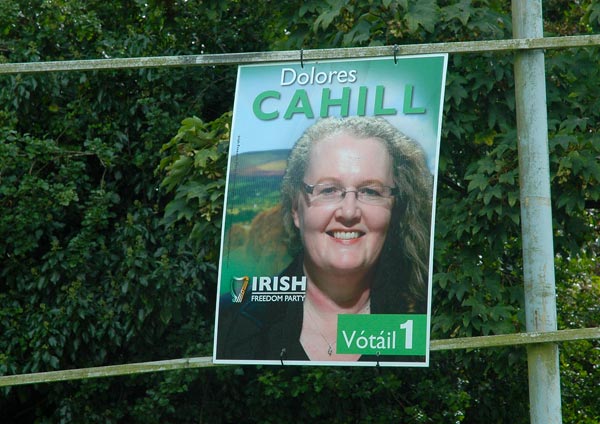
Anti-vaccination; anti-Irish EU Membership campaigner and failed Tipperary politician Ms Dolores Cahill is understood to be no longer an employee and lecturer at University College Dublin (UCD), with her details having been removed from the University’s online staff directory.
General Election Poster at Monakeeba, Thurles, Co. Tipperary survives “Storm Ellen”. Picture G. Willoughby. [Photo taken 21st August, 2020]
UCD had faced criticism in the past for not taking action against Ms Cahill over false and misleading claims she made about Covid-19, over the course of the pandemic. There were also calls from some members of the university’s 40-member governing body, including from more than 130 students for an investigation into her conduct publicly.
A former Chair of the Irish Freedom Party; a failed Tipperary General Election candidate; Ms Cahill had publicly stated that ‘Lockdown’ and ‘Social Distancing’ was not needed to stop the spread of the Covid-19 virus. People who recover are then “immune for life” after 10 days and deaths and illnesses could have been prevented by extra vitamins. Opposing vaccinations, Ms Cahill had publicly stated; “politicians and the media” are using Covid-19 “as a fear-mongering propaganda tool to try and take away rights from people and to make them more sick (sicker) and to force vaccinations on us.” Speaking at an anti-lockdown rally in Dublin on St. Patrick’s Day, Ms Cahill claimed that children who wore face masks would have a lower IQ as their brains were being “starved” of oxygen.
Following such statements Ms Cahill was asked, in 2020, to resign as Vice Chair of the Scientific Committee of the Innovative Medicines Initiative (IMI), latter a partnership between the European Commission and the drugs industry, to promote new drugs. In seeking her resignation the European Commission said that the claims made by Ms Cahill; then a professor of translational medicine in UCD, could cause “significant harm”, if taken literally by inhabitants around the world.
On August 10th last, a warrant was issued for Ms Dolores Cahill’s arrest. The bench warrant for the arrest was issued in London, for her failure to turn up to a number of scheduled court hearings. The misinformed and prominent Covid sceptic and anti-vaccination campaigner, now faces charges arising out of an alleged illegal rally, involving more than 30 people, held in Trafalgar Square, London in September of 2020.
Ms Cahill failed to appear before a court hearing on July 3rd last. She again failed to appear at a hearing on July 20th and at her latest hearing scheduled on August 10th last. It was at this hearing that a warrant was issued for her immediate arrest. Her case was adjourned until September 10th last, the outcome of which, so far, is not known.
Thurles.Info has received a request from a parent who is anxious to find accommodation for their son.
The parent writes:- “My son is starting his first year in LIT Thurles. Unfortunately, it is practically impossible to find accommodation. We have searched everywhere without success. Getting very anxious as he starts next Monday. Can any of your readers help or advise us. Your help would be much appreciated. Thanking you. …………”
Anyone out there in the locality with a room or other accommodation to rent, or any other students looking to share accommodation, may contact us here at Thurles.Info by clicking HERE and we will put you in contact with the parent concerned.
In any communication, please supply, in strictest confidence, your Name, Address and Telephone No.
Paying tribute to the winners, not least those in younger age groups and special needs categories, Mr James Twohig, (Director of Ireland Operations for Valero Energy (Ireland) Limited), congratulated all the young artists who, he said, “continue to demonstrate their skills and ability in the incredible prize-winning entries we see this and every year.”
Celebrating an unbroken 67 year history, the Texaco Children’s Art Competition was conducted, this year, in the face of school Covid-19 closures and other limitations applying over the past 12 months, which required amendments to the announcement of winners; the presentation of prizes; and other activities which are traditionally held in April and May each year.
Not surprisingly therefore, Mr. Twohig should praise not just the artists, but also their parents and teachers for what he calls “their enthusiasm and continued interest in the Competition, as a platform on which they can showcase their imagination, exercise their creativity and display their very exceptional talents.”
Past winners whose early interest in art and the arts may well have been encouraged by their participation in the Texaco Children’s Art Competition include artists Graham Knuttel, Robert Ballagh, Bernadette Madden, Dorothy Cross, fashion designer Paul Costelloe, and artist and former broadcaster Thelma Mansfield.
This year’s Co. Tipperary winning entries, whose work can be viewed HERE are named as follows:-
Frankie Burke, aged 8, representing Killurney National School, Clonmel, Co. Tipperary, with artwork entitled“Butterfly Fish”. Ailbhe Treacy, aged 12, representing Lissenhall National School, Nenagh, Co. Tipperary, with artwork entitled “Life Going On”. Anna Chirubvu, aged 16, from Scoil Ruain, Killenaule, Thurles, Co. Tipperary, with artwork entitled “New Life In A Pandemic”. Chloe Egan, aged 16, representing Borrisokane Community College, Nenagh, Co. Tipperary, with artwork entitled “Procrastinating”. Heather Barnett, aged 17, representing Cashel Community College, Cashel , Co. Tipperary, with artwork entitled “Lost In Music“.
From now until October 2nd next, Drogheda’s Highlanes Municipal Art Gallery is hosting an exhibition of the top 126 winning paintings in this year’s Competition. Admission is free and further information is available at www.highlanes.ie.
This website uses cookies to improve your experience. We'll assume you're ok with this, but you can opt-out if you wish.AcceptRead More
Privacy & Cookies Policy
Privacy Overview
This website uses cookies to improve your experience while you navigate through the website. Out of these, the cookies that are categorized as necessary are stored on your browser as they are essential for the working of basic functionalities of the website. We also use third-party cookies that help us analyze and understand how you use this website. These cookies will be stored in your browser only with your consent. You also have the option to opt-out of these cookies. But opting out of some of these cookies may affect your browsing experience.
Necessary cookies are absolutely essential for the website to function properly. This category only includes cookies that ensures basic functionalities and security features of the website. These cookies do not store any personal information.
Any cookies that may not be particularly necessary for the website to function and is used specifically to collect user personal data via analytics, ads, other embedded contents are termed as non-necessary cookies. It is mandatory to procure user consent prior to running these cookies on your website.







Recent Comments