“The first, the gentle Shure (Suir) that making way By sweet Clonmell (Clonmel), adornes (adorns) rich Waterford; …” (Excerpt from poem by Edmund Spenser’s ‘Irish rivers’.)
♦ Note: It should be noted that in 2026 Cahir Castle has since been fully restored and has now become a major tourist attraction in Cahir, Co. Tipperary. However this was not the case in 1912 when McCraith published her book.
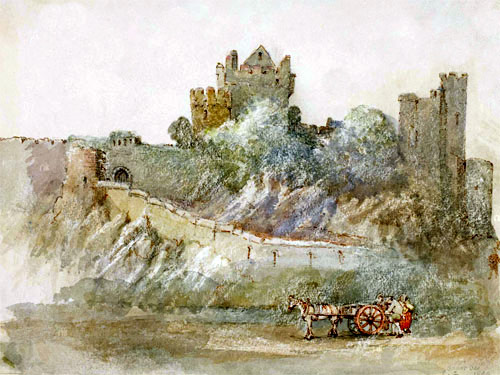
Cahir Castle as depicted by the artist James Stark Fleming (1834-1922).
The Suir – From Its Source To The Sea.
Cahir Castle rises on an island in the Suir, and commands the bridge in the middle of the town. This old ivy-clad Butler stronghold is probably the best example of late feudal architecture in Ireland. It was built in the fifteenth, or early in the sixteenth, century, and has remained in the family of its builders ever since.
The Butlers ceased to live in their castle about a hundred and fifty years ago. It has not been inhabited since a company of infantry was quartered there in the days of the late Earl of Glengall (he it was who gave the site for the present barracks, about a mile outside the town, formerly used for Cavalry, and now used for Field Artillery). For over a century the Castle has undergone no structural alteration, but remains an eloquent witness of the life led long ago in Ireland by a Lord of the Pale.
Centuries before the Butlers built the present Castle; centuries before even Conor O’Brien, Lord of Thomond, founded his castle there in 1142, the rock in the Suir upon which it stands was regarded as a natural point of vantage, to be defended by a “dun,” or fort. Its very name in Irish, Cathair-Duine-Iascaigh, (Irish – “the stone stronghold of the fish-abounding fort), is a word-history.
An old Irish MS♦., the Book of Lecan, records the destruction of this fort of Cathair Curreagh in the third century.
♦ Note: “MS” is the standard abbreviation for “Manuscript” (from Latin manu scriptus, “written by hand”)
This is the outline of the romantic story. A relative of Curreagh Lifé was killed by Finn MacRadamain, chief of the district surrounding Cathair, the modern Cahir. In revenge, Curreagh Lifé murdered Finn’s mistress, Badamair, who had her dwelling on the Cathair-Duine-Iascaigh, whence she supplied Finn with food and clothing, no doubt of her own catching and weaving. After murdering her, Curreagh plundered the fort, and escaped away beyond the river Bannow towards Waterford. Finn pursued him. After many days he got sight of Curreagh in the distance. Thereupon Finn pronounced an incantation over his spear, and hurled it at Curreagh, who was in the midst of a group of friends. Nevertheless, the spear found its way truly to Curreagh’s heart and killed him.
The Brehon Laws refer to this fort of Cathair, and Geoffrey Keating states that, among many other royal residences, Brian Boru fortified and used this fort of Cathair also.
When the Anglo-Normans came first to Ireland, Knockgraffon, and not Cahir, was the principal place in the Barony, which passed, about 1215, to one of Henry II’s knights, Philip of Worcester. From him it passed to his nephew, William, whose great-granddaughter brought it to the de Berminghams by her marriage with Milo de Bermingham. In 1332 the Barony reverted to the Crown on William de Bermingham’s attainder. But the English King was little bettered by Cahir. As has been said already, Bryan O’Brien and his Irish had by 1332 overrun and re-conquered Tipperary.
However, in 1325 the King granted the Barony to James, Earl of Ormonde, and to Elizabeth, his wife. James Cildare, the natural son of this Earl, by Catherine Fitzgerald, daughter of the Earl of Desmond, has generally been recognised as the founder of the Cahir branch of the Butlers. Since he, or his successor, quartered the de Bermingham arms with his, there was probably also a prudent alliance with the previous owners.
The new Lords of Cahir held an equivocal position. They occupied the borderland between the two great warring houses of Butler (Ormonde) and Fitzgerald (Kildare). Butlers by descent, Fitzgeralds by marriage and interest, they contrived throughout the Barons’ War, and the fiercest struggles of the sixteenth century, to retain their estates amid the ruin of their confederates. Perhaps the position of their Castle helped them, for an old record says:
“In the mydst of ye ryver Suyre lyeth an Ilaund, ye same a natural rock, and upon yt a Castle, which, although yt may not be built with any greate arte, yet is ye seite such by nature that yt may be said to be inexpugnable.”
Cahir Castle has changed little during the centuries. Today it closely resembles its appearance in 1599, as pictured in the Pacata Hibernia ♦.
♦ Note: Pacata Hibernia (Latin for “Pacified Ireland”) is a significant 17th-century historical work by Sir Thomas Stafford detailing the Elizabethan Wars in Ireland, particularly the campaign in Munster under Sir George Carew, offering a contemporary, soldier’s perspective with valuable maps and plans of Irish towns and fortifications. First published in 1633, it serves as a primary source for understanding the final, bloody stages of Gaelic Irish resistance against English rule, culminating in the Flight of the Earls and the Plantation of Ulster.
Instead of at once attacking O’Neill in the North, those of the Irish Council who had estates to lose in the South persuaded Essex to lead his army into Munster. Having been defeated near Maryborough, Essex marched to Kilkenny, thence to Clonmel, and so on to Cahir.
Reynolds, secretary to the Earl of Essex, describes Cahir as “the only famous Castle of Ireland which was thought impregnable; it is the bulwark for Munster, and a safe retreat for all the agents of Spain and Rome.” The Butlers of Cahir were staunch for Hugh O’Neill. Cahir Castle, therefore, Essex attacked.
Encouraged by Hugh O’Neill’s victories, and expecting reinforcements from Mitchelstown, those “heathens,” as the English writer courteously termed the garrison, refused to surrender. Thereupon Essex put his cannon into position, and began a vigorous siege. Despite wide breaches in their walls the garrison held out bravely for ten days, until they found that their expected reinforcements had been cut off. Despairing, the garrison attempted to make a sortie and to vacate the Castle under cover of darkness. It was a desperate endeavour, and was discovered by the besiegers. Eighty of the garrison were slaughtered, and the English took the Castle.
Essex re-garrisoned Cahir with English troops, left his wounded there, and went on to Clonmel. It was his first success, and his last, in Ireland.
In spite of this armed resistance, the Lord of Cahir managed to keep his Castle and lands from confiscation. This was through the influence of the head of the Butlers, Thomas, Earl of Ormonde, called “the Queen’s Black Husband” from his colouring and his Sovereign’s marked preference.
During the Cromwellian Wars and, later, during the Revolution, the luck of the Butlers of Cahir held. The Baron of Cahir was a minor during the wars of 1641–50, his guardian being George Mathew, a half-brother of the Earl of Ormonde. In 1647, previous to the coming to Ireland of Cromwell in person, Lord Inchiquin, ‘Murrough of the Burnings‘, (Murrough O’Brien, 1st Earl of Inchiquin♦), who was then fighting on the side of the Parliamentarians, invested Cahir Castle. The siege was one of hours only. The Castle was promptly handed over to Inchiquin, and a flimsy story put about to shelter Mathew’s cowardice; or was it his prudence?
♦ Note: The slaughter of the garrison at Cashel and the subsequent devastation of Catholic-held Munster earned Inchiquin the Irish nickname, Murchadh na Dóiteáin or “Murrough of the Burnings”.
Cromwell himself appeared before Cahir Castle on February 24th, 1650, and again George Mathew surrendered without a shot having been fired. One of the conditions of surrender was that: “The Governor may enjoy his estate, which he has as his jointure, and the wardship of the heir of Cahir”.
Although the Butler estates were surveyed by Petty♦during the Commonwealth for that object, they were not actually allotted to soldiers or adventurers; and at the Restoration, in 1662, Ormonde had little difficulty in reinstating his kinsman, “the heir of Cahir.”
♦ Note: Sir William Petty (1623–1687), an English scientist, physician, and political economist who was a key figure in the Cromwellian land confiscations in Ireland. He was responsible for overseeing the famous Down Survey of Ireland in the 1650s, which was the first detailed, large-scale land survey in the world.
The Butler luck, or prudence, held also during the Revolution. Thomas, seventh Baron Cahir, fought for James II on the bloody and disastrous field of Aughrim♦, and was outlawed in 1691. But, two years later, his outlawry was reversed and his estates restored. Being known as strong Catholics, with Jacobite leanings, the Lords of Cahir lived abroad during the eighteenth century.
♦ Note: Aughrim, County Galway. The battle was one of the bloodiest ever fought in Britain and Ireland; 7,000 people were killed.
By the death of Pierce, eleventh Baron, in 1788, the old Butler line became extinct. But a claimant appeared in the person of Richard Butler of Glengall, who derived his descent from Sir Theobald Butler, Baron of Cahir, in the time of Elizabeth. Richard Butler was married to a niece of Lord Chancellor Clare, and, as legal difficulties were thus smoothed over, he succeeded as twelfth Baron Cahir. He was afterwards created first Earl of Glengall. His son, the second Earl, died in 1858 without a male heir. The Barony of Cahir fell into abeyance again, and the Earldom became extinct.
The present representative of the Butlers of Cahir is the last Earl of Glengall’s daughter, Lady Margaret Charteris, to whom belongs the beautiful park through which the Suir runs for over two miles, together with many acres of surrounding mountain and valley.
Cahir Castle is in excellent preservation. It still serves for flower shows and other gatherings. The Butlers migrated, first, to Cahir House, a Georgian mansion, overlooking the Market Square on one side, and the lovely demesne upon the other, and, later, to the Lodge, on the opposite bank of the Suir.
Cahir Park.
The beautiful green banks of the River Suir are nowhere more attractive than in Cahir Park. To appreciate the place properly, you really have to see it for yourself.
Fortunately, the park is open to pedestrians. Private carriages and anglers can also enter, but only with permits, which (at the time of writing) were available from the Estate Offices in Castle Street.
It’s hard to say when Cahir Park looks its best: on a hot summer’s day, when cattle stand knee-deep in the broad, clear river and the trees and pastures are at their richest “living green”; or in late autumn, when the scarlet coats of huntsmen and the dappled white, black and tan of the foxhounds come and go through groves of golden oaks and coppices, with yellow bracken underfoot and laurels still keeping their summer colour.
In places the riverbanks become almost steep, and a graceful bridge spans the Suir at Kilcommon. From there you can reach a picturesque thatched cottage, built as a tea-house♦, and once a favourite rendezvous-is reached.
♦ Note: “Picturesque thatched cottage, built as a tea-house” refers to the ‘Swiss Cottage’ and again, is today 2026 also fully restored and a major tourists attraction. END
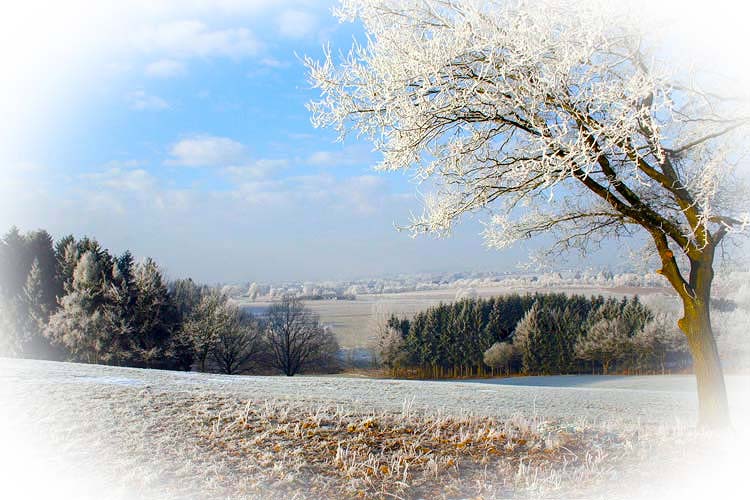
Met Éireann’s figures from Gurteen AWS (Automatic Weather Station); latter situated on the grounds of Gurteen Agricultural College, Co. Tipperary, point to 28 very wet days and 33 frost days, in the Thurles area.
Met Éireann’s Annual Climate Statement for 2025 confirms that indeed 2025 was Ireland’s second warmest year on record (since 1900), continuing a clear warming trend, with 2022 to 2025 now the four warmest years in the national series.
Using the Island of Ireland dataset, Met Éireann reports an average annual air temperature of 11.14°C for 2025, 1.59°C above the 1961 to 1990 long-term average and 0.97°C above the 1991 to 2020 average. Provisional rainfall for 2025 is 1,338.7mm, around 104% of the 1991 to 2020 long-term average, placing 2025 as the 15th wettest year since 1941.
Met Éireann’s Gurteen AWS also notes the year included the warmest and sunniest spring on record, the warmest summer on record, and a very wet autumn (the 4th wettest on record), with major weather impacts including ‘Storm Éowyn‘ which witnessed record winds at Mace Head, Co. Galway.
Thurles area snapshot:(nearest official monthly “weather events” station being Gurteen, Co Tipperary) While Met Éireann’s Annual Climate Statement is national in scope, its Public Works Contracts “weather events” tables provide month-by-month counts at station level. The closest suitable station for a Thurles-area proxy is Gurteen, Co Tipperary, which recorded the following information in 2025:
Days with rainfall>10mm: 28 days in total. Monthly counts: Jan 2nd, Feb 2nd, Mar 1st, Apr 4th, May 2nd, Jun 1st, Jul 2nd, Aug 0, Sep 3rd, Oct 6th, Nov 3rd, Dec 2nd.
Frost days(minimum temperature <0°C): 33 days in total. Monthly counts: Jan 13th, Feb 5th, Mar 5th, Apr 1st, May 1st, Jun 0, Jul 0, Aug 0, Sep 0, Oct 0, Nov 4th, Dec 4th.
Wind threshold days(maximum 10-minute mean wind speed ≥15m/s): 4 days in total Monthly counts: Jan 1st, Feb 1st, Mar 0, Apr 0, May 0, Jun 0, Jul 0, Aug 0, Sep 0, Oct 1st, Nov 0, Dec 1th.
These month-by-month counts are published as an objective measure of whether weather thresholds are exceeded for public works contract purposes, and provide a useful, locally relevant indicator of very wet days, frost incidence and notable wind events in the wider mid-Tipperary area.
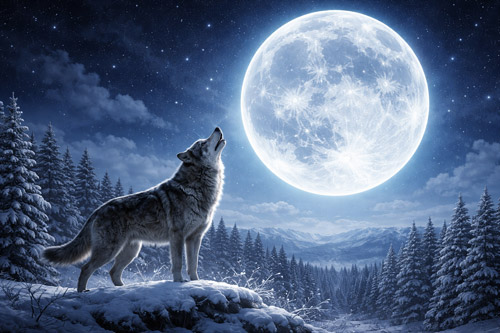
With Tipperary skies cloud free tonight, the first full moon of 2026, known as the Wolf Moon, lights up our skies.
Why is it called the Wolf Moon, I hear you ask? The name “Wolf Moon” is traditionally used to name the January full moon. It’s commonly linked to winter folklore, particularly the idea of wolves howling more often in midwinter, and belongs to a wider set of seasonal full-moon names popularised in North America and echoed in other traditions. It’s also been known historically by other names in some traditions, including the “Moon After Yule.”
“Wolf Moon” or “Moon After Yule”.
The term “supermoon” is not a formal astronomical definition, but is widely used in public skywatching guides. Ireland’s first full moon of the year, the Wolf Moon, reached peak illumination this morning (10:02am Irish time/GMT), with skywatchers getting their best viewing opportunities from Friday evening (January 2nd 2026) through the weekend, weather permitting.
This January 26 full moon is also widely being described as a “supermoon”, an informal term used when a full moon occurs relatively close to Earth in its orbit, which can make it appear a little larger and brighter than average. Even if you have already missed the exact peak time earlier this morning, not to worry, the moon will still look full to the naked eye across this weekend, all you need is a clear horizon, and a few minutes outside away from bright street lighting.
Best ways to see it in Ireland. Look for moonrise at dusk: the moon will rise in the east around sunset and climb higher as the evening goes on, with times varying by location. Try an open viewpoint: parks, beaches, higher ground, or anywhere with a clear eastern sky. Use binoculars or a small telescope; while the “full” phase flattens shadows on the lunar surface, it can still be striking, especially near the horizon.
The Child Law Project, under the executive directorship of Dr Carol Coulter, has been commissioned by the Department of Justice, Home Affairs and Migration to deliver a new Family Law Reporting Project, aimed at improving public understanding of private family law proceedings, while safeguarding the privacy of children and their families.
This project was awarded following a competitive procurement process that was launched on August 21st 2025 last. It is intended to build confidence in how private family law disputes are determined by the courts, while ensuring proceedings continue to remain private for those involved.
The Family Law Reporting Project is an initiative under Goal 6 (Data, Information and Management) of the Government’s Family Justice Strategy 2022-2025, which commits to improving data collection and sharing across the family justice system. Once established, the project is expected to run for three years.
Dr Coulter founded the Child Law Project in 2012 and has served as Executive Director since then. She is a former Legal Affairs Editor of The Irish Times and previously ran a pilot family law reporting project for the Courts Service in 2006/2007.
So what will the project will do:
Once operational, the Family Law Reporting Project is expected to:
Gather and analyse information on key aspects of private family law cases to support statistical reporting and trend analysis.
Produce accessible, anonymised reporting to enhance transparency and understanding of proceedings, while maintaining privacy protections for children and families.
Background The Family Justice Strategy is also committed to reviewing the operation of the in-camera rule. An independent research report published in May 2025 made 21 recommendations on balancing transparency with the privacy rights of families and children, including recommendations related to private family law reporting.
Extract from a publication by L. M. McCraith, [Mrs Laura Mary McCraith-Blakeney (born 1870)], originally published in 1912. (See Part One HERE)
“The first, the gentle Shure (Suir) that making way By sweet Clonmell (Clonmel), adornes (adorns) rich Waterford; …” (Excerpt from poem Edmund Spenser’s ‘Irish rivers’.)
Holy Cross. Beyond Thurles, the Suir, now a broad and shallow stream, flows lazily, through sedge and reeds and fringes of flowering water-weeds, between some of the finest pasture lands in Munster.
About three miles south-west of Thurles, on the right bank, low down by the river-side, stands the lovely ruin of the once far-famed Abbey of Holy Cross. [ Note: This building has since been extensively restored to its former beauty and serenity.]
The once ruin of Holycross Abbey. [Artist James Stark Fleming (1834-1922)]
This Abbey was founded in 1168, for Benedictines, by that indefatigable church-builder, Donal Mór O’Brien, King of Munster. The original charter is still in existence, by which it appears that, about 1182, the Abbey was transferred from the Black Monks to the White, that is, from the Benedictines to the Cistercians.
Early in the twelfth century the Pope, Paschal II, gave to the grandson of Brian Boru, Donough O’Brien, a bit of the True Cross. It was magnificently enshrined and set about with precious stones, and confided to the care of the Cistercians. In 1214 this Abbey was re-built, and about that time the sacred relic, which gave its name to Holy Cross, came to its resting-place on the banks of the Suir.
This relic, being amongst the most revered in Christendom, the Abbey was, for over three and a half centuries, one of the most frequented places of pilgrimage in Ireland. In the reign of Queen Elizabeth the English described the relic as “the idol which the Irish more superstitiously reverence than all the idolatries in Ireland.”
In 1600, the great Hugh O’Neill came in state to Holy Cross to visit the holy relic, for reasons no less political than pious. He marched through the centre of the island at the head of his troops, a kind of royal progress, which he thought fit to call a pilgrimage to Holy Cross. He held princely state there, concerted measures with the southern lords, and distributed a manifesto announcing himself as the accredited Defender of the Faith.
In 1603, Red Hugh O’Donnell came to Holy Cross, on his way to the disastrous battle of Kinsale, and demanded that the fragment of the True Cross should be borne out to him at the west door, to bless him on his way.
The Abbey of Holy Cross was suppressed in 1536, at the break-up of the monastic orders in Ireland. In 1563, Elizabeth conferred the Abbey lands upon Gerald, Earl of Ormonde. The Butlers remained friendly, if not faithful, to the old faith, and the line of Abbots continued at Holy Cross until as late as 1700. The relic also passed eventually into Butler hands. It was exposed for public veneration for the last time in Holy Cross Abbey about the year 1632. In that year, Walter, eleventh Earl of Ormonde, seeing his grandson, the first Duke, had become a Protestant, confided the relic to Catholic keeping until such time as the House of Ormonde should return to the old faith.
Subsequently, it passed through various hands, until in 1809 it was given to the Catholic Bishop of Cork, who deposited the relic in the Ursuline Convent in Cork. It continues in the Ursulines’ keeping, having moved with them to Blackrock.
Perhaps the most interesting thing which remains in ruined Holy Cross Abbey is the lovely little pillared shrine between the two side chapels in the north transept. This arcade is a fine example of thirteenth-century carving. Its pointed arches spring from a double row of beautifully twisted pillars. Its roof is a marvel of graceful groining. Every variety of delightful detail has been lavished upon this little sanctuary. Its sides are elaborately adorned with fine carving.
The design of two doves and two owls, kissing, is repeated upon the panels, and the beautiful Gothic details show a French influence. The elaborate wealth of detail and the loving workmanship point to some special, and important, purpose for this unique feature. It has been suggested that here the dead Cistercians lay before burial. But surely not a dead brother, but rather the Relic, the True Cross itself, occupied such a shrine. Was it within this greatly ornamented little arcade that the Relic was preserved when not exposed upon the Gospel side of the High Altar? This is, however, a matter of controversy.
Another matter of keen controversy is “the Tomb of the Good Woman’s Son.” Who was the “Good Woman”? Why are the Royal Arms of England carved on the shields between the arches of the canopy of the tomb, together with those of Ormonde and Desmond? Was the “Good Woman” an English Queen, her son a Plantagenet Prince? Was he “Pierce the Fair,” son of Isabella of Angoulême, the widow of King John, by her second husband, Le Brun, Count of La Marche, and half-brother of King Henry III? His death is recorded by the Four Masters as having occurred in Ireland in 1233.
Many maintain that this canopied monument is nothing more than a beautifully elaborate three-seated sedilia for the priests. Others suggest that it is the tomb of one who re-built the Abbey of Holy Cross in a far finer style than that of King Donald, at the close of the fourteenth century. The position, at the north side of the High Altar, is that usually assigned to founders.
Legend and tradition tell a more mysterious and interesting tale. The personality of “the Good Woman’s Son” is sufficiently interesting to make it worthwhile to quote the local story, as told by the custodian of the ruins, in her own words:
“The King of England’s son he was, and he was sent over to Ireland to collect the Peter’s Pence for the Pope. Now, there was a family in these parts in those times by name Fogerty, and they knew of all the money the young Prince had with him. So they followed him to a lonely place, and set upon him and killed him there, and stole the money. Then they buried the body in the soft ground in the wood, without waiting to know was the life gone out of it altogether or not.
Now, in the Abbey of Holy Cross at this time there was an old monk, and he was blind. One night he dreamed a dream. He dreamed that the Good Woman, his mother, had placed upon the young prince’s stone here, (set in the corner of the High Altar, of course, it is only set up by the Board of Works to show where the High Altar stood, for the dear knows where the real stones were thrown to by the soldiers when they were quartered in the ruins a hundred years ago), and there is a little round hole right through that stone. That hole was bored through the stone by the dropping of a tear. For seven generations they repented, and as the tear wore the hole through the slab of stone the curse wore away from the Fogertys.“
So some say, anyway, and a priest wrote it all down in a book lately, so I’m told, and sure isn’t it as likely as not it is true, after all?
The chief beauty of Holy Cross Abbey which remains are its windows. Their tracery is perhaps unmatched in perfection in Ireland, and its elaboration points to the fourteenth, rather than the twelfth, century. No doubt they belong to the period of the Abbey’s splendid restoration, whenever exactly that took place. The reticulated (or “honeycomb”) east window is notably fine. It is particularly beautiful when observed from the opposite bank of the Suir, from which the most picturesque view of Holy Cross Abbey may be obtained.
The plan of the Church of the Holy Cross is cruciform, with double side chapels. Quaint bits of carving here and there have escaped the hand of the spoiler and the ignorant. But for many years the Abbey passed from one to another, and fell into a lamentable condition. About thirty years ago the Board of Works took over the ruin, restored it to some decency and order, and ensured its preservation. The cloisters, however, are in private hands, and the cloister garth is used as a croquet ground.
The site of Holy Cross is unimpressive. Thick groves of trees now surround the ruins, which are of great extent, and in remarkably good preservation, all things considered. Little houses cluster round the approaches to the Abbey, as they may have done in the monastic days. It is not easy to picture the stately processions which must have crossed the old bridge and wound their way to the west door.
Holy Cross has still about it a peaceful, graceful, scholastic charm hard to describe or define, not easy to account for. Perhaps the aura of calm, holy, austere lives still lingers, like the perfume in dead rose-leaves. There is a homeliness about Holy Cross, for all that its rule was Cistercian and its Abbots Lords of Parliament and Vicars-General of the Order, as well as “Earls of Holy Cross.”
The Suir at Holy Cross is spanned by an ancient bridge, which was built in 1626 by James Butler, Baron Dunboyne, and his wife Margaret O’Brien, a descendant, doubtless, of King Donald, the Abbey’s founder. Their pious act is recorded in Latin on a carved stone set in the wall facing the ruins. It bears the Butler and O’Brien arms, with the initials of James and Margaret, and a Latin inscription which ends and bids the traveller to say a short prayer that both the builders may escape the Stygian Lake.
It was only natural, in medieval days, that bridge-building should be accounted a blessed and meritorious deed. Women, to whom the difficulties of medieval travelling no doubt came home with special force, were ever foremost in this work in Ireland. The famous and beautiful Margaret O’Carroll, “Áinéigh”(The Bountiful), was long remembered as a builder of bridges, as well as a giver of feasts, in the fifteenth century. In this case, another Margaret evidently followed her example a century later.
END.
Today January 2026 Visiting Tourists Please Note:
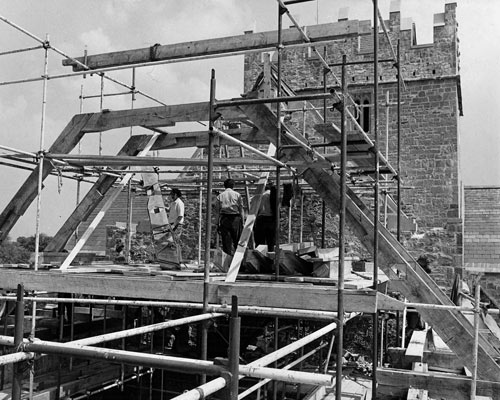
Holycross Abbey painstakingly restored in the early 1970s after centuries of ruin.
Still set on the banks of the River Suir, Holycross Abbey today is one of Tipperary’s great places of quiet grandeur; a medieval Cistercian foundation whose clean lines, cloistered calm and finely worked stone immediately draw you in. Painstakingly restored in the early 1970s after centuries of ruin, it has regained the sense of harmony and purpose that shaped it in the first place, still serving today as a living place of worship as well as a welcoming stop for visitors.
This website uses cookies to improve your experience. We'll assume you're ok with this, but you can opt-out if you wish.AcceptRead More
Privacy & Cookies Policy
Privacy Overview
This website uses cookies to improve your experience while you navigate through the website. Out of these, the cookies that are categorized as necessary are stored on your browser as they are essential for the working of basic functionalities of the website. We also use third-party cookies that help us analyze and understand how you use this website. These cookies will be stored in your browser only with your consent. You also have the option to opt-out of these cookies. But opting out of some of these cookies may affect your browsing experience.
Necessary cookies are absolutely essential for the website to function properly. This category only includes cookies that ensures basic functionalities and security features of the website. These cookies do not store any personal information.
Any cookies that may not be particularly necessary for the website to function and is used specifically to collect user personal data via analytics, ads, other embedded contents are termed as non-necessary cookies. It is mandatory to procure user consent prior to running these cookies on your website.






Recent Comments