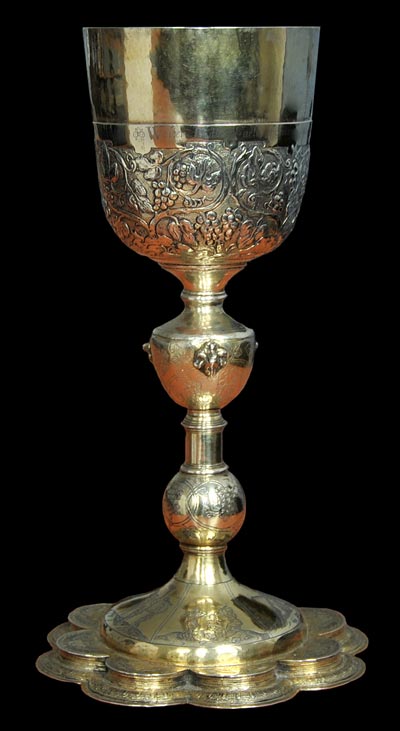
If you ask Thurles [Map Ref.] people what is the oldest manufactured object in daily use in this area, they might not immediately think of the chalices located in their local Church. This may well be so, and the story behind each chalice may be interesting in itself, to lovers of local and Irish history.
Our special thanks to historian and researcher Very Rev. Monsignor Dr Maurice Dooley, AP, Parish of Loughmore, Templemore, Co. Tipperary, and former lecturer on Canon Law at St Patrick’s College, Cathedral, Street, Thurles, Co. Tipperary.
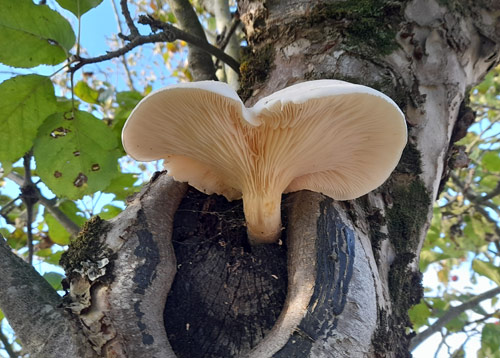
Spotted this week in Thurles, Co. Tipperary, an oyster mushroom making the most of the mild autumn weather; a perfect reminder of how resilient and fascinating these woodland dwellers are.
Oyster mushrooms are among the most popular edible fungi in Ireland, known for their delicate flavour and firm texture. They are versatile in cooking and can be added to soups, pasta, and stir-fries, or sautéed as a side dish.
They typically grow high up on the trunks and branches of broadleaf hardwood trees in mixed woodlands.
Large Oyster Mushroom(Hypsizygus ulmarius), Thurles, Co. Tipperary
Their fruiting bodies are semicircular or shell-shaped, often with smooth, pale caps that catch the light in forests. Though similar in look to other oyster-like species, this particular variety, Hypsizygus ulmarius, belongs to a different genus entirely. Its Latin name offers a small map of its habits: hypsi meaning “high up”, zygus referring to a “yoke”, and ulmarius translating to “of the elms”, its favourite tree host.
You’ll usually find these mushrooms sprouting individually from branch scars and wounds on living elms and box elders, though they occasionally make their home on beech, maple, willow, oak, or even, as in this case, an apple tree.
While they prefer living trees, slowly causing white rot in the wood, they can also thrive on fallen trunks and decaying branches. That duality, living as both parasite and saprotroph (Latter an organism that feeds on or derives nourishment from decaying organic matter), makes them remarkable survivors, feeding either on the living or the dead.
So next time you’re walking through a Tipperary woodland, look up, not down. The quiet life clinging to the bark above might just be an oyster mushroom enjoying the same soft weather as the rest of us.
Piseógs were the most common form of curse used in old Ireland, a Piseóg being a superstitious belief or practice, charm or spell.
Piseógs are traditional Irish curses often associated with rural communities and folklore. Same can be used to cause misfortune to others, steal their luck, or influence events, and are often cast with the intention of causing harm. The very fear of the piseóg itself was often considered a significant part of the curse, sometimes more damaging than the actual act itself.
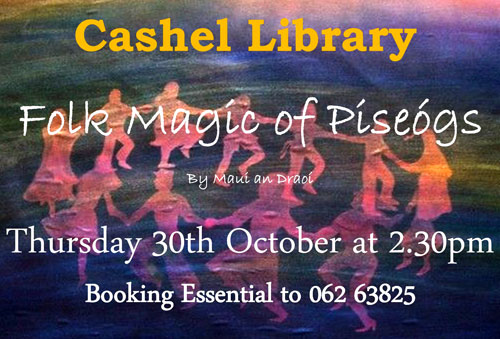
Join Maura for Folk Magic of Piseógs in Cashel Library, onThursday 30th October at 2.30pm. Note: Adult Event.
This is just one of the many free eventsat Cashel Library each year. Do Remember booking is essential to Tel: 062-63825.
The Food Safety Authority of Ireland (FSAI) today published a new Guidance Note on Food Safety Culture, which aims to support food businesses in meeting their legal requirements to establish and maintain an appropriate food safety culture in their business. This new resource will assist food businesses in embedding food safety into their everyday practices and will also provide a framework for inspectors to assess food safety culture during inspections.
To produce safe food, behaviour and awareness must align with safe food practices. Food safety culture encompasses how everyone, including managers and employees, think and act in their job on a consistent basis. It reflects the commitment to food safety at every step and within every role. The Guidance Note contains practical tools such as a self-assessment checklist and questionnaires to help businesses evaluate their own culture and prepare for inspections.
By increasing awareness and adopting safe food behaviours, an appropriate food safety culture can:
Maintain high food safety and hygiene standards and regulatory compliance.
Aid in keeping consumers safe from foodborne illness.
Increase transparency and improve communication among all employees.
Help prevent problems that results from unsafe food.
Mr Greg Dempsey, Chief Executive, FSAI, said: “Having the right food safety knowledge and skills is not just a regulatory requirement; it is essential for building and sustaining an appropriate food safety culture within a food business. This reduces food safety incidents, protects public health and also strengthens consumer trust and brand reputation. Our new Guidance Note is designed to support businesses in meeting their legal obligations while embedding best practices that safeguard consumers and support a stronger, safer food system. We encourage all food business operators to make full use of this new resource and commit to promoting a positive food safety culture.”
The FSAI’s Learning Portal also has a training module on food safety culture to assist food businesses that can be used in tandem with the Guidance Note.
Under an amendment to EU Regulation 852/2004, all food businesses with the exception of primary producers are now required to establish, maintain, and provide evidence of an appropriate food safety culture, taking in account the size and nature of the food business.
Medicinal product (melatonin) not permitted in food products present in various Life Extension food supplements.
Alert Summary dated Thursday October 2nd 2025
Category 1: For Action. Alert Notification: 2025.53. Product Identification: Please see table below. Batch Code: All batch codes and all best before dates.
Message: The below Life Extension food supplements contain melatonin, a medicinal product which should only be taken when prescribed by a medical professional. In Ireland, melatonin is regulated as a medicinal product when authorised by the Health Products Regulatory Authority and it is not permitted in food supplements available on the Irish market.
Product.
Pack size.
Fast-Acting Liquid Melatonin.
59ml.
Melatonin IR/XR.
60 capsules.
Melatonin 1 mg.
60 capsules.
Melatonin 6 Hour Timed Release.
60 vegetarian capsules.
Melatonin 3 mg.
60 vegetarian capsules.
Nature Of Danger: In Ireland, melatonin is a prescription medication, is not authorised in food and should only be taken under medical supervision. Use with caution if you have depression, bleeding disorders, high blood pressure, or seizure disorders. Common side effects can include drowsiness, headaches, vivid dreams and confusion. Avoid driving or operating machinery after taking melatonin There remain concerns about its long-term effects when used by children.
This website uses cookies to improve your experience. We'll assume you're ok with this, but you can opt-out if you wish.AcceptRead More
Privacy & Cookies Policy
Privacy Overview
This website uses cookies to improve your experience while you navigate through the website. Out of these, the cookies that are categorized as necessary are stored on your browser as they are essential for the working of basic functionalities of the website. We also use third-party cookies that help us analyze and understand how you use this website. These cookies will be stored in your browser only with your consent. You also have the option to opt-out of these cookies. But opting out of some of these cookies may affect your browsing experience.
Necessary cookies are absolutely essential for the website to function properly. This category only includes cookies that ensures basic functionalities and security features of the website. These cookies do not store any personal information.
Any cookies that may not be particularly necessary for the website to function and is used specifically to collect user personal data via analytics, ads, other embedded contents are termed as non-necessary cookies. It is mandatory to procure user consent prior to running these cookies on your website.







Recent Comments