“History is who we are and why we are the way we are” – Quote by David McCullough
Here on thurles.info we raised the issue of required entry road signage for Thurles back in July 2018, and again on March 21st, 2019. The current signage into our Cathedral Town remains 12 years outdated, outworn, archaic and a source of shameful embarrassment to local business and residents.
On April 3rd, 2019, we again wrote about this signage. Amazingly and just prior to our recent local Municipal District election, new approach road sinage for Thurles was, shall we say, “conveniently mooted”.
The four key strengths of the town which were identified were:- Arts & Culture, Business, Sport and Education.
According to the Minutes of our Municipal District, dated March 27th last, the four key strengths of Thurles, identified above, were recognised following public consultation. How come town residents, missed this public consultation invitation? Did any member of our electorate get an invitation? In the case of secretarial error, will these minutes be now fully corrected? After all (See picture (4) above) Tipperary Co. Council are committed to :- “AG OBAIR LEIS AN BPOBAL” – “WORKING WITH THE COMMUNITY“.
Suggested New Thurles entry road signage
We here on Thurles.Info noted, with disappointment, that while Thurles is more often referred to as the “Cathedral Town”, no Cathedral building appears to feature in any of these hastily prepared proposals, that we have so far previewed.
Where is that “Identified Strength” known as ‘Thurles History’ recognised?
“A people without the knowledge of their past history, origin and culture is like a tree without roots”. Quote by Marcus Garvey
Thurles Chamber of Commerce take note:- From purely a local economic prospective; Thurles Cathedral possibly brings more footfall to our Thurles town centre, than even the Gaelic Athletic Association (GAA); attracting people through their daily Mass, Funerals, Weddings, Communions, Confirmations etc. Unless I am gravely mistaken, Thurles Cathedral will never be driven out by Tipperary Co. Council’s crippling parking charges, to move to the freedom generated by Thurles Shopping Centre, unlike so many of our other fine town centre businesses.
Arts & Culture; are they really a local strength or simply consist of a theatre and exhibition space, built with taxpayers money, to be controlled, once again, to provide financial benefit to Tipperary Co. Council. For the most part our Arts & Culture strengths locally consist of inviting lesser talented Dublin based theatre companies, to rent our ‘The Source’ theatre space, before racing back to Dublin, clutching tightly our €25 Euro per head ticket charge.
Our history, on the other hand, is a real strength and by not identifying same with intense pride, we greatly disrespect and gravely slight those who have gone before, latter having achieved so much on behalf of this present, often ingrate, generation.
According to Minutes published, it was agreed that this signage would be erected on the N75 (Dublin Road), N62 (Templemore Road), N62 (Slievenamon Road) and the R498 (Nenagh Road, Thurles). The time frame for completion of the signage is dependent on the selection of an agreed design.
There were, it appears, some conflicting views expressed on the imagery being used on this proposed signage and it was therefore unanimously agreed that a separate meeting should be convened on Tuesday 2nd. April, 2019 at 5:00pm to finalise the design. Any decisions agreed at that same meeting once again remain withheld from the ears of the great unwashed electorate.
In our most recent local Municipal district elections we, the electorate, voted for “more of the same”, and it was therefore with some further disenchantment, not to mention cynicism, that I listened to a radio pod-cast, featuring the newly elected Cathaoirleach (Chairperson) of Tipperary County Council, Mr Michael Murphy (Fine Gael), speaking on what was to be “high on his agenda”, over the next 12 months. Mr Murphy appeared to be solely focusing on projects in his home town of Clonmel. May we take this opportunity to remind Mr Murphy that he was elected as Cathaoirleach to serve all of Co. Tipperary, not just Clonmel.
Ireland’s National Heritage Week 2019 – August 17th – August 25th.
Over the coming weeks in preparation for Thurles National Heritage Week; Thurles.Info will attempt to highlight the massive national, historical importance and physical presence of Thurles Cathedral of the Assumption.
Forgetting briefly the everyday religious benefits obtained by Thurles and Tipperary people, not to mention that same religious spiritual advantage enjoyed by hundreds of visiting day-trippers down the centuries; it is important to again reveal the many untold stories relating to this iconic building, latter which symbolises a Cathedral Church, built to the glory of God; holding many now forgotten yet true stories.
“We learn from history that we don’t learn from history”. Quote by Bishop Desmond Mplio Tutu, latter South African Anglican cleric, theologian, awarded the 1984 Nobel Peace Prize.
The EPA are leading a National Stop Food Waste Week campaign to highlight issues and raise awareness on food waste, beginning today Wednesday June 12th until Wednesday June 19th 2019 inclusive.
Globally, one third of the food produced in the world for human consumption is lost or wasted and every year people in Ireland waste over one million tonnes of food. The campaign aims to motivate people across Ireland to make real changes in how they use the food they buy.
Laura Burke, (Director General, EPA) said,“It takes a lot of resources to put food on our tables. Growing, processing, transport and storage all use massive amounts of energy and water, along with packaging, fertilisers and machinery. This activity generates greenhouses gases which drive climate change, so it is important that we value and carefully use the food we produce.”
“Many of us would like to take action on climate change, but sometimes it’s hard to know where to start. Reducing food waste contributes to lowering our carbon footprint, and we can achieve this through some surprisingly simple actions.”
The four key steps people can take to Stop Food Waste are:- (1.) Know your food waste: Make a list of what you throw out over the next week, this will give you a better understanding where your habits produce waste so you know what to target for improvement.
(2.) Planning and Shopping: Smarter shopping ensures that you don’t waste hard-earned money on food that goes in the bin. Plan your meals (including lunches at work), check the cupboards and fridge before you go, and use a shopping list.Cooking and Storing: Store food properly to make the most of what you have bought to keep food fresher for longer. The Stop Food Waste ‘A-Z of food’ contains tips and advice on how to store and cook various food types. Using leftovers for lunch not only helps reduce food waste, it will also save you money.
(3.) Cooking and Storing: Store food properly to make the most of what you have bought to keep food fresher for longer. The Stop Food Waste ‘A-Z of food’ contains tips and advice on how to store and cook various food types. Using leftovers for lunch not only helps reduce food waste, it will also save you money.
(4.) Bin it better: Use the brown bin (or try home-composting) for the unavoidable food waste you do generate. A recent national study showed that almost 50% of household organic waste is still being disposed of in the “wrong bins”, i.e. recycling or black bin.
Odile Le Bolloch, (EPA Stop Food Waste Manager), spoke about the National Stop Food Waste Week campaign: “Each day during Stop Food Waste week we will be sharing information and resources to help people to Stop Food Waste at work and at home. Our online campaign provides practical tips to help us all reduce waste and make the most of our food. We are also running our new workplace training programme with guidance on tackling food waste both at work and at home.”
Information on stopping food waste at home can be found at www.stopfoodwaste.ie.
For Stop Food Waste week, because the food people buy is not just consumed at home, the EPA are encouraging businesses and employees to target food waste at work.
Stop Food Waste’s top tips to reduce food waste in the workplace are:- (A) Have sharing shelves in the canteen and fridge and let everyone know that food left there is fair game. (B) Events with catering often produce large amounts of food waste. Try a slight under-order; and share any leftovers with colleagues. (C)Store unused food properly for future use, and don’t leave food forgotten in the fridge over the weekend.
To take part in raising awareness, the EPA are inviting businesses around Ireland to sign-up as supporters of Stop Food Waste week and receive posters, daily tips and a chance to win free Stop Food Waste workplace training.
“A Meeting of Youth” – [Translated into the Irish language, ‘Cruinniú na nÓg’.]
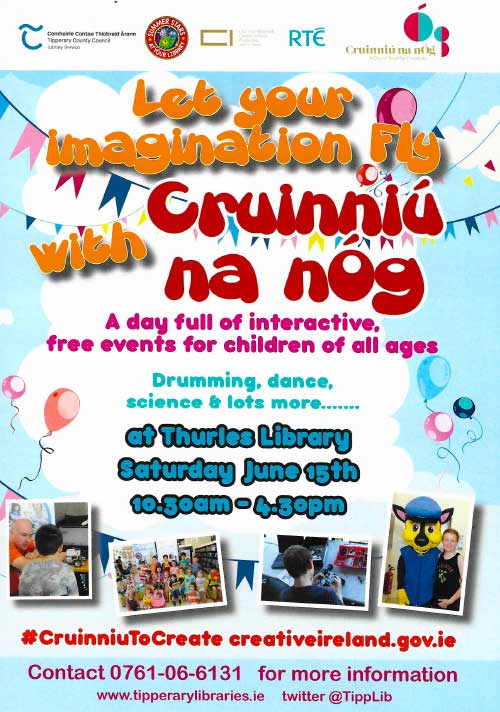
Ms Suzanne Brosnan (Senior Library Assistant), Tipperary County Council LibraryService, invites all our youth to let their “imagination fly with Cruinniú na nÓg”, here in Thurles Library, Cathedral Street on Saturday June 15th 2019. (That is next Saturday).
Cruinniú na nÓg represents a national day of creativity for our young people; giving them the opportunity to express themselves through a specific programme of cultural and creative activities, where they can share ideas, learn new skills while having fun.
Enjoy a day full of interactive free events for children of all age groups.
10:30 am – 11:45 pm – “Clowning Around Workshop”, hosted by Danielle Martin. A workshop for children ages 7-12 years exploring mime, comedy and lots more……
11:00 am – 12:00 pm – “Story-time”, with Sarah Tully, who believes “imagination is the magic of childhood”. Sarah will incorporate props, puppets and story sacks into her tales.
12:00 noon – “Summer Stars Reading Challenge” launch: A nationwide campaign promoting reader development and literacy in children.
12:00 noon – 12:30 pm – “Wobbly Circus Performance”. The award-winning circus and street theatre company will provide two street performances during the day.
12:30 pm –“Dance workshop” with dance instructor ‘Cerys’ from the Dwan Dance Academy, latter based in Thurles. This session is suitable for children aged 7 years and plus.
12:30 pm – 1:30 pm – Mobile Music School will host two workshops this first drumming session is aimed at children aged 4 – 7years. Explore the members of the percussion family and learn the importance of beat in music.
1:30 pm – “Dance Workshop” with ‘Cerys’ – a fun filled lively workshop for children ages 4 years and plus.
1:30 pm – 2:30 pm – “Mad Professor Performance”, join Niall O’Dwyer for 60 minutes of educational and fun experiments. This show will spark the imagination with mad programs and activities involving air, sound and lots more! Session 2 of the “Mad Professor” will take place at 2:30 pm – 3:30 pm.
2:30 pm – 3:30 pm – A 2nd session of the “Mobile Music School” suitable for children aged 8 years and plus.
3:00 pm – 4:00 pm – “Wobbly Circus Workshop”. Using the props provided and the guidance of excellent teachers; learn to walk the tight-wire, stilt walking, plate spinning and loads more circus skills.
4:00 pm – 4:30 pm – “Wobbly Circus”. A final performance and a great way to end the family day.
We will also have “Pavement Art” and “Milk the Cow”; weather of course permitting, as these are outside events.
Looking forward to welcoming all in attendance.
For further Information please do contact Tel. No. 0761-06-6131
Teacher: “Paddy now listen carefully; if I gave you 2 rabbits, then another 2 rabbits and then yet another 2 rabbits, how many rabbits in total would you own?”
Paddy: “Seven Miss”.
Teacher: “No Paddy, you are not listening. If I gave you 2 rabbits, then another 2 rabbits and then 2 more rabbits, how many rabbits in total would you have in all?”
Paddy: “I would have seven rabbits Miss”.
Teacher: “OK, I will put it to you differently. If I gave you 2 apples, then another 2 apples and then another 2 apples, how many apples in total would you have?”
Paddy: “I would have six apples Miss”.
Teacher: “Excellent. Now lets try this again. If I gave you 2 rabbits, then another 2 rabbits and then 2 more rabbits, how many rabbits in total would you have?”
Paddy(Counting on his fingers): “I would have seven rabbits Miss”.
Teacher (Now annoyed): “Paddy in the name of God, where are you getting your seven from?”
Paddy: “Well I feckin already have one rabbit at home, Miss”.
“Things I Remember About My Father and Mother” was a published document written by Ms Charlotte L. Roberts, whose mother was Charlotte Knaggs-Roberts, latter originally from Thurles, in Co. Tipperary.
Charlotte L. Roberts writes fondly about her mother:-
“We walked to church and mother always went except when she had a small baby or someone was ill. Mother loved music but had never had an opportunity to learn to play. She sometimes played on a Jew’s Harp. Will Atkins, a brother-in-law, directed the church choir at the First Methodist Church. She sang in the choir whenever possible. Sunday evenings she could go because my father would stay home with Olive and me. He would hold me on his lap and sing many hymns – usually gospel hymns.
Mother was a very good cook and we always had plenty of good food. She made pickles of the little cucumbers; mustard pickle, red cabbage pickle which was kept in a big crock down cellar; string bean pickles and many kinds of jelly. She also made her own bread and pies and cakes. We had many family picnics, usually at the Trout Ponds.
Mother was always patient with her children. She was born in Thurles, Ireland. Her father and mother were staunch Protestants. There were, Jane, Annie, Sarah, and Charlotte and several sons: Tom, Jim, George, and I think,one other. There was an Anne Jane, two with the name Hannah, [one died as a baby], Elizabeth, Robert, and Benjamin.
They came to America in 1864 and stayed in New York City for a few years. At Duane Street, Methodist Church they met many young people. My mother married John Oliver Roberts. They lived in Ohio for a time where my father bought butter and eggs and shipped them to New York. Later he came to Smithboro and finally to Newark Valley (New York) where they spent the rest of their lives”.
Charlotte L. Roberts writes also about her father John Oliver Roberts:-
John Oliver Roberts 1848 was from Middleton. Co. Cork, was the son of John Oliver Roberts. We were always at church every Sunday. My father was treasurer of the Sunday School. Also, teacher of a men’s class. He knew the Bible well. I found books that had been given to him as awards for his Bible study. I believe Father was also on the Official Board. He always liked to have his family look nice and he himself, was very meticulous about his own appearance.
He was a wonderful gardener – no weeds in his garden. He raised all kinds of vegetables, so we had good food summer and winter. Apple trees in the back garden furnished fruit and jelly.
He was fond of games. On afternoons when he could get away from the store, he would go with Bert Livermore to the Trout Ponds to play croquet. They each had their own special mallet and ball. At home he liked to play Checkers and Crokinole, (Latter a dexterity board game similar to marbles, and shove ha’penny).
As children we had Parcheesi (Played with two dice), Dominos, Authors (Card Game), Devil Among the Tailors (Table skittles), Jack Straws (Game involving a bundle of “sticks”, between 8 and 20 centimetres long, which are dropped loosely in a bunch onto a table top, jumbled into a random pile), and Croquet. He enjoyed company and we had cousins from Jersey who used to visit us in the summer. One year 15 cousins had their pictures taken at our home, though all were not visiting us.
Father was born in Middleton, Co. Cork, Ireland. Roberts is a Welsh name, but I know nothing about his family, his ancestors. There was an Uncle Ben who lived in London. Father’s brother James lived in this country and all his later years were spent in Smithboro. There were two sisters who visited in New York, but there is no further information about them. My father came to this country when he was 18 years of age in 1865″.
James Knaggs, eldest son of Robert Knaggs, Archerstown Mills, Thurles, Co. Tipperary
Our brief research undertaken will first deal with Mr James Knaggs who through a Codicil in 1816 [Codicil being an additional formal legal document, added to a will, through which the Testator can make valid changes to their estate], obtained a lease from his father, latter Robert Knaggs (Surveyor of Excise), with an address at New Ross, Co. Wexford; of cabins including mills and a brewery on Littleton Road, Thurles, for 3 lives.
Mr James Knaggs married Ms Elizabeth Langford on February 11th, 1839 here in Thurles. They had 10 children – five daughters; Charlotte, Sarah, Anna Jane, Hannah Marie and Elizabeth, together with 5 sons; James, George, Robert, Benjamin and Thomas.
We are aware that Ms Ann Jane Knaggs, daughter of above named, Mr James & Elizabeth Knaggs, married Mr Sexton Roane, here in Thurles on June 29th 1860.
The Archerstown brewery and bakery, in 1846, was situated on the left side of the road, while the Archerstown water mill was situated on the right-hand side, as commuters travelled southwards from Thurles to Littleton via the Mill Road, latter formerly known as “Manor Mill Road”.
‘Poulaneigh’ is a pond in the townland of Galboola near Littleton. Same is the source or starting point of the Poulaneigh river. Joined by the river ‘Bréagagh’ same fed this 6-acre property of Archerstown mill, leased to Mr James Knaggs.
[Take time to halt and view the Ordnance Survey map, 6-inch to a mile, first edition, first surveyed 1840-1841, engraved in 1843, in the video shown above.]
‘Poulaneigh’ –(“Poll an eigh”) Irish translation “the pool of the horse”.‘Bréagagh’ – Irish adjective for “false, deceptive or lying”, from the noun ‘bréag’ meaning a lie.
Regrettably today, Archerstown Mill (later which later become Dan Brady’s Mill) no longer exists. All that remains today is a narrow section of the millrace that provided fast running water to the old mill wheel. The archway leading into the once Brewery yard, (also shown in the above video) stands situated across the roadway remaining today, somewhat in decline.
You can read more about Knaggs Mill, same later to be known as Dan Brady’s Mill, by clicking HERE.
As exists today; the Poulaneigh river then continues on, to be joined by the ‘Drish’ river, as a tributary, and then continues to the Manor Mills [The Manor Mills, today better known as Byrne’s Mills, are marked on the 1840’s map as the “old tuck mill” and the “old flour mill”] situated on the Mill Road side of today’s Drish Bridge [Marked on the map as the “Old Mills bridge”] near the entrance to Lady’s Well. The output or mill-race from the Manor Mills is still marked as the “Poulaneigh or Manor river” until it feeds into the Suir river, just beside ‘Lady’s Well’. The river Breagagh is marked as a tributary of the Poulaneigh river, joining it just after it has begun to flow out of Poulaneigh pond.
The Old Tuck Mill Reference
Cloth washing areas go back a long way. Old Testament Bible Quote: “Then the LORD said to Isaiah, “Take your son Shear-jashub and go out to meet King Ahaz. You will find him at the end of the aqueduct that feeds water into the upper pool, near the road leading to the field where cloth is washed”. [From Book of Isaiah: Chapter 7, Verse 3. Written in the 8th century before Christ (BC)]
The concept of ‘Tucking’, also known as ‘Fulling’, ‘Walking’ or ‘Waulking’; was a stage in the manufacture of woollen cloth, which in turn involved the cleansing of cloth (particularly wool), thus eliminating oils, dirt, and other impurities, and to make it thicker. The workers undertaking this work were known as ‘fullers’, ‘tuckers’, or ‘walkers’.
Tucking involves two processes: (1) Scouring and (2) Thickening; each carried out originally by the pounding of the woollen cloth with a club, or the tucker’s own feet or hands.
By the time of the Crusades; in the late eleventh century, ‘Fulling / Tucking Mills’ were active throughout the medieval world. From this medieval period, tucking was often carried out in a water mill, followed by the stretching of the cloth on large frames known as ‘tenters’, to which the ‘Tucking’ product is attached by hooks. [It is from here that the phrase“being on tenterhooks”is derived, usually meaning that one is being held in suspense.]
The second function of fulling (Thickening) was to thicken cloth by matting the fibres together thus giving it strength and increased waterproofing (known as felting). After this stage, water would then be used to rinse out any foul-smelling residue.
‘Tucking’ or ‘Fulling’ in Roman times was labour consigned usually to slaves who worked the cloth, while ankle deep in tubs of human urine. Stale urine, known as ‘Wash’, was a source of ammonium salts which assisted in cleansing and bleaching the cloth. It is understood that urine from the Thurles Workhouse (Hospital of the Assumption, Thurles) and from the wealthier houses was collected and used to bleach such cloth.
As already stated, marked on the 1840’s map, the Breagagh river finished where it flowed into the Poulaneigh river, latter which then continued on as the Poulaneigh river, to feed Archerstown [Brady’s] Mill first and having being joined by the Drish river; to feed Manor [Byrne’s] Mills.
Same river in turn would then also contribute to the running of the Turtulla Mill, same once existing close to the Meagher residence, better known today as Thurles Golf Club. In all 4 mills operated on this less than 1 kilometre stretch of water.
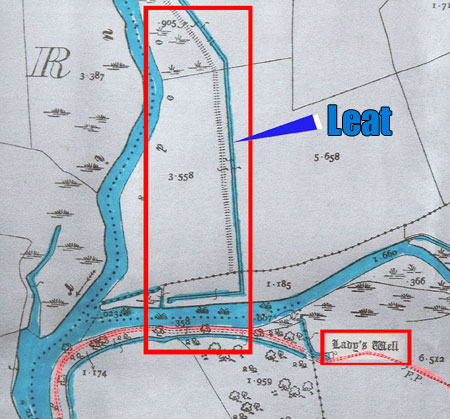
On the 1904 Ordinance Survey map a new feature or attribute appears in 1846, on the Thurles landscape – namely a Leat.
Leat (also spelt lete or leet) is the name for an artificial watercourse or aqueduct dug into the ground, especially one supplying water to a watermill or its mill pond. Here also we come across the welcome activity of yet another of the Knaggs Family; namely Robert Charles Knaggs [Medical Doctor (MD)], latter who resided where the Ulster Bank operates today, at no 49 Liberty Square, Thurles previously then known as Main Street Thurles.
Dr. Robert Charles Knaggs (MD) Main Street Thurles
Monday April 20th, 1846 On Monday April 20th, 1846; according to the ‘Minutes of the Thurles / Rahealty Famine Food Committee’ [Minutes of Great Famine 1845 -1849]; members of same met with Rev. Henry Cotton (Chairman), Dr. O’Connor, Rev. Mr Barron (RC), Rev. Mr Baker, Rev. Mr Lanigan, Mr. Francis O’Brien (Treasurer), Dr. Robert Charles Knaggs and Mr J. B. Kennedy present.
We learn: “Dr R.C. Knaggs also reports – he having inspected the works to be done at Limekiln Lane, College Lane and the Double Ditch – calculated the expense of the works at College Lane at £20. Proposals from P. MGrath and Danl Carroll for barrows – ½ a doz ordered from MGrath at 9/- each. ½ doz from Carroll at 9/6 each. ½ doz also to be got from Dan Dwyer, (if he wishes to make them)”. (1.) Hours of labour for all employees to be from 7:00am to 7:00pm; minus 2 hours for meals. (2.) Any labourer found to shirk from reasonable and fair work or refusing to follow the directions of his overseer, shall forthwith be discharged and not admitted to the works again. (3.) That the persons employed shall be paid every evening. (4.) That in case a greater number of labourers shall offer themselves, than the funds will enable the committee to pay, a preference shall be given to those who have the largest and most necessitous families.
The ‘Double Ditch’ would act as a badly needed short cut / raised path to James Knaggs mill in Archerstown, beginning from College Lane, Kickham Street.
Later a ‘Leat’ would travel from the grounds of today’s St. Patrick’s College as far as ‘Lady’s Well’, before travelling under the Poulaneigh river, thus removing flood water from the Thurles river Suir end; draining it further downstream back into the River Suir once again. This ‘Leat’ remains visible to this very day.
17th Oct 1846 On October 17th, 1846 we also learn that:- “On discussion as to the appointment of an assistant secretary and providing the use of a room for a future sitting of the Committee; it was deemed advisable to do so and it was accordingly arranged with Dr. R.C. Knaggs to allow his parlour (in the now Ulster Bank building) to be continued to be used by them and that he should be appointed assistant secretary and paid a stipulated sum to be hereafter agreed upon, out of the sums of money granted by the Lord Lieutenant.”
Friday November 13th 1846. At the 3:00pm meeting on Friday November 13th 1846 we read:- “Dr. R.C. Knaggs states that a large number of men could be employed on making sewers through the town, if there was a quarry to be had. Venerable Archdeacon Dr. H. Cotton offers the use of a quarry on his land.”
Note: Here we have the first ever sewage system being built here in Thurles, making the then existing ‘Shit Wells’ / ‘Honey Wells’ positioned in the back lanes of the town, now redundant. Indeed, so well designed was this sewer system; that in more modern times pipes were, for the most part, laid directly into this same old sewer system, when it was being upgraded.
According to Griffith’s Valuation of Ireland, Dr. Robert C. Knaggs owned property at Pike Road (Today’s Kickham Street, Thurles), at Wrensborough, Thurles (Dublin Road), and at Monakeeba, Thurles.
Perhaps the existing Knaggs Clan around the world, might like to take a trip back here to Thurles, Co. Tipperary, in the not too distant future and we will be happy to walk you in the footsteps of your ancestors.
This website uses cookies to improve your experience. We'll assume you're ok with this, but you can opt-out if you wish.AcceptRead More
Privacy & Cookies Policy
Privacy Overview
This website uses cookies to improve your experience while you navigate through the website. Out of these, the cookies that are categorized as necessary are stored on your browser as they are essential for the working of basic functionalities of the website. We also use third-party cookies that help us analyze and understand how you use this website. These cookies will be stored in your browser only with your consent. You also have the option to opt-out of these cookies. But opting out of some of these cookies may affect your browsing experience.
Necessary cookies are absolutely essential for the website to function properly. This category only includes cookies that ensures basic functionalities and security features of the website. These cookies do not store any personal information.
Any cookies that may not be particularly necessary for the website to function and is used specifically to collect user personal data via analytics, ads, other embedded contents are termed as non-necessary cookies. It is mandatory to procure user consent prior to running these cookies on your website.






Recent Comments