167 probationer Gardaí assigned to Garda Divisions nationwide.
Three further attestations scheduled to take place in 2026.
Over 200 new trainees due to enter the Garda College on Monday next, February 9th 2026.
The Minister for Justice, Home Affairs and Migration, Mr Jim O’Callaghan today welcomed the attestation of 167 new Gardaí at a ceremony in the Garda College, Templemore, Co. Tipperary.
A total of 100 men and 67 women were attested and will now be assigned to Garda divisions across the country by the Garda Commissioner.
Of this cohort, 104 probationer Gardaí will be deployed across the Dublin Metropolitan Region, with 21 assigned to the Southern Region, 31 to the Eastern Region and 11 to the North-Western Region. Only two one will be allocated to the Co. Clare/Co. Tipperary Garda division, with one being allocated to Ennis in Co. Clare and one to Clonmel in Co. Tipperary.
Speaking at the Garda College, the Minister said: “I am very pleased to see another 167 new Gardaí attest from Templemore today. This is the first of four attestations due to take place this year and I look forward to larger classes attesting as the year progresses. This cohort of newly attested Gardaí will take up positions in communities across the country as they begin a career of service to their communities, and to the people of Ireland. They join a tradition that stretches back over a century, one built on trust, integrity, and a steadfast commitment to the public they serve. Recruitment into An Garda Síochána is now gathering real momentum. I am looking forward to seeing this momentum continue in 2026. The next intake of up to 215 Garda trainees will enter the Garda College next Monday, 9 February.”
Two recruitment campaigns were held in 2025, with over 11,100 applications received to join An Garda Síochána. Engagement is continuing with publicjobs in relation to scheduling and conducting a further recruitment competition in 2026, supporting an ongoing pipeline of recruits into Templemore.
The Minister added that Budget 2026 provides €2.74 billion to support recruitment and staffing in An Garda Síochána. The Minister also said work will continue with the Garda Commissioner to optimise recruitment, including measures to expand training capacity.
The Minister also noted that the Garda Training Review Group has been established to identify how training and continuous professional development capacity can be increased, including consideration of the case for a second Garda training college, in line with a Programme for Government commitment.
Contrary to what some consumers believe, a “Security Protected” label on a product is not a food-safety warning and it does not mean the food has been “tampered with” in the past or is unsafe.
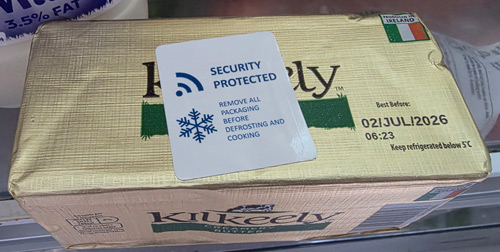
The sticker in the photo shown hereunder is exactly what it says on the wrapper “security protected” and is, over recent months, found on items like butter or meat. Same is a retail anti-theft security label or Electronic Article Surveillance (EAS) label.
“Security Protected” is the deterrent message retailers print on/over the tag so would-be shoplifters can see it at a glance. Loss-prevention groups explicitly note this wording is used on tags/labels as a visible warning.
Why butter and meat? Because same are high-theft, easy-to-conceal, relatively high-value grocery items (especially branded butter and premium cuts). Irish reporting has specifically noted security tagging spreading to staples like butter and meat in some stores and Irish retailers have described meat and other small, high-value groceries as common targets.
The label says “SECURITY PROTECTED” and includes a “signal/waves” style icon, used on retail security labels.
The small print says “REMOVE ALL PACKAGING BEFORE DEFROSTING AND COOKING”. That wording is common on meat/chilled security labels, because some EAS label types aren’t intended to go into heating/defrosting and retailers want the label/outer wrap removed first.
How it works. In plain terms the label contains a thin electronic element that can set off the exit gates within grocery outlets if it’s still active. At your checkout, it’s usually deactivated (often automatically as part of scanning in grocery setups).
Why you’re seeing it recently on butter/meat in Ireland: Irish stores have increasingly been tagging everyday groceries like butter and meat as an anti-shoplifting measure. Practical tip: you don’t need to do anything special—just pay as normal. If the alarm ever sounds on the way out, it’s typically because the label wasn’t deactivated properly, and staff can sort it quickly back at the till.
What happens if the sticker is removed in shop by a customer? If a customer removes it within the shop before paying, it can trigger suspicion immediately. That label is there as a theft-deterrent, so peeling it off on the shop floor looks like an attempt to defeat security. In Ireland, theft is defined as dishonestly appropriating property without consent, with intent to deprive. Also, any person may arrest without warrant someone they reasonably suspect is in the act of committing an arrestable offence (with conditions set out in law). Practically, most shops will simply detain/store-policy stop you, review CCTV, and/or call Gardaí if they believe something is happening.
Ratepayers’ Cultural Safety Briefing for the Maryland USA Mission (St Patrick’s Weekend Edition).
Tipperary ratepayers warmly welcome news of the proposed Maryland excursion by the CEO of Tipperary County Council, Ms Sinead Carr, along with the Cathaoirleach, Cllr Mr John Carroll and Mr Anthony Fitzgerald (Head of Enterprise and Economic Development and Tourism), latter a brave initiative in international relations, and an even braver initiative in free expensing, courtesy of Tipperary taxpayers.
However, before anyone is released into the wilds of a round of St Patrick’s weekend receptions, it is essential the travelling party completes the Maryland Compulsory Heritage Module, because nothing says “strategic engagement in quantum technologies” like being caught flat-footed on a 19th-century poem in front of a room of people who can quote it at you.
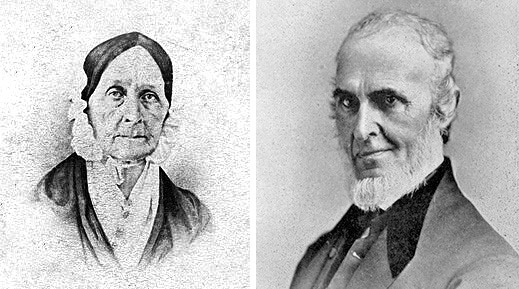
Pic L-R:Barbara Frietchie, & poet John Greenleaf Whittier.
Module 1:Barbara Frietchie (1766 – 1862), [Fritchie, Fritchie-ish, depending on who’s correcting you]. All delegates must demonstrate a working knowledge of the famous Frederick legend in which an elderly woman allegedly waves the Union flag, while Stonewall Jackson passes through, and he, like a well-trained character in a civic morale story, obligingly delivers the appropriate line on cue. Warning, this is not optional. In Maryland, this is basically local scripture, and you will be judged accordingly.
Module 2: Stonewall Jackson, not just a beard, a brand. You don’t have to agree with the legend, but you must be able to nod thoughtfully, while someone says “Of course you know the story…” and you respond like a person who has absolutely not spent the flight learning it from a laminated handout.
Module 3: Frederick’s “Shared Heritage”. Delegates are reminded that Frederick’s history has more edge than a brochure. For example, your hosts may be vaguely aware of the 1781 treason case in Frederick, (Mr Caroll please note), involving British loyalists, including Mr John Caspar Fritchie (Barbara’s father-in-law), convicted in a plot involving British prisoners and a rendezvous with Cornwallis in Virginia, resulting in their nasty executions two months later. This is the part of “people-to-people ties” that rarely makes the PowerPoint, but it does wonders for small talk, if the canapés are slow coming out of the kitchen.
Assessment: A short oral exam may occur at any point, possibly mid-toast, possibly in front of cameras. Passing grade requires:
Correct pronunciation of “Frietchie/Fritchie” without looking panicked.
Ability to smile as if you’ve always loved American Civil War folklore.
The restraint not to say “Sure we’ve our own rebels at home”(referring to ‘People Before Profit’ and ‘Sinn Féin’), unless you enjoy diplomatic incidents.
Anyway, thank God, we are getting some return on our Property Taxes and it’s so comforting, because for a moment there I worried our money was being used efficiently. Now, with the bar so low (it’s basically underground), yet we are still managing to trip over it. Absolutely, nothing says ‘value for money’ like spotting that single working streetlight and the knowing that the Thurles potholes are really just a normal street feature.
Finally, ratepayers would like to reassure this delegation, that if you accidentally confuse Barbara Frietchie with any other historic flag-waver, don’t worry, the room will correct you instantly, with great enthusiasm, at full volume, and for free.
Safe travels. Spend wisely. Reports of any major successes in tourism, business, of course will be required. Oh and for the love of God, do your homework.
Now, to add some educational context; read the poem by John Greenleaf Whittier (1807 – 1892) latter published in October 1863.
Barbara Frietchie.
Up from the meadows rich with corn, clear in the cool September morn, The clustered spires of Frederick stand green-walled by the hills of Maryland. Round about them orchards sweep apple and peach-tree fruited deep, Fair as a garden of the Lord to the eyes of the famished rebel horde, On that pleasant morn of the early fall when Lee marched over the mountain wall, Over the mountains winding down, Horse and foot, into Frederick town. Forty flags with their silver stars, forty flags with their crimson bars, Flapped in the morning wind, the sun of noon looked down, and saw not one. Up rose old Barbara Frietchie then, bowed with her fourscore years and ten; Bravest of all in Frederick town, she took up the flag the men hauled down; In her attic window the staff she set to show that one heart was loyal yet. Up the street came the rebel tread, Stonewall Jackson riding ahead. Under his slouched hat left and right he glanced: the old flag met his sight. “Halt!”, the dust-brown ranks stood fast, “Fire!”, out blazed the rifle-blast. It shivered the window, pane and sash, it rent the banner with seam and gash. Quick, as it fell, from the broken staff, Dame Barbara snatched the silken scarf; She leaned far out on the window-sill, and shook it forth with a royal will. “Shoot, if you must, this old grey head, but spare your country’s flag,” she said. A shade of sadness, a blush of shame, over the face of the leader came. The nobler nature within him stirred, to life at that woman’s deed and word. “Who touches a hair of yon grey head dies like a dog! March on!” he said. All day long through Frederick street, sounded the tread of marching feet, All day long that free flag tossed over the heads of the rebel host. Ever its torn folds rose and fell, on the loyal winds that loved it well, And through the hill-gaps sunset light shone over it with a warm good-night. Barbara Frietchie’s work is o’er, and the Rebel rides on his raids no more. Honour to her, and let a tear fall, for her sake, on Stonewall’s bier. Over Barbara Frietchie’s grave, flag of Freedom and Union, wave, Peace and order and beauty draw round thy symbol of light and law; And ever the stars above look down on thy stars below in Frederick town! End
We’re used to seeing Imbolc pinned neatly to 1st February. Handy, yes, but it can blur what these festivals originally were: not fixed diary dates, but season-markers tied to what people could observe overhead and around them.
Imbolc – Saint Brigid’s Day
In the old Gaelic seasonal rhythm, four great festivals sit at the “hinges” of the year, Samhain, Imbolc, Bealtaine and Lughnasadh, each signalling the beginning of a season. Imbolc, in particular, sits in that brightening stretch about halfway between the winter solstice and the spring equinox.
So when is Imbolc in 2026? If you define Imbolc astronomically as the midpoint between the December solstice and the March equinox, it doesn’t always land on the same calendar day. In fact, it generally falls somewhere between 3rd–6th February, depending on the year.
For 2026, we can anchor the calculation using the exact solstice/equinox instants:
December solstice (2025): 21 Dec, 15:03 UTC. [ UTC– Co-ordinated Universal Time ]
March equinox (2026): 20 Mar, 14:46 UTC.
That places the midpoint in the early hours of today 4th February 2026 (UTC), which means: 4th February in Ireland, while it can still be 3rd February in parts of the Americas, depending on time zone.
And if you’re reading this “down under”; some modern seasonal calendars flip the Wheel-of-the-Year festivals to match local seasons, so you’ll sometimes see Lughnasadh (the harvest hinge) marked instead.
Why does it “clash” with St Brigid’s Day? Because modern life likes fixed dates. Over time, Imbolc became closely associated with early February observances such as St Brigid’s Day (1st Feb) and Candlemas (2nd Feb), a blending of seasonal tradition and church calendar that made sense culturally, even if the astronomical midpoint drifts a little year to year.
What does “Imbolc” actually mean? Here’s the honest and interesting answer; we’re not 100% sure, and scholars have offered more than one plausible thread. “In the belly”: A common explanation traces Imbolc/Imbolg to Old Irish i mbolg (“in the belly”), often linked to pregnancy in livestock and the returning promise of life. Milk: Cormac’s Glossary (early 10th century) offers Oímelc, explaining it as “ewe milk”, though modern linguists often treat that as a later “made-to-fit” explanation rather than a definitive origin story. Cleansing: Another scholarly proposal links the word to ideas of washing/purification, which fits neatly with late-winter customs like tidying, clearing out, and preparing for spring work.
Either way, the feel of the season is clear; this is the turn toward light, the first real loosening of winter’s grip, a time of readiness, renewal, and “getting things in order”.
Stone Age Ireland was watching too: One of the most striking things about these seasonal hinge-points is how deep they seem to go in the Irish landscape, beyond medieval texts, beyond “Celtic” labels, and back into the Neolithic. At the Mound of the Hostages on the Hill of Tara, the passage alignment is such that the rising sun illuminates the chamber around Imbolc and again around Samhain. And the monument itself is ancient, built between roughly 3350 and 2800 BC, long predating the later royal and mythic fame of Tara, and long predating the arrival of Celtic culture in Ireland.
Whatever name people used, whatever language they spoke, they were clearly paying close attention to the turning year.
A simple way to mark “astronomical Imbolc”. If you want to honour the sky-timed moment (without arguing with the calendar), try something easy and meaningful:
Step outside at dawn (or just early morning) and notice the light, even a few minutes.
Do one small “spring clean”: a drawer, a shelf, the car, the inbox.
Light a candle, a nod to returning brightness and to the season’s links with Brigid and Candlemas.
Happy Imbolc, whenever you mark it, and happy hinge-of-the-year to anyone celebrating the season from the other side of the world.
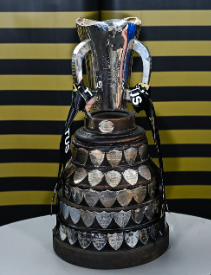
Doughan inspires Nenagh CBS to second Harty Cup, as the Tipperary Run Continues.
TUS Munster Post Primary Schools Senior ‘A’ Hurling – Dr Harty Cup Final. St Joseph’s CBS, Nenagh 0-20 – St Flannan’s College, Ennis 0-18. Venue: Zimmer Biomet Páirc Chíosóg, Ennis – Attendance: 6,909.
St Joseph’s CBS, Nenagh, Co. Tipperary, have captured the Dr Harty Cup for the second time, adding another major title to Tipperary’s recent schools dominance, after edging St Flannan’s College, Ennis, Co. Clare, by two points in a tense decider at Ennis.
Nenagh captain Eoghan Doughan produced a decisive, man-of-the-match display, finishing with 0-12pts (eight frees), including key scores from play after being switched inside as the contest developed. The win marks Nenagh’s second Harty Cup in three seasons and continues a strong run for Tipp schools in the competition.
St Flannan’s made the sharper start on home soil, moving 0-8pts to 0-3pts clear by the 16th minute as they dominated early possession. Nenagh responded by pushing Doughan closer to goal, and the change helped swing momentum, with a late first-half burst bringing the sides back to 0-11pts apiece at half-time.
The second half returned score-for-score. Flannan’s briefly nudged their noses in front, but Nenagh’s resolve showed in the closing quarter, with Joe O’Dwyer and Patrick Hackett crucial around the breaks and Doughan punishing late infringements to stretch the lead before a final free from Flannan’s narrowed it at the finish.
After the final whistle, Nenagh manager Donach O’Donnell summed up the achievement simply: “This is so rare, and what’s rare is beautiful.”
Match details: ScorersNenagh CBS: Eoghan Doughan 0-12pts (8 from frees); Austin Duff 0-2pts; Patrick Hackett 0-2pts; Joe O’Dwyer 0-2pts; Dara O’Dwyer 0-1pt and Patrick Ryan 0-1pt. Scorers St Flannan’s: Harry Doherty 0-8pts (5 from frees, 1 X ’65); Darragh MacNamara 0-3pts; Thomas O’Connor 0-2pts; Eoin O’Connor 0-1pt; Graham Ball 0-1pt; Isaac Hassett 0-1pt; Patrick Finneran 0-1pt and Colm Daly 0-1pt.
Player of the Match: Eoghan Doughan (Nenagh CBS). Referee: Thomas Walsh (Waterford).
This website uses cookies to improve your experience. We'll assume you're ok with this, but you can opt-out if you wish.AcceptRead More
Privacy & Cookies Policy
Privacy Overview
This website uses cookies to improve your experience while you navigate through the website. Out of these, the cookies that are categorized as necessary are stored on your browser as they are essential for the working of basic functionalities of the website. We also use third-party cookies that help us analyze and understand how you use this website. These cookies will be stored in your browser only with your consent. You also have the option to opt-out of these cookies. But opting out of some of these cookies may affect your browsing experience.
Necessary cookies are absolutely essential for the website to function properly. This category only includes cookies that ensures basic functionalities and security features of the website. These cookies do not store any personal information.
Any cookies that may not be particularly necessary for the website to function and is used specifically to collect user personal data via analytics, ads, other embedded contents are termed as non-necessary cookies. It is mandatory to procure user consent prior to running these cookies on your website.





Recent Comments