Senator Frances Black’s maximalism is no substitute for serious government and Micheál Martin is right to put Ireland’s interests before current Sinn Féin and opposition political theatre.
Taoiseach Micheál Martin deserves much credit for bringing a measure to Cabinet that is possibly legally focused, diplomatically serious, and economically responsible. In limiting the Israeli Settlements Bill to goods rather than extending it to services, he has done what responsible governments are supposed to do; distinguish between what is politically satisfying and what is actually implementable.
Taoiseach Mr Micheál Martin.
There is a world of difference between taking a symbolic stand and passing workable law. A ban on goods from Israeli settlements can be monitored through customs, import records, product origin and enforcement mechanisms already known to the State. It is narrow, targeted and legally intelligible. A services ban, by contrast, would be a minefield. What exactly is a settlement-linked service? A hotel booking? A cloud contract? A software licence? A payment platform? A professional service? A mapping tool? A multinational with branches in Ireland, Israel and the United States could easily be caught in a web of uncertainty.
That is why Micheál Martin’s warning matters. Ireland is not an isolated moral debating society. It is a small, open economy whose prosperity depends heavily on foreign direct investment, especially from American multinationals. To dismiss those concerns is not bravery; it is total recklessness. A government that casually exposes Irish jobs, tax revenue and diplomatic relationships to avoidable risk is not acting in solidarity with anyone. It is indulging in gesture politics at the taxpayers expense.
What has the now recovering but once alcohol dependent Senator Frances Black actually achieved in nearly ten years in the Seanad, apart from making opposition to Israel the centrepiece of her political identity? She has introduced bills and spoken on worthy causes, but there is little evidence of major, enacted legislation bearing her name that has transformed life for ordinary Irish people. On the otherhand, Micheál Martin is accountable for the national interest; Senator Black is free to pursue activist politics without carrying the same responsibility for Irish jobs, Irish investment, diplomacy or Ireland’s relationship with the United States. That is the difference between government and protest.
This is where Senator Frances Black and others in the opposition are wrong. Their demand to include services may sound stronger, but stronger rhetoric is not the same as stronger law. It is easy, from the opposition benches, to denounce, condemn and demand the maximum possible measure. It is harder to govern, to take legal advice seriously, and to protect the national interest, while still making a principled foreign policy statement.
Senator Black has been consistent on this issue, and consistency is not in itself a fault. But her criticism of the Government’s bill as a “partial ban” misses the central point. Partial laws are often better than performative laws that collapse under legal challenge or produce unintended economic damage. The question is not whether a services ban sounds morally satisfying. The question is whether it can be defined, enforced and defended without harming Ireland more than the target it is aimed at. Micheál Martin has answered that question honestly.
Ireland also needs to be careful not to slide from criticism of settlements into an attitude of hostility toward Israel itself. Israel is a democratic state facing real security threats, including terrorism, regional hostility and the trauma of repeated attacks on its citizens. One does not have to agree with every Israeli government policy to recognise Israel’s right to exist, defend itself, trade, innovate and maintain normal diplomatic relations with democratic countries like Ireland.
Too much of the Irish debate has lost that balance. There is often immense passion for condemning Israel, but far less energy for acknowledging Israeli suffering, Israeli security fears, or the fact that peace will require negotiation, not one-sided denunciation. When Irish politicians speak as though pressure on Israel alone will solve the conflict, they offer the public a dangerously simplified picture.
Micheál Martin’s approach is more mature. He has supported Palestinian statehood. He has backed international legal processes. He has criticised Israeli actions where he believes criticism is warranted. But he has also recognised that Ireland must act within the limits of law, competence and economic reality. That is real statesmanship. It is not cowardice. It is the difference between governing or campaigning in support of terrorism.
The opposition’s approach risks turning Ireland’s foreign policy into a theatre of moral absolutism. The loudest voice is not always the wisest. The most punitive proposal is not always the most just. The most dramatic amendment is not always the most effective law. Senator Black and her allies should ask themselves whether they want legislation that can actually pass and operate, or whether they prefer a slogan that makes them feel righteous while leaving Ireland exposed.
There is also a wider diplomatic danger. Ireland has already developed a reputation in Israel and among many supporters of Israel as being disproportionately hostile. A goods-only bill is controversial enough. Expanding it to services could deepen that perception, damage Ireland’s relationship with Israel, and invite serious concern from the United States. A small country must choose its battles carefully. Moral conviction is important, but so is prudence.
Supporting Micheál Martin on this issue does not require abandoning compassion for Palestinians. It requires accepting that good intentions are not enough. Law must be clear. Enforcement must be realistic. Economic consequences must be weighed. Diplomatic relationships must be protected. And Israel, whatever criticisms may be made of its government, should not be treated as a pariah by a country that benefits enormously from international trade, technology and democratic alliances.
Micheál Martin has taken the responsible course. He has advanced a small targeted measure, while refusing to be pushed into an unworkable services ban. Senator Frances Black; Sinn Féin and that dwindling Trotskyist political party known as “People Before Profit”, together with others in opposition may prefer the politics of maximalism, but Ireland needs the politics of seriousness.
Mr Micheál Martin should travel to Israel, not to apologise for Ireland’s principles, but to repair a badly damaged relationship and make clear that Ireland is not anti-Jewish, anti-Israel, or indifferent to Israeli suffering. He should meet Israeli leaders, hostage families, survivors of the October 7th attacks, Irish-Israeli citizens, and Jewish community representatives. Such a visit would show that Ireland can criticise particular Israeli policies without demonising Israel itself, and that serious diplomacy means speaking directly to both sides rather than grandstanding from a distance. A Taoiseachial visit to Israel, ideally alongside some engagement with Palestinian representatives, would be an act of real statesmanship; firm on Ireland’s values, respectful of Israel’s security and trauma, and determined to rebuild trust, where Irish political opposition rhetoric has done real damage.
But for God sake leave the gullible Mr Simon Harris; Mrs Helen McEntee and our President Mrs Catherine Connolly at home.
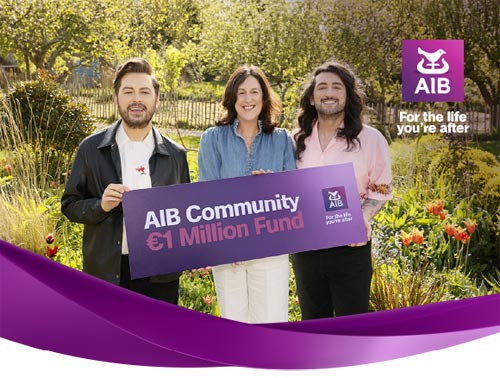
The AIB Community €1 Million Fund is now open for nominations.
Since 2022, the AIB Community €1 Million Fund has helped make a real difference in communities across Ireland, supporting almost 300 registered charities.
AIB will once again allocate €700,000 to charities chosen by its customers and the community, while €300,000 will be donated to charities chosen by employees.
As we celebrate 60 years of AIB in 2026, we’re marking this milestone by strengthening that commitment and adding an extra once-off €60,000 to the AIB Community €1 Million Fund. This will provide an additional €10,000 per region, enabling us to support even more local projects and initiatives in our communities.
If there’s a cause close to your heart, now’s your chance to get involved. Nominate your local charity for them to be in with a chance to receive funding. Nominations are open until 19th June.
RTÉ is once again at the centre of controversy after new figures revealed that more than 200 people at the broadcaster were earning over €100,000 a year by the end of 2025, including 18 individuals paid more than €200,000 annually.
This latest revelation lands after years of scandals involving hidden payments, secret commercial deals, undisclosed barter accounts, and repeated failures in transparency from Ireland’s national broadcaster.
The public was already furious after the 2023 payments scandal exposed how RTÉ had understated presenter earnings, while continuing to demand television licence payments from ordinary households struggling through a cost-of-living crisis. Trust in the organisation collapsed, senior executives resigned, and multiple government and committee investigations followed.
Yet despite the outrage, RTÉ has continued to rely heavily on taxpayer support.
In recent years, the broadcaster has effectively received two major state financial rescue packages funded by the public: ► A €725 million annual public funding model through licence fees and state support. ► An additional government-backed financial bailout package worth hundreds of millions aimed at stabilising RTÉ after the payments scandal and declining revenues.
At the same time, licence fee inspectors continued pursuing households across Ireland for non-payment, even as questions mounted over excessive salaries, waste, governance failures, and opaque contractor arrangements inside the organisation.
In Ireland, thousands of people have been prosecuted over non-payment of TV licences, but only a relatively small number have actually been jailed.
Historically; in 2012, there were about 11,500 prosecutions for TV licence non-payment. Of those convicted, 242 people were jailed, though most were imprisoned only for a few hours and six overnight. In 2008, 49 people were jailed over licence-related fines. Between 1973 and 1993, at least 15 people were imprisoned during a civil disobedience campaign linked to Irish-language broadcasting activism. More recently, prosecutions and convictions have declined sharply after the RTÉ payments scandal damaged public trust: Irish courts dealt with 7,263 prosecutions in 2022, falling to 6,555 in 2023. Nearly 15,000 court summonses were issued in 2022 alone for non-payment. Convictions for non-payment reportedly fell by around 30% over recent years amid the fallout from RTÉ controversies.
People are generally not jailed directly for “not having a licence” itself, but for failing to pay court-imposed fines after conviction. Fines can reach up to €1,000 for a first offence.
The newest figures also show nearly 1,300 people received between €50,000 and €100,000 from RTÉ in 2025, while thousands more contributors were classified as contractors.
Meanwhile, viewers and taxpayers are still asking the same unanswered question: How can RTÉ continue demanding mandatory licence fee payments from the public while repeatedly failing basic standards of transparency and accountability with public money?
For many viewers, RTÉ no longer looks like an independent broadcaster but a taxpayer-supported institution protected by Government funding, despite repeated controversies.
After receiving a €725 million taxpayer-funded rescue package, RTÉ now faces growing criticism that it has become increasingly dependent on the State while asking the public to continue funding both its operations and charitable initiatives.
RTÉ is facing mounting criticism after launching a tender process that could see up to €855,000 spent on outside consultants to manage and distribute Late Late Toy Show Appeal funds, despite the broadcaster already benefiting from a massive taxpayer-funded rescue package worth €725 million over three years.
The national broadcaster is seeking a consultancy firm to oversee grant assessments, compliance, audits, reporting, PR support and fund distribution linked to the Toy Show Appeal, which has raised more than €31 million since 2020. Crucially, the tender documents confirm that the consultancy costs “will be deducted from the Fund” itself — meaning public donations intended for children’s charities will partly finance administration and consultancy fees.
The move is likely to anger many taxpayers and viewers who have already watched RTÉ receive extraordinary levels of state support following the broadcaster’s financial and governance scandals. In July 2024, the Government approved a controversial €725 million public funding package for RTÉ covering the years 2025 to 2027, effectively guaranteeing the broadcaster’s future despite collapsing public trust after the Ryan Tubridy payment controversy.
That bailout followed an earlier emergency rescue package worth €56 million approved in late 2023.
Now, critics are asking why an organisation already heavily dependent on taxpayers and public donations requires nearly another €1 million for consultants to administer a charity fund.
RTÉ insists the appeal operates efficiently, pointing to figures claiming that 96.7% of all Toy Show Appeal money raised has gone directly to frontline charities, with operating costs accounting for 3.3% of funds raised over five years. But opponents argue that almost €900,000 in administration costs remains difficult to justify given the emotional public fundraising campaigns surrounding the annual Toy Show.
The controversy comes as RTÉ also faces backlash over its politically charged decision to boycott the 2026 Eurovision Song Contest over Israel’s participation. Ireland is among several countries refusing to participate or broadcast the event this year.
The decision is expected to drive large Irish audiences toward rival UK coverage on BBC One, over the coming nights, with BBC broadcasts now becoming the default viewing option for many Eurovision fans in Ireland.
While millions across Europe tune into Eurovision from Vienna this week, RTÉ will instead stupidly air alternative programming including reruns such as ‘Father Ted’ during the final.
For many critics, the optics are increasingly damaging; a broadcaster reliant on hundreds of millions in taxpayer support, deducting consultancy fees from children’s charity donations, while simultaneously walking away from one of Europe’s biggest television events and effectively handing audiences to the BBC.
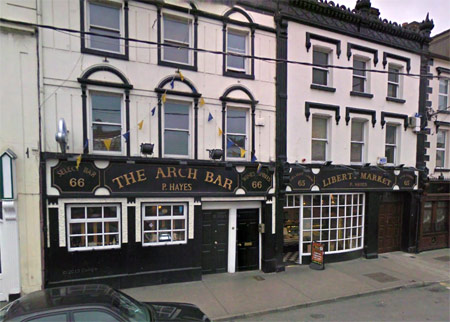
It was a damp Tuesday morning in Thurles when according to Mikey Ryan, he first heard whispers of “The Shed” in a conversation overheard in the Arch Bar. From his evesdropping he learned that this was not just any shed, no, this was “THE Shed”; a €127,000 monument to human ambition; a bicycle sanctuary if you will; a stainless-steel Cathedral to two-wheeled transportation, and a structure so majestic that local lads had begun referring to it as “The Taj Ma-Cycle.”
Mikey, using his Charlie Haughey granted free travel pass, was soon to be seen standing outside University Hospital Kerry with a chicken fillet roll in one hand and existential rage in the other.
“Sweet suffering Jaysus,” he was heard to mutter, staring up at it. “For that money they could’ve built a second hospital, or at least fixed the machine in SuperValu that keeps robbing me Clubcard points.”
The bike shed shimmered in the Kerry drizzle like a spaceship designed by accountants. A gust of wind blew dramatically through Tralee town as elderly pensioners, nurses, and one confused German tourist gathered around hospital trollies, gawked in stunned silence.
“They say,” whispered young Paudie who had journeyed down with Mikey for free, having declared himself to be an Independent Travel Support assistants, “that there’s heated bolts in it.” “Heated bolts?” said Mikey. “Heated Bolts” replied Paudie sounding like an echo. Mikey nearly fainted into a nearby puddle.
Meanwhile, inside the Dáil, panic spread quickly among the Shinners and the Peoples Before Profit Liberation Army; the announcement moving faster than free pints at an Irish wake. The Public Accounts Committee had declared the bike shed “extravagant,” which in Irish political language is only one level below “Ah now lads, come on seriously.”
Opposition politicians stormed corridors, led by Molly Loo, some carrying folders, spreadsheets, and previously unopened copies of “Value For Money For Dummies”. One TD dramatically slapped a photograph of the shed onto a desk. “This,” he roared, “is no longer infrastructure. This is performance art.” The controversy would soon echo the wider political fallout from the infamous Dáil bike shed saga at Leinster House, where a bicycle shelter costing more than €330,000, triggered a national debate on public procurement, value for money, and as suggested by a Tipperary Labour Deputy, should itself be classified as another UNESCO World Heritage Site.
Politicians now clutched spreadsheets like rosary beads, while ordinary citizens stared into the middle distance, calculating how many breakfast rolls, semi-detached houses, or actual bicycles could have been bought instead. At one point, rumours spread that the shelter included heated seating, mood lighting, and a part-time Sommelier (Latter a trained, knowledgeable wine professional), necessary for assisting exhausted civil servants arriving on electric scooters.
Meanwhile, the HSE defended the project. “It’s a long-term investment,” they insisted. “Long term” barked Mikey now back in Thurles, and seated on his couch watching RTÉ. “For €127,000 that bike shed should be curing gout and baptising children.”
Rumours spiralled wildly across Kerry. Some claimed the shed had underfloor heating. Others insisted it had held its own Eircode, three civil servants, the Healy Brothers and full diplomatic immunity. One woman swore she saw Michael Flatley emerge from it, days earlier, and at dawn surrounded in a cloud of dry ice.
Mikey Ryan was determined to uncover the truth. The next morning after a quick pint in The Arch Bar in Liberty Square, Thurles and armed only with a hi-vis Uisce Éireann jacket that he found in the boot of his cousin’s Corolla; then with the confidence of a man who once argued with a parking meter for forty minutes, he headed to Kerry to infiltrate the actual site. Inside, silence, stillness and bicycles, just normal bicycles, including a rusty Halford’s mountain bike stood, fitted with a child’s seat covered in rainwater. Another bike stood without any cycle lock; one wheel missing entirely, so it wouldn’t be stolen.
Mikey stared in disbelief. “That’s it?” he gasped. “There’s only bikes in it? I thought there’d at least be a butler.” Suddenly, a motion sensor light flicked on overhead with the drama of a Hollywood premiere. Mikey froze. The shed hummed softly around him. And then, suddenly Mikey understood. This wasn’t a bike shed anymore. No, it was a facsimile of Ireland itself; overpriced; overcomplicated; mysteriously damp and somehow still held together with zip ties and taxpayer goodwill.
A single tear rolled down Mikey Ryan’s cheek. Then he looked at the polished steel beams one last time and whispered: “Wouldn’t it be grand if they put in a coffee dock though.”
And somewhere deep in Leinster House, another civil servant was quietly ordering a €94,000 umbrella stand.
This website uses cookies to improve your experience. We'll assume you're ok with this, but you can opt-out if you wish.AcceptRead More
Privacy & Cookies Policy
Privacy Overview
This website uses cookies to improve your experience while you navigate through the website. Out of these, the cookies that are categorized as necessary are stored on your browser as they are essential for the working of basic functionalities of the website. We also use third-party cookies that help us analyze and understand how you use this website. These cookies will be stored in your browser only with your consent. You also have the option to opt-out of these cookies. But opting out of some of these cookies may affect your browsing experience.
Necessary cookies are absolutely essential for the website to function properly. This category only includes cookies that ensures basic functionalities and security features of the website. These cookies do not store any personal information.
Any cookies that may not be particularly necessary for the website to function and is used specifically to collect user personal data via analytics, ads, other embedded contents are termed as non-necessary cookies. It is mandatory to procure user consent prior to running these cookies on your website.







Recent Comments