|
|
Approval has been granted to the County Tipperary Joint Libraries Committee for the provision of a replacement library delivery van for County Tipperary.
 Thurles Library The grant to be provided, which will amount to €30,237.90 and this grant will go towards the purchase and provision of upgrading the present mobile library vehicle.
The accepted tender came from Surehaul (Irl) Ltd, and funding will come from the coffers of the Department of the Environment.
Local North Tipperary Independent TD Michael Lowry stated that this excellent scheme currently being provided by the Library Service would further enhanced the lives of the many people who currently used it, who would otherwise not be able to use the more conventional library services in North Tipperary.
He also stated that he hoped that the provision of this mobile library would further improve the service itself and he would encourage anyone who wished to avail of this mobile unit to immediately contact their nearest library to ascertain when the unit will visit in their area next.
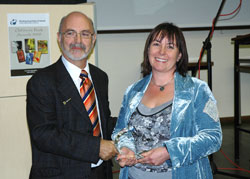 Celine Kiernan and Finian O'Shea The 2009 Reading Association of Ireland (RAI) Book Award winners were announced on Thursday, 24th September in St. Patrick’s College, Drumcondra at the opening of “Literacy in the 21st Century: Perspectives, Challenges and Transformations,” RAI’s 33rd Annual Conference on Literacy.
Celine Kiernan was awarded the 2009 RAI Book Award by Mr Finian O’Shea, ( RAI Committee Member and Lecturer in Education) at the Church of Ireland College of Education, for her debut novel ‘The Poison Throne‘.
The Poison Throne is the first book in a trilogy and this novel, set in a fictionalized fourteenth-century Europe, is a remarkable combination of court intrigue, adventure and romance. Fifteen-year-old Wynter Moorehawke returns with her father to the Kingdom after a five-year long banishment. Much has changed in that time, religion and race have become divisive and fear and loathing commonplace. Forced to abandon her father, she and her friends attempt to restore the fragile kingdom to its former stability.
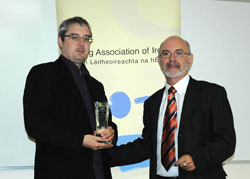 Conor Kostick and Finian O'Shea For his body of work, including his latest children’s novel ‘Move’, Conor Kostick received the 2009 RAI Special Merit Award. In ‘Move’ Conor Kostick has created an alternative view of alternative worlds and brings the reader on an unforgettable journey of adventure. In this, his third book, (‘Epic’ 2004 and ‘Saga’ 2006) Conor presents the story of Liam who has the ability to move between universes. He uses this ability to his and his friends’ advantage by moving to the reality that presents the best chance of things going their way for them. But, there are consequences of many kinds of such moves and Conor crafts a wonderful story around this.
There were eighty-eight eligible books submitted for the RAI Children’s Book Awards in 2009. Publishers north and south of the border were represented with a sizable representation of books in Irish. The initial reading of the books by the RAI jury brought that total to twenty titles, representing books for the very young to books more suited to adolescents. Each of the titles was considered over several
meetings before arriving at a short list of six titles.
Each one of the shortlisted books is a winner as each represents superior excellence in writing and in publishing for children in Ireland and indeed the list is well worth noting with Christmas just thirteen weeks away.
The remaining books shortlisted for the 2009 RAI Children’s Book Award were:
THE STORY OF IRELAND. Author: Brendan O’Brien, Illustrator: The Cartoon Saloon Publisher: O’Brien Press.
ADOLF SNA hARDA. Author: Marvin Halleraker, Translators: Treasa Ní Bhrua agus Magnus Vestvoll Publisher: Cois Life.
WILD DUBLIN. Author: Éanna Ní Lamhna, Photography: Anthony Woods Publisher: O’Brien Press.
HAL’S SLEEPOVER. Author: Maddie Stewart, Illustrator: Greg Massardier Publisher: O’Brien Press.
The RAI book awards were announced this year by Tipperary Comedian Pat Shortt .
RAI is anon-profit organisation whose primary aim is to promote and disseminate best practice in the teaching and study of literacy. It was founded in 1975 and is run on a voluntary basis by its members who comprise of educationalists at first, second and third-level. RAI is affiliated to the International Reading Association, a body with over 100,000 members worldwide. To find out more about RAI and its activities visit www.reading.ie.
Currently working on the pilot of his new series ‘Mattie’, accomplished writer, comedian, performer and Tipperary native Pat Shortt, took some time out of his hectic filming schedule to check out the six books, shortlisted for the 2009 Reading Association of Ireland (RAI) Children’s Book Award.
Established in 1984, the RAI Children’s Book Award has been awarded every second year to the authors and illustrators of outstanding books for children and adolescents published in Ireland.
Six Books Shortlisted For The 2009 RAI Children’s Book Award
THE STORY OF IRELAND
Author: Brendan O’Brien.
Illustrator: The Cartoon Saloon
Publisher: O’Brien Press
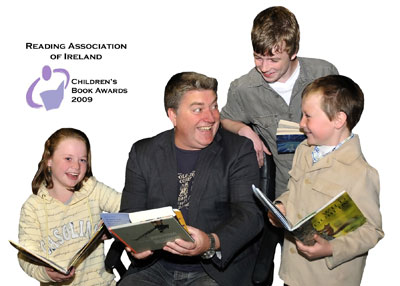 Pat Shortt with Tipperary readers Maria Cullinane, Ryan Grace and Killian Cullinane. WILD DUBLIN
Author: Éanna Ni Lamhna
Photography: Anthony Woods.
Publisher: O’Brien Press
MOVE
Author: Conor Kostick
Publisher: O’Brien Press
THE POISON THRONE (Book 1, The Moorehawk Trilogy).
Author: Celine Kiernan
Publisher: O’Brien Press
ADOLF SNA hARDA
Author: Marvin Halleraker
Translators: Treasa Ní Bhrua agus Magnus Vestvoll
Publisher: Cois Life
HAL’S SLEEPOVER
Author: Maddie Stewart
Illustrator: Greg Massardier
Publisher: O’Brien Press
The 2009 RAI Book Award winners will be announced on Thursday, 24th September next in St. Patrick’s College, Drumcondra at the opening of “Literacy in the 21st Century: Perspectives, Challenges and Transformations,” RAI’s 33rd Annual Conference on Literacy.
The RAI is a non-profit organisation whose primary aim is to promote and disseminate best practice in the teaching and study of literacy. It was founded in 1975 and is run on a voluntary basis by its members who comprise of educationalists at first, second and third-level. RAI is affiliated to the International Reading Association, a body with over 100,000 members worldwide.
To find out more about RAI and its activities visit www.reading.ie.
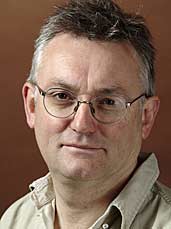 From the author of The Celtic Tiger: The Myth of Special Partnership (2000) and The Corporate Takeover of Ireland (2007) comes a new book entitled ‘Irelands Economic Crash’. From the author of The Celtic Tiger: The Myth of Special Partnership (2000) and The Corporate Takeover of Ireland (2007) comes a new book entitled ‘Irelands Economic Crash’.
The author, Dr. Kieran Allen, a senior lecturer at the School of Sociology in University College Dublin, recounts how a miracle economy turned into an economic disaster zone. While ordinary people suffer hardships, the government seeks solutions through bailing out banks and imposing wage cuts, levies and reductions in basic public services. The result is a downward spiral with further unnecessary expenditure, skyrocketing health care costs, soaring personal debt and increased government spending.
Ireland’s Economic Crash is a call for new thinking about economic alternatives for Ireland’s future
In this damning critique, Dr Allen advocates a withdrawal of state support to private banks and the creation of a “good” public banking system. He calls for a scheme of public works to give jobs to the unemployed and to stimulate an economy on the verge of extinction. He argues that those who made vast fortunes during the boom years should carry the cost of cleaning up the mess they largely created. Shifting from the local to global dimensions, Allen examines the reckless growth of our ‘casino economy’ where valuable resources were squandered by hedge funds and other financial speculators. He suggests that our current ‘for profit’ system is facing a deep, long-term crisis.
Written in a clear and very accessible style, this book backs up its claims using carefully marshalled evidence and logical argument, destroying five myths about the Irish crash, including the belief that we must all share pain. It further goes on to propose specific solutions to our present crisis.
Dr Allen launched his book at a public meeting in Grants Hotel, Castle St., Roscrea, Co. Tipperary recently.
Th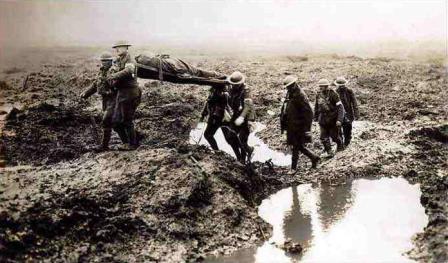 urles author Tom Burnell colaberates with his brother Seamus Burnell to produce his second book entitled The Wicklow War Dead. urles author Tom Burnell colaberates with his brother Seamus Burnell to produce his second book entitled The Wicklow War Dead.
This new book contains a full record, for the first time, of some 840 soldiers, officers, sailors, airmen, nursing sisters from County Wicklow, 752 from WW1, together with the names of casualties who listed their next of kin as residents of Co.Wicklow. Casualties named, died during WW1 and WW2 while in the service of the British Army, the Australian Army, the NewZealand Army, the American Army, the Indian Army, the Nursing Service, the Canadian Army, Queen Mary’s Army Auxiliary Corps, Queen Alexandra’s Imperial Military Nursing Service, the South African Army, the Royal Navy and lastly the Mercantile Marine.
There were seven children born to Patrick (Pakie) and Peggy (Margaret) Burnell in Finglas, Dublin during the 1950s. Margaret, Paddy, Tom, Seamus, Paul, Greg and Michelle and four of the lads served in the Irish Defence Forces here at home, on the South Armagh, Monaghan, Cavan, and Louth borders, during the ‘troubles’ and overseas with the United Nations on peace keeping duties. Their relations have fought in World War 1 and World War 2 and two of them died during the Irish Civil War. It is therefore no mystery that the author and his brother still hold an interest in all things military.
Like most Dublin families at least one of their parents came from outside The Pale, so it was not surprising that every one of Pakie Burnell’s children moved out of Dublin to the countryside to enjoy a more peaceful and a slower pace of life. Some things are taken for granted by people who reside in rural areas, not least of which is that they are surrounded by history and solitude.
This new book contains not only all the casualties of two World Wars buried in County Wicklow but also includes those who were not native to Irish soil. The disproportionate amount of Wicklow casualties sent to watery graves by German torpedoes, mostly men from Arklow in Co.Wicklow, were one of the major surprises in this research, as were the number of unfortunate airmen who came to rest here in the Garden of Ireland from places far afield. Wicklow men were involved in every action of both wars on land, sea and in the air. Some of them died of their wounds in England after receiving a ‘blighty wound’. However the majority of them died on varying battlefields. A surprising amount of these have no known graves and remain just a name on a cold stone memorial.
If no one-else remembers these unfortunate men and women, their sacrifice will at least be recorded thanks to this little book ‘ The Wicklow War Dead’.
|
Support Us Help keep Thurles.info online by donating below. Thank you.
Total Donated 2026: €300.00
Thank You!
Daily Thurles Mass Livestream
|



Recent Comments