|
|
Junk Kouture is all about creating fashion from recyclable materials of every sort. Its purpose is to encourage young future designers, in second level institutions, to create striking couture designs and impressive works of wearable art, from simple everyday junk that would normally find its way into our rubbish tips.
So, how popular is this competition? Well try to obtain a ticket for the Southern Regional Final in Limerick on March 9th next, and you will find the Venue is fully ‘Sold Out’.
This year once again a total of 6 young creative designers from Transition Year at the Ursuline Convent Secondary School in Thurles have taken part in the ‘National Junk Kouture Competition 2018’, sponsored by Bank of Ireland (BOI).
It is no secret that the annual National Junk Kouture competition aims to inspire and ignite passion in young teenagers, while at the same time subtly educating them regarding the importance of recycling and the reusing of what is too often regarded as waste materials.
Over the past number of years, Bank of Ireland’s Junk Kouture event has established itself as the premier recycling fashion competition for teenagers throughout Ireland and Northern Ireland; and in 2015, extended its creative platform, further afield; to the shores of Scotland.
Featured here are just two of the Ursuline Convent’s very imaginative, chosen dress designs, entitled “All Wired Up”, [modelled /designed by Miss Elena Quirke and design aided by Miss Alannah O’Donoghue and Miss Saoirse Quirke] ; and “Palette Prisoner”, [modelled and designed by Miss Benita Wrochna and design aided by Miss Kayleigh Fogarty and Miss Kathelyn Egan.]
Congratulations! “Super designs and we wish all students taking part at the Ursuline Convent Secondary School, including those not featured here, the very best of luck”.
M/s Imelda McDonagh to Adjudicate at the Co. Tipperary Open Drama Festival in Holycross, Thurles, Co. Tipperary, from March 16th to March 24th.
Author and Freelance Journalist Tom Ryan Reports:-
 M/s Imelda McDonagh Holycross/Ballycahill Drama Group, Thurles Drama Group and Nenagh Drama Group will be the Co. Tipperary representatives in the prestigious Co. Tipperary Open Drama Festival to be held in St. Michael’s Community Centre, Holycross. Competitors will bid for an array of awards, including the “Tipperary Star Cup” in the Confined Section and the “Tipp FM Trophy” in the Open Category.
The Festival Director is Mr Donal Duggan as usual and a dedicated committee have been working diligently to maintain the proud traditional status of the Abbeysiders in this great festival featuring the country’s top drama groups staging some of the world’s finest drama.
Meet Adjudicator M/s Imelda McDonagh
Adjudicator, Imelda McDonagh, is an award-winning director and actress with a first-class Honours M.A. in Theatre Studies. She is a qualified Make-Up Artist and holds a Licentiate (Speech and Drama) from The London College of Music.
Well known for her various acting roles as ‘Lady Bracknell’, in Oscar Wilde’s “The Importance of Being Earnest”; ‘Blanche’, in Tennessee William’s “A Streetcar Named Desire”; ‘Baglady’, in the rarely performed Frank McGuinness play of the same name; ‘Stephanie’, in Tom Kempinski’s “Duet for One”; ‘Gertrude’, in William Shakespeare’s “Hamlet”, and ‘Kate’, in Arthur Miller’s “All My Sons”.
She recently performed with The Dublin Shakespeare Society, as part of the Shakespeare 400 celebrations and as ‘Maisie Madigan’ in the second of Sean O’Casey’s Dublin Trilogy, “Juno And The Paycock”.
Also, much at home in the world of musical theatre, M/s McDonagh has won the coveted Association of Irish Musical Societies’ award for ‘Best Director’, for her production of Samuel and Bella Spewack / Cole Porter’s, “Kiss Me Kate”, for Gorey, (Co. Wexford) Musical Society, and was nominated as ‘Best Director’ for the Irish Premiere of Alistair McGuckian’s “The Ha’penny Bridge”.
Her most recent production was the loosely based on actual events musical, “Footloose” (Music is by Tom Snow, lyrics by Dean Pitchford, and book by Pitchford and Walter Bobbie), for the Oyster Lane Theatre Group, her seventeenth musical to date.
Imelda has enjoyed adjudicating throughout Ireland since 2001, including the finals for Macra and the Irish Country Women’s Association (ICA) and the Confined All-Ireland Drama Finals, in Tubbercurry in 2017.
She is also secretary of The Association of Drama Adjudicators and has recently been awarded “The Civic Merit Award” for her services to the community by Irish President, Michael D. Higgins.
Programme of Plays and Drama Groups (D.G.)
Friday, March 16th, – (Open) – “Unbroken Circle”, – Gorey L.T.G..
Saturday, 17th March, –(Confined) – “The Beauty Queen of Leenane”, – Kilworth D.G..
Sunday, 18th March, – (Confined) – “Abigail’s Party”, – Skibbereen D.G..
Monday, 19th March – (Confined) – “Caught in the Net”, – Conna D.G..
Tuesday 20th March – (Open) – “Stolen Child”, – Brideview D.G..
Wednesday 21st March – (Open) – “Blyth Spirit”, – Thurles D.G..
Thursday 22nd March – (Confined) – “Some Girls”, – Curtain Call, Dungarvan D.G..
Friday 23rd March – (Confined) – “Bold Girls”, – Holycross/Ballycahill D.G..
Saturday, March 24th – (Open) – “Duet For Two”, – Nenagh D.G..
Conor O’Connell to adjudicate unique Schools Drama Festival
The County Tipperary Open Drama Festival Schools Festival, the only such event in Ireland will be held on Tuesday, March 13th, starting at 7.30pm.
The entries to date include Ursuline Convent Secondary School, Thurles; Presentation Convent Secondary School, Thurles; and Colaiste na Trionoide, Doon, east Co. Limerick, who will stage two plays.
The adjudicator is once again Mr Conor O’ Connell, nephew of former Thurles hotelier and businessman, Mr Derek O’Connell. A great friend of the organising committee; Conor has himself starred in an acting role on stage in Holycross, with the renowned Silken Thomas Players and who was a big hit with the young players last year.
The magnificent recently restored Cathedral of The Assumption, situated here in Cathedral Street, Thurles, Co. Tipperary, looks particularly attractive at Christmas time each year; enhanced by the construction of the Nativity Scene. Same takes the form of a manger or crib located in a stable, together with other art objects (e.g. figures of the three wise men or Magi, shepherds, camels, donkeys, sheep and cattle, and of course Mary the mother of Jesus, with her husband Joseph) each and all representing and reminding us of the birth of Jesus Christ, which we celebrate and as recounted to us through Bible stories, to be found referred too, in particular, in some of the 27 books which make up the New Testament.
At this time each year the manger scene annually reminds me of the actions of my now long deceased (1969) grandmother. In her later years she would request her local friendly postman (Mr Walsh) to visit the local crib, giving him between a sixpenny piece and a half crown (latter a former denomination of money, equivalent to two shillings and sixpence or almost one day’s labourer’s pay back in the late 1950’s) to put into the collection box. The postman would remove a piece of straw from the crib and this would be placed in my grandmother’s purse, where it would remain until the following week of Christmas.
This action she assured me would guarantee that regardless of prevailing economic conditions, God would continue to supply all her needs. Strangely, I must admit that despite living in lowly impoverished circumstances all of her 90-year life span, her purse never appeared to empty, and saw her paying all her bills on time, while never having reason to be sent into hospital ever. Today our own home continues with this Christmas and Christian practise.
Of course, it is St. Francis of Assisi, (Patron Saint of Italy and one of the most venerated religious figures in our history) who is credited with creating the first live nativity scene, way back around 1223; his objective to cultivate the worship of Jesus Christ. We are given to understand that he had recently been inspired by his own personal visit to the Holy Land, where he had viewed the traditional birthplace of Jesus Christ. The nativity scene, therefore, which he presented, can be viewed as his ‘physical modern-day holiday snap’.
So if you are in and around town over Christmas or if you are attending tonight’s Service of Christmas Carols in the Cathedral of The Assumption, do visit with your kids; it makes for nostalgia; long remembered reminiscences of happy family togetherness.
Leaving Cert play ‘The Trial’ takes to the stage in Borrisoleigh Hall.
This coming Bank Holiday Weekend (April 28th, 29th & May 1st 2017) will see Borrisoleigh Drama Group present their latest stage production, ‘The Trial’.
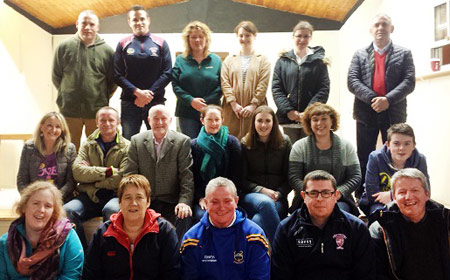 Cast of ‘The Trial’ to be staged in Borrisoleigh Community Hall on April 28th, 29th & May 1st, 2017. The play was originally written in Irish as ‘An Triail’, by the Irish playwright Máiréad Ní Ghráda and is part of the Irish language curriculum for the Leaving certificate.
The play is set in Ireland during the 1960’s and deals with the pregnancy, and subsequent single motherhood of a young woman, (played by Antoinette McMahon) latter who is shunned by her family, spends time in a mother and baby home and in some rather unsavoury accommodation in Dublin city.
The play travels back and forth between “flashbacks” and the trial itself and contains adult themes, perhaps suitable for more mature audiences.
People are advised to book their seats early, as last year’s very successful run of ‘The Chastitute’, by John B. Keane, which was also performed by Borrisoleigh Drama Group; same was completely sold out over the 3 night period, hence much disappointment.
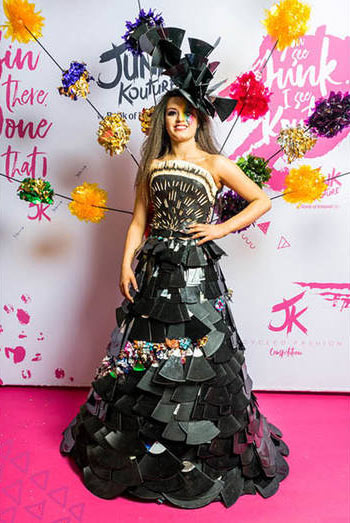 Ursuline Convent’s fabulous ‘Junk Kouture’ design ‘Kamuro’. Junk Kouture is all about creating fashion from recyclable materials of every sort. Its purpose is to encourage young future designers, in second level education, to create striking couture designs and impressive works of wearable art, from everyday junk that would normally find its way into our rubbish dumps.
This year a number of young designers from Transition Year at the Ursuline Convent here in Thurles are taking part in the ‘National Junk Kouture Competition’, sponsored by Bank of Ireland (BOI).
It is no secret that the annual National Junk Kouture competition aims to inspire and ignite passion in young teenagers, while at the same time subtly educating them about the importance of recycling and the reusing of waste materials.
Over the last six years, Bank of Ireland’s Junk Kouture has established itself as the premier recycled fashion competition for teenagers throughout Ireland and Northern Ireland and in 2015 extended its creative platform, further afield, to the shores of Scotland.
This year the Ursuline Convent’s very imaginative, chosen, dress design, entitled “Kamuro”, was initially inspired by fireworks going off in our Thurles night sky. The firework explosion formation known as ‘Kamuro’, (Japanese for ‘boy’s haircut’) creates a tight cluster of silver or gold stars, with attendant glittery, cloudy trails, leaving the viewer hard-pressed not to see what appears to be a ‘haircut’ in the sky.
The dress, affected totally from recycled materials only, was contrived and manufactured over a seven month period by student designer’s M/s Winona Ryan, M/s Sarah Ryan and M/s Roisin Heffernan.
These Ursuline students would really appreciate if you could vote for their dress design in this national final. Voting was launched on Monday last 3rd April 2017 @ 9am and closes at midnight on Friday 14th April 2017.
You can greatly assist their efforts in this competition simply by clicking HERE and picking out their dress called KAMURO, then click on it to vote. See flashing “Click here to vote” at top of web page. (Above last year’s winner’s head.) Do not forget “Hit that share button also”.
Do remember you can vote once every 24 hours and every vote counts!
The Grand Final of Bank of Ireland Junk Kouture, for which tickets are available, takes place at the 3Arena, North Wall Quay, North Dock, Dublin 1, on Thursday 27th of April 2017, beginning at 7.00pm (19:00hrs) sharp.
Amongst the many valued prizes up for grabs on the night, the winning school can picks up €2,500 in cash and takes home the valued Junk Kouture Trophy.
 “Super design and best of luck to all students taking part.” “Super design and best of luck to all students taking part.”
|
Support Us Help keep Thurles.info online by donating below. Thank you.
Total Donated 2026: €300.00
Thank You!
Daily Thurles Mass Livestream
|



Recent Comments