The growing use of LED street lights, floodlights and security lighting is raising serious concerns about the impact of artificial light on bats, migratory birds, insects and the wider natural environment. Recent court proceedings have highlighted why these concerns cannot simply be ignored.
Modern LED lighting is widely promoted as environmentally friendly because it consumes less electricity, reduces carbon emissions and lowers maintenance costs. However, an important question is increasingly being asked; Are we saving energy at the expense of our wildlife?
Scientific research confirms that artificial light at night can interfere with the natural behaviour of wildlife, disrupting feeding, migration, reproduction and essential biological rhythms. For thousands of years, wildlife has depended upon the natural cycle of daylight and darkness. Today, that delicate balance is increasingly disturbed by powerful artificial lighting.
Back in August 2024 aspeciesofPipistrelles Batcaused similar delays in the erection of a €3.4 million project in Cathedral Street, Thurles.The work has since been completed.
Bats Are Particularly Vulnerable. Ireland’s bats are legally protected, yet many are highly sensitive to artificial illumination. Bats depend upon dark hedgerows, rivers, woodlands and countryside corridors to travel between their roosts and feeding grounds. Bright street lights can discourage certain bat species from using established routes, effectively creating barriers across otherwise suitable habitats. Lighting near roosting sites can delay bats emerging to feed, reducing opportunities to catch insects during the important hours after sunset. Although some bat species feed around street lights, others actively avoid them. Consequently, installing additional lighting may benefit a few species while seriously disadvantaging others.
Migratory Birds Also Face Serious Risks. Artificial lighting can disorient birds migrating at night, drawing them away from established routes and increasing the risk of exhaustion and collisions. Floodlighting near wetlands and feeding grounds can also discourage protected birds from using habitats essential to their survival. This is especially concerning where conservation measures are intended to restore declining bird populations.
Insects. Insects, meanwhile, are attracted to artificial lights, which can interfere with their feeding, reproduction and pollination activities. The consequences extend throughout the food chain.
Hundreds of roosting Pied Wagtails congregate nightly all year round, unnoticed in Liberty Square, Thurles, Co. Tipperary.
An Important Irish High Court Decision In May 2024, the Irish High Court found in favour of environmental organisation Dark Sky Roscommon in a challenge concerning planning permission for 21 floodlights at Tarmon National School, County Roscommon. The case concerned potential effects on the nearby Bellanagare Bog Special Protection Area, associated with the protected Greenland white-fronted goose. The Court found that An Bord Pleanála had failed to properly address reasonable scientific concerns regarding the development’s possible impact on the conservation objectives of the protected area, including the potential return of the geese. The ruling demonstrated that planning authorities must take potential ecological impacts seriously and comply with European environmental assessment requirements. Importantly, this was not a general court ban on LED lighting, nor was it a confirmed order permanently switching off the installed floodlights. Nevertheless, it provides a significant legal warning against overlooking wildlife protection when approving lighting developments.
Why This Matters in County Tipperary This issue has direct relevance to Tipperary. Tipperary County Council is undertaking a substantial programme of converting public street lights to LED technology. According to its 2025 Climate Action Progress Report, the Council maintains approximately 19,000 public lights, with more than 10,000 converted to LED by September 2025. Further upgrades were expected during 2026. Energy efficiency and cost savings are important public objectives. However, the ecological consequences must also be considered. Tipperary contains extensive rivers, hedgerows, woodlands, wetlands and countryside habitats supporting protected wildlife. The River Suir and its associated habitats are particularly important examples of environments where inappropriate lighting could affect wildlife movement and feeding. Significantly, Tipperary County Council’s own Public Lighting Policy, adopted in December 2022, recognises the need for special consideration of lighting near bat roosts, dark-sky areas and environmentally sensitive locations. The question is whether these safeguards are being consistently implemented as LED lighting expands.
Cloughjordan, Co. Tipperary Shows Another Way. There is encouraging news from Tipperary itself. In April 2026, press reported that Cloughjordan Ecovillage had introduced an innovative wildlife-sensitive lighting scheme. Ecological surveys recorded eight of Ireland’s nine established bat species foraging in the ecovillage, along with an impressive diversity of moths. The community responded with carefully directed, warm-coloured, dimmable LED lighting, designed to preserve darkness while allowing residents to move safely at night. Representatives of Tipperary County Council and Bat Conservation Ireland welcomed the initiative. Cloughjordan demonstrates that public safety, modern lighting and biodiversity protection need not be mutually exclusive.
Time for a Countywide Approach? Surely it is reasonable to ask that all new and replacement public lighting in Tipperary be assessed for potential ecological impacts, particularly near rivers, hedgerows, mature trees, bat roosts and protected habitats.
Practical measures could include: Using warmer-coloured, lower-intensity lighting where appropriate. Directing illumination downwards and preventing unnecessary light spill. Dimming or switching off unnecessary lighting during quieter hours, where safe. Maintaining dark wildlife corridors. Undertaking appropriate ecological assessments before installing lighting in sensitive locations.
None of this requires abandoning energy efficiency or compromising essential road safety. It requires thoughtful planning, appropriate technology and recognition that darkness is itself an important natural resource. Sadly in Thurles Co. Tipperary, street lighting remains lit both day and night for the past 4 years.
Protecting the Night Is Protecting Nature Ireland has rightly invested considerable effort in protecting biodiversity, restoring habitats and addressing climate change. Yet these objectives risk being undermined if artificial lighting continues to expand without sufficient regard for nocturnal wildlife. The High Court decision in Roscommon should encourage planning authorities throughout the country to examine the ecological consequences of lighting carefully. Tipperary already has an excellent example of what can be achieved at Cloughjordan Ecovillage. Perhaps the time has come for Tipperary to lead by example, ensuring that the drive towards energy-efficient lighting does not leave our bats, migratory birds and other wildlife struggling to survive in an increasingly illuminated world.
Saving electricity matters. Saving wildlife matters too. We should be capable of doing both.
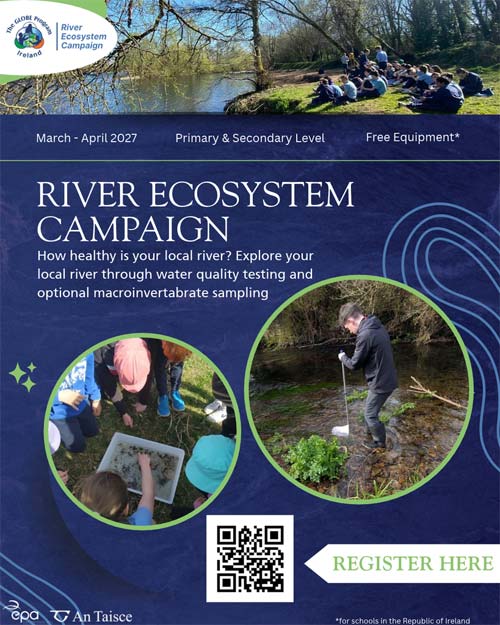
Registration is now open for the GLOBE Ireland River Ecosystem Campaign 2027. Open to primary and secondary schools nationwide, this hands-on citizen science project gives students the opportunity to investigate the health of their local river while contributing valuable environmental data to a national database.
River Ecosystem Campaign. GLOBE Ireland are inviting schools to take part in this exciting campaign, which will take place during March and April 2027. Participating students will visit their local river ecosystem and explore its health through visual analysis, water sampling, chemical testing, and ecological monitoring. Schools will contribute their findings to the GLOBE international database, helping to build a picture of river health across Ireland. All participating schools will receive free teacher training and support and equipment packs containing everything needed to take part. The campaign will also feature an Expert Webinar, Student Sharing Webinar and GLOBE Ireland Annual Project Competition, which are open to all enrolled schools. Register Your School Places are limited. Registration is open until 27th November 2026 or until all places have been filled. Register to take part here: River Ecosystems Campaign 2027
Learn more. For more information on GLOBE Ireland and their campaigns, email globe@antaisce.org.
GLOBE (Global Learning and Observations to Benefit the Environment) is an international environmental citizen science programme which is active in over 127 countries. In Ireland, the programme is delivered by An Taisce’s Environmental Education Unit (EEU) and is supported and funded by the EPA. The programme delivers citizen science campaigns to hundreds of primary and secondary schools nationwide each year, on themes including climate resilience, air quality, and water quality.
Pre-deceased by her son Philip, parents Paddy and Mary Hickey, grandson Philip, brother Pat and son-in-law Jim (Corcoran); Mrs McNeill, sadly, passed away while in the care of staff at Mercy University Hospital, Cork.
Her passing is most deeply regretted, sadly missed and lovingly remembered by her sorrowing family; husband Philip sons Patrick, Wesley, Trevor and Stephen, daughters Angela, Leona and Yvonne, daughters-in-law Tina, Kathleen and Kirsten, sons-in-law Trevor and David, adored grandchildren and great grandchildren, sister Ann, sister-in-law Mary, brother-in-law Kevin, nieces, nephews, extended relatives, neighbours and many friends.
For those persons who would wish to attend Requiem Mass for Mrs McNeill, but for reasons cannot, same can be viewed streamed live online, HERE.
The extended McNeill and Hickey families wish to express their appreciation for your understanding at this difficult time, and have made arrangements for those persons wishing to send messages of condolence, to use the link shown HERE.
Deputy Joe Cooney Calls For Examination Of Emergency Response Capacity And Ambulance Provision Across North Tipperary, Clare & Limerick.
Deputy Joe Cooney TD.
The Mid-West recorded the lowest proportion of out-of-hospital cardiac arrest patients transported to hospital in Ireland in 2025, alongside the lowest rate of return of spontaneous circulation (ROSC), [ROSC is the resumption of a sustained, natural heart rhythm and effective blood circulation after cardiac arrest] according to figures provided by the National Ambulance Service (NAS) to Fine Gael TD Joe Cooney.
Deputy Cooney said these figures raised important questions about emergency response capacity and ambulance provision across North Tipperary, Clare and Limerick, particularly given the region’s combination of longer ambulance response times and lower rates of ROSC and hospital transport.
The figures, released in response to parliamentary questions submitted by Deputy Cooney, show that just 29% of cardiac arrest patients in the Mid-West were transported to hospital last year, compared with a national average of 38%. Of the 233 out-of-hospital cardiac arrest cases recorded in the Mid-West where resuscitation was attempted or continued, just 68 patients were transported to hospital. The region also recorded a median ambulance call-to-scene response time of 17 minutes, compared with the national median of 15 minutes. This was joint highest nationally, alongside the West and North West region.
The figures further show that the Mid-West had the lowest rate of return of spontaneous circulation, at 21%, compared with the national average of 25%. The proportion of patients achieving ROSC on arrival at hospital was also the lowest nationally, at 17%, against a national average of 20%. The percentage of patients surviving to hospital discharge in the Mid-West was 7.3%, compared with 9.7% nationally.
Deputy Cooney said, “When somebody suffers a cardiac arrest, every minute matters. The speed of the emergency response and the availability of appropriate resources can be critical. While the National Ambulance Service has advised that there is no statistically significant difference in survival rates between the regions, the combination of these figures raises legitimate questions about how emergency services are operating across the Mid-West. We need to understand whether there are particular challenges arising from the region’s geography, rural communities, ambulance deployment or access to emergency hospital services.People living in rural parts of Clare, in particular, need to have confidence that they can access an effective and timely emergency response when they need it.”
In its response, the National Ambulance Service said that a higher proportion of cardiac arrest patients were transported to hospital in the more urban regions, particularly Dublin and the North East and Dublin and Midlands regions. However, it also stated that there was no evidence that a higher proportion of patients being transported was associated with higher survival.
The NAS cautioned that regional differences in survival outcomes should be interpreted carefully because of the relatively small number of cases, adding that there was no statistically significant difference in survival to hospital discharge between the six HSE Health Regions. Deputy Cooney said he would be seeking further clarification from the HSE and National Ambulance Service on the factors contributing to the figures.
“I want to establish what work has been undertaken to examine why the Mid-West has the lowest transport rate and whether differences in ambulance response times, rural coverage or the availability of resources are contributing factors. I will also be seeking information on ambulance deployment across the region, the role of community first responder schemes and what additional measures could help improve emergency response times. This is about ensuring that people in Clare, Limerick and North Tipperary receive the same standard of emergency care and have the best possible chance of survival when faced with a life-threatening medical emergency.”
These figures are deeply concerning, particularly for rural communities in North Tipperary. The question must now be asked: Why are our North Co. Tipperary TDs, (namely Lowry, Kelly & O’Meara), all remaining so silent on such a serious issue? Where is the outrage, the accountability and the demand for better ambulance services? When lives are at stake, silence is simply not good enough. The people of Tipperary deserve answers and action, not excuses.
55% of wastewater treatment plants in Ireland discharged wastewater that failed to meet EPA standards designed to prevent pollution.
Failures at half of these treatment plants were due to inadequate operation and maintenance.
Four more towns and villages stopped discharging raw sewage following connection to new treatment plants.
Essential wastewater infrastructure upgrades needed to prevent pollution and protect the environment are not being delivered quickly enough.
The Environmental Protection Agency (EPA) published its Urban Wastewater Treatment in 2025. The report today, highlights the need to accelerate the delivery of wastewater infrastructure and improve the operation and maintenance of existing treatment plants.
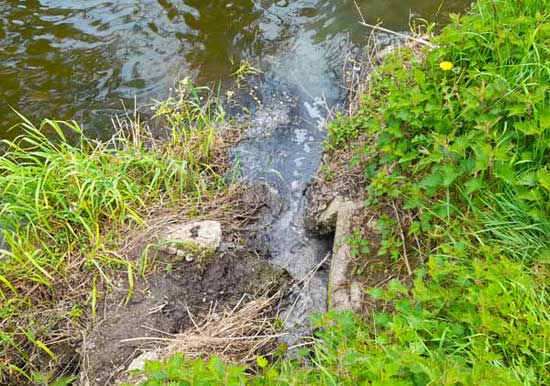
Effluent and waste water flowing into the river Suir in Thurles, Town centre for the past 13 years.
Investment at priority areas identified by the EPA continues to deliver environmental improvements while supporting housing development and sustainable economic growth. However, the necessary treatment infrastructure is not being delivered quickly enough or at the scale required. Furthermore, existing treatment plants are not being properly operated and maintained, undermining the environmental benefits of increased investment in new wastewater infrastructure. As a result, wastewater discharges continue to harm water quality in rivers, estuaries, lakes and coastal waters, and pose a risk to human health.
Wastewater discharged from 55% of licensed treatment plants did not consistently meet the standards set in wastewater discharge licences by the EPA to prevent pollution and protect the environment. Roughly half of failures were due to deficient infrastructure, while the other half were due to poor operation and maintenance.
Launching the report, Mr Pat Byrne, Director of the EPA’s Office of Radiation Protection and Environmental Monitoring said: “Investment in new treatment plants is helping to protect the environment and delivering benefits for local communities, such as in Ramelton, Rathmullan and Milford in Co. Donegal. However, EPA inspections continue to identify poor operational practices and inadequate maintenance of wastewater infrastructure, resulting in wastewater being discharged without proper treatment and adversely impacting water quality. Many of these failures could and should have been prevented, and Uisce Éireann must take immediate and effective action to address these failings.”
While operation and maintenance issues can be addressed in the short term, upgrading deficient infrastructure is a longer-term challenge because of the scale of work involved and the investment required. The EPA has identified 72 priority areas where action is most urgently needed to prevent pollution and protect the environment. These include 13 towns and cities that failed to meet mandatory European-wide wastewater treatment standards introduced more than thirty years ago.
Mr Noel Byrne, EPA Programme Manager, said: “It is encouraging to see critical infrastructure projects such as the upgrade of Ringsend treatment plant being delivered. However, progress by Uisce Éireann in delivering works at many EPA priority areas remains too slow, with around 60% of these areas still not started. This is prolonging impacts on the environment. Uisce Éireann must accelerate the delivery of these essential improvements.”
The EPA’s Urban Wastewater Treatment in 2025 report and the list of priority areas are available on the EPA website. The priority areas list includes the environmental issues at each location and Uisce Éireann’s plans to address them.
This website uses cookies to improve your experience. We'll assume you're ok with this, but you can opt-out if you wish.AcceptRead More
Privacy & Cookies Policy
Privacy Overview
This website uses cookies to improve your experience while you navigate through the website. Out of these, the cookies that are categorized as necessary are stored on your browser as they are essential for the working of basic functionalities of the website. We also use third-party cookies that help us analyze and understand how you use this website. These cookies will be stored in your browser only with your consent. You also have the option to opt-out of these cookies. But opting out of some of these cookies may affect your browsing experience.
Necessary cookies are absolutely essential for the website to function properly. This category only includes cookies that ensures basic functionalities and security features of the website. These cookies do not store any personal information.
Any cookies that may not be particularly necessary for the website to function and is used specifically to collect user personal data via analytics, ads, other embedded contents are termed as non-necessary cookies. It is mandatory to procure user consent prior to running these cookies on your website.







Recent Comments