Percy French celebrated the County Limerick village of Dromcollogher in his comic song Drumcollier, [ Vocals:- The late Irish Tenor Brendan O’Dowda, (1925–2002 ) ], also recorded under spellings such as Dromcolliher. After receiving a particularly warm welcome there during a visit in the 1890s, the songwriter immortalised the village and its famously compact main street.
That same street was to become the setting for one of the darkest episodes in modern Irish history. On Sunday, September 5th, 1926, 100 years ago today, a fire in a makeshift cinema above Mr Patrick Brennan’s hardware store killed 48 men, women and children. The catastrophe would thereafter be remembered locally by two words: “The Burning.”
The upstairs loft normally functioned as an informal community hall, hosting meetings, dances and theatrical performances. It was an L-shaped timber structure, approximately 50 feet long and 15 feet wide, positioned about 12 feet above the store floor. Access was through a single narrow door reached by a steep wooden staircase. Small windows at the back were fitted with bars, while much of the roof, internal partitioning and wall covering was made from combustible materials.
The film show was organised by local hackney driver Mr William “Babe” Forde in association with Mr Patrick Downing, a projectionist employed at a Cork cinema. The films had reportedly been removed from the Cork venue, which did not open on Sundays, and brought to Dromcollogher without their protective metal cans.
Around 150 spectators paid nine pence each and crowded onto benches in the loft. The screening was scheduled for after Sunday-night Benediction in nearby St Bartholomew’s Church. The programme began with a short film called “False Alarm”, followed by the main feature, “The Decoy”.
At approximately 9:50pm, shortly after the second film began, a candle, being used near the projector, fell and ignited exposed cellulose-nitrate film. The nitrate film was extraordinarily flammable and, once alight, burns with fierce intensity.
The fire rapidly spread from the projection area to the timber floor, partitioning and wall covering. A burning reel was reportedly carried towards the entrance during the initial panic and fell near the wooden stairs, obstructing the loft’s only normal exit.
People rushed towards the opposite end of the room. Someone eventually forced apart the bars on one of the rear windows, allowing several spectators to jump onto piles of hay below. That escape route was soon blocked, however, and many remained trapped inside.
Within approximately 10 to 15 minutes, the roof fell in and the loft floor collapsed into the hardware store beneath it. Forty-six people died at the scene. Two more who escaped subsequently died from their injuries, bringing the final death toll to 48; almost one person in every ten then living in Dromcollogher.
Fifteen of the victims were children, while more than half were under the age of 25. The youngest, James Kenny and Thomas Noonan, were both seven years old; the oldest victim, Ms Mary Turner, was 68.
An entire household was also among the dead; retired national schoolteacher Mr Jeremiah Buckley; his wife, Ellen; their ten-year-old daughter, Bridie; Ellen’s sister Mrs Kate Wall; and the family’s maid, Ms Nora Kirwan.
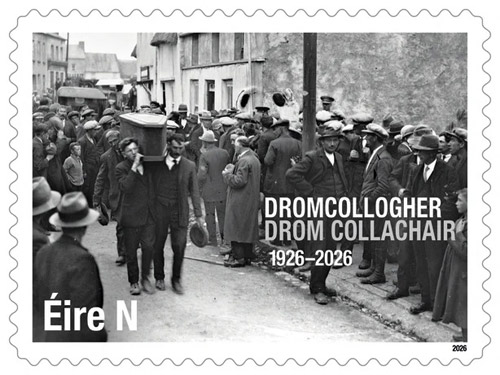
A vigil was maintained through the night as the remains were recovered from the ruins. Identification was extremely difficult, and many victims could not be recognised. Forty-six of the dead were subsequently buried together in an enormous communal grave in the grounds of St Bartholomew’s Church.
President of the Executive Council W. T. Cosgrave attended the funeral. Messages of sympathy arrived from King George V, religious leaders, local authorities, trade unions and organisations throughout Ireland and abroad. Cosgrave established a national relief fund for those affected by the catastrophe; remarkably, its final payments were not made until 1958.
The disaster immediately raised questions about responsibility. Although existing legislation required commercial film venues to be licensed and to observe fire-safety precautions, temporary screenings in rural halls, stores and other improvised premises were relatively common.
Downing and Forde were arrested and charged with manslaughter, but the State ultimately decided not to proceed with the prosecution. No public inquiry was held, despite Cosgrave’s initial promise of one. Regulations governing film screenings in unofficial premises were subsequently tightened.
The site of the fire remained derelict for more than two decades. A local committee later acquired it, and in 1953 a public library was opened there as a permanent memorial. The library still occupies the site today, while a large Celtic cross over the communal grave bears the names and ages of those who died.
For decades, many families spoke little about the catastrophe. Survivors and relatives described a silence born from grief, trauma and the belief that such events had to be accepted as God’s will. Yet the memory has endured.
Now, a century later, the tragedy remains Ireland’s deadliest cinema fire. The National Library of Ireland preserves contemporary newspapers and photographs documenting its aftermath, while Dromcollogher’s memorial library and communal grave ensure that the 48 victims of “The Burning” are not forgotten.





Leave a Reply