The small Holly Blue butterfly is one of those bright, delicate insects that can be missed until it suddenly flashes pale blue in front of you. This one was spotted in Thurles, Co. Tipperary, drinking water from damp stones; a behaviour butterflies often use to take in moisture and dissolved minerals.
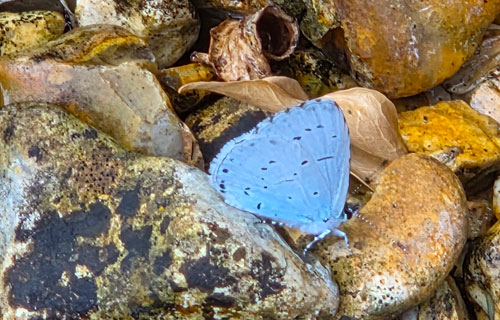
Picture: George Willoughby.
The Holly Blue, (Celastrina argiolus), is a small butterfly with a wingspan of about 2.6 – 3.4cm (1.02 -1.34 Inches approx). It is usually the first “blue” butterfly, that people see in spring, and it can appear again later in summer.
Unlike the Common Blue, which is more often seen low over grassland, the Holly Blue tends to fly higher around hedges, shrubs, trees, gardens, parks and woodland edges. Its pale silvery-blue underside, marked with small black spots but no orange markings, is a useful identification feature.
So how rare is it in Co. Tipperary? Nationally, the Holly Blue is not considered threatened. The Irish Red List assessment lists it as Least Concern, describing it as common and widespread in Ireland, with evidence of spread in suburban habitats. However, that does not mean every sighting is ordinary at local level. In Tipperary, Holly Blues are present but still worth recording, especially because they can be easily overlooked as they move quickly through gardens and hedgerows. A recent Butterfly Conservation Ireland note describes the Holly Blue as a successful garden and woodland-edge species, seen in wooded parks, gardens, hedges and woodland, with a second generation often emerging in July.
Its success is closely linked to two familiar plants; namely holly and ivy. In spring, females lay eggs mainly on holly flower buds; later in the year, ivy becomes especially important for the summer generation. This is why mature hedges, old gardens, churchyards, woodland margins and ivy-covered walls can be surprisingly good places to find them.
The Thurles sighting is a lovely local record because it shows the species using an everyday urban or garden-edge habitat. Damp stones, puddles and wet paths can attract butterflies when they need moisture, particularly during warm weather. Leaving a little wildness helps: keep ivy where safe, allow holly to flower, avoid cutting all hedges at once, and grow nectar plants such as bramble, bugle, thistles and other native flowers.
In short, the Holly Blue is not rare in Ireland overall, but a confirmed sighting in Thurles is still a valuable reminder that Co. Tipperary’s gardens, hedgerows and green spaces can support beautiful native butterflies.
Anyone who sees one should consider submitting the record to the National Biodiversity Data Centre, as local sightings help build a clearer picture of how this small blue butterfly is doing across the county.





A VERY NICE BUTTERFLY