Ireland’s political and media class increasingly seems trapped in a cycle of outrage, where emotion appear to matters more than realism.
The recent arrest of Dr. Margaret Connolly; sister of Irish President Mrs Catherine Connolly; on board a Ga, so called aid flotilla immediately caused uproar in Irish political and media circles. Government figures condemned Israel, activists treated the incident as a major international drama, and RTÉ coverage became highly emotional.
At the same time, Eurovision exposed another reality that many activists do not want to face. Despite loud campaigns demanding Israel be excluded, Israel still took part in Eurovision and finished in second place. RTÉ and several other broadcasters boycotted the contest over Israel’s participation, but Eurovision went ahead anyway without their participation. So will RTE, who this year ignored licence fee payers, decide to repeat this boycotting scenario again next year?
That raises a very simple question; what exactly is the long-term plan? If the goal is somehow to make Israel disappear, that is not serious politics. Israel is not going anywhere. It is a strong country with major international alliances, a powerful economy, and the world’s largest Jewish population.
If the goal is to isolate Israelis from international events, that also appears to be failing. Eurovision continued. International organisations continue working with Israel. Trade continues. Sporting and cultural events continue. And if Israel competes again next year in Sofia, Bulgaria, the wider world will largely move on, regardless of any Irish outrage.
This is where many ordinary people are beginning to lose patience with what critics now call the “Paddystinian” movement.
Many feel the movement has gone far beyond criticism of Israeli government policy and has become something more obsessive and even hostile. Criticising Israel is perfectly legitimate, just as criticism of any government is legitimate. But when every issue becomes centred around Israel, people naturally begin asking questions.
There is also growing concern about the atmosphere being created for Jewish people living in Ireland. Across Europe, Jewish communities have reported rising hostility and intimidation since the Gaza conflict intensified. Many Irish Jews now feel increasingly uncomfortable speaking openly about their identity or opinions. That should rightly alarm decent people.
A country can support Palestinian civilians without turning hostility toward Israel into a national obsession. It is possible to care about Gaza while also rejecting hatred, intimidation, and political hysteria.
Many people now treat attending such weekend protests in major cities as a kind of social pastime, with large numbers taking part, despite having only a limited understanding of the history or complexities behind the issues involved.
Unfortunately, parts of Irish public debate no longer seem interested in balance or nuance. Too often, disagreement is treated as proof of moral failure. Anyone who questions the dominant activist narrative, risks abuse, smears, or social pressure. That is not healthy democratic debate.
Ireland once had a reputation as a calm, sensible country known for diplomacy and peace-building. Increasingly, however, parts of Irish politics and media appear more interested in performative outrage than practical solutions. Meanwhile, the rest of the world simply keeps moving.
Israel continues trading internationally, participating in global events, building alliances, and developing economically. Eurovision survived the RTE boycott. International audiences still voted for the Israeli entry in huge numbers. That reality may be uncomfortable for activists, but it is reality nonetheless.
Movements built mainly on anger and grievance eventually run into a problem: outrage alone is not a strategy. Shouting louder does not necessarily change minds. In fact, constant moral lecturing often pushes ordinary people away, and that may ultimately be the biggest danger for Ireland itself. Because countries that become consumed by ideological crusades can end up isolating themselves far more than the people they are trying to punish.
In the end, most people simply want balance, common sense, and a bit of perspective, not this endless outrage, division, and political theatre pumped out on news bulletins and via social media.
The Central Criminal Court has heard that “no one knows exactly what happened” on the night a 32-year-old Polish man died, following an incident at a house in Co Tipperary.
Mr Tomasz Rozpeda, aged 29, of no fixed abode, previously pleaded guilty to the manslaughter of Mr Maciej Nowak, who died at Ballycranna, Kilross, Co Tipperary, during the early hours of December 27th, 2023.
During the sentencing hearing today Tuesday, the court heard that both men had consumed large quantities of alcohol and drugs, while socialising together on St Stephen’s Day. A toxicology report showed Mr Nowak had an extremely high level of amphetamines in his system, close to a fatal level, although medical experts ruled this out as the cause of death.
The court heard Mr Rozpeda called emergency services and claimed his friend had “gone crazy”, hitting himself and smashing items around the house. However, pathologists later determined that Mr Nowak died from blunt force trauma to the head and neck, injuries which were not consistent with self-inflicted harm.
Medical evidence revealed Mr Nowak suffered extensive injuries, including dozens of bruises and trauma caused by the brain twisting within the skull. Gardaí also found blood-stained broken bottles scattered across the kitchen floor of the house.
Prosecution counsel told the court that CCTV footage showed the two men together at an Applegreen service station outside Tipperary town, before returning to Mr Nowak’s home. Additional evidence included phone calls and voice messages sent by Mr Rozpeda during the night, in which he reportedly told friends he had “f**ked up” and that an accident had happened.
Gardaí later arrested Mr Rozpeda, who initially denied responsibility and attempted to distance himself from the incident. Investigators said a number of untruths were told during interviews.
Victim impact statements were read to the court from Mr Nowak’s sister and fiancée. His sister described learning of her brother’s death as the moment her “world came to a standstill”, while his fiancée said she had lost “the love of her life” and struggled to cope emotionally since the tragedy.
The court also heard that Mr Nowak was a father of three children and had been due to marry in June 2024.
Defence counsel said the men had been friends for approximately ten years and there had been no previous animosity between them. He described the events as a tragic escalation during a night where both men had consumed substances “to excess”.
Counsel for Rozpeda apologised on behalf of his client and said there was no evidence that he had brought a weapon to the house or intended serious violence.
The Director of Public Prosecutions accepted the guilty plea to manslaughter, with the original murder charge set aside.
Ms Justice Eileen Creedon remanded Mr Rozpeda in custody ahead of sentencing on July 6 next.
FSAI warn of recall of various Glenisk Baby Organic Fromage Frais products due to possible mould growth and spoilage.
Alert Summary dated Tuesday, 19th May 2026.
Category 1: For Action. Alert Notification: 2026.25. Product Identification: Please refer to table below for list of implicated products. Batch Code: Please refer to table below for implicated use-by date. Country Of Origin: Ireland.
Message: Glenisk is recalling the below batches of Glenisk Baby Organic Fromage Frais products due to possible mould growth and spoilage. Recall notices will be displayed at point-of-sale.
Action Required:Manufacturers, Wholesalers, Distributors, Caterers & Retailers: Retailers: Same are requested to remove the implicated batches from sale and display recall notices at point-of-sale. Consumers: Parents, guardians and caregivers are advised not to feed the implicated batches to young children.
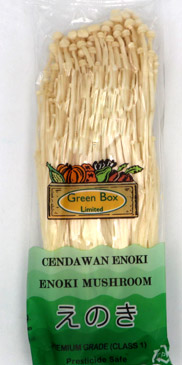
FSAI warn of recall of an additional batch of Green Box Limited Enoki Mushroom, due to the presence of Listeria monocytogenes (Update 1)
Alert Summary dated Tuesday, 19th May 2026.
Category 1: For Action Alert Notification: 2026.19 (Update 1) Product Identification: Green Box Limited Enoki Mushroom (Cendawan Enoki); Pack Size: 100g Batch Code: G22014 Country Of Origin: China
Message: Further to FSAI Food Alert 2026.19,the above additional batch of Green Box Limited Enoki Mushroom is being recalled due to the presence of Listeria monocytogenes. Recall notices will be displayed at point-of-sale.
Nature Of Danger: Symptoms of Listeria monocytogenes infection can include mild flu-like symptoms, or gastrointestinal symptoms such as nausea, vomiting and diarrhoea. In rare cases, the infection can be more severe, causing serious complications. Some people are more vulnerable to Listeria monocytogenes infections, including pregnant women, babies, and people with weakened immune systems, including the elderly. The incubation period (time between initial infection and first symptoms appearing) is on average 3 weeks but can range between 3 and 70 days.
Action Required:Manufacturers, Wholesalers, Distributors & Retailers: Retailers: Same are requested to remove the implicated batch from sale and display recall notices at point-of-sale. Wholesalers / Distributors: Same are requested to contact their affected customers and recall the implicated batch and provide a point-of-sale recall notice to their retailer customers. Caterers: Same should not use the implicated batch. Consumers: Consumers are advised not to eat the implicated batch.
The whole thing kicked off in the Arch Bar in Thurles, Co. Tipperary last Friday night, when Mikey Ryan burst through the door looking like a man who’d just witnessed either a miracle or a tractor on fire.
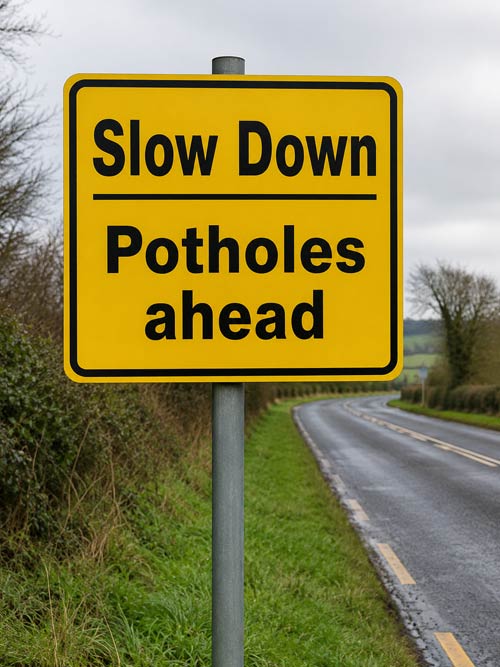
“Lads,” he says, gasping for breath, “Tipperary County Council have given up.” Now that got attention. Even Pat Hayes behind the bar stopped drying glasses. “What d’ye mean given up?” says Pat. “Gone altogether,” says Mikey. “No more speed limits.” The pub fell silent. Jimmy Bourke slowly lowered his pint. “No…” says he in his usual languid manner of speaking turning his single syllables into multiple sounds. “Oh yes,” says Mikey. “They’re replacing every speed sign in the county with signs saying: ‘SLOW DOWN – POTHOLES AHEAD.”
A woman at the corner table crossed herself. Pat blinked twice. “Sure isn’t that just every road in Tipperary?”
“EXACTLY,” says Mikey, lowdly slapping the counter so hard that a bowl of peanuts nearly declared independence.
Apparently the Council realised there was no point changing from 80 km/h to 60 km/h when the average human spine couldn’t physically survive 40 km/h anyway. Mikey claimed he saw three council workers outside Littleton removing a brand-new speed sign only four hours after initially installing it.
“One lad looked exhausted,” says Mikey. “Poor devil, a native of Co. Cork says; ‘What’s the point, bai? The road itself is enforcing the speed limit.”
And according to Mikey, the council has gone fully committed now. Outside Thurles there’s allegedly; a pothole deep enough to baptise a child; another has been classified by NASA as a “seasonal crater,” and one near Templetuohy village that is supposed to have swallowed a Nissan Micra and returned it as a Ford Focus.
“Jaysus,” says Jimmy. “That’s nothing,” says Mikey. “A fella hit one outside Roscrea last week and it activated his airbags, windscreen wipers and Eircode and all at the same time.”
The Council, according to recent rumour, have now stopped measuring potholes in inches. They’re measuring them in sizes; “small dog,” – “washing machine,” and “possible entrance to the underworld.” Meanwhile crews are driving around replacing all official speed signs. 80 km/h sign?Gone. 60 km/h sign? Gone. Now every road in Tipperary just has giant yellow signs reading: “SLOW DOWN – POTHOLES AHEAD”
Mikey says one poor tourist from Ukraine thought it was the county slogan, while another from Gaza asked if “Potholes Ahead” was a village near Cashel. But the best story came from near The Ragg. Council workers arrived with cones, flashing lights, diggers, rollers and enough machinery to invade a small European nation. Locals thought: “Grand. They’re finally fixing the road.” No, they installed six massive warning signs around a pothole before announcing that it was now “part of local Tipperary heritage.” Another engineer apparently referred to it as, “Traffic calming infrastructure.”
At this point the pub was in ribbons laughing. Even the old lad asleep beside the fire woke up laughing and he hadn’t previously been conscious since the 2022 All-Ireland Final.
Mikey took a deep dramatic gulp of Guinness. “But wait till ye hear the newest plan.” “Oh sweet suffering Jaysus,” muttered Pat. “They’re thinking of renaming roads altogether,” announced Mikey “What?” said Pat. “Yeah. Instead of the N62 or the R498…”; He leaned in over the counter. “…they’ll just call them according to the size of the potholes.” Examples include: ‘The Shaky Mile’; ‘Axlebreaker Avenue’; ‘Suspension Lane’ and one outside Nenagh simply called, ‘Abandon Hope All Ye Who Enter Here.” “And what about the speed vans?” an unknown someone asked. “Cancelled,” says Mikey. “Why so?” “No car in Tipperary can physically reach speeding pace anymore,” said Mikey.
At this stage the entire pub was gone completely feral with laughter. Mikey drained the last of the pint, straightened himself proudly and delivered the final line, like a prophet descending from Slievenamon mountain itself; “Mark my words lads… within five years every road sign in Tipperary will simply say: ‘Best of Luck.”
This website uses cookies to improve your experience. We'll assume you're ok with this, but you can opt-out if you wish.AcceptRead More
Privacy & Cookies Policy
Privacy Overview
This website uses cookies to improve your experience while you navigate through the website. Out of these, the cookies that are categorized as necessary are stored on your browser as they are essential for the working of basic functionalities of the website. We also use third-party cookies that help us analyze and understand how you use this website. These cookies will be stored in your browser only with your consent. You also have the option to opt-out of these cookies. But opting out of some of these cookies may affect your browsing experience.
Necessary cookies are absolutely essential for the website to function properly. This category only includes cookies that ensures basic functionalities and security features of the website. These cookies do not store any personal information.
Any cookies that may not be particularly necessary for the website to function and is used specifically to collect user personal data via analytics, ads, other embedded contents are termed as non-necessary cookies. It is mandatory to procure user consent prior to running these cookies on your website.








Recent Comments