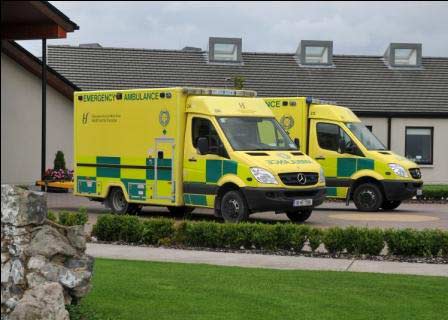
The Services Industrial Professional and Technical Union (SIPTU) has formally notified the National Ambulance Service (NAS) of planned strike action next month, marking a significant escalation in a long-running dispute with the Health Service Executive (HSE) over pay and working conditions.
Around 2,000 SIPTU members working across the ambulance service in Ireland, including Emergency Medical Technicians (EMTs), paramedics, advanced paramedics, specialist paramedics and supervisors, have voted overwhelmingly in favour of industrial action, up to and including full strike action.
The planned industrial action will begin with a 24-hour strike on 12 May, followed by a 48-hour stoppage starting on 19 May and a 72-hour stoppage from 26 May. Further strikes are also scheduled for June.
In addition, a work-to-rule will commence on 11 May, meaning staff will not cooperate with new procedures or changes introduced by management.
The dispute centres on the HSE’s failure to implement recommendations from an independent review published in 2020, which called for updated salary scales to reflect the increased responsibilities and workload of ambulance staff over the past two decades.
According to SIPTU, ambulance personnel now provide a far higher level of pre-hospital care than in the past, requiring additional training, qualifications and clinical decision making. The union argues that despite these expanded duties,including a significant increase in medication administration, staff pay and grading structures have not been updated to reflect these changes.
Government Announces Extended Fuel Relief Measures as Pressure Mounts to End Disruptive Protests.
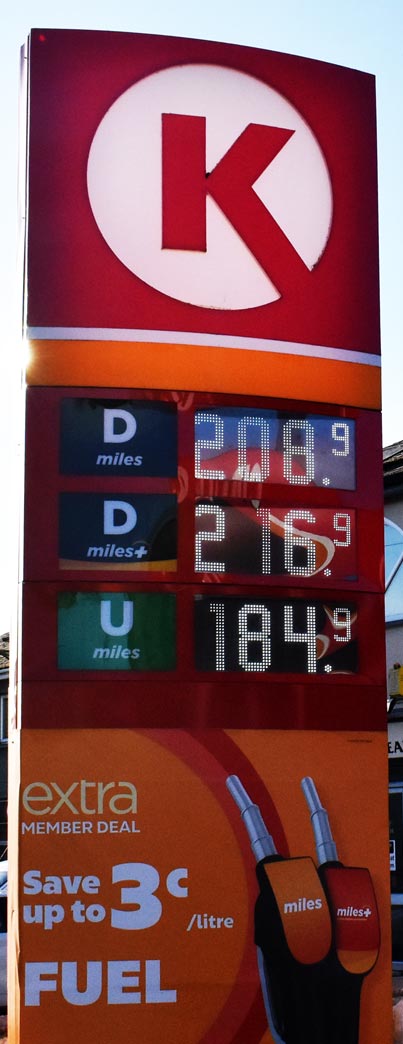
The Government has confirmed a further extension of fuel cost relief measures, as Taoiseach Mr Micheál Martin announced new steps aimed at easing the financial burden on households and businesses amid ongoing nationwide protests.
Under the revised plan, temporary reductions in excise duty on petrol, diesel, and marked gas oil will now remain in place until the end of July, rather than expiring at the end of May.
Taoiseach Mr Micheál Martin.
The updated measures include:
A 10 cent per litre reduction on both petrol and diesel.
A 2.4 cent per litre reduction on marked gas oil (“green diesel”).
A deferral of the planned carbon tax increase, originally due in May, now postponed until the Budget in October.
These steps are intended to provide immediate cost relief in response to sustained increases in fuel prices linked to global supply pressures.
Despite these concessions, significant disruption continues across the country as protest actions, largely organised via informal networks of transport operators, farmers, and drivers, have blocked key transport routes and fuel depots.
The Government has reiterated that it recognises the financial strain facing those in fuel-dependent sectors. However, it has strongly criticised the ongoing blockades, warning that such actions are having serious and disproportionate consequences for the general public.
With schools reopening and workers returning after the weekend, the continuation of these protests risks widespread impact on daily life. Commuters face delays, families are affected in getting children to school, and essential services, including healthcare and emergency response, remain under pressure due to fuel supply concerns and traffic disruption.
The obstruction of critical infrastructure, including fuel depots and major roadways, has also raised concerns about the availability of medicines, agricultural supplies, and other time-sensitive deliveries. Authorities, including An Garda Síochána, have now moved into an enforcement phase, and the Defence Forces remain on standby to assist in removing vehicles where necessary.
Public Interest and Proportionality. While the Government’s latest measures demonstrate a willingness to respond to rising costs, the continuation of large-scale disruption raises serious questions about proportionality.
The burden of these protests is not being carried by policymakers alone, it is being felt most acutely by ordinary members of the public. Workers attempting to commute, parents preparing for the school week, and vulnerable individuals relying on timely access to services are all directly affected.
In this context, the persistence of blockades appears increasingly difficult to justify, particularly as concrete measures have now been introduced to address core concerns around fuel pricing.
The Government has urged all participants to disengage from disruptive actions and instead pursue dialogue through established representative bodies, emphasising that meaningful progress can only be achieved without jeopardising public safety and national infrastructure.
Further developments are expected in the coming days as pressure intensifies to restore normality across the country.
Tipperary County Council: World Leaders in Revenue Collection, but still Struggling With… Roads.
Tipperary County Council has proudly confirmed that it extracted a tidy €308,112 in parking fines in 2025, proving once again that when it comes to collecting money, efficiency is not an issue.
Fixing roads, however, remains a bold and experimental concept. See in particular Emmett Street, Westgate junction, Barry’s Bridge etc. etc. here in Thurles,
Across nine towns, thousands of motorists were “caught red-handed”, — “embarrassed even”, according to local press reports, having been photographed by traffic wardens, committing the heinous crime of allowing two wheels to exist slightly outside a faded white line or failing to have their hair permed within the 15 minute permitted free time frame.
Thurles, notably, now continues to excel in two key areas: (1)Generating revenue. (2)Avoiding pothole repairs.
Of course, as one would expect, Clonmel led the charge with 2,469 fines, followed by Nenagh with 1,346fines, Thurles(God help us in a town where most car parks were closed in 2025)1,258fines, while Carrick-on-Suir tried and failed to catch-up with a mere 1,052fines.
A further breakdown reveals a more refined vehicle operator: Tipperary Town:914 fines. Cashel:548 fines. Templemore:267 fines. Roscrea:256 fines. Cahir: took the wooden spoon, with a miserable 142 fines only. Still all admirable figures, if the goal is to run a highly efficient penalty collection service, rather than maintain public infrastructure.
Motorists are charged €40 – €80 for parking offences, rising by 50% after 28 days, because nothing says “public service” like interest rates that would impress a credit card company.
Other highlights include: ♣ €60 for failing to display a tax disc. ♣ In keeping with Health & Safety, No Charge for failing to display a NCT disk. ♣ €150 for parking in a disabled space.
Meanwhile, in Thurles, the surface of Barry’s Bridge is once again disintegrating, bravely demonstrating the council’s innovative “Natural Erosion Management Strategy.”
Residents are reportedly delighted to see their contributions; over €300,000 worth, being reinvested into… somewhere; possibly sending salaried staff on St Patrick’s weekend junkets; but certainly not road surfaces.
A spokesperson, (latter who does not wish to be named), standing carefully to avoid loose flying gravel, stated: “We take great pride in maintaining strict parking enforcement, while also maintaining a flexible, evolving interpretation of the word ‘roadworthy.”
Local drivers have expressed confusion, noting that while their tyres are expected to meet exact legal standards, the road beneath them appears to be auditioning for a gravel pit. Experts confirm that if potholes themselves could be fined, Tipperary County Council would likely be running a budget surplus.
Until then, motorists are advised to: ♦ Display their tickets correctly facing upwards. ♦ Pay promptly. ♦ Have a suspension system worthy of Dakar Rally conditions▲ when crossing Barry’s Bridge. {▲The Dakar Rally is considered the world’s most challenging endurance motorsport event, held annually over two weeks in extreme desert conditions.}
Wonder would Tipperary Sinn Féin TDs meet and move a motion of no confidence in Tipperary Co. Council. Ops, sorry, forgot that the Tipperary electorate failed to elect Sinn Féin TD’s, last election. I wonder why?
Yes, here in Tipperary, the fines are fixed – but the roads are anything but.
Minister For Justice, Home Affairs & Migration Mr Jim O’Callaghan TD has stated in a press release issued at 6:28pm this evening that, quote: “Over the past four days An Garda Síochána has engaged extensively with protestors seeking to allow access to critical sites and ensure certain trucks containing fuel, medicine and animal feed were allowed pass through blockades.
Despite the increasingly difficult situation facing people across the country and requests from Government to end the blocking of critical infrastructure, the blockades continued. This is unacceptable.
While we all acknowledge the impact of higher fuel prices, and seek to minimise that impact, no groups are entitled in our Republic to hold our people to ransom in such a manner.
An Garda Síochána has commenced operations to allow critical infrastructure to operate, so that people have access to fuel.
I will continue to engage with the Garda Commissioner and my colleagues in Government as these operations continue.
I want to thank the Gardaí and their colleagues from the Defence Forces, for carrying out these difficult duties in such a professional manner.”
We now understand that An Taoiseach Mr Micheál Martin has convened a Cabinet meeting for tomorrow where an update on ongoing fuel crisis talks, undertaken between ministers and sectoral representatives will be given. However, the Government has stated that nothing will be announced until protesters end their blockades.
A large-scale national protest concerning fuel costs is set to take place on Tuesday morning, with participants expected to mobilise from early hours across multiple regions, including Tipperary.
Organisers have confirmed that convoys will begin departing from 6:00 a.m., converging on key towns and cities nationwide. Demonstrations are also expected at various locations throughout Tipperary, as part of the coordinated action. The protest aims to call for a further reduction in excise duty on fuel, as well as the removal of the carbon tax, which organisers argue is placing significant strain on households and businesses.
Participants involved in the protest have expressed serious concerns about the current economic climate. They warn that rising fuel costs are contributing to increasing financial pressure across sectors, with some suggesting that urgent action is needed to prevent wider economic instability.
Law enforcement authorities have been notified in advance of the planned routes and assembly points, including those in Tipperary. Traffic disruptions are expected in several areas, and the public is advised to plan journeys accordingly.
Government sources have indicated that, at present, there is no immediate concern regarding fuel supply shortages. However, officials have acknowledged that the situation remains fluid, particularly in light of ongoing developments affecting global energy infrastructure.
Calls have been made for urgent attention to the energy crisis, with growing pressure for swift and coordinated action to address rising costs and their impact on citizens.
Further updates are expected as the situation develops.
This website uses cookies to improve your experience. We'll assume you're ok with this, but you can opt-out if you wish.AcceptRead More
Privacy & Cookies Policy
Privacy Overview
This website uses cookies to improve your experience while you navigate through the website. Out of these, the cookies that are categorized as necessary are stored on your browser as they are essential for the working of basic functionalities of the website. We also use third-party cookies that help us analyze and understand how you use this website. These cookies will be stored in your browser only with your consent. You also have the option to opt-out of these cookies. But opting out of some of these cookies may affect your browsing experience.
Necessary cookies are absolutely essential for the website to function properly. This category only includes cookies that ensures basic functionalities and security features of the website. These cookies do not store any personal information.
Any cookies that may not be particularly necessary for the website to function and is used specifically to collect user personal data via analytics, ads, other embedded contents are termed as non-necessary cookies. It is mandatory to procure user consent prior to running these cookies on your website.







Recent Comments