Switzerland didn’t “get lucky” with clean rivers. It decided, in law, in funding, and in enforcement, that clean water is basic infrastructure. After decades when wastewater and industrial pollution badly damaged waterways, Switzerland eventually hard-wired wastewater treatment into national policy. By 2005, some 97% of the population was connected to a central sewage treatment plant.
And Switzerland didn’t stop at “good enough”. A revised waters protection law took effect on January 1st 2016, requiring many treatment plants to add extra purification stages to tackle trace pollutants. Today, Switzerland’s own federal assessment says bathing water in lakes and rivers is generally very good, with more than 97% of assessed bathing waters at least “sufficient”.
That’s the core lesson; clean rivers don’t come from speeches. They come from a system that measures, funds, upgrades, and insists on outcomes.
Now let us look at the Suir in Thurles. A river described as “disgraceful” in a town that should be proud of a God given assett. Indeed, the positioning of the River Suir should be one of Thurles’s defining assets. Instead, the public record reads like a running argument, frustration, photos, political rows, and a river that locals and officials say is fast “slipping away”.
Video hereunder shows one area of River Suir in the heart of Thurles town.
At a Tipperary County Council meeting, one councillor described the Suir running through Thurles as “disgraceful, embarrassing and shocking”, alleging rubbish, trolleys and “raw sewerage”. Local radio carried similar comments in 2024, calling the river an “eyesore” and “an embarrassment to the town”. This is not just “bad optics”, it’s a signal to the people on the ground that local government, charged with keeping essential infrastructure working and keeping the environment protected, is now seriously broken.
Tipperary County Council says it has a remit. Residents are asking, “Where are the results?” A national newspaper reported that EPA sampling, at Thurles Bridge in 2023, found the river “poor”, and quoted the council saying it has “a statutory remit to maintain and protect the water quality status of rivers” and works with the Local Authority Waters Programme (LAWPRO). Fine, but “remit” isn’t recovery. LAWPRO’s own reporting at a public meeting in Templemore captured what many locals believe is happening in the Suir catchment around Thurles; declines in water quality, impacts on fish and aquatic life, and “river weed growth” and “general neglect”, much of it linked to excessive nutrients. So the public isn’t imagining that something is wrong. Multiple sources, local reporting, stakeholder meetings, and the council’s own statements about responsibility, all point back to the same uncomfortable truth; the river needs a plan that delivers measurable improvement.
The wastewater system is a known pressure point, and the utility admits it Here’s the part that should end the “who’s to blame” merry-go-round. Uisce Éireann’s own project page for Thurles states plainly that “the current wastewater infrastructure in the town is inadequate” and that upgrades are required to meet environmental compliance and “alleviate flooding issues”. When your own infrastructure provider says the network is inadequate, it’s no longer credible to treat river decline as a mystery. It becomes a delivery question, what is being done, by when, and how will the river show improvement?
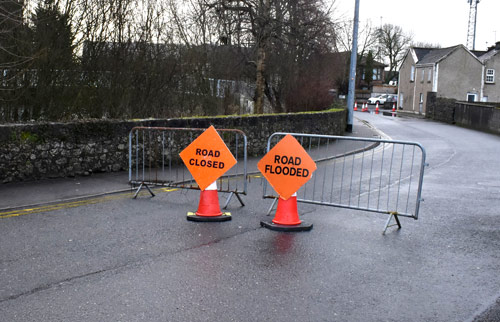
Robert Emmet Street, Thurles, closed today due to flooding for the second time in past 3 months.
Flooding, when the river rises, the same arguments return. This week, Tipperary County Council issued an operational update noting elevated levels on the Suir and overtopping in parts of the catchment area. Local press also reported flood scenes in South Tipperary, with the council saying water levels had risen and overtopping had occurred at several points. Thurles residents are familiar with what follows: the river rises, pinch points show up fast, and the anger sharpens around a simple claim, basic river management and preventative maintenance are not being done consistently enough.
A Thurles.Info article (November 2025) illustrates the Emmet Street riverside walkway and describes it as unserviceable due to flooding, arguing that repeated warnings over a 13-year period have not been matched by the maintenance needed to prevent blockages and overflow. To be clear, the precise causes of any single flooding incident, whether reeds, silt, debris, undersized drainage, or all of the above, require engineering assessment. But the political point is unavoidable, if people can’t see routine, transparent upkeep and enforcement, they assume it isn’t happening.
And here’s the paragraph Ireland can’t ignore: we have the money What turns this from local frustration into national hypocrisy is the scale of spending Ireland is willing to contemplate elsewhere. The Irish Government has backed the Water Supply Project for the Eastern and Midlands region, intended to bring a new long-term water source from the Shannon system towards the greater leaking Dublin area. RTÉ reported the proposal would take about 2% of the average flow and was estimated to cost €4–€6 billion. The Department’s own press release gives a preliminary cost estimate of €4.58bn to €5.96bn (verified through an expert review process).
So yes: Ireland can mobilise billions for water infrastructure for Dublin when it chooses. Which makes the Suir question harder to dodge: how can we plan to move vast volumes of water across Ireland while towns like Thurles are still fighting over basics; river health, monitoring, enforcement, and routine maintenance?
Switzerland vs Thurles: the difference is measurable accountability Switzerland’s lesson isn’t “be rich” or “buy better technology”. It’s this, treat water quality as a deliverable.
If Thurles wants a Suir that supports biodiversity, recreation, tourism, and doesn’t become a recurring source of anger, then the county needs to stop treating the river like a PR problem and start treating it like infrastructure with a public scoreboard:
Quarterly updates on the Thurles stretch (water quality trend points, incident reporting, actions taken).
A clear, named lead for publishing progress locally, one place the public can check.
Transparent milestones for the wastewater upgrades already acknowledged as necessary.
A preventative maintenance programme that is visible, scheduled, and publicly reported, so people aren’t left guessing until the next flood.
Switzerland didn’t fix its rivers by talking. It fixed them by building a system that delivers, and proving it, year after year. Thurles deserves the same axtion and seriousness.
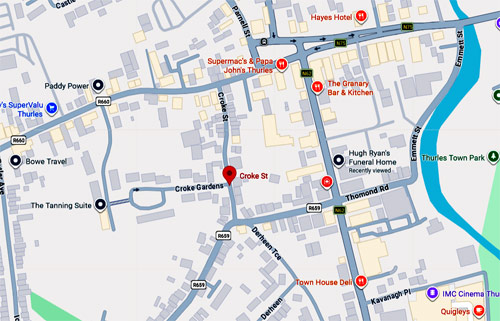
Tipperary County Council have granted planning permission for a new social housing development that will deliver six one-bedroom apartments on Lower Croke Street, (Formerly known as Stradavoher), Thurles, Co. Tipperary.
The board of directors of Thurles Lions Trust applied to the local authority to build the scheme on a vacant town-centre site. The development will comprise two new buildings providing a total of six one-bed apartments, all intended for social housing.
A number of local residents made submissions during the planning process, raising concerns about storm-water capacity and the potential for overlooking of neighbouring properties. One objection argued that a proposed balcony (on apartment 5), would allow direct overlooking into a private garden and negatively impact on privacy. Another submission warned the project could place added pressure on a storm drainage/sewerage system that, they claimed, is already struggling with surface-water run-off; contributing to flooding risk for older homes on the street.
Despite the objections, the council have approved the development subject to conditions. These include the removal of the proposed balcony for apartment 5, requirements to keep the public road clean and tidy during construction, and that all service cables be routed underground. The developer must also submit a public lighting scheme for council approval, agree details of external finishes in advance, and comply with restricted construction hours: Monday to Friday (8am–6pm) and Saturday (8am–2pm).
Thurles & Tipperary Says Stop The “Junket” Slur – Start the Accountability – Publish the Outcomes of St Patrick’s US Missions.
Ireland must travel, must engage, and must report back, in black and white.
Ireland should maintain the St Patrick’s Day diplomatic programme within the United States, including the Taoiseach’s White House engagement, because it is one of the few annual moments when a small island reliably gets direct access to the world’s most consequential decision-makers, investors and influencers.
But if we are truly serious about ‘people before posturing’, then every travelling politician and councillors must also be required to prove value for money and publish measurable outcomes on return.
That is the missing piece in this annual debate: loud accusations of “junkets” on one side, defensiveness on the other, and far too little mandatory, standardised reporting to the public.
It has been reported that nine or ten ministers are expected to travel to up to 15 US states around St Patrick’s Day. Meanwhile, FOI figures reports show €1,096,493 spent on 569 St Patrick’s Day events globally, with an average cost per event of €1,927.
That is not inherently scandalous. It can be excellent diplomacy. But it must be auditable diplomacy. Engagement is not endorsement, it’s statecraft.
Tourism matters too; and we should never insult the American people. The United States is one of Ireland’s most important tourism markets and supports jobs right across this island, from hotels and restaurants to visitor attractions, guides and local festivals. Tourism Ireland notes that in 2023 the island welcomed over 1.2 million US visitors, who spent about €1.7 billion here, making the US the most important overseas market for revenue. Tourism Ireland’s USA Market Profile 2024 reports 1.3 million American tourists, €2.0 billion in spend, and 11.4 million bed nights; figures that underline just how much Irish employment depends on maintaining goodwill with ordinary American people, not just the political class in Washington. You can disagree robustly with any US administration, while still showing respect to the American public, the diaspora, and the millions who choose Ireland in good faith.
Diplomacy that drifts into contempt is not “taking a stand” – it is self-harm.
Some opposition voices argue our Taoiseach should not go to Washington at all. People Before Profit TD Mr Richard Boyd Barrett has said it is “not appropriate” for Mr Martin to present President Donald Trump with shamrock this year. Labour MEP Mr Aodhán Ó Ríordáin has also publicly taken a “No to the Shamrock ceremony” position. Labour leader Ms Ivana Bacik has also ‘raised conditions’ around any visit if threats continue. Whatever the merits of ‘snub the White House’ rhetoric, it is just gesture politics unless those calling for such a boycott can set out a credible alternative strategy, which of course they haven’t.
Yes, they are entitled to their stance. But the public is entitled to ask a harder question: what is their alternative plan to protect Irish jobs, Irish exports and Irish leverage, in real time, when the stakes are highest?
Ireland cannot clap itself on the back for moral purity, while leaving Irish workers, exporters and inward investment exposed. The national interest is not served by boycotts that make headlines at home and achieve nothing in Washington.
The public interest test: show the receipts and the results. If critics insist on calling these trips “junkets”, and who can blame them, then the answer is simple: remove the ambiguity. From this year onwards, every minister and senior office-holder travelling on St Patrick’s missions should be required to publish a short, standard “Outcomes Report” within 30 days of returning, laid before the Oireachtas and posted publicly.
That report should include:
Full itinerary (meetings, organisations, purpose).
Total cost (travel, accommodation, hospitality), itemised.
Follow-up actions with named officials/agencies and deadlines.
What did not happen (meetings refused, issues parked, risks flagged).
This is not bureaucracy, it is basic democratic accountability. If nearly €1.1m is being spent globally on St Patrick’s Day events, the public should see, clearly, what Ireland gets in return.
A direct challenge to the “boycott brigade”. It is easy to demand that Ireland “takes a stand” from a safe distance. It is harder to sit across the table from power and argue Ireland’s case, on trade, immigration, investment, peace and international law, and then come home and account for what was achieved.
If the likes of People Before Profit and a Labour MEP want to oppose engagement, let them publish their own alternative: a costed, credible strategy that protects Irish livelihoods and advances Irish values, without access, without dialogue, and without influence. Otherwise, it is politics as performance. Who elected these people anyway?
Ireland should go – and Ireland should know.
Ireland should absolutely maintain the St Patrick’s diplomatic programme in the US, and Irish politicians should visit American cities beyond Washington because that is where investment decisions, diaspora networks and industry clusters live.
But also the era of “trust us” travel must end.
Go. Engage. Promote Ireland. Protect jobs. Defend values, and then report back to the over taxed individuals who fe..ing paid for it all.
Farmers across Co, Tipperary are being urged to heighten vigilance and review on-farm biosecurity measures, following confirmation of bluetongue virus serotype 3 (BTV-3) confirmed in a herd of cattle in Co. Wexford, the first confirmed case in the Irish State.
The confirmation is “unwelcome” but not unexpected, pointing to the spread of the virus across Europe, Great Britain and recently in Northern Ireland.
Bluetongue is a viral disease of ruminants that can affect cattle and sheep, as well as goats, deer and llamas. The disease does not pose a risk to human health or food safety and is spread primarily by biting midges.
The current spell of colder weather should reduce the risk of onward spread at this time, as the virus cannot replicate effectively in midges when daily temperatures are below 12°C. Further sampling is under way to clarify the wider epidemiological picture.
While there are no implications for meat and dairy exports to the EU, UK and most international markets, the Minister warned the outbreak will affect exports of live cattle and sheep, with added costs and logistical requirements to meet importing-country rules.
Separately, the Department has already confirmed that bluetongue vaccination will be permitted in Ireland in 2026 for cattle and sheep, following detections of BTV-3 in Northern Ireland. Farmers are advised to engage with their private veterinary practitioner on the timing and suitability of any vaccination programme.
The Irish Creamery Milk Suppliers Association (ICMSA) described the Wexford confirmation as “hugely worrying” for the family concerned and the wider farming community, and said supports must be available for those impacted.
Advice to Tipperary farmers: what to do now Although the confirmed case is in Wexford, farmers in Tipperary are being asked to remain alert and to act early if anything looks amiss:
Monitor stock daily and contact your vet immediately if you see signs consistent with bluetongue (which can vary by species and individual animal), including fever, lethargy, lameness, facial swelling, mouth/eye/nose irritation or discharge, and sudden drops in performance.
Tighten biosecurity around animal movements and visitors; keep accurate records and follow Department guidance if any restrictions or control measures are introduced.
Reduce midge exposure where practical (e.g., housing vulnerable animals at peak midge activity times and using appropriate veterinary-approved insect control measures).
Keep up to date with official Department updates as sampling continues and any control zones/movement measures are clarified.
Farmers are being encouraged to take the situation seriously but calmly, with early reporting seen as critical to limiting spread and protecting the live trade, particularly as the sector prepares for the 2026 vaccination programme.
As Promised: Time to Construct Plans and Attempt to Find a “Bookable Visitor Experience,”for Thurles.
Thurles Tourism Debate: Part IV. Concerns over Tipperary’s ability to sustain and grow tourism have intensified following a recent council presentation on our tourism performance and marketing activity; but then in the words of T.C. Haliburton and later P.T. Barnum, “Talk is Cheap” and the words of councillors and officials come easier than their actions.
Thurles ‘A Sellable Product’.
“Thurles: Cathedral, Liberty Square & Local Stories, Lár na Páirce.” (90–120 mins)
The promise: (what the visitor gets.) A guided, easy walking loop that explains Thurles through three stops foreigners can understand instantly:
Cathedral of the Assumption: Big visuals + a clear “why it matters” story: architecture, stained glass, music/choir tradition, and key moments that root the town in Irish life.
Perfect as an add-on stop between other major routes.
Why Irish Rail is a big advantage for Thurles. Thurles has a very strong practical selling point; it’s a rail town with visitor basics already in place. From Irish Rail’s station information, Thurles station is 0.5 miles to the town centre, has toilets, passenger shelters, an enclosed waiting room, and strong accessibility (lifts to platforms, accessible toilet, ramps). It’s also on key intercity routes including Dublin Heuston – Cork (directs and intermediate), plus services connecting towards Limerick/Ennis and Tralee.
That means we can pitch Thurles as: “Arrive by train, walk the town, back on the train.” Ideal for weekend/day-trip groups who dislike motorway fatigue, parking stress, or long coach days.
In Part V, of our Thurles Tourism Debate, in the coming days we will assist in where to contact/sell and will provide a short, copy/paste social media advert.
Note: Since two paid tour guides with proper temperament, will be required to undertake this work, (yes we already have two knowledgable individuals, trained by myself), thus creating two jobs, which is more than our Tipperary public reps. have created in the past 20 years.
Time to increase failed footfall and reverse the deliberate destruction of our town centre, (Liberty Square), as a centre for business.
This website uses cookies to improve your experience. We'll assume you're ok with this, but you can opt-out if you wish.AcceptRead More
Privacy & Cookies Policy
Privacy Overview
This website uses cookies to improve your experience while you navigate through the website. Out of these, the cookies that are categorized as necessary are stored on your browser as they are essential for the working of basic functionalities of the website. We also use third-party cookies that help us analyze and understand how you use this website. These cookies will be stored in your browser only with your consent. You also have the option to opt-out of these cookies. But opting out of some of these cookies may affect your browsing experience.
Necessary cookies are absolutely essential for the website to function properly. This category only includes cookies that ensures basic functionalities and security features of the website. These cookies do not store any personal information.
Any cookies that may not be particularly necessary for the website to function and is used specifically to collect user personal data via analytics, ads, other embedded contents are termed as non-necessary cookies. It is mandatory to procure user consent prior to running these cookies on your website.







Recent Comments