A group identifying itself as representing professional drivers, farmers, hauliers and other transport-dependent sectors has warned that further large-scale, peaceful fuel protests may be organised across Ireland as early as next month.
The “People of Ireland Against Fuel Prices Protest” group, which previously played a central role in nationwide demonstrations that disrupted transport networks and fuel supplies, has confirmed it is currently holding a series of meetings across the country to determine its next course of action. These earlier protests, driven by rising fuel costs and wider cost-of-living pressures, resulted in significant disruption nationwide, including blockades of key infrastructure such as the Whitegate oil refinery, major ports, and central urban routes.
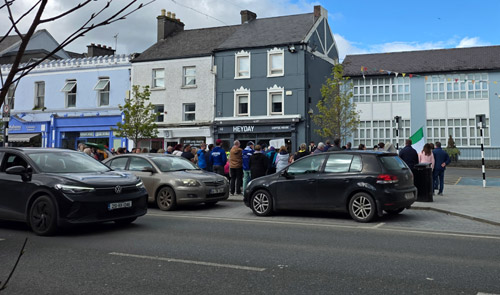
Modest turnout to support fuel and cost-of-living protest, held in Thurles on Saturday, April 18th. 2026.
In a recent statement, the group emphasised that it has already made a “massive statement” to Government and insists it will not accept what it describes as unsustainable taxation and fuel costs impacting everyday workers and businesses.
Organisers say discussions over the coming fortnight will determine whether further coordinated demonstrations proceed. Should there be no “meaningful progress,” the group has indicated that peaceful protests will take place across major towns nationwide from May 2nd next.
The group maintains that the issue extends beyond motorists, highlighting the impact of rising fuel costs on home heating, agriculture, logistics and small businesses. It argues that these are essential costs, not discretionary expenses, and claims many people are struggling to cope. The previous wave of protests prompted a significant political response, including a government support package worth over €500 million and a successful motion of confidence in the Dáil, following opposition pressure.
Limited Turnout at Thurles Demonstration Separately, a recent protest held in Thurles, organised by Sinn Féin activist Dan Harty, appears to have attracted limited public support despite calls for widespread participation. The demonstration formed part of a series of regional events responding to fuel costs and the broader cost-of-living crisis, with organisers encouraging those dissatisfied with government measures to attend. However, reports indicate the event failed to generate the level of turnout seen during the earlier nationwide protests, raising questions about the consistency of public engagement outside of large-scale coordinated actions.
Next Steps. The protest group has stated it will reassess the situation following its current round of meetings, but reiterated its position clearly; “We are prepared to protest again, peacefully, but in numbers that cannot be ignored.”
Further developments are expected in the coming weeks as discussions continue and pressure remains on the Government to address ongoing fuel price concerns.
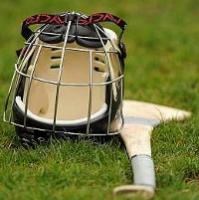
Cork opened their Munster Championship campaign with a 0-29 to 1-22(25pts) win over Tipperary in Thurles, but the margin arguably reflected a key period of control rather than outright dominance across the full 70 minutes.
Tight Contest for Long Periods. For much of the game, there was little between the sides. Tipperary recovered from an early deficit to build momentum in the first half, hitting a run of scores to move in front. Cork, while seeing plenty of possession, were at times wasteful and relied on late scores to draw level at the break (0-13 each). Jason Forde’s accuracy from frees and the work rate of Oisín O’Donoghue were central to Tipp’s attacking play, while Cork’s scoring was more spread across their forward line.
Game Swings After Half-Time. The match turned during a relatively short spell early in the second half. After a fairly even restart, Cork put together a run of eight unanswered points in just over 10 minutes, which created a gap that Tipperary struggled to close. That period coincided with improved puckout control from Cork, resulting in reduced scoring opportunities for Tipp with a growing reliance on frees for the home side.
Tipperary also went a long stretch without a score from play, only ending that drought in the 64th minute, a factor that ultimately proved costly.
Contributions at Both Ends. Cork’s debutants William Buckley (0-06) and Barry Walsh (0-04) were among their more effective forwards, contributing steadily rather than explosively. At the other end, Tipp remained competitive with Forde keeping the scoreboard ticking from frees A late goal from Alan Tynan briefly reduced the gap while substitutes helped bring the margin down late on However, Tipperary were chasing the game from the moment Cork built their second-half lead.
Late Push Falls Short. Tipperary did respond in the closing stages and reduced the deficit to a single score at one point after the late goal. But Cork managed the final minutes more effectively, adding a closing score to secure the result without allowing a full comeback. This was not a one-sided contest with first half, evenly balanced. The key period came with Cork’s second-half scoring burst, and while Tipp rallied in the final stages, same effort came too late. Cork took their chances during a decisive window, while Tipperary’s lack of scoring from play, after the break, proved very difficult to overcome.
Next Games. Cork face Limerick next in what should be a more demanding test, while Tipperary will travel to Waterford.
A newly published audit by the Houses of the Oireachtas has found that seven TDs and senators claimed a combined €7,088 in expenses without sufficient supporting documentation, raising renewed concerns over compliance with Public Representation Allowance (PRA) rules.
The audit reviewed over €286,000 in expense claims from a random sample of elected representatives in 2023. While the majority of claims were valid, the findings highlight recurring issues around documentation, eligibility, and cost-sharing practices.
Importantly, the report confirmed that all disallowed amounts have since been repaid to the State, and that €115,593 of claims by the same group were deemed fully compliant and approved.
Key Findings from the Audit.
€7,088 in claims lacked sufficient evidence or eligibility.
€5,793 disallowed for falling outside approved expense categories.
€735 incorrectly claimed due to improper cost-sharing (pro-rata issues).
€560 rejected due to missing receipts or documentation.
The auditors stressed that all claims must be “wholly and exclusively” related to official duties and supported by clear documentation.
Recurring Issues Identified. The report highlighted repeated compliance problems, including:
Incorrect advertising expense claims.
Failure to split shared costs (e.g. newsletters featuring multiple politicians).
Errors in annual cost apportionment (utilities, insurance, IT services).
Auditors recommended ongoing guidance and reminders for Oireachtas members, and even suggested reviewing the eligibility of AI-related expenses going forward.
Tipperary Politician Highlight: Mr Martin Browne (Former Tipperary Sinn Féin TD). One of the most notable cases involving a Tipperary politician was Mr Martin Browne (Sinn Féin), identified as claiming the second-highest ineligible claim of €1,729 in expenses which was disallowed. This placed Mr Browne among the top individuals flagged in the report for non-compliant expense claims, though, like all others involved, the funds were fully reimbursed.
Other Notable Cases.
Ms Pauline Tully (Sinn Féin) – €3,060 (largest disallowed amount). Ms Fiona O’Loughlin (Fianna Fáil) – €1,256. Mr Francis Noel Duffy (Former Irish Green Party) – €470. ♦ Additional smaller claims ranged from €140 to €266.
Majority of Claims Audited – Fully Compliant. The audit also confirmed that 15 politicians provided complete documentation, accounting for €279,124 in valid expenses. These included senior government figures and long-serving TDs, demonstrating that compliance is achievable when guidelines are properly followed.
Conclusion. While the overall level of irregular claims remains relatively low, and all funds have been repaid, the audit underscores persistent procedural weaknesses in how some politicians manage expenses. The findings reinforce the need for:
Stronger compliance awareness.
Better documentation practices.
Clearer guidance on shared and emerging expense categories.
As scrutiny around public spending continues, transparency and accountability remain central to maintaining public trust in elected representatives.
The Government has warned that electricity prices may rise modestly over the coming months, as global energy market pressures continue to create uncertainty for households and businesses across Ireland. Minister for Energy Mr Darragh O’Brien said electricity costs could increase by between 4% and 9% during the summer period, with potential changes expected from May through July. He described the current market conditions as “very volatile,” pointing to rising international fuel costs driven by geopolitical tensions.
While acknowledging broader concerns about significant price hikes, the Minister emphasised that electricity increases are expected to remain in the single-digit range, depending on individual suppliers and their pricing strategies, including hedging arrangements. Gas prices, however, may see higher increases, though not to the levels of 30% suggested in some commentary.
Government Response and Supports. The Government has already introduced a €750 million cost-of-living support package, one of the largest in Europe, aimed at helping households manage rising energy costs. Measures include targeted supports such as fuel allowances, now reaching approximately 470,000 households nationwide.
Minister O’Brien reaffirmed that the Government will remain “flexible and nimble” in responding to further price pressures, with additional supports, including potential energy credits, not ruled out ahead of Budget discussions in October. The Minister also confirmed plans to reintroduce the energy levy in the upcoming Budget, while noting that the carbon tax has been temporarily paused to ease financial pressure on households and businesses.
Focus on Long-Term Solutions. In addition to short-term supports, the Government is prioritising long-term cost reduction measures, including expanded grants for home retrofitting and energy efficiency improvements. These initiatives are designed to help households reduce reliance on volatile energy markets and lower bills sustainably. Minister O’Brien stressed that while immediate pressures are being addressed, there will be “no rolling back” on climate commitments, with efforts continuing to transition towards more secure and sustainable energy sources.
Monitoring Fuel Price Transparency. Separately, the Minister has requested that the Competition and Consumer Protection Commission (CCPC) enhance its monitoring of fuel price fluctuations. This follows sharp increases in global oil prices linked to international conflict, which have raised concerns about pricing transparency. While recent findings attribute fuel price spikes primarily to higher wholesale costs, the Government has emphasised the importance of ensuring fair pricing and consumer protection, particularly during periods of crisis.
Outlook. Ireland’s energy supply remains secure, but global pressures are expected to continue influencing prices in the months ahead. The Government has committed to closely monitoring developments and taking further action where necessary to support households and businesses.
Ms Coughlan, sadly, passed away unexpectedly at her place of residence.
Her passing is most deeply regretted, sadly missed and lovingly remembered by her sorrowing family; loving partner Gerry (Darmody), son Seán daughter Sarah, parents Michael and Mary, sister Sue, father-in-law John, nephew Aaron and niece Aoife, brother-in-law Ian, aunts, uncles, cousins, extended relatives, work colleagues, Niamh, Josephine, Bríd and Clara, wonderful neighbours and many friends.
For those persons who would wish to attend Requiem Mass for Ms Coughlan, but for reasons cannot, same can be viewed streamed live online, HERE.
The extended Coughlan and Darmody families wish to express their appreciation for your understanding at this difficult time, and have made arrangements for those persons wishing to send messages of condolence, to use the link shown HERE.
Note Please: No flowers. Donations in lieu, if desired, to the Irish Heart Foundation in memory of Ms Elaine Coughlan.
This website uses cookies to improve your experience. We'll assume you're ok with this, but you can opt-out if you wish.AcceptRead More
Privacy & Cookies Policy
Privacy Overview
This website uses cookies to improve your experience while you navigate through the website. Out of these, the cookies that are categorized as necessary are stored on your browser as they are essential for the working of basic functionalities of the website. We also use third-party cookies that help us analyze and understand how you use this website. These cookies will be stored in your browser only with your consent. You also have the option to opt-out of these cookies. But opting out of some of these cookies may affect your browsing experience.
Necessary cookies are absolutely essential for the website to function properly. This category only includes cookies that ensures basic functionalities and security features of the website. These cookies do not store any personal information.
Any cookies that may not be particularly necessary for the website to function and is used specifically to collect user personal data via analytics, ads, other embedded contents are termed as non-necessary cookies. It is mandatory to procure user consent prior to running these cookies on your website.







Recent Comments