The UK’s longest serving monarch, of 70 years, Queen Elizabeth II, has passed away peacefully at Balmoral near Aberdeen, in Scotland, aged 96 years.
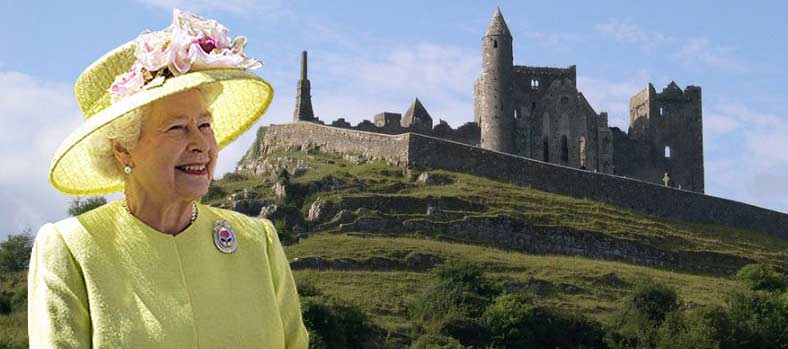
Queen Elizabeth II pictured visiting Rock of Cashel, Co. Tipperary in May 2011.
Her immediate family had gathered at her Scottish estate, following concerns about her health earlier today.
Queen Elizabeth II came to the throne in 1952 and during her reign witnessed enormous social change same which spanned post-war austerity, the transition from empire to Commonwealth, the end of the Cold War and the UK’s entry into – and later withdrawal from – the European Union.
Her reign spanned 15 prime ministers, beginning with Sir Winston Churchill, and ending with Ms Liz Truss, latter appointed by the Queen earlier this week.
Her Majesty Queen Elizabeth II visited Cashel and Fethard in Co. Tipperary briefly in May of 2011.
With her death, the current Prince of Wales, her eldest son Charles, will return to London tomorrow from Balmoral, to lead the country in mourning, as their new King and Head of State, for the UK’s 14 Commonwealth realms.
Suaimhneas síoraí dá h-anam dílis. (Translation from Irish: “May her faithful soul rest in peace”. )
Pre-deceased by his loving wife Mary; Mr Ryan passed away peacefully, while in the care of staff at Connolly Hospital, Blanchardstown, Co. Dublin.
His passing is most deeply regretted by his sons Stephen and Ken, daughters Sínead and Lorraine, grandchildren Robert, David, Tadhg, Donnacha, Enya and Madeline, sons-in-law Sean, Brian and Daniel, daughter-in-law Tamara, sisters, brother, brothers-in-law, sisters-in-law, nieces, nephews, extended relatives and his many good neighbours and friends.
For those unable to attend Requiem Mass for Mr Ryan, same can be viewed online HERE.
[NB: Due to C-19 virus fears; those attending will continue to observe strict adherence to social distancing, face covering, with no hand shaking.]
The extended Ryan family wish to express their appreciation for your understanding at this difficult time and have made arrangements for those wishing to send messages of condolence, to use the link shown HERE.
For a relatively small almost landlocked realm; Co. Tipperary has had a long and close historical association with the British Royal Family; going back in this instant, described hereunder, to the late 15th century.
Sir Francis Bryan “Vicar Of Hell”.
Sir Francis Bryan was born on June 1st 1490, in Buckinghamshire, England; the son of Sir Thomas Bryan, latter who made his career at court, where he was an ‘Esquire of the Body’ (or personal attendant and courtier) to Henry VII and Henry VIII, and vice-chamberlain to Queen Catherine of Aragon and his later to be wife, Margaret Bourchier, mother of Sir Francis Bryan.
Sir Francis Bryan was regarded as a distinguished Diplomat, Soldier, Sailor, Cipher, Man of letters, and Poet. However, he also had a lifelong reputation as a witty person who pursued sexual depravity, and was rumoured to be an accomplice in the extramarital affairs of King Henry VIII; latter best known for his six marriages and for separating the Church of England from the then existing papal authority. Indeed King Henry trusted Sir Francis sufficiently to send him to Rome to discuss the annulment of his marriage to Katherine of Aragon, with then Pope Clement VII. Here one of Bryan’s non-conforming methods of diplomacy included sleeping with a prostitute in Rome, to find out what the pope’s views were with regard to King Henry’s marriage issues. Despite the diplomatic ability of Sir Francis, Pope Clement refused to annul Henry’s marriage.
Sir Francis first came to court at a young age, together with his brother-in-law Nicholas Carew, joining the Privy Chamber during the reign of King Henry VIII. Both were well known for their avoidance of moderation and excessive indulgences, especially in alcohol use. However, they held much influence with King Henry and were rewarded for their friendship with a number of public offices, by the king; e.g.“Master of the Toils” (1518–48), “Constable of Castles” at Hertford, Harlech and Wallingford, (1518–36), “Cipherer of the Household” (1520), “Gentleman of the Privy Chamber” one year later in 1521 and “Esquire of the Body” by 1522 [latter post a personal attendant and courtier to the King of England.] Sir Francis Bryan also sat in the English Parliament, as a Member for Buckinghamshire, certainly in the parliaments of 1539, 1542 and 1545.
In 1519, Bryan and Sir Edward Neville disgraced themselves during a diplomatic mission to Paris, having been found throwing eggs and stones at poor smallholders and labourers of lower social status. Correspondence sent by him, in or about this period, requests that Arthur Plantagenet, 1st Viscount Lisle, the Captain of Calais, (then in English hands), should find Bryan a ‘soft bed and a young woman’.
On returning from France back to England both men behaved as French men in their eating and drinking habits and also in their newly found fashion attire. Under the Eltham Ordinance (named after Eltham Palace) of January 1526; [latter was a failed attempted reform of the English court of Henry VIII by Cardinal Thomas Wolsey], they were removed from the Privy Chamber on the grounds that ‘after their appetite’ they ‘governed the King’.
About the same time, in or about 1526, Sir Francis lost an eye in a Jousting Tournament at Greenwich, forcing him to wear an eyepatch for the rest of his life.
In 1528, following the death of Sir William Carey, [latter was married to Mary Boleyn, sister of King Henry’s second wife Anne Boleyn, a known mistress of King Henry VIII], a vacancy occurred once again within the Privy Chamber, and Bryan returned, aided possibly through the influence of his half cousin Anne Boleyn, latter commonly then referred to as “the king’s whore” or the “naughty paike [prostitute]”.
Later, King Henry XIII would accuse Anne Boleyn of adultery, incest, and high treason and would commute Anne’s death sentence from being burnt alive at the stake, to being beheaded, and rather than have a queen beheaded with the common executioners axe, he brought an expert swordsman from Saint-Omer in France, to perform her execution.
It was Thomas Cromwell who first coined Sir Francis Bryan’s nickname, “Vicar Of Hell”, in his letter to the Bishop of Winchester [referring to his total abandonment of his half cousin Anne Boleyn]. Later Thomas Cromwell was also himself beheaded on the orders of King Henry VIII and following Cromwell’s execution, Sir Francis Bryan became vice-admiral of the fleet, and later, during the reign of Edward VI, Lord Justice of Ireland.
In his private life in March of 1522, Sir Francis Bryan had married Philippa Spice, (1492 – 1548), only daughter of Humphrey Spice of Black Notley, Essex, latter the former wealthy widow of Sir John Fortescue of Ponsbourne, in March 1522. After her death the same year, on August 1st 1548, Sir Francis Bryan married Lady Joan Fitzgerald, the widow of James Butler, 9th Earl of Ormond, ( James the Lame, – leg wound received at the siege of Thérouanne in 1513); former already the mother of seven sons.
After 1534 James Butler, 9th Earl of Ormond had been created Viscount Thurles. Twelve years later on October 17th 1546, he was in London with many of his household. They were invited to dine at Ely Palace in Holborn, where he was poisoned along with his steward, James Whyte, and 16 of his household. He died nine days later, on October 28th, leaving Lady Joan Fitzgerald a widow in her thirties.His poisoning was believed to have been brought about as a result of a previous heated argument with the quarrelsome and unpopular, Lord Deputy of Ireland, Sir Anthony St Leger, latter also a favourite of King Henry VIII.
The marriage by Sir Francis Bryan to Lady Joan is believed to have been a political manoeuvre to prevent Lady Joan from marrying her cousin, the 15th Earl of Desmond. However, their union was believed to have been not the happiest of relationships. After Bryan’s death in Clonmel, Co. Tipperary, on February 2nd 1550, aged 60; Lady Joan Fitzgerald-Bryan did eventually marry Gerald FitzGerald, 15th Earl of Desmond in 1551, with latter groom being many years her junior.
Despite Bryan’s expressed desire to be buried in Co. Waterford, his body was interred in Old St. Mary’s Churchyard, Clonmel, County Tipperary, latter the jewel in the crown of today’s Clonmel historic sites. Alas, today the oldest headstone that is readable in the graveyard, dates only back to 1625 and no known portrait of Sir Francis Bryan, or his poetic verse is known to exist.
Minister for Justice, Mrs Helen McEntee TD, today published the Office of the State Pathologists Annual Report for 2021, which provides a detailed account of the Office’s operations over the past year.
The core work conducted by the State Pathologist Office is providing independent expert advice on matters relating to forensic pathology and performing post mortem examinations in criminal, suspicious or unusual deaths. State Pathologists are often required to attend and give evidence in coronial, criminal or civil courts.
The Office of State Pathologist also deals with a significant number of other types of cases such as skeletonised remains, which may require the expertise of a forensic anthropologist, cold case reviews and referred cases, which are cases that are referred for a further professional opinion, usually from outside the Irish jurisdiction.
Speaking on the publication of the report Minister McEntee said:
“I want to commend Dr. Linda Mulligan for her leadership since her appointment in early 2021. I welcome the addition of two new State Pathologists to the team in 2021 and also the successful completion of a Deputy State Pathologist competition, which resulted in two Deputy State Pathologists being appointed in 2022.
These appointments along with that of a new Shared Facilities Manager are essential in strengthening the Office’s capacity to carry out its vital functions. The additional resources will also support the State Pathologists in their important role in assisting families on the loss of their loved ones by helping to answer their questions, as well as playing a vital role developing autopsy practice in Ireland”.
The Office of the State Pathologist provides expert forensic advice to various groups and plays an important educational role by providing teaching to government bodies, An Garda Síochána, the Military Police and to medical schools in higher education institutions.
Speaking about the Report, Minister McEntee said:
“The Annual report for 2021 demonstrates the complex work undertaken daily by our forensic pathologists and also the additional challenges presented by the COVID-19 pandemic.
The Office of the State Pathologist continues to be the liaison between the Coroners, An Garda Síochána, the Faculty of Pathology in the Royal College of Physicians Ireland and mortuaries around the country. Through her work with the Faculty of Pathology and because of this unique position, the Chief State Pathologist is currently chairing a review group for the HSE Standards and Recommended Practices for Post Mortem Examination Services. The updated document will be available later this year”.
The Irish Department of Public Health has confirmed that it is investigating circumstances behind an increase in cases of a potentially-deadly bacteria, known as Verotoxigenic Escherichia Coli (VTEC), in the Mid-West region. Ireland’s mid-west region covers three counties: Tipperary, Limerick, and Clare, latter area with a rising population of some 473,269 or about 10% of Ireland’s total population.
Data published by the Health Protection Surveillance Centre (HPSC) for 2022, confirm that there have been more than 20 identified Verotoxigenic E Coli cases in this Mid-West region in the weeks between July 31st to August 27th, same resulting in a number of patients having to be hospitalised.
Verotoxigenic Escherichia Coli, as well as causing severe stomach pains and diarrhoea, can bring about Haemolytic Uremic Syndrome (HUS), resulting in the breakdown of human red blood cells or kidney failure. A small number of Haemolytic Uremic Syndrome cases have already been confirmed.
The Department of Public Health warn that between 5% to 10% of Verotoxigenic Escherichia Coli cases, particularly in children under five and in elderly persons, will be become infected by Haemolytic Uremic Syndrome, often requiring kidney dialysis. Some 5% per cent of patients, who develop this serious condition, may also die.
Public Health teams are investigating outbreaks in certain households in rural settings, near farms, and on infected sites with access to private water supplies.
People are being advised to use warm water and soap to wash their hands after preparing and eating food; after toilet use or changing of children’s nappies, and or near farm settings/petting zoos etc. People should also wash raw vegetables before eating, and fully cook all meat; as farm animals can carry VTEC in their bowels and can pass this bacterium to humans from eating undercooked contaminated food and drink.
Verotoxigenic E Coli can also be spread by people infected; such as in household or childcare settings where there is nappy changing or shared toilet facilities.
Over the past 10 years, the Department of Public Health Mid-West has been notified of approximately 1,250 cases of Verotoxigenic E Coli in the Mid-West region, same area having one of the highest rates of E Coli in Ireland.
This website uses cookies to improve your experience. We'll assume you're ok with this, but you can opt-out if you wish.AcceptRead More
Privacy & Cookies Policy
Privacy Overview
This website uses cookies to improve your experience while you navigate through the website. Out of these, the cookies that are categorized as necessary are stored on your browser as they are essential for the working of basic functionalities of the website. We also use third-party cookies that help us analyze and understand how you use this website. These cookies will be stored in your browser only with your consent. You also have the option to opt-out of these cookies. But opting out of some of these cookies may affect your browsing experience.
Necessary cookies are absolutely essential for the website to function properly. This category only includes cookies that ensures basic functionalities and security features of the website. These cookies do not store any personal information.
Any cookies that may not be particularly necessary for the website to function and is used specifically to collect user personal data via analytics, ads, other embedded contents are termed as non-necessary cookies. It is mandatory to procure user consent prior to running these cookies on your website.







Recent Comments