Blackrock, Co. Louth, 1937 – A kiss that made international headlines.
It is almost impossible to imagine today, but in 1937 a young Scottish woman was sentenced to one month in prison; her crime was for kissing her boyfriend on church property, in Blackrock, Co. Louth. Her name was Ms Julia Clarke, and she came from Glasgow, Scotland.
The local vigilance committee was reportedly outraged by the incident, and the matter eventually came before the court in Dundalk. Ms Clarke received a month’s prison sentence, while her boyfriend was ordered to contribute £2 (40 Shillings) to the St Vincent de Paul Society. [Note: In 1937, the minimum weekly wage for a male agricultural labourer in Ireland, aged over 20 years was 1 pound and 4 shillings (or 24 shillings) for 54 hours work. Employers frequently provided room and board, which they were legally allowed to deduct from these cash payments at the rate of 1 shilling and 11 pence per day.]
Fortunately for Ms Julia, she had already returned to Glasgow, and thus the prison sentence was never served. And what was her crime again? Simply kissing a young man! The case attracted international attention and became an extraordinary example of the strict moral attitudes prevailing in Ireland at that time.
How times have changed! Today, a kiss between newly-weds is a familiar and joyful sight at church weddings. In many wedding ceremonies, the words “You may kiss the bride”, are among the most eagerly anticipated of the entire celebration. Although note, the kiss is not formally part of every church’s marriage rite, it has become a cherished tradition at countless weddings.
The contrast is remarkable. In 1937, a young woman could receive a prison sentence for kissing her boyfriend on church grounds. Today, couples regularly exchange a kiss in front of family, friends and clergy as an expression of love and commitment.
But Holy Ireland was not alone in punishing public affection. (1) As recently as 2010, two British people received one-month prison sentences in Dubai, following allegations of kissing in a restaurant. (2) In 2009, a woman in Bahrain was jailed for 20 days following an incident involving kissing in public and an argument with police. (3) In 2017, a couple in Tunisia received prison sentences after being found kissing in a car, although their convictions also involved other allegations. (4) In 2026, a young couple in Aceh, latter a western province of Indonesia, were publicly caned after being convicted of kissing during a livestream.
The above cases remind us that attitudes towards public affection have varied enormously across different societies – and that freedoms we now take for granted are not universal.
Returning to Blackrock, Co Louth, it is fascinating to think that a simple kiss in a seaside village in County Louth could once cause such an international sensation. Nearly 90 years later, Ms Julia Clarke’s story offers a striking reminder of just how much Irish society has changed.
From a prison sentence for a kiss to a kiss celebrated at a wedding – what a difference a few generations can make! And perhaps the greatest irony of all is that the original kiss took place on church property. What would the authorities of 1937 make of the Ireland we know today?
Warning: Here in Thurles, Co. Tipperary local romantics are still advised to exercise extreme caution, particularly around the areas of Liberty Square and church properties. While back in 1937, a kiss could land you in prison; here in Thurles today, a kiss could end up in marriage and according to some married men, that’s a life sentence with no possibility of parole!
So for God’s sake, if visiting in Thurles, do try to control yourselves.
Lyrics: Irish songwriter Christina Keane. Vocals: Co Kilkenny singer, drummer and publican Seamus Moore, (“Moore The Hurr”).
SingerSeamus Moore.
They say money can’t buy happiness, but sure, wouldn’t it be lovely to have enough of it to find out! I suppose we’ve all dreamed of winning the lottery, throwing away the bills, buying a new car, and never having another worry in the world. Well, this next song tells the story of an old Irish countryman whose luck takes a wonderful turn, and suddenly all his dreams come true. But as we all know, there’s a big difference between dreaming of a fortune and waking up with one! Enough said.
The Winning Dream.
The Winning Dream.
It was early Friday mornin’ I was cycling into town. The front wheel it was wobbling and the mud guard fallin’ down. The two legs of me trousers were tied up with bits of twine, And the pension book was telling me a pint would soon be mine. “How are ye Mr. Murphy” said the postal clerk to me. “Not too bad “, says I, “for a man of seventy three”. A fox came to me house last night and stole me only duck. “Buy a lottery ticket” she says, “it might change your luck”. I took the little girls advice and I handed her a pound. Outside I scratched the ticket with a pen knife I had found. Well I nearly dropped me trousers and grew a head of hair, When I realised I was a bloody millionaire. No more hay or turf to save, no more feeding calves. One kick from me big boot and the bike was in two halves. I headed for the local, sure I was feeling great, And friends I never knew before came in to celebrate. Not long after that I had a new suit on me back, A new red car outside the door and a telephone on the rack. The wife was sporting a blond wig, where her grey head used to be, And the wellington tracks had disappeared from just below her knee. I sat down admiring the new dress that she wore, A brand new set of teeth she got installed the day before. Well I held her oh so tightly, like when I was a groom, And we looked rich and graceful as we waltzed around the room. T’was then I got an awful shock I thought I’d nearly die, I spied me ugly misses as I opened up one eye. With curlers in her old grey head she nearly made me sick, “Get up and milk the cows”, she says, “you ravin’ lunatic”. T’was then I realised that it was all a dream. The cows were mooing in the field and the cat was at the cream. Me bike was thrown in the hedge and me trousers had a shine, T’was lovely while it lasted, that winning dream of mine. T’was lovely while it lasted, that winning dream of mine.
One of three high-profile murder cases involving victims in County Tipperary has now reached a verdict, following the conclusion of the trial into the death, sadly, of 80-year-old Timothy (Teddy) Murnane.
Mr Sean Harding aged 32, with an address at Marian Terrace, Tipperary Town, has been found not guilty of murder, but guilty of manslaughter. The jury returned a 10-2 majority verdict after seven hours and 40 minutes of deliberations at the Central Criminal Court sitting in Cork.
Mr Murnane died at University Hospital Limerick on 14 September 2025, two days after being found seriously injured outside his home, having disturbed Harding during a burglary. Mr Harding showed no reaction as the verdict was delivered. A sentencing hearing has been scheduled for Monday next, November 9th, when victim impact statements will be heard.
Two other major Tipperary murder trials have also been before the courts: Josephine “Josie” Ray aged 89, Nenagh: Jury deliberations in the trial of Hasan Ali Gori, who denies her murder, have been adjourned until Monday. Scarlett Faulkner aged 28, Birdhill: A woman and a teenage girl have denied murdering Ms Faulkner, who died following an assault earlier this year.
While the Teddy Murnane case has now reached a verdict, sentencing remains outstanding. Three major Tipperary cases. One verdict delivered. Two further murder cases awaiting resolution.
Our thoughts remain with the families and loved ones of all three victims.
A moment captured in Limerick in 1952, a photograph that became part of Irish sporting history, and a remarkable lady whose passing marks the end of an era.
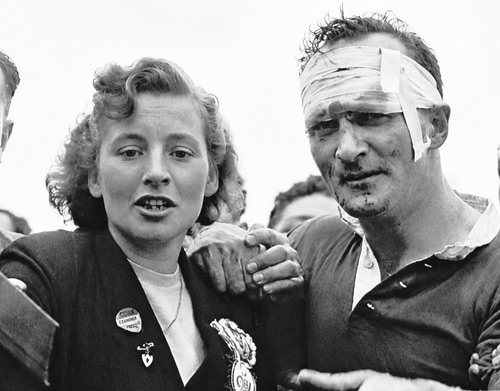
On 13 July 1952, following one of the most memorable Munster Hurling Finals ever played, a photograph was taken at the Gaelic Grounds in Limerick that would become one of the most recognisable images in the history of Gaelic games.
Cork had just defeated Tipperary by 1-11 (14pts) to 2-6, (12pts), ending Tipp’s great hopes of four successive Munster titles. At the centre of Cork’s victory was the legendary Christy Ring, battered, bloodied and bandaged after another extraordinary performance. Standing beside him was a young woman holding a Kodak box camera. Her name was Rita Fenton, (later Rita Lowry,
Then a native of Ballygarvan, County Cork. The image captures a wonderful moment of sporting history. Mr Ring, his head heavily bandaged, rests his arm across Rita’s shoulders as she attempts to have her own photograph taken with her hurling hero.
What makes the story particularly fascinating is that Rita was no ordinary spectator. Born in 1927, she was herself an accomplished camogie player. Having moved from Cork to Fawnagown, Tipperary in 1948, she helped establish the Seán Treacy camogie club and went on to represent Tipperary. Remarkably, she had played against her native Cork in the Munster Camogie Final that very same year.
Rita was also a personal friend of Christy Ring. Their friendship continued long after that famous afternoon, with Ring sending her letters and Christmas cards over the years. For decades, the identity of the young woman in the photograph remained largely unknown to the wider public. She became affectionately known as the “Blood and Bandage Lady”. It was not until May 2016, some 64 years after the photograph was taken, that the Irish Examiner, assisted by family friend Jerry Ring, brought her remarkable story to a wider audience.
Rita recalled that she had been passing her Kodak box camera to a friend so that a photograph could be taken of herself alongside Christy. At that very moment, another unknown photographer captured the scene that would become famous. The photograph appeared in the Cork Examiner on 14 July 1952 and would eventually find a permanent place in the visual history of Cork hurling, including a display at Páirc Uí Rinn. Although the original photograph survives in the Irish Examiner archives, the name of the photographer responsible has not yet been firmly established. Beyond that celebrated image, Rita devoted much of her life to Gaelic games, collecting photographs, newspaper reports and sporting memorabilia in an extraordinary series of scrapbooks.
Now comes the sad news that Mrs Rita Lowry (née Fenton) has passed away, in her 100th year. Her death was reported yesterday November 5th 2026. She leaves behind a wonderful legacy, not only as the young woman in one of hurling’s most cherished photographs, but as a camogie player, club pioneer, lifelong sporting enthusiast and devoted family woman. Seventy-four years after that unforgettable afternoon in Limerick, the photograph remains a powerful reminder of a different sporting age an era of fierce rivalry, extraordinary characters and enduring friendships.
Christy Ring’s name will forever occupy a special place in Irish sporting history. Thanks to one remarkable photograph, Rita Lowry’s name will always be remembered alongside his.
The growing use of LED street lights, floodlights and security lighting is raising serious concerns about the impact of artificial light on bats, migratory birds, insects and the wider natural environment. Recent court proceedings have highlighted why these concerns cannot simply be ignored.
Modern LED lighting is widely promoted as environmentally friendly because it consumes less electricity, reduces carbon emissions and lowers maintenance costs. However, an important question is increasingly being asked; Are we saving energy at the expense of our wildlife?
Scientific research confirms that artificial light at night can interfere with the natural behaviour of wildlife, disrupting feeding, migration, reproduction and essential biological rhythms. For thousands of years, wildlife has depended upon the natural cycle of daylight and darkness. Today, that delicate balance is increasingly disturbed by powerful artificial lighting.
Back in August 2024 aspeciesofPipistrelles Batcaused similar delays in the erection of a €3.4 million project in Cathedral Street, Thurles.The work has since been completed.
Bats Are Particularly Vulnerable. Ireland’s bats are legally protected, yet many are highly sensitive to artificial illumination. Bats depend upon dark hedgerows, rivers, woodlands and countryside corridors to travel between their roosts and feeding grounds. Bright street lights can discourage certain bat species from using established routes, effectively creating barriers across otherwise suitable habitats. Lighting near roosting sites can delay bats emerging to feed, reducing opportunities to catch insects during the important hours after sunset. Although some bat species feed around street lights, others actively avoid them. Consequently, installing additional lighting may benefit a few species while seriously disadvantaging others.
Migratory Birds Also Face Serious Risks. Artificial lighting can disorient birds migrating at night, drawing them away from established routes and increasing the risk of exhaustion and collisions. Floodlighting near wetlands and feeding grounds can also discourage protected birds from using habitats essential to their survival. This is especially concerning where conservation measures are intended to restore declining bird populations.
Insects. Insects, meanwhile, are attracted to artificial lights, which can interfere with their feeding, reproduction and pollination activities. The consequences extend throughout the food chain.
Hundreds of roosting Pied Wagtails congregate nightly all year round, unnoticed in Liberty Square, Thurles, Co. Tipperary.
An Important Irish High Court Decision In May 2024, the Irish High Court found in favour of environmental organisation Dark Sky Roscommon in a challenge concerning planning permission for 21 floodlights at Tarmon National School, County Roscommon. The case concerned potential effects on the nearby Bellanagare Bog Special Protection Area, associated with the protected Greenland white-fronted goose. The Court found that An Bord Pleanála had failed to properly address reasonable scientific concerns regarding the development’s possible impact on the conservation objectives of the protected area, including the potential return of the geese. The ruling demonstrated that planning authorities must take potential ecological impacts seriously and comply with European environmental assessment requirements. Importantly, this was not a general court ban on LED lighting, nor was it a confirmed order permanently switching off the installed floodlights. Nevertheless, it provides a significant legal warning against overlooking wildlife protection when approving lighting developments.
Why This Matters in County Tipperary This issue has direct relevance to Tipperary. Tipperary County Council is undertaking a substantial programme of converting public street lights to LED technology. According to its 2025 Climate Action Progress Report, the Council maintains approximately 19,000 public lights, with more than 10,000 converted to LED by September 2025. Further upgrades were expected during 2026. Energy efficiency and cost savings are important public objectives. However, the ecological consequences must also be considered. Tipperary contains extensive rivers, hedgerows, woodlands, wetlands and countryside habitats supporting protected wildlife. The River Suir and its associated habitats are particularly important examples of environments where inappropriate lighting could affect wildlife movement and feeding. Significantly, Tipperary County Council’s own Public Lighting Policy, adopted in December 2022, recognises the need for special consideration of lighting near bat roosts, dark-sky areas and environmentally sensitive locations. The question is whether these safeguards are being consistently implemented as LED lighting expands.
Cloughjordan, Co. Tipperary Shows Another Way. There is encouraging news from Tipperary itself. In April 2026, press reported that Cloughjordan Ecovillage had introduced an innovative wildlife-sensitive lighting scheme. Ecological surveys recorded eight of Ireland’s nine established bat species foraging in the ecovillage, along with an impressive diversity of moths. The community responded with carefully directed, warm-coloured, dimmable LED lighting, designed to preserve darkness while allowing residents to move safely at night. Representatives of Tipperary County Council and Bat Conservation Ireland welcomed the initiative. Cloughjordan demonstrates that public safety, modern lighting and biodiversity protection need not be mutually exclusive.
Time for a Countywide Approach? Surely it is reasonable to ask that all new and replacement public lighting in Tipperary be assessed for potential ecological impacts, particularly near rivers, hedgerows, mature trees, bat roosts and protected habitats.
Practical measures could include: Using warmer-coloured, lower-intensity lighting where appropriate. Directing illumination downwards and preventing unnecessary light spill. Dimming or switching off unnecessary lighting during quieter hours, where safe. Maintaining dark wildlife corridors. Undertaking appropriate ecological assessments before installing lighting in sensitive locations.
None of this requires abandoning energy efficiency or compromising essential road safety. It requires thoughtful planning, appropriate technology and recognition that darkness is itself an important natural resource. Sadly in Thurles Co. Tipperary, street lighting remains lit both day and night for the past 4 years.
Protecting the Night Is Protecting Nature Ireland has rightly invested considerable effort in protecting biodiversity, restoring habitats and addressing climate change. Yet these objectives risk being undermined if artificial lighting continues to expand without sufficient regard for nocturnal wildlife. The High Court decision in Roscommon should encourage planning authorities throughout the country to examine the ecological consequences of lighting carefully. Tipperary already has an excellent example of what can be achieved at Cloughjordan Ecovillage. Perhaps the time has come for Tipperary to lead by example, ensuring that the drive towards energy-efficient lighting does not leave our bats, migratory birds and other wildlife struggling to survive in an increasingly illuminated world.
Saving electricity matters. Saving wildlife matters too. We should be capable of doing both.
This website uses cookies to improve your experience. We'll assume you're ok with this, but you can opt-out if you wish.AcceptRead More
Privacy & Cookies Policy
Privacy Overview
This website uses cookies to improve your experience while you navigate through the website. Out of these, the cookies that are categorized as necessary are stored on your browser as they are essential for the working of basic functionalities of the website. We also use third-party cookies that help us analyze and understand how you use this website. These cookies will be stored in your browser only with your consent. You also have the option to opt-out of these cookies. But opting out of some of these cookies may affect your browsing experience.
Necessary cookies are absolutely essential for the website to function properly. This category only includes cookies that ensures basic functionalities and security features of the website. These cookies do not store any personal information.
Any cookies that may not be particularly necessary for the website to function and is used specifically to collect user personal data via analytics, ads, other embedded contents are termed as non-necessary cookies. It is mandatory to procure user consent prior to running these cookies on your website.







Recent Comments