|
|
The Irish Government has introduced a new suite of multimedia materials, including engaging videos, to help children better understand family justice processes in a clear and age-appropriate way. These resources are specifically designed for children aged 8 to 12 who may be going through family changes such as separation or divorce, or whose parents are involved in family court proceedings.
This initiative forms part of the broader reform of Ireland’s family justice system under the Family Justice Strategy 2022–2025. The strategy aims to reshape the system so that it places a stronger emphasis on the needs, rights, and voices of children, recognising their central role in many family law matters.
The newly launched video series is available online via a dedicated government webpage and can also be accessed through the Department of Justice, Home Affairs and Migration’s YouTube channel. The project received financial support from the Dormant Accounts Fund and aligns with the strategy’s priority of “Supporting Children.”
A key objective of the strategy is to ensure children have access to clear, understandable information about family justice processes. This includes helping them grasp how decisions are made, how those decisions may affect them, and how their own views can be heard and considered.
To achieve this, the Government reviewed existing information available to young people and identified ways to improve how such information is delivered. The result is a series of child-friendly materials that explain legal processes and outcomes in a way that is accessible and appropriate for younger audiences.
The development of these resources involved collaboration with government agencies, NGOs, service providers, and relevant departments, including education and children’s services. Importantly, the content was also shaped by direct consultation with children who have experienced family separation, ensuring the materials reflect their perspectives and needs.
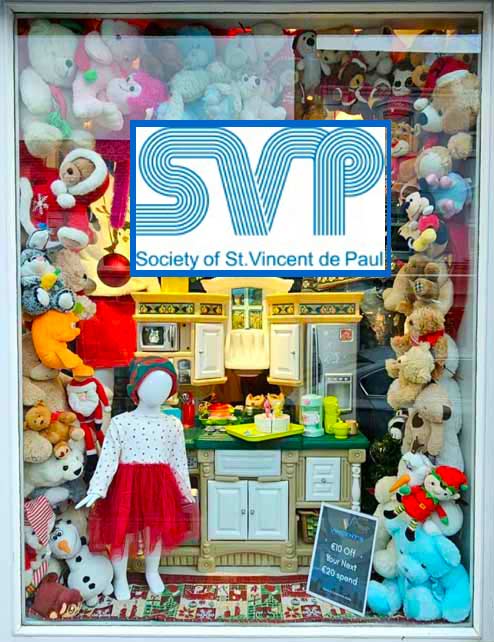
A Rich Country Begging for €8: What SVP’s TV Appeal Reveals About Ireland’s Broken Model.
There is something profoundly uncomfortable about watching an advert from Society of St. Vincent de Paul on Irish television, asking for just €8 a month to help Irish children. Not because the request is unreasonable, but because it is necessary in the first place.
In Ireland, one of the wealthiest countries in the world, a charity is asking ordinary people to fund basic childhood needs. That should stop and sicken us in our tracks.
The Quiet Power of SVP
For generations, SVP has been one of Ireland’s most trusted safety nets, quietly visiting homes, paying bills, buying food, and restoring dignity where the system on our Island falls short. Their work is not theoretical; it is immediate and it is human.
Now, for the first time, they have launched a major TV campaign focused on Irish child poverty. It is not subtle. It is not abstract. It is a direct appeal to the public to act.
The message is simple: “Give €8 a month to stop poverty hurting children”. The campaign highlights a stark truth, over one in five children in Ireland experiences deprivation, the highest of any age group and that statistic alone should be politically explosive. Instead, it has become normalised.
The Reality Behind the Advert.
SVP’s appeal is not about charity, it is about failure elsewhere.
Their own research shows, that child poverty has surged dramatically, rising from 4.8% to 8.5% in just a single year. Income supports for older children meet only 64% of actual needs. The cost of a basic standard of living has risen by 18.8% since 2020. This is not marginal hardship. It is systemic.
Children are hungry. Homes are cold. Parents are cutting essentials so their children can eat. These are not isolated cases, they are widespread enough to justify a national TV campaign.
Let’s Be Blunt: This Is a Political Failure, there is no polite way to say this.
This situation did not arise by accident. It is the result of policy choices made repeatedly over decades. Successive governments, led primarily by Fianna Fáil and Fine Gael and by those who supported them namely Labour, The Greens, Lowry’s Independants; latter who chose:-
• To rely on the private market to deliver housing.
• To underinvest in social housing for years.
• To allow essential costs (rent, childcare, energy) to spiral.
• To patch over problems with temporary payments rather than structural reform.
Even now, Budget 2026 offers increases, but they fall short of what families actually need. That is not an accident. That is a choice.
The Core Problem:
Ireland Is Expensive, Not Poor. Ireland does not have a ‘lack-of-money’ problem. It has a ‘cost-of-living’ problem. The state redistributes income reasonably well, but it does almost nothing to control the cost of essentials:
• Housing is among the most expensive in Europe.
• Energy costs remain elevated.
• Childcare is prohibitively expensive.
• Everyday goods have risen sharply.
So what happens?
The government gives with one hand, and the market takes with the other. The result is predictable, families fall short. Perhaps the most disturbing shift is this, people who are working; sometimes full-time, are now turning to SVP. This is not traditional poverty. This is a system malfunction. When employment no longer guarantees a basic standard of living, something fundamental has broken.
Charity is becoming structural as SVP handled hundreds of thousands of requests for help in recent years. That is not emergency support anymore, that is parallel welfare.
Let’s be honest about what this means; the Irish system is now quietly outsourcing part of its social responsibility to charities, and charities, no matter how good, cannot replace the State.
Where We Should Be Heading
Ireland does not need minor tweaks. It needs a shift in direction. Housing must be treated as infrastructure. The state must build at scale, tens of thousands of homes annually; not rely on private developers to solve a public crisis. Reduce costs, not just increase payments. Throwing money at people, while leaving rents and childcare untouched is futile. Costs must come down.
Benchmark Social Welfare to Reality. Supports should be tied to the actual cost of living, not political compromise.
Invest in Children Directly. Free school meals throughout, reduced education costs, and meaningful child supports should be universal.
The Political Courage Question.
None of this is impossible but it does requires confronting uncomfortable truths:
• Property values may stabilise or fall.
• Investors may lose out.
• Government spending must increase.
That is the trade-off and for years, Irish politics has chosen to avoid it.
Final Thought: What the €8 Really Means.
The €8 in that SVP advert is not just a donation. It is a signal. It tells us that:–
The system is not working. The gap between wealth and lived reality is widening and ordinary people are being asked to bridge that gap themselves.
SVP deserves enormous respect. Their work is compassionate, effective, and essential, but they should not have to do this at scale in a country like Ireland.
When a wealthy nation relies on charity to meet children’s basic needs, the problem is not charity, it is policy and until that changes, the adverts will keep coming.
It was with a great sadness that we learned of the death, yesterday Monday 4th May 2026, of Mrs Grazia Carroll, Springhill, Killenaule, Thurles, Co. Tipperary.
Pre-deceased by her husband Bill and great grandson Jack; Mrs Carroll passed away peacefully, while in the care of staff at Tipperary University Hospital, Clonmel, South Co. Tipperary.
Her passing is most deeply regretted, sadly missed and lovingly remembered by her sorrowing family; loving daughter Anna (Whitfield), son-in-law Nigel, grandchildren Emma and Liam, great grandchildren James, Reuban and Pippa, extended relatives, neighbours and friends.
Requiescat in Pace.
Funeral Arrangements.
The earthly remains of of Mrs Carroll will repose at O’Connell’s Funeral Home, Killenaule, Thurles, (Eircode E41 HH66), on tomorrow afternoon, Wednesday May 6th, from 5:00pm until 7:00pm same evening.
Her remains will be received into thhe Church of St Mary, Bailey Street, Killenaule, Thurles on Thursday morning, May 7th, to further repose for Requiem Mass at 11.30am, followed by interment, immediately afterwards, in Crosscannon Cemetery, Killenaule, Thurles, Co. Tipperary.
For those persons who would wish to attend Requiem Mass for Mrs Carroll, but for reasons cannot, same can be viewed streamed live online, HERE.
The extended Carroll family wish to express their appreciation for your understanding at this difficult time, and have made arrangements for those persons wishing to send messages of condolence, to use the link shown HERE.
Ar dheis Dé go raibh a h-anam dílis.
Newly released figures show that hundreds of patients experienced harm due to medication related incidents within public health services over the past year.
Out of the reported cases, 738 patients were affected. The vast majority; 732 incidents, resulted in minor to moderate harm, while six cases were classified as causing severe harm.
In total, approximately 10,400 medication related incidents and near misses were recorded. Of these, more than 7,150 incidents reached patients, but caused no harm or only negligible effects. Meanwhile, over 2,540 incidents were classified as near misses, meaning they were identified before affecting any patient.
Medication incidents are defined as preventable events that may lead to inappropriate medication use or patient harm, while under the supervision of healthcare professionals.
Data from state claims records indicates that the most frequent type of incident involved missed or delayed doses of medication.
Public health services handle a significant volume of care annually, including around two million inpatient and day-case treatments, along with a similar number of emergency department visits.
Efforts are ongoing to improve patient safety, with medication-related harm identified as a key focus area. Safety improvements are being implemented at local, regional, and national levels to reduce risks associated with medication use.
A new performance measure introduced this year focuses on polypharmacy. This tracks the percentage of individuals aged 65 and older who are prescribed ten or more regular medications, as this group is considered at higher risk of receiving potentially inappropriate treatments.
Additionally, hospital inspections are carried out to monitor and enhance medication safety practices across healthcare settings.
Ms Maura Barrett (Cashel Branch Librarian) Reports:-
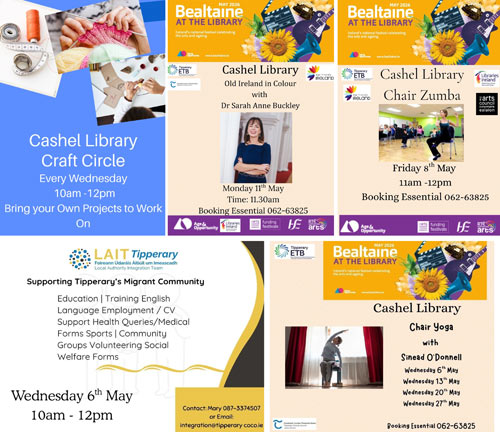
[1] Join the Cashel Craft Circle every Wednesday from 10:00am-12:00pm for their social gathering. Bring along your own project to work, share ideas, patterns and enjoy a chat and cuppa with others. No need to book just come along.
[2] Chair Yoga with Sinead O’Donnell on Wednesday 6th May 3pm-4pm for four weeks.
Booking Essential to Tel: 062-63825.
[3] The next meeting of the Local Integration Team Clinic Supporting Migrants in the Community will take place in Cashel library on Wednesday 6th May 10:00am-12:00pm
[4] Chair Zumba With Eimear Byrne. Friday 8th May 11am-12pm.
Booking Essential to Tel: 062-63825.
[5] “Old Ireland in Colour” Monday May 11th. at 11:30am. In this engaging talk, Dr Sarah-Anne Buckley explores Ireland’s past through carefully restored and colourised photographs. These vivid images, spanning the Land War, the revolutionary decade, and everyday life across the island are placed within their wider historical context, revealing the social, political and cultural forces that shaped modern Ireland. Combining rigorous research with striking visual material, the talk shows how colour can deepen our understanding of history and reconnect us with the real lives behind the photographs. Dr Sarah-Anne Buckley is co-author of the award-winning Old Ireland in Colour Series with Professor John Breslin.
Booking Essential to Tel: 062-63825.
[6] Join Suzanne Buttimer for an interactive fun singing session designed to engage participants and evoke happy memories. Suzanne will be in Cashel Library. Monday 11th May 2:30–3:30pm.
Booking Essential to Tel: 062-63825.
People wishing to attend the above events can locate the Cashel Library building; situated on Friar Street, Lady’s Well, Cashel, Co. Tipperary, HERE. (Eircode E25 K798).
|
Support Us Help keep Thurles.info online by donating below. Thank you.
Total Donated 2026: €300.00
Thank You!
Daily Thurles Mass Livestream
|







Recent Comments