Pre-deceased his sisters Maureen, Celia and Pauline and his brother TJ; Mr Caplis passed away peacefully while in the care of staff at Croí Óir, Our Lady’s Hospital, Cashel, Co. Tipperary.
His passing is most deeply regretted, sadly missed and lovingly remembered by his sorrowing family; loving wife Frances, daughters Joanne and Mary and her partner Paddy, son James and his wife Louise, grandchildren Fionn and Clíona, sister Joan, brother Gerard and his partner Maura, sister-in-law Betty, brother-in-law Jack, nieces, nephews, cousins, extended relatives, neighbours and friends.
For those persons who would wish to attend Requiem Mass for Mr Caplis, but for reasons cannot, same can be viewed streamed live online, HERE.
The extended Caplis family wish to express their appreciation for your understanding at this difficult time, and have made arrangements for those persons wishing to send messages of condolence, to use the link shown HERE.
Between boycott and Bill: why the “settlements goods” debate has become a test of Irish politics’ bordering on Antisemitism.
A set of recently released State papers shows that, long before today’s Gaza-driven political polarisation, Irish officials worried that opening an Israeli embassy in Dublin could trigger an “Arab backlash”, carry significant security costs, and create diplomatic knock-on effects. Contemporary reporting based on the 2025 National Archives release says officials weighed Arab trade links and security resourcing before the embassy ultimately opened in 1996.
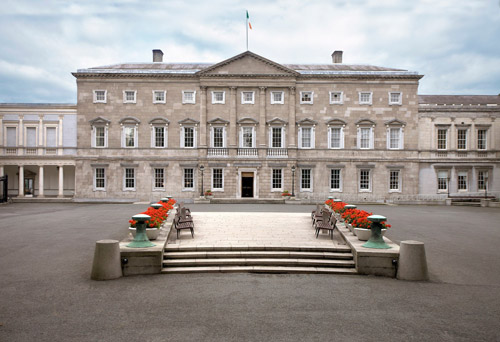
Leinster House, Kildare St, Dublin 2
That archival caution matters because it speaks to a recurring Irish instinct: to treat the Middle East not only as a moral question, but as a practical one; a mix of international law, trade and domestic cohesion. In 2025, those strands are tightly knotted around the Government’s proposed legislation to ban imports of goods, originating in Israeli settlements in the Occupied Palestinian Territory.
What the proposed law does, and why it’s politically explosive. On 25 June 2025, the Department of Foreign Affairs published the General Scheme of the Israeli Settlements in the Occupied Palestinian Territory (Prohibition of Importation of Goods) Bill 2025, framing it as compliance with Ireland’s international legal obligations, explicitly citing the International Court of Justice advisory opinion of 19th July 2024.
The Oireachtas committee subsequently published its pre-legislative scrutiny report. Dáil debate later in 2025 described the Bill’s purpose in plain terms: to prohibit the importation of goods from Israeli settlements in the occupied territories. Yet the measure’s impact is likely to be economically small while politically enormous; latter situation not yet identified by Senator Frances Black and those representing the opposition in our national parliament. It was reported in December 2025 that Minister of State Mr Thomas Byrne described the proposed curbs as “extremely limited” and confined “strictly to goods”, citing an estimated import value of about €200,000, while noting the controversy has far outpaced the trade involved.
Other coverage has used different estimates over longer periods, underlining that the real weight of the debate is symbolic and legal rather than commercial. The legislation also sits within a wider arc: Ireland’s decision to recognise the State of Palestine in May 2024, and the subsequent sharp deterioration in diplomatic relations with Israel. In December 2024, Israel announced it would close its embassy in Dublin, with Foreign Minister Ms Gideon Saar accusing Ireland of “extreme anti-Israel policies”, “double standards” and antisemitism, allegations which the Irish Government rejected. So the Bill lands in an atmosphere already totally charged with distrust.
The antisemitism argument: Intent, Impact, and the “line” everyone claims to defend. Supporters of the import ban argue it is a narrow response to an illegal situation: it targets settlement commerce, not Israel as a state and certainly not Jewish people. They frame it as an attempt to align Irish trade practice with international law; a position the Irish Government has repeatedly emphasised through its own framing of the General Scheme.
Critics, including representatives of Ireland’s Jewish community and some international voices, argue that whatever the stated intent, the political message is felt differently. In a submission to the Oireachtas committee in July 2025, the Jewish Representative Council of Ireland said (in essence) that criticism of Israel is not antisemitism, but that when criticism becomes a campaign or law and when no other state is treated the same, Ireland should rightly pause and question consistency.
RTÉ’s coverage of that committee process captured the temperature; witnesses used pointed language, including explicit claims that the Bill was antisemitic, which drew pushback in the room and highlighted how quickly the debate shifts from legal argument to accusations about motives.
This is where definitions matter. In January 2025, Ireland endorsed the IHRA Working Definition of Antisemitism (non-legally binding) and associated global guidelines, presenting the move as part of a broader equality and non-discrimination framework.
For supporters, that endorsement is proof the Irish State is capable of defending Jewish communities while criticising Israeli policy. For critics, it is a reminder that the State has accepted a framework which warns that antisemitism can sometimes attach itself to discourse about Israel, and that politicians should be alert to how rhetoric can drift from policy critique into collective blame.
A country with an old history, and a new vulnerability. God knows Ireland does not need to import antisemitism; it already has its own built-in history. The Limerick boycott of 1904 – 1906, was instigated after a Redemptorist priest, Fr John Creagh, preached two virulent anti-Semitic sermons, delivered in January 1904. His sermons accused the city’s approximately 170 Jews, mostly refugees from Lithuania, of being “leeches”, He claimed they exploited the poor through dishonest trading and moneylending, calling for an economic boycott. A riot following Creagh’s first sermon on January 11th, saw a mob of roughly 200 people attacking the Jewish quarter on Colooney Street (now Wolfe Tone Street), pelting residents and homes with mud, stones, and breaking windows. The boycott of Jewish businesses, lasted for two years (1904 -1906). The campaign received support from local nationalist figures like Arthur Griffith(founder of Sinn Féin) and the 6,000-member Arch-Confraternity of the Sacred Heart.
The impact of same boycott crippled the livelihood of Jewish traders, many of whom were peddlers selling small items. Although no one was killed, the sustained intimidation and poverty, forced many families to leave Limerick. Some moved to Cork or emigrated to England and South Africa.
The campaign was denounced by several prominent figures, including Irish nationalist Michael Davitt, founder of the Irish National Land League; the Church of Ireland Bishop Thomas Bunbury; and eventually Creagh’s ownreligious superiors, who moved him out of Limerick city, sending him to Belfast and shortly afterwards to Wellington, New Zealand, and later to North Perth, Australia. Same remains the clearest Irish example of organised anti-Jewish pressure, remembered as a boycott that also involved intimidation and violence.
History should have taught us the lesson that today’s so called Palestine Solidarity Marches are in fact a repeat of the riots brought about following Fr. Creagh’s first sermon, and that minority communities can easily become targets when Irish politics turns moralistic and simplifying.
In 2025, the Jewish Representative Council says it is compiling a report that will detail “over 100” antisemitic incidents during a four-month period in this year, 2025, including graffiti explicitly calling on individuals to “Kill Jews”, same publication expected in 2026. Garda figures also show hate-crime and hate-related incident reporting has increased in recent years; the force has published 2024 data and has stressed under-reporting, while the Criminal Justice (Hate Offences) Act 2024 commenced on December 31st 2024, strengthening provisions around offences aggravated by hatred.
Those data points don’t “prove” a particular political party or cause is antisemitic. But they do set the background risk: a small community says hostility is rising, while national politics is consumed by a conflict that easily collapses nuance into slogans.
When symbols become proxies: the Herzog Park row. The recent controversy over a proposal to rename Herzog Park in Dublin, illustrates how quickly symbolism turns into a proxy war over antisemitism. It is reported that opponents, including government figures and members of Ireland’s Jewish community, warned the move was divisive and could be seen as antisemitic, while supporters framed it as solidarity with Palestinians; before the council delayed the vote.
It was also reported that senior Government figures warned that removing the name would be seen as antisemitic and would erase Irish-Jewish history. Whatever one’s view of the park, the episode showed how the debate now operates: the Israel-Palestine question is no longer only foreign policy. It is a domestic argument about who belongs, whose history is honoured, and what language is acceptable.
If the settlements import ban proceeds, Ireland faces a dual obligation: to pursue any international-law-based policy in a way that is consistent and legally robust and to police the boundary between legitimate criticism of a state and hostility toward a minority at home.
The Government’s case rests on law and narrow scope. Its critics’ case rests on impact, consistency and the social climate. Neither side can credibly claim the other concern is imaginary. And that may be the most “Irish” feature of the argument: an instinct to see moral urgency and community vulnerability in the same frame, yet struggle, in real time, to keep both from colliding.
Pre-deceased by her sons Joe and Michael, infant daughter Martina, grandsons Vincent and Kieran, son-in-law Vincent; Mrs McCormack passed away peacefully following a short illness, surrounded by her loving family.
Her passing is most deeply regretted, sadly missed and lovingly remembered by her sorrowing family; loving husband Seamus, sons Pat, Jim, Philip, John and Thomas, daughters Margaret (Costello), Josie (Woodlock), Elsie (Rafter) and Sandra (Corcoran), grandchildren, great-grandchildren, daughters-in-law Blanche, Helen, Adita, Michelle and Sandra, sons-in-law Ger, John and Paul, sister Tessie, nephews, nieces, brothers-in-law John and Pascal, sisters-in-law Mary (Meaney) and Helen (Delahunty), cousins, extended relatives, neighbours (especially Christina) and many friends.
The extended McCormack and Fanning families wish to express their appreciation for your understanding at this difficult time, and have made arrangements for those persons wishing to send messages of condolence, to use the link shown HERE.
Pre-deceased by his parents William and Josephine and his brother Noel; Mr Kent passed away peacefully while in the care of staff at University Hospital Galway, surrounded by his loving family.
His passing is most deeply regretted, sadly missed and lovingly remembered by his sorrowing family; loving wife Geraldine, daughters Pheilo and Vanessa, son Oliver, sons-in-law David and John, grandchildren Ian, Bob, Sarah, Jayne, Conor, Daniel and Aaron, brothers Kevin and Gerard, sisters Tess, Gretta and Mary, brothers-in-law, sisters-in-law, nieces, nephews, extended relatives, neighbours and many friends.
Rest in Peace.
Funeral Arrangements.
The remains of Mr Kent will repose for a private service of cremation, attended only by family members, in accordance with his previous wishes.
The extended Kent family wish to express their appreciation for your understanding at this difficult time, and have made arrangements for those persons wishing to send messages of condolence, to use the link shown HERE.
Note Please: House strictly private. Family flowers only. Donations in lieu, if desired, to Galway Hospice Foundation.
The Cabinet has approved the publication of the Garda Síochána (Powers) Bill 2025, a major piece of legislation designed to modernise and consolidate the statutory basis for key Garda powers, placing them on a clearer and more accessible legislative footing.
Key measures in the Bill:
Reform of search warrants (including electronic devices)
Updates and reforms the law on search warrants in light of Supreme Court judgments.
Provides for tailored search warrants specifically authorising the seizure and search of electronic devices, and procedures to assess claims of privilege.
Strengthens rights for individuals to be informed about authorised access to data on seized electronic devices (Section 23), reflecting the Landeck judgment of the Court of Justice of the European Union.
Creates a statutory mechanism enabling the examination of devices seized without prior judicial approval, with appropriate authorisation arrangements.
Judicially supervised handling of privileged material.
Establishes clear statutory procedures to ensure privileged material is handled through a judicially supervised process.
Confirms legal professional privilege as absolute, and provides a structured process for other forms of privilege, including (where required) determination by the High Court under Section 24.
Stop-and-search provisions.
Introduces provisions to support greater consistency in the use and understanding of Garda stop-and-search powers.
Requires Gardaí to make a formal record of all searches, and provides for stop-and-search of a person or vehicle in a public place where Gardaí reasonably suspect possession of a relevant article (as defined in the legislation).
Custody and interview safeguards.
Places on a statutory footing the existing right of a person in custody to consult a solicitor before and during interview.
Provides for electronic recording of Garda interviews and modernises the custody framework.
The Bill is intended to clarify the law in an area that has become complex, strengthen safeguards, and provide clear procedures for dealing with privileged material, grounded in the principle that human rights are the foundation and purpose of policing.
A stamped draft of the Garda Síochána (Powers) Bill 2025 has been made available, with formal publication by the Oireachtas to follow in due course. The Bill builds on the objective of codifying and modernising police powers of search, arrest and detention and strengthening procedural rights, as set out in the earlier general scheme (published June 2021).
This website uses cookies to improve your experience. We'll assume you're ok with this, but you can opt-out if you wish.AcceptRead More
Privacy & Cookies Policy
Privacy Overview
This website uses cookies to improve your experience while you navigate through the website. Out of these, the cookies that are categorized as necessary are stored on your browser as they are essential for the working of basic functionalities of the website. We also use third-party cookies that help us analyze and understand how you use this website. These cookies will be stored in your browser only with your consent. You also have the option to opt-out of these cookies. But opting out of some of these cookies may affect your browsing experience.
Necessary cookies are absolutely essential for the website to function properly. This category only includes cookies that ensures basic functionalities and security features of the website. These cookies do not store any personal information.
Any cookies that may not be particularly necessary for the website to function and is used specifically to collect user personal data via analytics, ads, other embedded contents are termed as non-necessary cookies. It is mandatory to procure user consent prior to running these cookies on your website.








Recent Comments