Pre-deceased by his parents Richard and Elizabeth, his brothers Michael and Ambrose and his sister Mai; Mr Boland passed away peacefully surrounded by his loving family, at his place of ordinary residence.
His passing is most deeply regretted, sadly missed and lovingly remembered by his sorrowing family; loving wife Anne, daughters Emma, Cara and Kate, sons Aidan, Barry and Eamonn, sister Lena, grandchildren Daniel, Ronan, Megan, Eva, Mia, David, Conor, Claire, James, Andy, and Eliza, sons-in-law and daughters-in-law, nieces, nephews, extended relatives, neighbours and a wide circle of friends.
Requiescat in Pace.
Funeral Arrangements.
The earthly remains of Mr Boland will repose at O’Connell’s Funeral Home, Killenaule, Thurles, (Eircode E41 HH66), on Monday afternoon, July 27th, from 4:30pm until 7:00pm, before being received into the Church of St Mary, Bailey Street, Killeanule, Thurles, at 7:30pm, same evening. Requiem Mass will be offered for Mr Boland on Tuesday morning next, July 28th, at 11:30am, followed by interment, immediately afterwards, in the adjoining graveyard.
For those persons who would wish to attend Requiem Mass for Mr Boland, but for reasons cannot, same can be viewed streamed live online, HERE.
The extended Boland family wish to express their appreciation for your understanding at this difficult time, and have made arrangements for those persons wishing to send messages of condolence, to use the link shown HERE.
Note Please: House strictly private. Family flowers only. Donations in lieu, if desired, to South East Palliative Care.
A teenage motorist has lost his life following a single-car collision near Ballynonty,Thurles, County Tipperary during the early hours of this morning, Sunday July 26th, 2026.
The fatal crash happened at approximately 3:45am on the L4101 at Lanespark, close to Ballynonty and Thurles.
Emergency personnel attended the scene, but the young driver, described by Gardaí as a male teenager, was sadly pronounced dead a short time later. He was the driver of the only vehicle involved in the incident. His remains have been taken to the mortuary at University Hospital Waterford, where a postmortem examination is expected to be conducted later. The local coroner has also been informed.
The teenager’s death brings to at least seven the number of people reported killed in road collisions in County Tipperary since the beginning of 2026.
The L4101 has been closed while Garda forensic collision investigators carry out a detailed technical examination of the scene. Motorists are being redirected through local diversions while that work continues.
Gardaí have urged anyone who saw the vehicle or witnessed the collision to contact the investigation team.
They are particularly interested in hearing from drivers or other road users who travelled through the Lanespark and Ballynonty area between 3:00am and 3:45am on Sunday. Anyone with dash-cam, mobile-phone or other camera recordings from that period is asked to preserve the footage and provide it to Gardaí.
Information can be given to Thurles Garda Station, Tel: 0504 25100, the Garda Confidential Line on Tel: 1800 666 111, or indeed at any Garda station.
Get ready to squish, splash, scoop and explore at our Messy Play Session in The Source Library, Thurles, Co. Tipperary!
Designed for children aged 0 – 4years, this fun sensory activity encourages little ones to discover new materials, textures, sounds and smells through hands-on play. It’s a wonderful way to spark creativity, build confidence and support early learning.
Date: Wednesday, August 5th. Time: 11:30am. Venue: The Source Library, Thurles. Suitability: Suitable for ages 0 – 4 years.
Note: Places are limited and advance booking is essential. Call Tel. No. 052 616 6131, to reserve your child’s place.
The Government’s decision to designate the proposed Shannon water pipeline, as “critical infrastructure”, represents a significant new development in a project that could profoundly affect North Tipperary and the wider Shannon region.
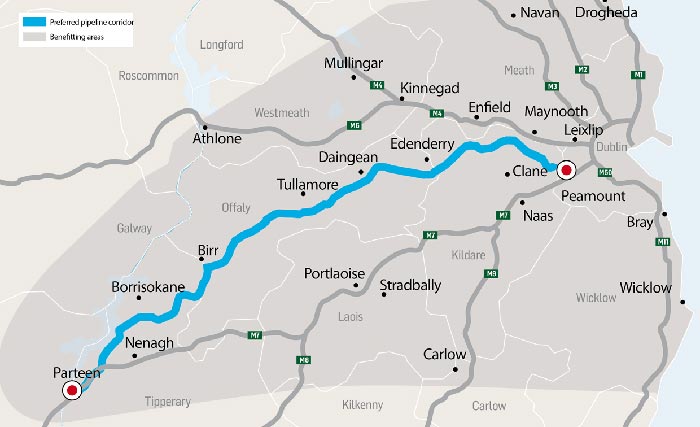
Officially known as the Water Supply Project for the Eastern and Midlands Region, the scheme is now one of the first nine projects placed at the “top of the queue” under the Critical Infrastructure Act 2026. It is one of three water projects selected, alongside the Greater Dublin Drainage Project and the upgrade of the Bunlicky Wastewater Treatment Plant in Limerick. The proposed scheme would take water from the lower River Shannon at the Parteen Basin in County Tipperary, treat it at Birdhill and carry it through a pipeline running across Tipperary, Offaly and Kildare to Peamount in County Dublin. Uisce Éireann says the project would provide a second major water source for the eastern and midlands region, reduce its heavy dependence on the River Liffey and help meet future housing, population and economic demands.
However, the scale of the proposal remains enormous. The planning application involves the abstraction of more than 300 million litres of water on certain days, according to reported project figures. Uisce Éireann describes this as a maximum of approximately 2% of the Shannon’s average flow at Parteen Basin. The utility’s current estimated cost is between approximately €4.6 billion and €6 billion. However, documents previously supplied by the Department of Housing to the Public Accounts Committee indicated that the final bill could exceed €10 billion under a worst-case risk scenario.
This new designation does not automatically grant planning permission, nor does it direct An Coimisiún Pleanála to approve the application. What it does is place a legal obligation on relevant State bodies to prioritise the project, allocate the necessary administrative and technical resources and reduce the time taken to process decisions, licences, consents and other authorisations. Public bodies are also expected, where possible, to carry out different approval processes simultaneously rather than waiting for one process to finish before beginning another.
That distinction is important. The project must still comply with planning law, environmental assessment requirements and Ireland’s obligations under European Union law. The designation is intended to accelerate decision-making, not predetermine its outcome. Nevertheless, from a Tipperary perspective, the Government’s announcement clearly increases the political and institutional pressure surrounding the project. Only weeks ago, An Coimisiún Pleanála postponed its expected decision on the application. Its official case record now states that a decision is due by 2nd July 2027. That postponement is not merely an administrative delay. It provides crucial breathing space for communities, farmers, environmental organisations, public representatives and independent experts to examine the proposal in full.
The central questions have not disappeared simply because the Government has labelled the pipeline nationally important. ► What would sustained abstraction mean for the Parteen Basin, Lough Derg and the lower Shannon during drought or unusually low-flow conditions? ► Have alternatives; including stronger leakage reduction, greater use of existing regional water sources and less centralised supply options, been adequately examined? ► What protections and enforceable guarantees will be provided to communities in Tipperary? ► How reliable are the cost projections for a project stretching approximately 170 kilometres and potentially lasting many years? ► Does placing the project at the “top of the queue” risk creating pressure for speed at the expense of proper scrutiny?
The eastern and midlands region undoubtedly needs a secure and resilient water supply. That need, however, cannot be used to silence legitimate questions from the county, where the water would be taken, treated and initially transported. Critical infrastructure status should demand a higher standard of evidence, transparency and accountability, not a lower one.
The period before July 2027 must therefore be used constructively. Tipperary needs clear hydrological evidence, independent environmental analysis, transparent costings and binding commitments concerning local water security and the protection of the Shannon system.
The Government may have accelerated the project politically, but it has not answered the fundamental questions surrounding it.
For Tipperary, the planning postponement remains a vital opportunity to ensure those questions are heard before any irreversible decision is made.
Firefighters in County Tipperary are continuing efforts to bring a series of wildfires on Slievenamon under control, with emergency crews now working at the scene for a sixth consecutive day.
Tipperary Fire and Rescue Service described conditions on the mountain yesterday evening as particularly difficult, as several previously extinguished areas reignited and required further attention. Crews faced repeated flare-ups across the affected ground, adding to the challenge of containing the blaze.
Acting Senior Assistant Chief Fire Officer Ms Carol Kennedy said firefighters had succeeded in extinguishing or controlling a number of sections, but some of these areas later caught fire again.
Emergency teams are carrying out a fresh assessment of the mountain this morning to identify remaining hotspots and determine where resources are most urgently needed. Ms Kennedy said the overnight change in weather had provided some assistance. Lower temperatures, fog and cloud cover helped reduce the intensity of the fires and calm some of the most active areas. Additional personnel are being deployed on the ground today, while aerial support is also expected to resume. Aircraft have been assisting crews by targeting parts of the mountain that are difficult or unsafe to reach on foot.
Despite the ongoing operation, the fire service has said there is currently no immediate threat to nearby homes or other property. However, residents and members of the public are being urged to remain cautious and follow official safety advice. People are being asked to stay away from Slievenamon wherever possible and to avoid non-essential travel in the surrounding area. Keeping roads and access routes clear is considered vital, as fire engines and other emergency vehicles need to move quickly and safely.
Residents who can see or smell smoke near their homes should keep windows and doors closed to reduce indoor exposure. Those living downwind of the fire are being advised to take particular care, as shifting winds may carry smoke towards nearby communities. Children, older people, pregnant women and anyone with respiratory or heart conditions are being encouraged to minimise their exposure. People are also being asked to check on neighbours, relatives or others who may be vulnerable or need assistance. Farmers and animal owners should continue monitoring livestock for signs of distress. Where it is safe and practical, animals should be moved away from areas affected by heavy smoke.
The fire service, supported by Civil Defence personnel, has carried out a house-to-house information campaign in nearby communities. Leaflets have been distributed, and residents have been given an opportunity to raise concerns and ask questions about the developing situation. Officials have stressed that emergency personnel remain available to provide guidance to people living close to the affected area. Although weather conditions have offered some relief, the operation remains active and demanding. Crews will continue monitoring sections that have already been treated, as dry ground and hidden heat can cause fires to restart.
The cause of the fire remains unknown and has not been officially determined.
The public has again been urged not to approach the mountain, both for personal safety and to avoid interfering with emergency operations.
This website uses cookies to improve your experience. We'll assume you're ok with this, but you can opt-out if you wish.AcceptRead More
Privacy & Cookies Policy
Privacy Overview
This website uses cookies to improve your experience while you navigate through the website. Out of these, the cookies that are categorized as necessary are stored on your browser as they are essential for the working of basic functionalities of the website. We also use third-party cookies that help us analyze and understand how you use this website. These cookies will be stored in your browser only with your consent. You also have the option to opt-out of these cookies. But opting out of some of these cookies may affect your browsing experience.
Necessary cookies are absolutely essential for the website to function properly. This category only includes cookies that ensures basic functionalities and security features of the website. These cookies do not store any personal information.
Any cookies that may not be particularly necessary for the website to function and is used specifically to collect user personal data via analytics, ads, other embedded contents are termed as non-necessary cookies. It is mandatory to procure user consent prior to running these cookies on your website.







Recent Comments