An in-depth genealogical survey, funded by the Department of Children, will be conducted on a patch of land at the mother and baby home at Sean Ross Abbey, Roscrea, Co. Tipperary, where some locals people believe that children and babies may have been buried. Some 1,090 children and babies, many of whom were under the age of three, are understood to have died over a period of almost four decades at this mother and baby home in Tipperary, run by the Sisters of the Sacred Hearts of Jesus and Mary.
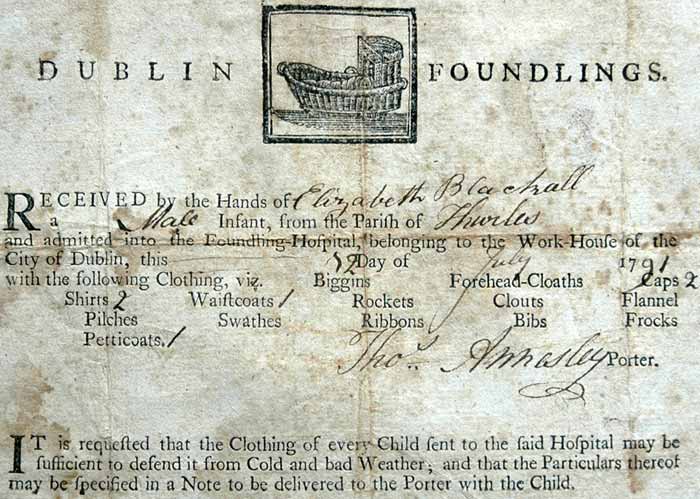
The picture show above is a billet (A billet in today’s language means a ‘ticket’ or a ‘receipt’ in French, but it originally meant a ‘short note’), that a male child “by the hands of Elizabeth Blackall” from the Church of Ireland parish of Thurles, was admitted to the Dublin Foundlings Hospital on July 12th 1791. The Porter’s name who admitted the child is shown as Thomas Annesley. Note from this receipt (billet), shown above, certain of the clothing names are no longer in use today. Biggins – A bonnet tied behind the neck and made of wool or linen. Clouts – Cloth diapers or nappies. Flannel – A square of fabric wrapped around a child over the diaper or a long undergarment. Forehead Clothes – Strip of cloth tied across the forehead to behind the ears for added warmth. Pilches – Layers of cloth tied around the diaper in an effort to prevent leakage. Swathes – Strips of cloth, usually of wool, wrapped around an infant’s body for warmth and to put pressure on the navel. Parents will be aware of the term “Swaddling”, – St Luke 2:7“And she brought forth her firstborn son, and wrapped him in swaddling clothes, and laid him in a manger; because there was no room for them in the inn”. Pic: G. Willoughby
The area of earth to be surveyed is understood to be located beside a designated burial ground known as “The Angel Plot”, but the area currently remains uncared for and is overgrown with heavy vegetation.
Sean Ross Abbey was one of the largest mother and baby homes within the Irish State, and contained a three-storey mansion, an orchard and a church on its grounds.
Some 6,079 babies were born there, to thousands of unmarried pregnant women who passed through its portals from 1931 until 1969. Babies born to unmarried girls in the home, were put up for adoption, with a known 487 of them sent to the United States of America.
Among its better known residents was Ms Philomena Lee, whose story featured in the book The Lost Child of Philomena Lee,(by author Martin Sixsmith) and the 2013 film, starring Judi Dench and Steve Coogan, [latter nominated for four Academy Awards, including ‘Best Actress’ for Judi Dench’s portrayal of Philomena Lee and Best Picture].
Four years ago, in 2019, as part of work then undertaken, about one tenth of “The Angel Plot” was excavated. Same examination revealed the remains of 42 infants on the site explored.
Note: In relation to the picture relating to Thurles, shown above; back in the year 1752, of the 691 children taken in charge by the Dublin Foundling’s Hospital, 365 children were dead by the end of that particular year. In 1757, burial of these children was described as “being chucked, naked into a hole, some eight or ten infants at a time”.
A report ordered by the Irish House of Commons regarding child mortality over the previous twelve years, ending in June 1796; same would reveal that of the 25,000 admitted more than 17,000 had died. Worse facts would be revealed in the five-year period between 1791 to 1796. Here, of the 5,016 infants sent to the Dublin Foundling’s Hospital infirmary, only one solitary child had survived.
There is an old Irish expression “Ní bhíonn cuimhne ar an arán a hitear”, commonly translated as ‘Eaten bread is soon forgotten”.
Today was such a case, it being the 200th anniversary of the birth of General Thomas Francis Meagher [born 3rd August 1823 – died 1st July 1867], himself the man who gave us our Irish Tricolour. Yet today passed sadly forgotten, by not just Co. Tipperary, but also sadly by the Irish nation. Read HERE and watch the video contained.
Signatures of Thomas Francis Meagher and Patrick O’Donoghue, arrested at Rathcannon, Holycross, Thurles, Co. Tipperary, following the 1848 Ballingarry (SR) rebellion. Both signatures are written on the back of a prison library book called “Wreath of Friendship”. Picture: G. Willoughby.
Thomas Francis Meagher was an Irish nationalist and leader of the “Young Irelanders” who led the Ballingarry (SR) Rebellion of 1848, [Battle of the Widow McCormack’s Cabbage Patch], before being convicted of sedition and sentenced to death, but instead received transportation, for life, to Van Diemen’s Land (now Tasmania) off the Southern coast of Australia.
In 1852, Meagher escaped on a whaling ship and made his way to the United States, where he settled in New York City. He studied law, worked as a journalist, and travelled widely to present lectures on the Irish cause.
At the beginning of the American Civil War, Meagher joined the U.S. Army and rose to the rank of Brigadier General and was most notable for recruiting and leading the Irish Brigade, encouraging support among Irish immigrants for the Union Army side. Here in Ireland he had one surviving son whom he never met.
Following the American Civil War, Thomas F.Meagher was appointed Montana’s Territorial Secretary of State by President Andrew Johnson, and served as acting territorial governor. In 1867, Meagher drowned in the Missouri River after falling from a steamboat at Fort Benton, Montana. His death has been disputed by historians, with varying hypotheses including weakness from dysentery, intoxication, suicide and murder.
Patrick O’Donoghue whose signature is shown avove, in his diary record, refers here to the Irish flag, Quote: “We entered Mullinahone for the first time, and unfurled the green banner.”
Irish tricolours were mentioned in 1830 and 1844, but widespread recognition is not accorded the flag until 1848. From March of that year Irish tricolours appeared side by side with French flags, at meetings held all over the country to celebrate the revolution that had just taken place in France. In April, Thomas Francis Meagher, this Young Ireland leader, brought a tricolour of orange, white and green from Paris and presented it to a Dublin meeting.
John Mitchel (1815-1875) referring to it, said: “I hope to see that flag one day waving, as our national banner”.
Although the tricolour was not forgotten as a symbol of hoped-for union and a banner associated with the Young Irelanders’ and revolution, it was little used between 1848 and 1916. Even up to the eve of the Rising in 1916, the green flag held an undisputed right to flutter in the then ever changing winds that was truly the now politically forgotten, County of Tipperary which was deciding the paths which were to guide Irish history.
Remember the statement by Thomas Davis, also earlier editor of ‘The Nation Newspaper’ in the 1840’s, “Where Tipperary Leads, Ireland Follows.” But maybe, and sadly, not any more.
Pre-deceased by his parents Tom and Josie and his beloved daughter Niamh; Mr Hickey passed away peacefully, while in the care of staff at Marie Curie Hospice, Belfast, Northern Ireland.
His passing is most deeply regretted and sadly missed by his sister Anne, brother-in-law Eddie (Wade), daughters Ailbhe and Deirdre (Barry), son Seamus, their mother Bridie, sons-in-law Brendan and John and grandchildren Seanán, Tom and Alfie, nieces Alma, Joy, Aoife and Grainne, nephews Shane, Eoghan and Eamonn, grandnieces Emily and Ellie Rose, grandnephews Richie, John and Beauden, extended relatives, neighbours, friends and all those who cared for him.
The extended Hickey family wish to express their appreciation for your understanding at this difficult time and have made arrangements for those persons wishing to send messages of condolence, to use the link shown HERE.
Do you ever get the sense that your phone battery doesn’t last as long as it used to? Have you ever had a laptop refuse to turn on, only to find out that it still works when plugged into the mains? Why batteries behave the way they do over time in our appliances and what you can do once they’re spent is explained in another great video from Ted Ed Daily. Watch hereunder. Why do batteries die in the first place? And what should you do with them once they’re spent?
Almost all batteries, even single-use batteries, are theoretically rechargeable. That’s because the metals and other chemicals are still there in the battery. So chemically speaking, a dead battery is actually not that different from a fresh one.
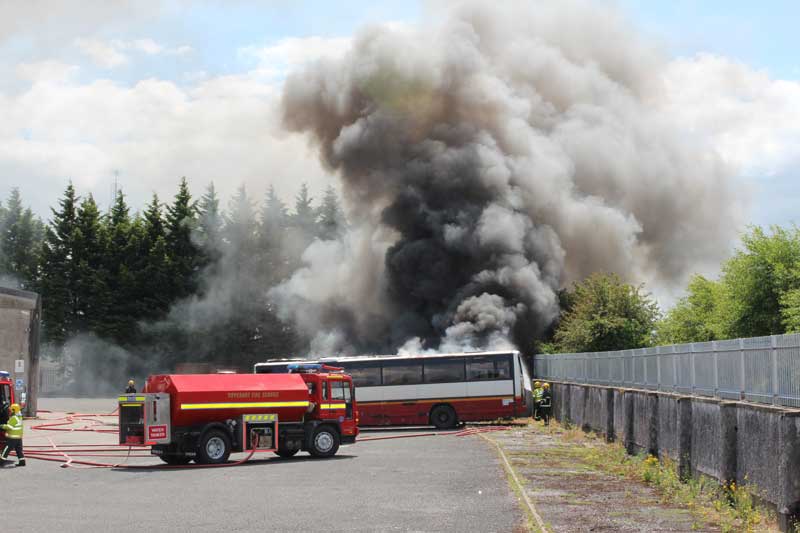
Retained firefighters in counties Tipperary and Waterford Began Two Days Of Strike Action Today
Unite union members, working as retained firefighters in Co. Tipperary and Co. Waterford, began a further two days strike action today Thursday August 3rd, and will continue their action tomorrow Friday August 4th.
These two days of strike action represent a further escalation of an industrial dispute which has arisen due to the continued refusal of the Local Government Management Association (LGMA), representing local authorities, to engage with the Unite union over workforce concerns.
Retained firefighters, who form the backbone of Ireland’s firefighting service, have seen retainers and call-out fees frozen for years, while the location requirements make it difficult or impossible for workers to supplement their low earnings with other employment. Retained firefighters are also seeking structured and predictable ‘off-call’ times, rather than as is currently the reality operating on a 24/7 basis.
This website uses cookies to improve your experience. We'll assume you're ok with this, but you can opt-out if you wish.AcceptRead More
Privacy & Cookies Policy
Privacy Overview
This website uses cookies to improve your experience while you navigate through the website. Out of these, the cookies that are categorized as necessary are stored on your browser as they are essential for the working of basic functionalities of the website. We also use third-party cookies that help us analyze and understand how you use this website. These cookies will be stored in your browser only with your consent. You also have the option to opt-out of these cookies. But opting out of some of these cookies may affect your browsing experience.
Necessary cookies are absolutely essential for the website to function properly. This category only includes cookies that ensures basic functionalities and security features of the website. These cookies do not store any personal information.
Any cookies that may not be particularly necessary for the website to function and is used specifically to collect user personal data via analytics, ads, other embedded contents are termed as non-necessary cookies. It is mandatory to procure user consent prior to running these cookies on your website.







Recent Comments