Pre-deceased by his beloved wife Eileen (née Seery), parents Tom and Joanna and sister Margaret, Mr Brennan passed away peacefully, while in the care of staff at Elm Green, Nursing Home, Castleknock, Co. Dublin.
His passing is most deeply regretted, sadly missed and lovingly remembered by his sorrowing family; loving nieces, nephews, grand nieces, grand nephews, extended relatives, neighbours and friends.
For those persons who would wish to attend Requiem Mass for Mr Brennan, but for reasons cannot, same can be viewed streamed live online, HERE.
The extended Brennan and Seery families wish to express their appreciation for your understanding at this difficult time, and have made arrangements for those persons wishing to send messages of condolence, to use the link shown HERE.
Note Please: Family flowers only. Donations in lieu of flowers to a charity of your choice.
Pre-deceased by his parents Thomas and Catherine and brother-in-law Tom; Mr Boland, sadly, passed away unexpectedly.
His passing is most deeply regretted, sadly missed and lovingly remembered by his sorrowing family; sisters Mary and Esther, brothers Michael, Richard, Sonny, Noel, twin brother P.J. and John, brother-in-law Shelly, sisters-in-law Nello, Jean and Ann Marie, aunts Pauline, Bid, Etty, Nonie and Peggy, nieces, nephews, grand nieces, grand nephews, extended relatives, neighbours and a wide circle of friends.
Requiescat in Pace.
Funeral Arrangements.
The earthly remains of Mr Boland will repose at Kennedy’s Funeral Home, Upper Kickham Street, Dublin Road, Thurles, (Eircode E41 XY 47), on tomorrow afternoon, Tuesday May 26th, from 5:00pm until 7:00pm same evening. His funeral cortège will leave his home, proceeding on foot to be received into the Church of Our Lady and St Kevin, Ballydavid, Littleton, Co. Tipperary, (Eircode E41 HD90) on Wednesday morning next, May 27th, at 10:30am, to further repose for Requiem Mass at 11:00am, followed by interment, immediately afterwards, in the adjoining graveyard.
For those persons who would wish to attend Requiem Mass for Mr Boland, but for reasons cannot, same can be viewed streamed live online, HERE.
The extended Boland family wish to express their appreciation for your understanding at this difficult time, and have made arrangements for those persons wishing to send messages of condolence, to use the link shown HERE.
There are moments in public life when ceremony becomes more than ceremony. There are moments when the formalities of State, handshakes, photographs, motorcade escorts, polished floors and diplomatic language carry a moral weight far beyond protocol.
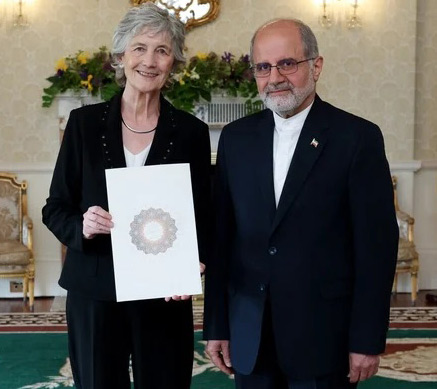
The decision to receive and photograph Iran’s ambassador at Áras an Uachtaráin, with the agreement of the Irish Government, was one such moment.
Of course, it will be said that this was merely a credentials ceremony. It will be said that diplomatic relations must continue, that ambassadors represent states whether we approve of those states or not, and that Ireland must keep channels of communication open. There is truth in that. Diplomacy is not friendship, and accreditation is not endorsement.
But symbols matter. They matter especially when they involve regimes that are still executing, imprisoning and torturing their own people.
Iran is not simply another difficult state with whom Ireland has disagreements. It is a regime whose record on executions is among the worst in the world. Human rights organisations have documented shocking numbers of executions, including executions following unfair trials, executions for political or security-related accusations, and executions connected to wider efforts to crush dissent. Reports of torture, forced confessions, arbitrary detention and brutal repression are not historical footnotes. They are part of the present reality faced by Iranians who dare to protest, speak, organise or simply refuse to submit.
That is why the image of Iran’s ambassador being formally welcomed and photographed with the President of Ireland (See above left), jars so deeply.
President Connolly now occupies an office that is, by design, above ordinary party politics. The President does not make foreign policy in the same way a government minister does. But the President does embody the State. The President’s actions, appearances and words carry ethical significance. When the President receives an ambassador from a regime carrying out executions and torture, the question is not whether the constitutional paperwork was correct. The question is whether the moral message was adequate.
Was there any public word for the prisoners awaiting execution? Was there any public acknowledgement of torture? Was there any mention of women, students, dissidents, trade unionists, journalists and minorities who have faced repression? Was there any reference to the many thousands alleged to have been killed in past massacres and crackdowns, or to the victims of the present wave of executions? If the above concerns were raised privately, the Irish public has not been clearly informed. If they were not raised at all, that is worse.
Ireland has often prided itself on speaking for human rights, international law and the dignity of small nations and oppressed peoples. We invoke that tradition when we speak about Palestine. We invoke it when we speak about Ukraine. We invoke it when we condemn apartheid, colonialism, war crimes and political imprisonment elsewhere. But a human-rights policy cannot be selective. It cannot be passionate in one case and ceremonially silent in another.
This is not an argument for cutting off all diplomatic contact with Iran. There may be Irish citizens, dual nationals, prisoners, humanitarian issues and international concerns that require a diplomatic channel. But maintaining a channel is not the same as offering the optics of normality.
Ireland could have handled this differently. The ceremony could have been accompanied by a strong public statement. The Government could have made clear that accreditation did not soften Ireland’s condemnation of executions, torture and repression. The President could have used the occasion, even in restrained constitutional language, to reaffirm Ireland’s concern for human dignity and human rights. There could have been a visible refusal to allow diplomatic protocol to become moral camouflage.
Instead, what the public saw was the familiar theatre of State recognition.That is the problem. Because for the families of those executed, for prisoners under sentence of death, for women beaten for defying compulsory controls, for protesters tortured into silence, and for exiles watching from Ireland, these images do not look neutral. They look like respectability being extended to the representative of a regime that has not earned it.
The office of President is not powerless. Its power lies in moral authority, in language, in symbolism, in the ability to remind the State of its values when convenience and protocol threaten to dull them. At a minimum, that moral authority should not be seen to soften the image of a regime still carrying out executions and torture.
Ireland must engage with the world as it is. But it must not forget what it claims to stand for. Diplomacy may require doors to remain open. Conscience requires that, when those doors open, the truth walks in as well.
Mrs Gleeson passed away peacefully, while at her place of ordinary residence.
Her passing is most deeply regretted, sadly missed and lovingly remembered by her sorrowing family; devoted partner Pádraig, sons Owen and David, daughter Linda. grandchildren Cara, Sophie, Jack and Saoirse, son-in-law Brendan, daughter-in-law Sarah, brothers Davy, Paddy, and Peter, sisters Phyllis and Eileen, brothers-in-law, sisters-in-law, nephews, nieces, extended relatives, great neighbours, especially Lillian and friends.
For those persons who would wish to attend Requiem Mass for Mrs Gleeson, but for reasons cannot, same can be viewed streamed live online, HERE.
The extended Gleeson and Morrissey families wish to express their appreciation for your understanding at this difficult time, and have made arrangements for those persons wishing to send messages of condolence, to use the link shown HERE.
Note Please: Donations in lieu of flowers, if desired, to COPD Support Ireland, in Memory of Mrs Ann Marie Gleeson (née Morrissey).
‘The Gleeson and Morrissey families would like to thank most sincerely Dr. Chawke’s team especially Niamh, Katie and Angela.‘
Members of the Divisional Drugs Unit have executed a warrant under the Drugs Act at a premises in Thurles suspected of selling cannabis, cannabis jellies and cannabis vapes.
During the search, Gardaí obtained a positive result, pending further analysis. An investigation has now commenced.
We would like to thank members of the community who brought this matter to attention through Community Policing. Your continued engagement and support play an important role in helping to keep our towns and villages safe.
Anyone with information relating to the sale or supply of illegal drugs is encouraged to contact their local Garda Station or the Garda Confidential Line.
Ní neart go cur le chéile – There is no strength without unity.
This website uses cookies to improve your experience. We'll assume you're ok with this, but you can opt-out if you wish.AcceptRead More
Privacy & Cookies Policy
Privacy Overview
This website uses cookies to improve your experience while you navigate through the website. Out of these, the cookies that are categorized as necessary are stored on your browser as they are essential for the working of basic functionalities of the website. We also use third-party cookies that help us analyze and understand how you use this website. These cookies will be stored in your browser only with your consent. You also have the option to opt-out of these cookies. But opting out of some of these cookies may affect your browsing experience.
Necessary cookies are absolutely essential for the website to function properly. This category only includes cookies that ensures basic functionalities and security features of the website. These cookies do not store any personal information.
Any cookies that may not be particularly necessary for the website to function and is used specifically to collect user personal data via analytics, ads, other embedded contents are termed as non-necessary cookies. It is mandatory to procure user consent prior to running these cookies on your website.







Recent Comments