One Council Restores History While Another Erases It – The Loss of Thurles’s Famine Double Ditch.
The decision by Dún Laoghaire-Rathdown County Council to spend approximately €660,000plus VAT restoring a historic ha-ha wall in Marlay Park (latter a sunken landscape boundary that uses a hidden trench and a vertical retaining wall), has understandably generated debate. The 197-metre structure, believed to date from the early nineteenth century, was designed to separate landscaped gardens from grazing animals without interrupting views across the estate. Much of its original locally sourced granite survived beneath vegetation, but the wall had fallen into disrepair. Restoration required specialist conservation work, dismantling and rebuilding sections of dry-stone wall, repairing the ditch and incorporating drainage infrastructure. The original contract was valued at €625,398 excluding VAT, with the final estimate rising to €660,374 following delays, unsuitable ground material, severe weather and difficulties obtaining appropriate stone.
Local construction professionals and taxpayers are entitled to question whether that represents value for money. Public bodies must explain how costs are calculated, why projects exceed their initial budgets and whether procurement arrangements adequately protect the public purse. Dún Laoghaire-Rathdown County Council has already faced criticism over the €753,528 cost of works at an entrance to Deerpark in Mount Merrion. That project is frequently described as the construction of “14 steps”, although the council says it also included a wheelchair-accessible ramp, retaining walls, granite paving, seating, landscaping, pedestrian crossings, road resurfacing, drainage, traffic-signal equipment and other public-realm works. The criticism of these costs is legitimate. Nevertheless, one important fact should not be forgotten: Dún Laoghaire-Rathdown County Council recognised that an historic structure was worth preserving.
That approach stands in painful contrast to what happened in Thurles.
The Thurles Great Famine Double Ditch was regarded locally as a rare surviving famine-era landscape feature. Local historical accounts date its construction accurately to 1846 and associate it with relief work provided to men and boys during the Great Famine. Rather than representing the landscaped elegance of a wealthy Dublin estate, this Double Ditch recalled hunger, poverty and the desperate struggle of local families to survive. It was not simply an old embankment. It was a physical connection with one of the darkest periods in Irish history. For generations, the route was also described locally as a public walkway and Mass path. Campaigners argued that it formed part of the social history of Thurles and should have been incorporated into a protected heritage trail.
Despite repeated warnings, the entire section of the Double Ditch was cleared in March 2022 supported by local councillors, as part of works connected with as yet a non existent, only proposed Thurles inner relief road. Contemporary photographs and local reporting showed mature vegetation being removed and the historic landscape feature being levelled by machinery.
Historic Thurles Double Ditch Eradicated in 2022. Pic. G.Willoughby.
Once such a structure is destroyed, it cannot truly be recreated. A replica might reproduce its approximate appearance, but it cannot restore the original stones, soil, boundaries and physical connection with the people who constructed it during the Great Famine.
This is the real loss suffered by Thurles. Tipperary County Council regularly speaks about protecting heritage and connecting communities with their past. Yet the treatment of the Double Ditch demonstrates the gulf that can exist between heritage policies and decisions taken on the ground. Roads and development are necessary, but heritage protection does not require a complete rejection of progress. It requires imagination, consultation and a willingness to examine alternative designs before destruction becomes inevitable.
The contrast between the two councils is striking. In Dublin, hundreds of thousands of euro are being spent restoring an aristocratic landscape feature. In Thurles, a structure associated with ordinary people surviving the Great Famine was treated as totally expendable. The Marlay Park bill deserves detailed scrutiny. So does every major publicly funded project. But the principle of conserving historic structures should be welcomed.
Led by the denials of elected councillors; mainly Mr Michaél Lowry (Non Party), Mr Sean Ryan (FF) and Mr Seamus Hanafin (FF), together with senior council officials, through wilful ignorance, self-deception, blind persistence and despite knowing better oversaw this reckless destruction. Thus the tragedy in Thurles is that the debate never reached the question of restoration costs.
The Double Ditch was not protected long enough for restoration to become an option. Dún Laoghaire–Rathdown County Council may reasonably be criticised for excessive costs. Tipperary County Council should be criticised for allowing irreplaceable local history to be destroyed.
One council appears willing to spend too much preserving history. The other did too little before all of that history was totally eradicated and lost forever.
Neither approach represents good stewardship of public money or public heritage, and the waste continues without the consent of the Irish taxpayer.
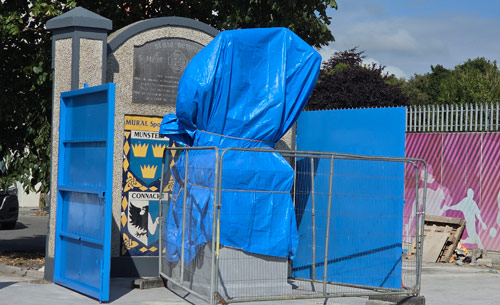
A striking new bronze artwork planned and in place at the entrance to FBD Semple Stadium in Thurles; celebrating Tipperary’s unique place in the history of Gaelic games.
The permanent public artwork was commissioned by Tipperary County Council in partnership with Tipperary GAA and the management of FBD Semple Stadium. It is installed near the stadium entrance, and expected to create a new landmark for supporters, visitors and the wider Thurles community.
Set to be unveiled; artwork celebrating Thurles as birthplace of the GAA. Pic: G. Willoughby.
Rather than honouring one individual player or official, we understand the sculpture is intended to represent Gaelic games more broadly. The original commission sought a bronze design featuring male and female sporting figures, reflecting the traditions of hurling, camogie, Gaelic football and ladies’ football.
The location is particularly significant. The Gaelic Athletic Association was founded in Hayes’ Hotel, Thurles, on November 1st 1884, while the Ladies Gaelic Football Association was also established in the town in 1974. The artwork will therefore recognise Thurles not only as one of Ireland’s great sporting towns, but as the birthplace of organisations that have shaped Irish community life for generations.
Semple Stadium itself has played a central role in that history. It is the home of Tipperary hurling and football and one of the country’s most famous GAA venues. The stadium was named after Mr Tom Semple in 1971 and hosted the historic 1984 All-Ireland Hurling Final, during the GAA’s centenary celebrations.
Full public details of the completed sculpture, including the selected artist and the formal unveiling arrangements, have not yet been clearly published on the council’s official project page.
When unveiled, the new bronze tribute should provide a lasting reminder of Thurles’ proud contribution to Ireland’s national games.
Where else in Ireland would a crossroads, latter situated on a blind hill, be allowed to have traffic approaching and exiting at 100 km/h?
Well this remains the case at Turtulla Cross, Thurles, Co. Tipperary. The proposed replacement of Turtulla Cross with a roundabout has been welcomed by local councillors as a major step forward. Nobody disputes that this junction has a serious safety problem. It has been associated with one pedestrian fatality, numerous collisions and long-standing concern among residents, motorists and public representatives.
Turtulla Cross, Thurles, Co. Tipperary, showing blind hill, which, despite previous TII intervention, remains flooded for 10 months of the year. Pic: G. Willoughby.
The present 100 km/h limit is a maximum permitted speed, not an instruction to drive at that speed. Nevertheless, allowing traffic to approach a known hazardous junction under a 100 km/h limit sends entirely the wrong message. Drivers travelling at or near that speed have less time to recognise danger, react to another vehicle and stop safely.
However, welcoming action should not mean giving Transport Infrastructure Ireland and Tipperary County Council a blank cheque. Before large sums of public money are committed to constructing a roundabout, the authorities must explain why a significantly cheaper and quicker safety measure has not been properly trialled; namely reducing the speed limit on the approach and exit to Turtulla Cross from 100 km/h to 50 or 60 km/h.
A roundabout would inevitably force approaching vehicles to slow considerably. That raises an obvious question: why not introduce lower approach speeds now and assess the results before committing to an expensive construction project?
The Government’s own Speed Limit Review recommended lower limits, including a proposed reduction of the default limit on national secondary roads from 100 km/h to 80 km/h. Official guidance also recognises 60 km/h transition zones on national and other significant roads entering areas where traffic conditions become more complex.
A properly designed trial could include a 60 km/h transition zone, a further 50 km/h limit immediately approaching the junction, prominent warning signs, refreshed road markings, flashing speed indicators, improved lighting and targeted Garda enforcement. The trial should be supported by speed surveys and collision-risk assessments, with the results published openly. A few hundred metres closer to Thurles town such signs exist, so just grab a screwdriver or pliers and move them.
According to Tipperary County Council’s May 2026 management report, preliminary design has commenced for a safety scheme involving a roundabout. The project is expected to enter the Part 8 planning process in 2026, with construction anticipated in 2027, or 2028 or maybe 2030.
That timetable provides an opportunity to test lower-cost interventions before construction begins. Public money must be treated with respect. A roundabout may ultimately prove necessary, particularly if the junction’s layout, visibility or traffic movements cannot be made acceptably safe through speed management alone. But that conclusion should be demonstrated through real evidence, not just simply assumed by councillors wishing to take advantage of a video opportunity.
TII and Tipperary County Council should publish the up-to-date collision history, traffic speeds, projected construction cost, alternatives considered and the reasons those alternatives were rejected.
Spending millions without first testing an enforceable speed reduction would be a failure of common sense and responsible public administration. Safety must come first, but value for money, transparency and evidence must come with it.
A 17-year-old boy has pleaded guilty to the manslaughter of a man, following a fatal incident in County Tipperary last year.
The teenager appeared before the Central Criminal Court today Wednesday, July 22, where he was formally charged with murdering the man at an undisclosed location in Tipperary on March 10th, 2025.
Because the defendant is under the age of 18, he is legally protected from being identified publicly. When the charge was put to him, the teenager entered a plea of not guilty to murder. However, he admitted responsibility for the lesser offence of manslaughter.
Mr Dean Kelly SC, representing the Director of Public Prosecutions, informed the court that the State was prepared to accept the manslaughter plea. No details about the circumstances surrounding the man’s death were outlined during the brief hearing. The court was told that the defendant was 15 years old, when the offence occurred and has since turned 17 years of age. Mr Kelly asked for a probation report to be prepared before the teenager is sentenced. Such a report can provide the court with information about a defendant’s personal circumstances, background and prospects for rehabilitation.
Mr Justice Tony Hunt provisionally scheduled the sentencing hearing for September 28, 2026. The teenager was remanded on continuing bail and is expected to return to the Central Criminal Court on Wednesday next, July 29th. The court may reconsider or confirm the proposed sentencing date at that appearance. The judge also directed that victim-impact reports be prepared. These reports will allow those affected by the man’s death to explain the emotional, personal and practical consequences of their loss, before the sentence is imposed.
The case remains before the courts, and the teenager has not yet been sentenced.
Most of Ireland’s Local Authorities Strengthen Environmental Enforcement in 2025.
Ireland’s local authorities delivered a strong environmental enforcement performance in 2025, with 83% of assessments under the National Enforcement Priorities rated Strong or Excellent. The EPA’s latest performance report shows that environmental teams across the country carried out more than 252,000 inspections, responded to 85,500 complaints, took 23,550 enforcement actions and initiated 386 prosecutions during the year.
Dún Laoghaire-Rathdown County Council, Galway City Council and South Dublin County Council achieved the required standard across every National Enforcement Priority. All 31 local authorities also met the required standard for tackling illegal waste. Despite the positive overall results, the EPA identified areas where enforcement must improve. Seventeen per cent of assessments fell below the required standard, while Leitrim County Council and Sligo County Council did not meet the required standard across several priority areas. Particular attention is now needed in relation to waste segregation, discharges to water and transport noise. The EPA has called on local authorities to maintain momentum, allocate sufficient resources and ensure that enforcement is consistent across the country.
Tipperary County Council. While Tipperary County Council recorded positive results across several environmental enforcement priorities in 2025, the EPA assessment indicates that improvement is needed in two important areas.
The council received yellow ratings for its performance under the Environmental Noise Directive and for discharge licences and Misconnections. These ratings indicate that the work carried out did not reach the required Strong or Excellent standard.
The Environmental Noise Directive requires local authorities to identify harmful transport-noise exposure, prepare action plans and demonstrate that appropriate measures are being implemented. Tipperary County Council should clarify what actions are planned, when they will be completed and how progress will be measured.
The rating for Discharge Licences and Misconnections is also a concern. Incorrect wastewater connections and poorly controlled discharges can result in pollution entering surface-water drains, rivers and streams. Stronger inspections, licence reviews, investigations and enforcement follow-up may be required to protect water quality.
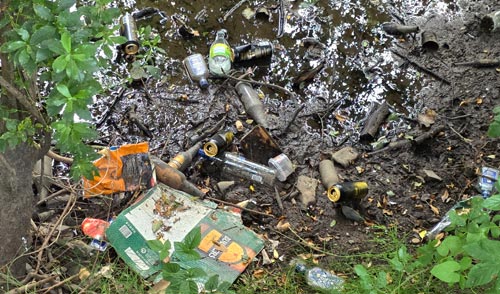
Visual Confirmation:State of the Suir River setin the heart of Thurles today; left uncleared since the recent Liberty Music Festival, which was held on Saturday July 4th and Sunday 5th, 2026 last.
These findings do not suggest failure across the council’s entire environmental programme. They do, however, show that enforcement must be consistent across every priority area. Tipperary County Council should respond by publishing clear corrective actions, measurable targets and realistic timelines for improvement. The report also highlights targeted work carried out in Tipperary’s firewood sector. Eleven firewood producers were contacted and provided with information on their obligations under solid-fuel legislation, including EPA registration and certification requirements. Following this engagement, three producers registered with the EPA and six began working towards certification through the Wood Fuel Quality Assurance Scheme. Two newly identified producers remain subject to further follow-up.
The Tipperary initiative demonstrates how inspections, education and sustained engagement can improve compliance. It also shows that continued oversight is necessary to ensure firewood meets the required quality and moisture standards, protects air quality and supports responsible producers.
The EPA will continue to monitor local-authority performance and work with councils to improve environmental outcomes for communities throughout Ireland.
This website uses cookies to improve your experience. We'll assume you're ok with this, but you can opt-out if you wish.AcceptRead More
Privacy & Cookies Policy
Privacy Overview
This website uses cookies to improve your experience while you navigate through the website. Out of these, the cookies that are categorized as necessary are stored on your browser as they are essential for the working of basic functionalities of the website. We also use third-party cookies that help us analyze and understand how you use this website. These cookies will be stored in your browser only with your consent. You also have the option to opt-out of these cookies. But opting out of some of these cookies may affect your browsing experience.
Necessary cookies are absolutely essential for the website to function properly. This category only includes cookies that ensures basic functionalities and security features of the website. These cookies do not store any personal information.
Any cookies that may not be particularly necessary for the website to function and is used specifically to collect user personal data via analytics, ads, other embedded contents are termed as non-necessary cookies. It is mandatory to procure user consent prior to running these cookies on your website.








Recent Comments