Retrospective use of FRT to be permitted to assist Gardaí when they are searching CCTV footage and help build stronger, safer communities.
Cabinet approves riot and violent disorder in list of offences for which Facial Recognition Technology can be used.
Oireachtas Justice Committee asked to examine if FRT can be used for further offences.
The Irish Government has given approval to publish the General Scheme of the Garda Síochána (Recording Devices)(Amendment) Bill 2023, which will allow An Garda Síochána to use Facial Recognition Technology (FRT) in specific circumstances. FRT is expected to save thousands of Garda working hours, by allowing the use of biometric identification to retrospectively search CCTV, thus building stronger and safer communities. In light of the riots in Dublin City Centre on the 23rd November last, Cabinet approval for the offences of riot and violent disorder is now to be included in the proposed scope of FRT.
The maximum penalty for each of these offences is an unlimited fine, a prison sentence of up to 10 years, or both. In addition to asking the Oireachtas Justice Committee to conduct pre-legislative scrutiny, the Committee will now be asked to consider an additional list of serious offences for possible inclusion in the schedule of offences in the Bill.
The publication of the draft FRT Bill follows shortly after the passage through the Oireachtas, on November 29th 2023, of the Garda Síochána (Recording Devices) Act 2023, which was signed into law on the December 5th last.
This Act will allow An Garda Síochána to rollout bodycams from next spring, beginning in Dublin city centre. It will also provide for a robust and modern statutory framework for the use by An Garda Síochána of recording devices and the processing of video and audio data, to support their functions in investigating, detecting, preventing, prosecuting criminal offences, safeguarding against and preventing threats to public safety, public order, and in matters relating to the overall security of the State.
The draft FRT Bill will amend the Garda Síochána (Recording Devices) Act 2023 in order to give effect to the Government decision to provide that biometric identification may be used by An Garda Síochána. Under the present Data Protection Act 2018, it is not possible for An Garda Síochána to process biometric data without a clear statutory basis being put in place. The power to utilise biometric identification using facial images (often referred to as facial recognition technology) needs to be explicitly provided for and is set out in this General Scheme.
There has been an explosion in the use of digital data in criminal investigations, and that without adequate data analysis tools, the length of criminal investigations will increase. Already Gardaí have to trawl through thousands of hours of CCTV, (12,000 hours in the case of the Dublin riot. The introduction of Facial Recognition Technology will dramatically save time, speed up investigations and free up Garda resources. Reducing the amount of time it takes Gardaí to go through video footage will be of particular help where time is of the essence, following a very serious crime having been committed. It is regarded, in the interests of all parties, not least victims of crime, to have criminal investigations pursued as effectively and rapidly as is possible.
The General Scheme is intended to provide for the use of biometric identification, using facial images, by An Garda Síochána for an exhaustive list of the most serious of offences. It will only provide for a limited form of retrospective use of biometric identification which can assist An Garda Síochána when they are searching CCTV footage and data.
This draft Bill will provide for retrospective searching of images which are legally in the possession of An Garda Síochána, through the safe and ethical use of biometric identification in the following circumstances only:
Where a serious offence is suspected, as listed in the Schedule of the General Scheme.
The use of biometric identification is necessary and proportionate in that specific case.
Each particular use of biometric identification is authorised in writing in advance by a Chief Superintendent and a record of that authorisation maintained.
The Government decision today has expanded this to include riot and public disorder. Such use can only be in the context of the prevention, investigation, detection or prosecution of one or more of the criminal offences listed in the Schedule or for the protection of the security of the State. It is also important to note that there are numerous provisions included in the General Scheme which provide safeguards and oversight of the powers granted to An Garda Síochána.
While allowing An Garda Síochána access to technology to assist them in performing their function, the power provided must be subject to sufficient safeguards and oversight to ensure the use of this technology is necessary and proportionate at all times. This draft Bill ensures that there is a requirement for a statutory code of practice, including requirements to conduct data protection and human rights impact assessments. Not only does it ensure that the requirements for a code of practice covers the use of this type of biometric identification, it also ensures that any code created under these provisions, will have to be approved by the Houses of the Oireachtas. We understand that there will also be judicial oversight. The designated judge of the High Court will have to report to the Taoiseach annually and this report will be laid before the Oireachtas.
The General Scheme will now be submitted to the Joint Oireachtas Committee on Justice for pre-legislative scrutiny and to the Office of the Parliamentary Counsel for drafting. The Oireachtas Justice Committee will consider an additional list of serious offences which FRT could be used to investigate. While they are not subject to a penalty on conviction of up to life imprisonment, however many carry very significant sentences (e.g. some have max sentences of 14 years). They comprise additional sexual and child exploitation offences and other serious violent offences for which biometric identification is likely to be effective and are subject to extremely serious penalties.
A full list of the offences being referred to the Committee include: Abduction/False Imprisonment; Aggravated Sexual Assault; Rape; Child Sexual Abuse; Aggravated Burglary; Causing serious harm; Homicide; Riot and Violent Disorder and Robbery.
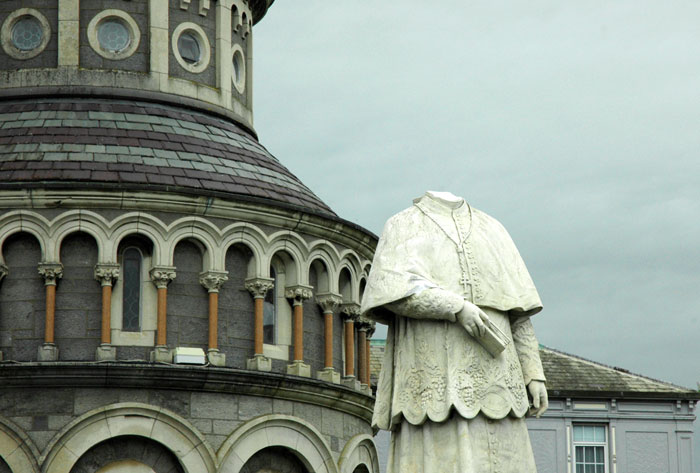
Decapitated statue of Archbishop Patrick Leahy D.D.
The decapitated statue of Archbishop Patrick Leahy D.D., latter Archbishop of Cashel from 1857-1875, and which was wilfully vandalised, has now been fully restored.
Most Rev. Patrick Leahy, D.D. Archbishop of Cashel 1857-1875
The statue, which depicts his right hand holding a breviary, stands 8ft (2.4384m) in height, on a limestone pedestal 7ft (2.1336m) high; attired in his episcopal soutane, rochet and mozetta, with his head uncovered, stood in the front yard of the Cathedral of the Assumption in Thurles.
Alas, the statue first erected 112 years ago, in 1911, was wilfully and shamefully decapitated in a gross act of vandalism, in late June 2019.
The statue harmonised well with its surroundings until the night of June 28th, 2019 when it was decapitated; latter occurring in the same month, 140 years exactly, after the Cathedral was solemnly consecrated.
The statue’s limestone pedestal was initially fashioned in Cashel, Co. Tipperary, by one, Mr Best and consists of four great blocks, chiselled, moulded and panelled, in accordance with the designs of one Mr J.C. Ashlin* of Dublin. The pedestal and statue, is long regarded as a work of fine art, and was erected by Messrs. Leahy Brothers of Thurles, Co. Tipperary.
[*Note: The architect for the building was J.J. McCarthy, while B. McMullen was the main builder, while the aforementioned J.C. Ashlin was responsible for the enclosing walls, railings and much of the other finished work.]
The statue was highly regarded at the time of being erected by those who knew and remembered Dr. Leahy; latter who stated that it was “an admirable and a remarkable likeness of him portraying his fine commanding presence and his handsome features”. An inscription on the limestone pedestal declares, “In commemoration of the Most Rev. Patrick Leahy, D.D., Archbishop of Cashel and Emly, 1857-1875, by whom this Cathedral Church of the Assumption was erected”.
A lengthy Garda investigation was initiated in the weeks which followed, however despite a €1,000 reward, the head of the statue was never recovered and those responsible were never brought to justice.
The restoration work has been carried out by sculptor Mr Stephen Burke, fashioned using photographs of the original statue and a portrait of Archbishop Leahy. The now restored statue will officially be blessed on Sunday next and this blessing will be followed by the annual Cathedral Carol Service.
Interesting to note that, being free from debt, Thurles Cathedral which replaced the ‘Big Chapel’, was eventually solemnly consecrated on Saturday, June 21st 1879. It was Archbishop Thomas William Croke whose statue stands on west Liberty Square, Thurles, who performed the ceremony himself including the consecration of the High Altar.
Bishop William Fitzgerald, Roman Catholic Bishop of Ross who consecrated Thurles Cathedral’s Sacred Heart Altar.
Bishop Francis McCormack, then Bishop of Achonry, (1871 to 1887)(latter consisting of twenty-three parishes in Counties Roscommon, Sligo, and Mayo), and later Bishop of Tuam, Co. Galway, who consecrated Thurles Cathedral’s Altar of the Blessed Virgin. [Note: History notes that Bishop Francis McCormack’s nephew was Captain Patrick McCormack, one of the Cairo Gang assassinated on Bloody Sunday (1920) on the instructions of Michael Collins, then Director of Intelligence of the Irish Republican Army]. Bishop Francis McCormack, died in 1909 and is buried in Galway Cathedral crypt, [His papers are stored in the Diocesan archive].
Recall of a batch of Tesco Finest Cranberry and Apple Stuffing Mix due to the possible presence of moths
Alert Summary: Wednesday, 13th December 2023. Category 1: For Action Alert Notification: 2023.38 Product Identification: Tesco Finest Cranberry & Apple Stuffing Mix; pack size: 130g Batch Code Best before date: September 24
Message:
The above batch of Tesco Finest Cranberry & Apple Stuffing Mix is being recalled due to the possible presence of moths. Recall notices will be displayed at point-of-sale.
Action Required:
Retailers: Tesco stores have been requested to remove the implicated batch from sale and display notices at point-of-sale. Consumers: Consumers are being advised not to consume the implicated batch.
Pre-deceased by her husband Graham, her passing is most deeply regretted and sadly missed by her son Joseph, sisters Carol and Anna, brother Kevin, nephews, nieces, extended relatives, neighbours and friends.
The extended Learoyd family wish to express their appreciation for your understanding at this difficult time, and have made arrangements for those persons wishing to send messages of condolence, to use the link shown HERE.
Pre-deceased by her parents Neddie and Ellie, and her sisters Ann and Esther; Mrs Dunne passed away peacefully while in the care of staff at Milford Care Centre, Co. Limerick.
Her passing is most deeply regretted and sadly missed by her loving husband Dinny, sons David and Tony, daughter Yvonne, grandchildren Keelan, Daithí, Darragh, Robyn, Rian and Aoibhín, daughter-in-law Carmel, son-in-law David, Maggie, brothers Paddy and Jimmy, sisters Mary, Eileen, Joan, Benny and Majella, brothers-in-law, sister-in-law, nephews, nieces, extended relatives, neighbours and a wide circle of friends.
Requiescat in Pace.
Funeral Arrangements.
The earthly remains of Mrs Dunne will repose at Kennedy’s Funeral Home, Dublin Road, Thurles, (E41 XY47) on Friday afternoon, December 15th, from 5:00pm until 7:00pm, following which her funeral cortège will be received into the Cathedral of the Assumption, Cathedral Street, Thurles at 7:45pm same evening. Funeral Mass for Mrs Dunne will be celebrated on Saturday morning, December 16th, at 11:00am followed by interment, immediately afterwards, in St. Patrick’s Cemetery, Moyne Road, Thurles, Co. Tipperary.
For those persons who are unable to attend the funeral service for Mrs Dunne , same can be viewed streamed live online, HERE.
The extended Dunne family wish to express their appreciation for your understanding at this difficult time, and have made arrangements for those persons wishing to send messages of condolence, to use the link shown HERE.
This website uses cookies to improve your experience. We'll assume you're ok with this, but you can opt-out if you wish.AcceptRead More
Privacy & Cookies Policy
Privacy Overview
This website uses cookies to improve your experience while you navigate through the website. Out of these, the cookies that are categorized as necessary are stored on your browser as they are essential for the working of basic functionalities of the website. We also use third-party cookies that help us analyze and understand how you use this website. These cookies will be stored in your browser only with your consent. You also have the option to opt-out of these cookies. But opting out of some of these cookies may affect your browsing experience.
Necessary cookies are absolutely essential for the website to function properly. This category only includes cookies that ensures basic functionalities and security features of the website. These cookies do not store any personal information.
Any cookies that may not be particularly necessary for the website to function and is used specifically to collect user personal data via analytics, ads, other embedded contents are termed as non-necessary cookies. It is mandatory to procure user consent prior to running these cookies on your website.









Recent Comments