Pre-deceased by her beloved son Shane, parents Michael and Josie (Kilvemnon), brother Michael (Ballycullen); Mrs Carroll passed away peacefully, surrounded by her loving family.
Her passing is most deeply regretted, sadly missed and lovingly remembered by her sorrowing family; loving and heartbroken husband James, daughter Emma, sons David, James, Stephen and Patrick, son-in-law Kenny, daughters-in-law Louise and Becca, grandchildren Alex, Patrick, Evie, Jack, Molly, Naomi, Darragh and Lillie, brothers Ray and Dick, sisters Aggie and Mary, brothers-in-law, sisters-in-law, nieces, nephews, extended relatives, neighbours and a wide circle of friends.
The extended Carroll and Dunne families wish to express their appreciation for your understanding at this difficult time, and have made arrangements for those persons wishing to send messages of condolence, to use the link shown HERE.
Note Please: Family flower only. Donations in lieu, if desired, to the Irish Cancer Society, in memory of Mrs Jacqueline (Jackie) Carroll (née Dunne).
“The Carroll and Dunne families would like to express their sincere gratitude to the staff of Slievnamon Unit, Oak Ward, University Hospital Waterford, the South East Palliative Care Team and the Irish Cancer Society, and to all the nurses who cared for Mrs Carroll throughout her illness and helped make it possible for her to return home to her residence during her illness”.
Could Bats Delay the Demolition of 52 Homes Overlooking the Rock of Cashel, in Co. Tipperary?
Plans to demolish 52 partially completed homes overlooking the Rock of Cashel are expected to move forward shortly, but first, an ecologist must determine whether bats are residing in the abandoned buildings.
Tipperary County Council says a bat survey will be carried out within the coming weeks at Ballypadeen, Cashel with demolition expected to begin soon afterwards. The unfinished properties have stood derelict for almost 20 years and were originally intended as holiday accommodation, connected to a proposed hotel development that was never completed.
The survey is more than a simple environmental formality. All bat species in Ireland are strictly protected. Under Irish and European nature conservation law, it can be an offence to deliberately kill or disturb bats or to damage or destroy their breeding sites and resting places. Those protections can apply even where demolition has otherwise been approved.
Back in August 2024 aspeciesofPipistrelles Batcaused similar delays in the erection of a €3.4 million project in Cathedral Street, Thurles. View HERE Pics: G. Willoughby.
So what happens if bats are found? The answer depends on how the buildings are being used. An ecologist will look for evidence of roosts, identify the species present and assess their activity. A building occasionally used by one or two bats may present a very different ecological issue from a maternity roost or an important seasonal resting place. If demolition would disturb protected bats or destroy a roost, the works may require a special derogation from the National Parks and Wildlife Service under Regulation 54. The National Parks and Wildlife Service (NPWS) states that works which would kill or capture bats, destroy their roosts or disturb them during important stages of their life cycle, cannot proceed without such permission where a derogation is required. However, A derogation does not necessarily mean the demolition would be stopped permanently.
Instead, conditions can be imposed on when and how the work takes place. Similar Irish cases have included restrictions on demolition during sensitive periods, ecological supervision, careful removal of roofs and other potential roosting areas, and the provision of alternative bat roosts or bat boxes. The timing of the Cashel survey could therefore become important. Different bat species use buildings differently throughout the year, and a survey represents conditions at a particular point in time. In some cases, further surveys or mitigation measures may be required before demolition can proceed.
The controversy surrounding Ballypadeen extends well beyond bats. The 52 units were originally approved as tourism accommodation linked to a proposed hotel development. Construction started in 2006, but stopped the following year following a planning dispute. After years of legal engagement, a mediated settlement was reached 19 years later, in July 2025. Tipperary County Council says the site lies on un-zoned and unserviced land outside Cashel’s settlement boundary and that technical assessments identified significant defects in the unfinished buildings. The council has estimated that adapting them for residential use would cost about €24 million.
Critics, including developer Liam Campion and Independent TD Mattie McGrath, have questioned the decision to demolish partly built three-bedroom properties during Ireland’s current housing shortage. The council maintains the old argument that its decision must comply with planning law, policy and the sustainable development of the area.
For now, however, the next chapter in this long-running Cashel saga may depend on something very small indeed. Before the bulldozers arrive, the bats, if they are there, must first be accounted for.
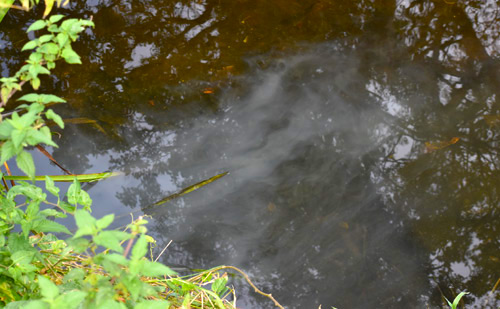
The issue which was outlined by Cllr. Jim Ryan at the recent Municipal District meeting: NOTE: The Environment & Climate Action Section, in conjunction with the River Basin Management Service (formerly LAWPRO), and Thurles Municipal District, has now committed to carrying out a misconnection survey in partnership with Uisce Éireann as part of the Catchment Management Plan for the Upper River Suir. Many of the pipes inspected were found to have little or no flow at the time of inspection, making it difficult to determine their source or to establish whether any misconnections are present. Further investigations are scheduled to take place towards the end of October. It is anticipated that higher flows at that time will assist in tracing the source of any discharges and identifying potential misconnections. The relevant agencies will continue to work collaboratively to support the protection and improvement of water quality in the Upper River Suir neglected over the past 13 years.
Effluent entering into the River Suir in Thurles town centre, from an unknown source. Picture: G. Willoughby.
Wildlife Was There Before – Thurles Deserves Clear Answers on the River Suir.
Time to name and shame. The debate over the condition of the River Suir in Thurles risks becoming trapped in a false choice; either protect wildlife or maintain the river. Surely Thurles can do both. Nobody seriously concerned about the Suir is asking Tipperary County Council to destroy valuable habitat or recklessly interfere with a living river. What residents are asking for is something far more reasonable:- remove litter, investigate and stop pollution, deal appropriately with fallen trees and serious obstructions, manage excessive growth where environmentally justified, and restore the river to a healthier condition.
That is not an attack on conservation. It is part of conservation. At the September meeting of Thurles Municipal District, Independent Cllr Mr Jim Ryan again raised grave concerns about large trees, branches and vegetation obstructing the River Suir. He recalled a river in the 1990s that was considerably more open and where activities such as kayaking could actively take place.
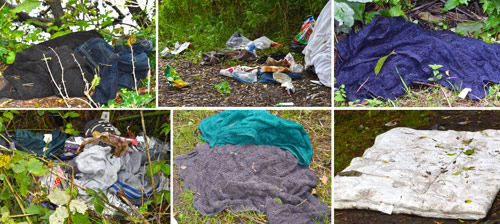
Mr Thomas Duffy, District Engineer with Tipperary County Council’s Thurles Municipal District, (him who reigns over current Thurles technocracy, town renowned for 90% of its road signs, for months, either pointing in the wrong direction or otherwise just misleading), reportedly responded by pointing to the wildlife and habitats supported by trees and vegetation and to representations from people opposed to cutting back that growth. Yes, those concerns deserve to be taken seriously, but Mr Duffy’s response leaves the central questions unanswered. (1) Was he concerned about the wildlife living in the filthy, abandoned clothing, same strewn about the river banks on either side of the river which we photographed this morning, Sat 26th September? (2) Was he referring to the fallen trees, the growing trees and oxygen stealing reeds within the river itself ?
Clothing strewn across both banks of the River Suir in Thurles Town centre photographed early this morning, left behind by homeless individuals over past weeks, latter living in tented accommodation on the river bank and in the shelter sought under the Thurles footbridge. Picture: G. Willoughby.
Cllr Jim Ryan had made an obvious but important point; wildlife also existed in and around the Suir when the river was properly maintained, under the governance of now retired Mr Michael Ryan, former Thurles Town Clerk. So the issue is not whether wildlife should be protected. Of course it should. The real questions for Mr Duffy and his officials, in his role as District Engineer, and for Tipperary County Council now remain much more specific.
Which habitats require protection?
Which trees and branches have actually been assessed?
Which obstructions can safely be removed?
What maintenance can proceed without damaging important habitat?
What work cannot proceed, and what scientific evidence supports those decisions?
Thurles residents are entitled to answers. Simply referring to biodiversity, whenever river maintenance is raised, risks giving the impression that conservation has become a reason for continued inaction. That would be unfair both to genuine conservation and to the people who have been raising legitimate concerns about the condition of the River Suir for 13 years.
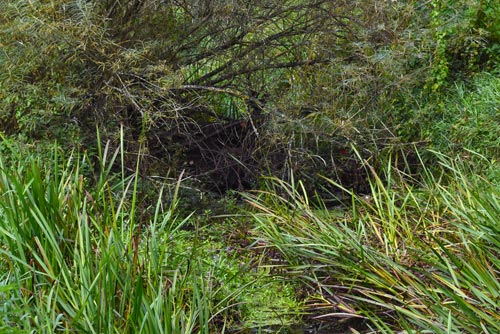
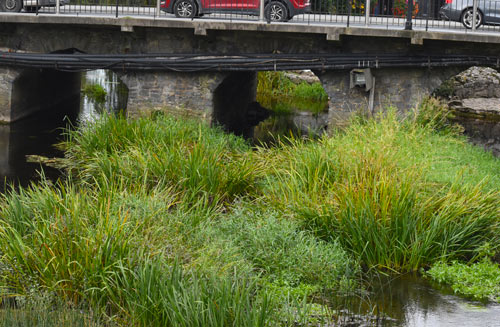
Branches. reeds and fallen tree trunks that now block the river Suir in Thurles. Picture: G. Willoughby.
There is nothing natural about litter, sewage, incorrectly connected drainage pipes or other pollutants entering a river. There is nothing environmentally responsible about allowing pollution to remain simply because vegetation has subsequently developed around parts of the river. There is little comfort in being told that existing vegetation provides habitat without an equally clear explanation of what Tipperary County Council and the relevant agencies are doing to improve the quality of the water supporting that habitat.
Conservation Must Not Become An Excuse for Neglect. This is where Mr Duffy’s explanation requires greater clarity. Nobody is suggesting that every tree should be cut down or every piece of vegetation removed. Equally, however, the presence of wildlife cannot automatically mean that every fallen tree, obstruction or area of excessive growth must remain untouched indefinitely. That is not an intelligent management strategy.
A professional river-management approach should identify what needs protection, what requires intervention and how both objectives can be achieved together.
If particular trees are ecologically important, tell the public.
If particular branches can safely be removed, remove them.
If environmental assessments are required before work can proceed, explain which assessments are needed and when they will be completed.
And if Tipperary County Council believes that certain sections of the Suir should no longer be maintained in the manner residents remember from previous decades, it should explain clearly why that policy has changed and what evidence supports the new approach.
Residents should not be left trying to interpret vague references to habitats while the visible condition of the river continues to cause concern.
Obvious Filth In River Suir left Ignored
The Aim Should Be Restoration Perhaps the better word for what Thurles needs is restoration. When severe air pollution was tackled in Ireland, nobody argued that polluted air should somehow be preserved because it had become part of the existing environment. The sources of the pollution were tackled so that cleaner air could return.
Why should our rivers be treated differently?
Protect what is genuinely ecologically valuable.
Remove what does not belong there.
Stop pollution at source.
Improve water quality.
Carry out appropriate maintenance under proper environmental supervision.
The River Suir should not be forced into an artificial argument between “cleaning” and “conservation”. The real objective should be restoration based on evidence.
If Work Cannot Be Done, Mr Duffy and the Council Should Explain Why. For every significant obstruction or area of concern identified along the Suir through Thurles; Tipperary County Council should be capable of answering some simple, straightforward questions.
Has it been inspected?
Has its ecological importance been assessed?
Does it present a flooding, pollution, amenity or maintenance issue?
Can any work safely be undertaken?
Which authority is responsible?
If work cannot proceed, what specific environmental consideration prevents it?
And, where work can proceed, when will it happen?
These are reasonable questions to put to Mr Thomas Duffy as District Engineer and to the wider management of Tipperary County Council.
Indeed, Tipperary council records show that concerns about the condition and maintenance of the River Suir are not new. Mr Duffy has served as District Engineer for Thurles Municipal District over a period in which these issues have repeatedly been discussed at council level. That makes it all the more important that the council now moves beyond explanations of constraints and tells residents what practical programme of work is actually possible.
Why Does Thurles Appear Different? Cllr Ryan has also questioned why stretches of the River Suir through Cahir and Clonmel appear to be maintained differently. Again, both Mr Duffy and Tipperary County Council should be able to provide a factual explanation. If the difference arises from flood-management requirements, ecological designations, ownership, OPW involvement, Inland Fisheries advice, engineering considerations or simply different physical conditions in the river, then say so. If different maintenance regimes are being applied in different towns, explain why. There may be perfectly legitimate reasons. But without a clear explanation, residents will understandably continue asking why work apparently possible elsewhere along the Suir appears so difficult to undertake in Thurles.
Water Quality Cannot Be Secondary to Vegetation. This is another important issue which must not be lost in the discussion about trees and vegetation.
Pollution. The investigation into pipes apparently discharging into the Suir south of The Source Arts Centre is therefore particularly important. Following repeated representations from Cllr Jim Ryan, a preliminary investigation has at last begun, with further investigations expected to try to determine the source of suspected misconnections. This is progress, but investigation cannot be the end of the process. If a pipe is discharging inappropriate material into the River Suir, residents should ultimately be told what was discovered, where the discharge originated, what remedial action is required, which organisation is responsible for that action and when the problem will be corrected. Otherwise, another survey simply becomes another entry in a dusty file cover.
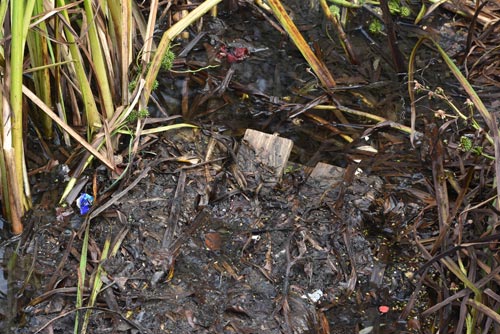
Reeds draining the River Suir of its oxygen. Picture: G. Willoughby.
Mr Duffy’s Role Carries a Responsibility to Explain What Can Be Done. As District Engineer for Thurles Municipal District, Mr Thomas Duffy is understandably required to take account of engineering requirements, environmental obligations, habitat protection and the advice of other statutory bodies. Nobody should expect him to disregard those responsibilities. But those same responsibilities also place him in an important position to explain clearly to councillors and the public what exactly can be achieved.
The response cannot end at: “There is wildlife there.” The next sentence must be: “Therefore, this is what we can safely do”. That is the missing part of the present discussion. If complete clearance would be environmentally damaging, nobody reasonable should demand complete clearance. But if selective tree work, removal of obstructions, litter clearance, bank management or other interventions can take place safely, residents deserve to know why those measures are or are not being undertaken. Conservation should define how appropriate maintenance is carried out. It should not automatically become an argument against maintenance itself.
Accountability Must Follow Investigation There is also a wider question of accountability. The problems now being discussed did not emerge overnight. Concerns about water quality, pollution, vegetation and the physical condition of the river have been raised over a 13 year period. Mr Duffy has occupied the role of District Engineer during much of that period. That does not mean every problem with the Suir falls personally at his door; responsibility is plainly shared between Tipperary County Council, water authorities, environmental agencies, landowners and other bodies. But it does mean that residents are entitled to expect a clear engineering and management response from the local authority responsible for the district. The answer cannot perpetually be another study, another consultation or another explanation of why something is complicated. At some stage complexity has to produce a plan, and that plan has to produce results.
Give Thurles a River Plan People Can Measure. What Thurles now needs is a River Suir management and restoration programme that ordinary residents can understand.
It should identify the problems.
It should publish the evidence.
It should state what work is permitted.
It should identify what work is environmentally unsuitable.
It should name the authority responsible for each action.
It should include target dates.
And it should report publicly on whether those targets have been achieved.
Where vegetation must remain for ecological reasons, explain why.
Where trees or branches can safely be removed, deal with them.
Where litter has accumulated, clear it.
Where misconnections are identified, correct them.
Where nutrient pollution is contributing to excessive plant growth, tackle the source rather than repeatedly treating the symptom.
Where additional assessments are required, give residents a date for their completion.
And where responsibility rests with another agency, identify that agency clearly instead of leaving residents caught between different authorities.
The River Suir does not need a battle between conservationists and people calling for action. Most people want exactly the same thing: A cleaner, healthier, living River Suir flowing through Thurles. Wildlife was there before the present level of overgrowth. Wildlife existed when the river was more open. People enjoyed the river then too. And wildlife ultimately depends not simply on trees and vegetation but on the quality of the water flowing between them.
So the question for Mr Thomas Duffy, District Engineer for Thurles Municipal District, and for Tipperary County Council is not: “Why can’t you clear everything?” It is a much more reasonable question; “Having identified what must be protected, what exactly can be maintained and restored and when will that work actually be carried out?”
This post has been forwarded to EPA; Tipperary Co. Co. and to River Basin Management Service (formerly LAWPRO).
After 13 years of concern about the River Suir, Thurles deserves more than explanations of what cannot be done. It deserves a clear explanation of what can be done, who will do it and when can the public expect to see results.
Steam, Stories and a Forgotten Line Through the Heart of Our Tipperary Community.
A date for your diary – Thursday, 29th October2026
There was a time when the sound of a steam whistle echoed across the fields of Ardmayle, when trains passed through our village carrying passengers, goods and news, and when the local railway station was a busy and important part of everyday life. Ardmayle Heritage Society invites you to step back in time and discover the remarkable story of a railway line that connected Ardmayle with Cashel, Gooldscross and the wider railway network.
The society are delighted to welcome their Vice Chairman and local railway historian, Mr Billy Maher, to St. John the Baptist Church, Ardmayle, for a special evening dedicated to this fascinating chapter of their local history. Through a wonderful collection of historic photographs, local stories and personal recollections, Mr Maher will bring back to life the days when steam trains travelled through Ardmayle; railway workers kept the line moving, and the station became a familiar meeting point for generations of local people.
The evening will explore the story of Ardmayle Railway Station, first opened in 1907; the railway houses; the men and families connected with the line, and the important part the railway played in the social and working life of the community.
It is a story of steam and steel, of journeys and livelihoods, and of a railway whose tracks may have disappeared but whose memory still runs through Ardmayle.
PLEASE REMEMBER.
Date: Thursday, 29th October. Venue: St. John the Baptist Church, Ardmayle, Cashel, Tipperary. Doors open at 7:30pm. Presentation begins sharp at 8.00pm. Admission is free. Tea & Coffee will be available afterwards. Donations welcome on the night.
Come along and join them for a journey back to the days when the railway ran through Ardmayle, Co. Tipperary.
There was great excitement in Thurles yesterday as Minister for Public Expenditure and Infrastructure Mr Jack Chambers arrived to inspect some of the town’s important infrastructure projects.
Accompanying him were Deputies Mr Ryan O’Meara and Mr Michael Lowry, and Cllr Sean Ryan, naturally an occasion of such national significance required that essential piece of modern infrastructure without which no Irish public project can possibly proceed: The camera. Lots of cameras. Photographs here. Photographs there. Video at the junction. Video beside the road. Possibly another photograph just in case the first photograph failed to adequately demonstrate the seriousness of looking into a field.
The Minister viewed the proposed Thurles Inner Relief Road. He viewed the proposed Turtulla Cross roundabout. The issues at the M8 junction at Two-Mile-Borris were also highlighted. All very worthwhile projects. And somewhere in the middle of this magnificent infrastructure expedition, one elderly local issue apparently went missing, vanished even. It was not a person. It was a project – THE THURLES BYPASS.
Yes, it was the legendary Thurles Outer Bypass. Older readers may remember it. Younger readers may have heard the stories about it from their great-great-great grandparents. Archaeologists believe even references to it may exist in ancient Department of Transport documents. There was even a selected route. There was a reserved corridor, and in 2026 it received a whole €50,000 to prepare a Phase 0 Project Outline document. Yes, Phase Zero. After all these years, Thurles has achieved the infrastructure equivalent of reaching the starting line and discovering that somebody still has to fill out the form, allowing us to approach the starting line.
Ireland’s 3 Day Working Power House.
Still, €50,000 is not to be sniffed at, particularly when Dublin’s MetroLink now has a central estimated construction cost of approximately: €15,750 billion. So while Dublin prepares for 19 kilometres of mostly underground railway, 16 stations, trains every few minutes and tunnelling on a scale rarely seen in Ireland, since the Irish Civil War 1922 era, when 112 republican prisoners successfully crawled to freedom through a secretly dug tunnel to a connected sewer system, toescape from Newbridge Barracks, Co. Kildare.
Project Outline Document. Steady now. We don’t want to rush these things. At this rate, by the time MetroLink passengers are travelling underneath Dublin; Thurles may have advanced triumphantly to: Phase 0.5 – Preliminary Consideration of the Possibility of Considering Phase 1. I forecast, there may even be another photocall.
Of course, the Inner Relief Road and Turtulla Cross are important projects. Congestion and road safety are indeed serious issues and investment is badly needed. But the remarkable thing about the Thurles Bypass is its extraordinary ability to remain permanently present, while simultaneously being almost completely invisible. It has a route. It has a corridor. It has appeared in plans. It has disappeared from plans. It has been discussed. It has been revived. It has been allocated money and yet somehow, whenever the cameras always arrive… POOF – the Thurles Bypass enters stealth mode. Perhaps Cllr Sean Ryan should put a large sign on the reserved corridor, “Minister — Project This Way ➡️”; preferably with a photographer taken of him standing beside it. Because judging by the speed at which infrastructure sometimes progresses, the most effective piece of road-building equipment available to Thurles, may not be a bulldozer at all. It may be a Canon EOS with a telephoto lens.
Finally, we can only hope that everyone travelled together yesterday in that one electric vehicle. After all, with €15.75 billion required for MetroLink, every small saving counts. One car. Four politicians. Three road schemes. Several cameras and one Thurles Bypass apparently hiding behind a hedge whispering: “Any chance ye might take a photograph of me while ye’re here?”
At this stage the people of Thurles don’t necessarily need another photograph of somebody looking thoughtfully, with their backs at a road. They’d probably settle for the extraordinary novelty of eventually being able to drive on one.
Oh my God I forgot; then there’s the small matter of the funding that was already… er… funded. Veteran followers of the Thurles infrastructure cinematic universe may remember a previous episode. Back in October 2021, former retired TD Jackie Cahill announced that Thurles was “finally receiving the funding we need” for the Inner Relief Road. Excellent. Funding secured. Champagne on ice. Start warming up the diggers. Except things subsequently became just a tiny bit confusing. Because by June 2023, Tipperary County Council’s own management report listed the next stage of the Inner Relief Road as: “SECURE FUNDING TO DELIVER THE INNER RELIEF ROAD PROJECT.”
Yes, we had apparently entered that fascinating branch of public finance, where funding can be secured before the funding that still needs to be secured has actually been secured. A remarkable rural Ireland innovation. Schrödinger’s Road Funding. The money is simultaneously there and not there until somebody opens the Department of Transport envelope. Perhaps this explains why infrastructure takes so long. We’ve been using ordinary mathematics. Maybe Thurles road projects operate under quantum mechanics.
In 2021: Funding secured ✅. In 2023: Next step: Secure funding ✅. In 2026: Minister photographed looking at project ✅.
Presumably the next headline will be: “GOVERNMENT DELIGHTED TO CONFIRM FUNDING TO DETERMINE WHETHER PREVIOUSLY SECURED FUNDING REQUIRES FURTHER FUNDING BEFORE FUNDING CAN OFFICIALLY BE DESCRIBED AS FUNDED.” There will naturally be a photograph. Possibly several; and somewhere nearby, leaning patiently against its reserved corridor, the Thurles Bypass will be watching the entire performance with the weary expression of a project that has seen governments come and go and knows better than to get excited.
The poor Bypass must be thinking: “Hold on lads… before ye announce that money, could somebody check whether I’ve already been funded as well?” Because at this stage, anything is possible. Perhaps the Thurles Bypass was actually completed in 1987 and nobody remembered to tell us. Maybe it’s invisible. Maybe you require a special pair of Department of Transport glasses to see it. Or perhaps – and this is the really radical idea – one day we might dispense with the announcements, the rediscoveries, the re-announcements, the photographs of people pointing thoughtfully into the middle distance and the ceremonial securing of money that apparently requires subsequent securing……and simply build the bloody road.
Until then: Smile everyone. The camera is ready. The politicians are assembled. The funding is simultaneously secured and awaiting securing, and the Thurles Bypass remains exactly where generations of Thurles people have learned to expect it:- COMING SOON.
Meanwhile, on behalf of the people of Thurles, allow me to congratulate all the local Press Correspondent; Access Journalists; all the “Stenographers To Power”, who failed miserably to critically question our visiting politicians yesterday, on what was truly a slow news day.
This website uses cookies to improve your experience. We'll assume you're ok with this, but you can opt-out if you wish.AcceptRead More
Privacy & Cookies Policy
Privacy Overview
This website uses cookies to improve your experience while you navigate through the website. Out of these, the cookies that are categorized as necessary are stored on your browser as they are essential for the working of basic functionalities of the website. We also use third-party cookies that help us analyze and understand how you use this website. These cookies will be stored in your browser only with your consent. You also have the option to opt-out of these cookies. But opting out of some of these cookies may affect your browsing experience.
Necessary cookies are absolutely essential for the website to function properly. This category only includes cookies that ensures basic functionalities and security features of the website. These cookies do not store any personal information.
Any cookies that may not be particularly necessary for the website to function and is used specifically to collect user personal data via analytics, ads, other embedded contents are termed as non-necessary cookies. It is mandatory to procure user consent prior to running these cookies on your website.






Recent Comments