Mr Ryan passed away peacefully, surrounded by his loving family, while in the care of staff at Our Lady’s Hospice and Care Services, Harold’s Cross, Dublin.
His passing is most deeply regretted, sadly missed and lovingly remembered by his sorrowing family; loving wife Karen, son John, daughter Susan, their partners Julie-Ann and Scott, brothers Walter (Maureen), Liam (Joanie), Martin (Mary), and Paddy (Caroline), sisters Aileen (Donal), Noreen (Nigel) and Ann (Ciarán), father-in-law Liam and the Clancy family, nieces, nephews, extended relatives, neighbours, staff and customers and many friends.
For those persons who would wish to attend Requiem Mass for Mr Ryan, but for reasons cannot, same can be viewed streamed live online, HERE.
The extended Ryan family wish to express their appreciation for your understanding at this difficult time, and have made arrangements for those persons wishing to send messages of condolence, to use the link shown HERE.
“Fortes Fortuna Adiuvat” – [Fortune favours the brave].
A new season begins for the athletes of Thurles Special Olympics Basketball Club.
Club Chairperson Mr Enda Bourke (Secretary) Reports:-
Activities kick off at Thurles Golf Club on Thursday 1st October at 5:30pm with a golfing skills lesson, chipping and putting, from the Club Pro, Mr Raymond Ryan. The athletes and their families will be treated to refreshments afterwards in the clubhouse.
Basketball training restarts on Wednesday 7th October at 7:00pm, in the Presentation sports hall and will continue weekly at the same time.
The Club has planned a Halloween disco for later in October, details to follow.
New athletes and volunteers are always welcome at our Club. Contact details are: Mary: Tel: 086 0818135 and Enda: Tel: 087 6060772.
We look forward to another season of continued dedication and commitment from our athletes, with the support of parents, carers and volunteers throughout the months ahead.
In his 90th year and pre-deceased by his infant son Philip, parents Johanna and Philip, brothers Dan, Mick, Billy, Philip and Richie, sister Leana; Mr Croke passed away peacefully at his place of ordinary residence, surrounded by his loving family.
His passing is most deeply regretted, sadly missed and lovingly remembered by his sorrowing family; loving wife Rita (née Donnelly), daughters Siobhan, Annmarie, Eithne and Jacinta, sons Criostóir, Fergal and Camillus, adored grandchildren, great-grandchildren, sons-in-law Michael, Ted and Rodger, daughters-in-law Carmel, Grainne and Katy, brothers Tommy and Albert, sister Jennie, nephews, nieces, sisters-in-law Nancy and Ruby, brother-in-law Dan, extended relatives, neighbours and friends.
Requiescat in Pace.
Funeral Arrangements.
The earthly remains of Mr Croke will repose at Hugh Ryan’s Funeral Home, Slievenamon Road, Thurles, (Eircode E41 CP59), on Tuesday afternoon, September 29th, from 5:00pm until 7:00pm, before being received into the former Cistercian Monastery Abbey, Holycross, Thurles, Co. Tipperary, (Eircode E41 PH01), at 8:00pm, same evening. Requiem Mass for Mr Croke will be offered on Wednesday morning, September 30th, at 11:30am, followed by interment, immediately afterwards, in the adjoining graveyard.
The extended Croke and Donnelly families wish to express their appreciation for your understanding at this difficult time, and have made arrangements for those persons wishing to send messages of condolence, to use the link shown HERE.
Dr James Carr, Associate Professor in the Department of Sociology at the University of Limerick, has been appointed as Ireland’s member of the Council of Europe’s European Commission against Racism and Intolerance (ECRI) for a five-year term.
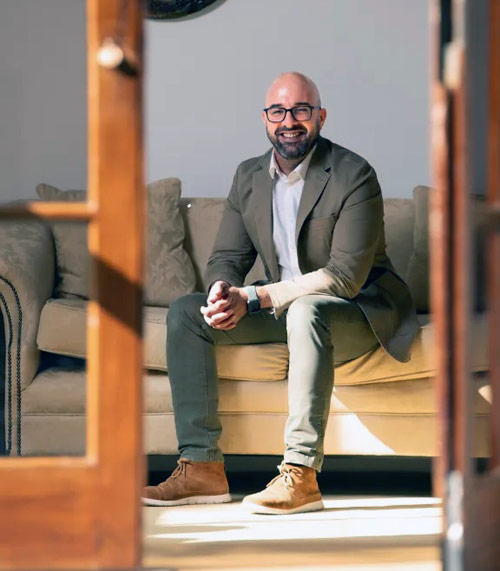
Associate Professor Dr James Carr.
The appointment recognises Dr Carr’s extensive academic, research and professional experience in the areas of racism, racial equality, anti-Muslim racism and discrimination.
Dr Carr has considerable familiarity with the work of the European Commission against Racism and IntoleranceECRI, having previously worked as a consultant adviser in relation to its General Policy Recommendations and having engaged with ECRI members during work associated with the Commission’s sixth-cycle monitoring of Ireland.
His wider European work has included engagement with the European Commission as an expert adviser on anti-Muslim hatred and anti-racism.
At the University of Limerick, Dr Carr’s research focuses on racism, anti-Muslim racism, racial literacy and public sociology. His work combines academic research with practical initiatives aimed at understanding racism, documenting lived experiences and developing approaches to tackling discrimination.
He is the author of Experiences of Islamophobia: Living with Racism in the Neoliberal Era and has contributed extensively to research examining experiences of Islamophobia and anti-Muslim racism in Ireland and internationally.
Dr Carr has also led and participated in a number of European-funded research initiatives. These include the Sustainable Alliances Against Anti-Muslim Hatred (SALAAM) project, which brought together academic and community organisations to develop anti-racism initiatives, and more recent European collaborative research examining anti-Muslim discrimination and racism.
In Ireland, he has served on national advisory structures concerned with racial equality and racism, contributing his research expertise to the examination of how racism is experienced and how effective responses can be developed.
His appointment to ECRI will see him contribute to the work of one of the Council of Europe’s principal independent human-rights monitoring bodies dealing specifically with racism, discrimination, xenophobia and related intolerance.
The role provides an opportunity for Irish academic expertise and research experience to contribute to wider European work examining discrimination, promoting equality and developing measures to address racism across Council of Europe member states.
Ms Maura Barrett Reports From Cashel Library, Co. Tipperary:
See below for list of library events happening in Cashel Library for the coming week – NOTE:All events are FREE, butthey do need to be booked with the Library – Tel: 062 63825 please, or by emailto maura.barrett@tipperarycoco.ie.
Monday September 28th: At 11:00am – Comhrá sa Leabharlann. Bain triail as do chúpla focal sa leabharlann Chaiseal Mumhan. Tá fáilte roimh gach duine. (Translation – Conversation in the Library. Try out your Irish at the Cashel Library. Everyone is welcome).
Monday September 28th: At 2:30pm – Learn English. Join our free conversational English classes in a friendly and welcoming environment.
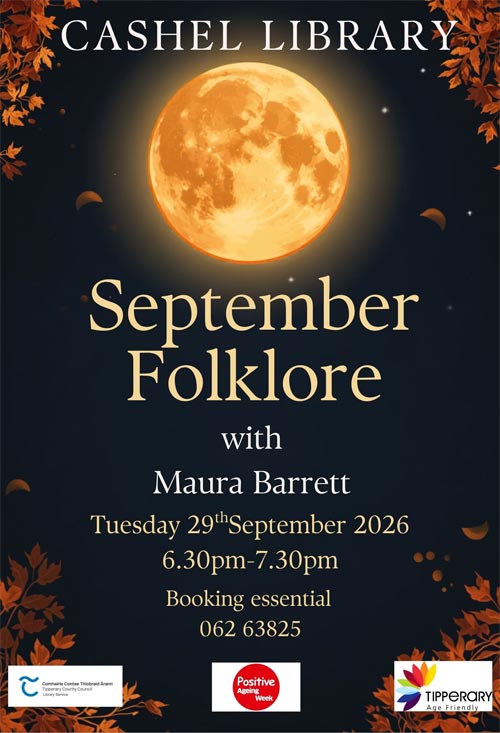
Tuesday September 29th: At 6:30pm – September Folklore with Ms Maura Barrett. Join us for our Positive Ageing Week talk on September in Folklore.
Wednesday September 30th: At 10:00am – Craft Circle – Join the Cashel Craft Circle every Wednesday from 10:00am–12:00pm for their social gathering.
Wednesday September 30th: At 12:30pm – Dance through the Decades – Chair Zumba Dance through the decades with Ms Eimear Byrne and her Chair Zumba class
Saturday October 3rd: At 10.30am; 11:45am and 2:00pm – “The King of Many Cloaks & Crowns“. A fun interactive story-time for children ages 3-5 years.
You canlocate Cashel Library building, situated on Friar Street, Lady’s Well, Cashel, Co. Tipperary, HERE. [Eircode E25 K798].
This website uses cookies to improve your experience. We'll assume you're ok with this, but you can opt-out if you wish.AcceptRead More
Privacy & Cookies Policy
Privacy Overview
This website uses cookies to improve your experience while you navigate through the website. Out of these, the cookies that are categorized as necessary are stored on your browser as they are essential for the working of basic functionalities of the website. We also use third-party cookies that help us analyze and understand how you use this website. These cookies will be stored in your browser only with your consent. You also have the option to opt-out of these cookies. But opting out of some of these cookies may affect your browsing experience.
Necessary cookies are absolutely essential for the website to function properly. This category only includes cookies that ensures basic functionalities and security features of the website. These cookies do not store any personal information.
Any cookies that may not be particularly necessary for the website to function and is used specifically to collect user personal data via analytics, ads, other embedded contents are termed as non-necessary cookies. It is mandatory to procure user consent prior to running these cookies on your website.






Recent Comments