Pre-deceased by his son JJ, parents Jimmy and Annie and sister Angela; Mr Doheny sadly passed away unexpectedly.
His passing is most deeply regretted, sadly missed and lovingly remembered by his sorrowing family; heartbroken wife and best friend Julie, son Keith, adored granddaughters Abbie and Lucy, daughter-in-law Fiona, brothers Jimmy, Anthony and Kieran, Julie’s children Dean and Leah, sisters-in-law, aunt Nell Wall, uncle Timmy Bergin, special cousins Ann Jackman and Bea Doheny, nieces, nephews, extended relatives, neighbours and a large circle of friends.
For those persons who would wish to attend Requiem Mass for Mr Doheny, but for reasons cannot, same can be viewed streamed live online, HERE.
The extended Doheny family wish to express their appreciation for your understanding at this difficult time, and have made arrangements for those persons wishing to send messages of condolence, to use the link shown HERE.
Note Please: House strictly private on Thursday morning.
A brief pause at a junction could prevent a death on Ireland’s roads.
Above is the message behind a new Road Safety Authority campaign asking motorists to check twice for motorcycles before entering a road, particularly when pulling out from a T-junction.
Sixteen motorcyclists have already died on Irish roads this year, adding urgency to the campaign. The danger often develops in an instant. A driver reaches a junction, checks both directions and begins to move. An approaching motorcycle, however, may have blended into the background or appeared farther away than it really was.
Unlike a car or van, a motorcycle occupies very little of a driver’s field of vision. This can make both its presence and its approaching speed difficult to judge during a quick check. The RSA wants motorists to break that routine by pausing and looking once more before proceeding.
Evidence gathered between 2021 and 2025 shows why that extra check matters. During those five years, 954 motorcyclists suffered serious injuries, while 117 lost their lives. Around two-thirds of the riders seriously injured were involved in crashes with another vehicle. Road Safety Authority confirm that failure to observe was the action most frequently identified in those multi-vehicle incidents. Junctions were also the scene of 38% of serious motorcyclist injuries.
The campaign arrives during a period when greater numbers of motorcycles are likely to be on the road. Drivers are being asked to approach junctions slowly, remove distractions and allow themselves enough time to make a proper assessment. Motorcyclists may be smaller and less visible than other vehicles, but they have the same right to be seen and protected.
Before pulling out, pause and check again. The bike missed on the first look could be visible on the second.
Pre-deceased by her parents, William and Josephine and brother Eddie; Mrs Joyce passed away peacefully, surrounded by her loving family, while in the care of staff at University Hospital, Galway.
Her passing is most deeply regretted, sadly missed and lovingly remembered by her sorrowing family; loving husband Festus, son Sean, daughter Karen, and son-in-law Geoff, brothers, sisters-in-law, extended relatives, neighbours and many friends.
For those persons who would wish to attend Requiem Mass for Mrs Joyce, but for reasons cannot, same can be viewed streamed live online, HERE.
The extended Joyce and Ryan families wish to express their appreciation for your understanding at this difficult time, and have made arrangements for those persons wishing to send messages of condolence, to use the link shown HERE.
“The family of Mrs Joyce would like to sincerely thank all of her carers and the wonderful staff at the University Hospital Galway for their kindness and compassion.”
Solas na bhflaitheas agus leaba i measc na n-aingeal di.
The deteriorating condition of the River Suir cannot be treated as a new discovery.
For years, residents, anglers and environmental campaigners have raised concerns about pollution, excessive vegetation, restricted flows and the general neglect of the river through Thurles and surrounding areas. Yet meaningful, coordinated action by elected representatives, Tipperary County Council and the responsible State agencies has been painfully slow. VIEW HERE and note date, November 7th 2013.
Note the dates of the following links published over the past 13 years
Recent statements and a carefully produced publicity videos may create the impression of decisive political intervention. But inspections, promises and political photo opportunities are not substitutes for an agreed restoration programme, clear accountability and work on the ground.
Ministerial Visit Raises More Questions Than It Does Answers. Minister of State Mr Kevin Moran recently visited sections of the Suir in Thurles and Holycross following representations from Independent TD Mr Michael Lowry. Not for the first time Deputy Lowry says the Office of Public Works will support an application from Tipperary County Council, under the enhanced Minor Flood Mitigation Works Scheme. The expanded scheme reportedly allows councils to seek 95% funding for eligible works costing up to €2 million.
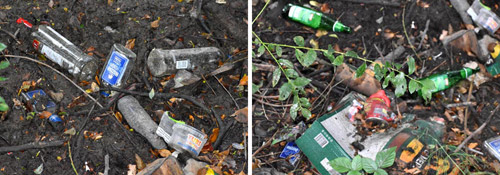
Pictures of the River Suir bed not shown in “Team Lowry’s” promotional video. The litter remains almost six weeks after the Liberty Music Festival, with no proper clean-up and no bin near “Wino’s Corner” despite repeated requests to Tipperary County Council.
All such commitments is welcome, but it remains only a commitment to support an application. The public has not yet been given a detailed proposal identifying:- The exact works to be undertaken. The evidence that those works will improve the river. The environmental assessments required. The project’s anticipated cost and timetable. The agencies responsible for delivering and monitoring it.
After years of warnings, the people of Tipperary are entitled to something more substantial than another announcement.
Where Have Our Representatives and Council Officials Been? The present condition of the Suir did not develop overnight. Local representatives and council officials have had ample opportunity to inspect the river, consult anglers and environmental groups, engage the relevant agencies and develop a long-term plan. Instead, the response has too often appeared fragmented and reactive.
Councillor Micheál Lowry and his father, Deputy Michael Lowry TD, are now drawing attention to conditions that local campaigners say have been evident for more than a decade. Their intervention must therefore be judged by what it delivers, not by the number of statements, videos or the ministerial visits it generates.
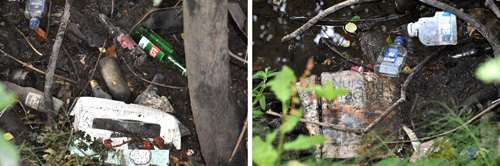
Other pictures of the River Suir bed not shown in “Team Lowry’s” promotional video. The litter remains in the river, together with 6 Supermarket trollies, almost six weeks after the Liberty Music Festival, with no proper clean-up and no bin near “Wino’s Corner” despite repeated requests to Tipperary County Council.
It should be noted:Thurles Town Park bye-laws were formally made by Tipperary County Council acting through the Templemore–Thurles Municipal District, and they came into operation on March 1st 2016. Available evidence indicates that those bye-laws then regulated alcohol consumption in the park, but this bye-law today remains totally ignored by all and sundry.
The same standard must be applied to Tipperary County Council. If the Council intends to seek OPW funding, it should publish its proposal and explain how any vegetation removal, blockage clearance or flood-related work will be reconciled with water quality, fisheries and habitat protection.
This Is More Than a Question of Appearance The problem cannot be reduced to reeds, bulrushes or an untidy riverbank. The Suir catchment covers approximately 3,500 square kilometres. Catchments.ie has previously identified excess phosphorus from sources including wastewater, animal waste and fertilisers as a major water-quality pressure. Excess nutrients can drive eutrophication, damaging aquatic habitats and reducing ecological quality. Catchments.ie’s Suir assessment also shows why pollution sources vary across the catchment and require targeted measures rather than a single cosmetic response.
Low summer flows, pollution, heavy plant growth, sediment and physical obstructions may interact, but they are not necessarily the same problem. Removing vegetation without identifying the underlying causes will not, by itself, restore the river. Any intervention must be scientifically informed and developed with the relevant environmental and fisheries authorities.
Too Many Agencies—and Too Little Accountability Responsibility for the Suir is spread across numerous organisations, including: Tipperary County Council. The River Basin Management Service, (formerly LAWPRO). The Environmental Protection Agency. Inland Fisheries Ireland. The Office of Public Works. Uisce Éireann. The National Parks and Wildlife Service. Local landowners, anglers and recreational organisations.
This above complicated structure cannot continue to provide cover for delay and buck-passing. The public needs to know which body is leading the response, what each agency is responsible for and when measurable improvements will be delivered. The failure to prominently involve or even acknowledge the River Basin Management Service in recent Lowry political presentations is particularly difficult to understand.
Community Initiatives Must Be Supported; but Properly Coordinated. The Cashel, Golden and Tipperary Anglers Association is reportedly considering seeking assistance to hire specialist equipment to remove bulrushes from parts of the riverbed. Separately, NoreVision is reported to be progressing proposals for River Suir and River Barrow trusts. Such trusts could help communities undertake practical restoration, education and awareness projects, provided they have appropriate scientific guidance, sustainable funding and constructive relationships with public agencies. Community organisations can make an enormous contribution, but volunteers should not be expected to compensate indefinitely for failures of statutory responsibility.
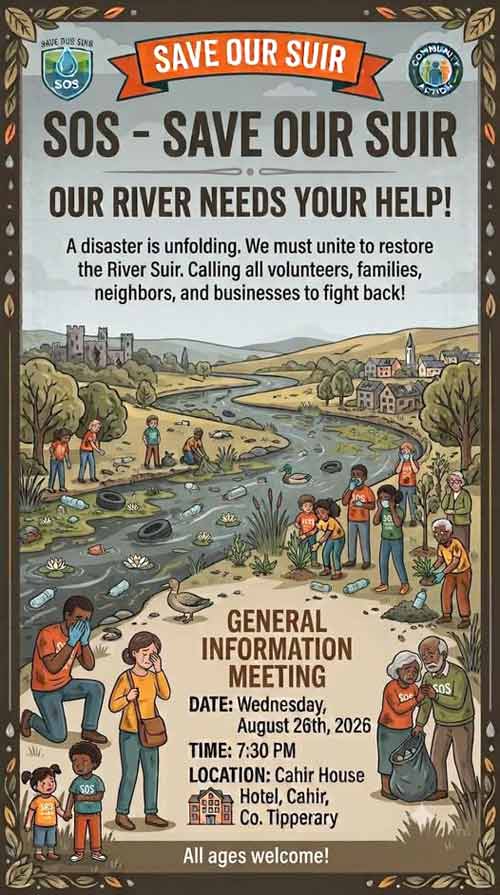
Public “Save Our Suir” Meeting in Cahir. A public information meeting is scheduled following a recent committee meeting of the Cashel, Golden and Tipperary Anglers Association. Date: Wednesday, August 26th, 2026. Time: 7:30pm. Venue: Cahir House Hotel. Tel.: 052 7443000. Admission: Open to all. Note: I could not independently locate an official online notice confirming the above event, thus intending attendees should check the organiser’s latest announcement before travelling.
The “Save Our Suir” proposed meeting offers residents, anglers, landowners, recreational users and environmental campaigners an opportunity to hear what is being proposed and to demand answers from those responsible.
The Suir Needs a Plan; NOT Another Vote Catching Publicity Exercise. The River Suir is an ecological, recreational and economic asset belonging to the entire community. Its future cannot be protected through disconnected funding announcements, short-term clearance projects or political sound-bites.
Those attending any Cahir meeting should demand: A published, science-based assessment of the river’s condition. Identification and investigation of pollution sources. A costed restoration and maintenance programme. A clear division of responsibility among the Council and State agencies. Meaningful consultation with anglers, environmental specialists, landowners and residents. Public reporting against firm delivery dates.
After years of warnings, elected representatives and council officials must be held accountable for the absence of effective action. The question is no longer whether the River Suir is under pressure. The question is who will take responsibility and how soon tangible work will begin.
Salmonella Alert Sparks Recall of Dunnes Meals and SuperValu Sesame Seed Products
A wide range of ready-to-eat products sold by Dunnes Stores has been recalled following the detection of salmonella in sesame seeds.
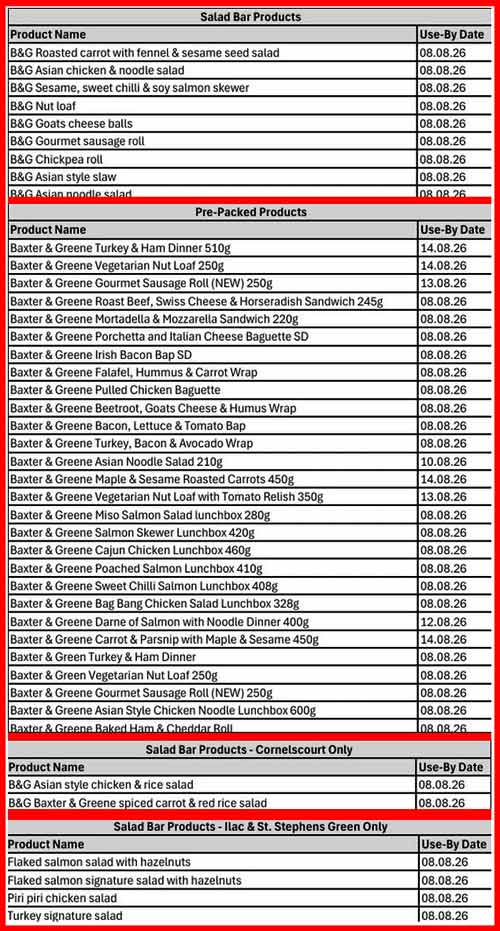
The Food Safety Authority of Ireland said the recall covers specified Baxter & Greene loose salad-bar items and pre-packed foods containing sesame seeds.
In all more than 40 products are affected, including selected sandwiches, wraps and salads. Consumers should check the product names and use-by dates against the full list published by the FSAI shown above and should not eat any of the implicated items.
Several separately branded seed products have also been recalled. Affected products include SuperValu Seed Mix in 200g packs. Batch codes 163 and 166, with a best-before date of May 2027, and batch 191, with a best-before date of June 2027, are included in the recall.
The following Gem Pack products are also affected: Gem Sesame Seeds 1kg, batches 155 and 177, best before May 2027 Sysco Sesame Seeds 1kg, batch 147, best before April 2027 Sysco Sesame Seeds 1kg, batch 169, best before May 2027 Sysco Sesame Seeds 1kg, batches 189 and 203, best before June 2027 Sesame Seeds 25kg, lots 32308 and 32704, best before 1 March 2027 Sowans Sesame Seeds 100g, batch 155, best before May 2027 Full details of those products are available on the FSAI website.
Earlier recalls include SuperValu Sesame Seeds in 200g packs, covering batch codes 167 and 168 with a best-before date of May 2027.
Compania Indilor Orientale Susan Sesame Seeds in 50g packs were also recalled. The affected product carries batch code L1312242 and a best-before date of July 2026. Although that date has passed, the FSAI has advised consumers to check their cupboards and dispose of any affected packs.
As many are aware Salmonella infection generally causes symptoms within 12 to 36 hours, although illness can begin anywhere from six to 72 hours after exposure. Diarrhoea is the most common symptom and may sometimes be bloody. Fever, headaches and abdominal cramps can also occur. Symptoms usually continue for four to seven days, but severe diarrhoea may require hospital treatment. Infants, older people and those with weakened immune systems face a greater risk of serious illness. Retailers have been instructed to remove affected products from sale and display recall notices. Wholesalers and distributors must contact customers who received the implicated batches, while caterers have been told not to use them.
Consumers should not eat any of the above recalled products.
This website uses cookies to improve your experience. We'll assume you're ok with this, but you can opt-out if you wish.AcceptRead More
Privacy & Cookies Policy
Privacy Overview
This website uses cookies to improve your experience while you navigate through the website. Out of these, the cookies that are categorized as necessary are stored on your browser as they are essential for the working of basic functionalities of the website. We also use third-party cookies that help us analyze and understand how you use this website. These cookies will be stored in your browser only with your consent. You also have the option to opt-out of these cookies. But opting out of some of these cookies may affect your browsing experience.
Necessary cookies are absolutely essential for the website to function properly. This category only includes cookies that ensures basic functionalities and security features of the website. These cookies do not store any personal information.
Any cookies that may not be particularly necessary for the website to function and is used specifically to collect user personal data via analytics, ads, other embedded contents are termed as non-necessary cookies. It is mandatory to procure user consent prior to running these cookies on your website.






Recent Comments