Mr Mullins passed away peacefully, surrounded by his loving family, while in the care of staff of Blackrock Clinic, Co. Dublin.
His passing is most deeply regretted, sadly missed and lovingly remembered by his sorrowing family; loving wife Carrie, daughter Rowena, son Jason, son-in-law Tristan, daughter-in-law Leann, grandchild Daniel, brothers-in-law, nieces, nephews, extended relatives, neighbours and friends.
For those persons who would wish to attend Requiem Mass for Mr Mullins, but for reasons cannot, same can be viewed streamed live online, HERE. For those persons who would wish to attend the Service of Cremation for Mr Mullins, but for reasons cannot, same can be viewed streamed live online, HERE.
The extended Mullins family wish to express their appreciation for your understanding at this difficult time, and have made arrangements for those persons wishing to send messages of condolence, to use the link shown HERE.
Note Please: Family flowers only. Donations in lieu, if desired, to the Irish Cancer Society.
In his 91st year and pre-deceased by his son Martin and grandson Francis; Mr Mulcaire passed away peacefully, while in the care of staff at St Theresa’s Nursing Home, Kilrush, Co. Clare.
Sadly missed and treasured forever by his wife Pearl, children Josephine, Bill, Mags, Gerry, Denis, Paul, Eileen, John, Deirdre and Raphael and all of his many beloved grandchildren and great grandchildren, daughters in law and sons in law, relatives, neighbours and friends.
Requiescat in Pace.
Funeral Arrangements.
The earthly remains of Mr Mulcaire will be received into the Church of St. Senan, Kilrush, Co. Clare on tomorrow evening, Wednesday, August 12th, from 6:00pm until 7:30pm, followed by Funeral Prayers. Requiem Mass for Mr Mulcaire will be offered on Thursday morning, August 13th, at 11:00am, followed by interment, immediately afterwards, in All Saint’s Cemetery, Shanakyle, Co. Clare.
The extended Mulcaire family wish to express their appreciation for your understanding at this difficult time, and have made arrangements for those persons wishing to send messages of condolence, to use the link shown HERE.
“Take the holy water and mind yourself crossing the road”
Note Please: House Strictly Private.
Solas na bhflaitheas agus leaba i measc na n-aingeal dó.
Ms O’Connor passed away unexpectedly, but peacefully, leaving all who loved her heartbroken.
Her passing is most deeply regretted, sadly missed and lovingly remembered by her sorrowing family; heartbroken and loving parents Marion (nee Noonan, Ballyclough) and Patrick, sister Tanya, brothers Jason, David and Stephen, nieces and nephews Cian, Kaitlin, Grace, Blathnaid, Odhran, Gabrijela and Marta, sisters-in-law and brother-in-law Kathryn, Lisa, Ivana and Declan, Aunts, uncles, extended relatives, neighbours and a large circle of friends.
Her absence leaves a silence that cannot be filled. Now she rests in the quiet peace of Heaven where sorrow fades and love endures without end. May angels cradle her gently, may the saints welcome her with joy, may her soul shine like a star in God’s endless sky.
Rest In Peace.
Funeral Arrangements.
The earthly remains of Ms O’Connor, will repose at the family home, Kanturk Road, Buttevant, Co. Cork, on tomorrow afternoon, Wednesday August 12th from 5:00pm until 8:00pm same evening, followed by prayers.
Her remains will be received into the Church of St. Mary, Buttevant, Co. Cork on Thursday August 13th, at 12:00noon, to further repose for Requiem Mass, followed by interment, immediately afterwards in Ballyclough New Cemetery, Cork.
The extended O’Connor and Noonan families wish to express their appreciation for your understanding at this difficult time, and have made arrangements for those persons wishing to send messages of condolence, to use the link shown HERE.
Solas na bhflaitheas agus leaba i measc na n-aingeal di.
On August 2nd, 2026, Thurles.Info highlighted the growing litter problem caused by drinks containers being discarded on streets, roadsides and in public spaces around Thurles and other Irish towns.
Among the containers increasingly being found are round aluminium BuzzBallz cocktail cans and miniature plastic bottles used for spirits and cocktail mixes. Many of these containers cannot be returned through Ireland’s Deposit Return Scheme.
The scheme generally covers PET plastic drinks bottles and aluminium or steel drinks cans with a capacity of between 150ml and three litres. However, containers must also display the Re-turn logo and carry a barcode registered with the Irish scheme. To be accepted, they must be empty, undamaged and retain their original shape. Consequently, an imported or unregistered container may be rejected by a Reverse Vending Machine, even when it is made from aluminium or PET plastic and falls within the specified volume range. Miniature glass bottles and containers made from plastics other than PET remain outside the scheme.
Government Minister’s office contacted Following publication of that report, we contacted Minister of State Mr Alan Dillon, who has responsibility for the Circular Economy at the Department of Climate, Energy and the Environment.
We received the following standard automated acknowledgement: “Thank you for your email to Minister of State Alan Dillon’s Office. Your correspondence will be brought to the attention of the Minister and relevant officials in the Department of Climate, Energy and the Environment. Please be advised that if the issue raised in your correspondence is more appropriate to another Government Department or Agency, your correspondence will be forwarded to that organisation for direct response, in accordance with the provisions of the Department’s Data Protection Policy.”
This acknowledgement merely confirms receipt of our correspondence. It provides no substantive response to the litter problem raised and offers no indication as to what action, if any, may be taken.
“100% recyclable” is not the same as being eligible for a deposit refund. Result littering.
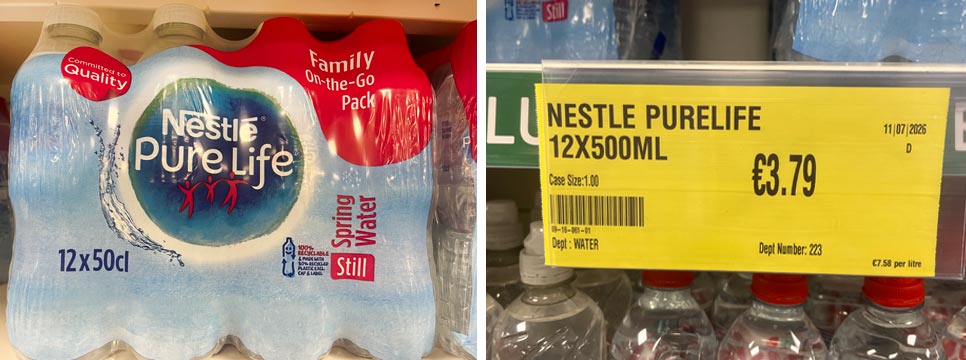
Bottled water without the Re-turn logo We have again contacted Minister Dillon’s office after observing Irish retailers selling multipacks of bottled water whose packaging states that the bottles are “100% recyclable”, but which do not appear to display the official Re-turn logo.
“100% recyclable” is not the same as being eligible for a deposit refund Under the published scheme rules, in-scope containers must display the Re-turn logo and carry a barcode registered with the scheme. Re-turn states that all in-scope drinks containers placed on the Irish market must meet these labelling requirements.
The water shown in our accompanying photograph above is sold in 500ml plastic bottles; a size that would normally fall within the scope of the Deposit Return Scheme if the bottles are made from PET plastic and properly registered. Their apparent lack of a Re-turn logo therefore raises questions as to why such products are being offered for sale and whether Irish consumers can return them for a deposit refund.
Without a financial incentive to return these bottles, more of them are ending up discarded along roadsides, on streets and in other public places, adding to an already serious litter nuisance.
Consumers who see a recycling symbol may understandably believe that a bottle can be placed in a Reverse Vending Machine. If the machine then rejects it because its barcode is not registered or because it lacks the required Re-turn marking, the system becomes confusing and public confidence is weakened.
We now respectfully ask Minister Dillon and his Department to clarify:
Why drinks containers that appear to fall within the scheme’s material and volume requirements are still being offered for sale without the Re-turn logo? Whether retailers are permitted to sell such products in Ireland? Which authority is responsible for inspecting retailers and enforcing compliance/ What measures will be taken to include, or otherwise address, aluminium cocktail containers, miniature bottles and other drinks packaging currently falling outside the scheme? Whether the Deposit Return Scheme will be reviewed to prevent avoidable gaps that contribute to litter?
Ireland’s Deposit Return Scheme can reduce litter only when the containers most likely to be discarded are included and when consumers can easily identify what is returnable.
A recyclable container that cannot be returned is still a container that can become litter.
Today marks the anniversary of the murder of Detective Garda Frank Hand, who was fatally shot by members of the Provisional IRA; latter the paramilitary organisation historically and politically associated with Sinn Féin, while protecting a delivery of pension and social-welfare money in County Meath.
On the morning of August 10th 1984, Detective Garda Hand and his colleague, Detective Garda Michael Dowd, were travelling in an unmarked Garda car as the armed escort for a Post Office mail van. When the vehicles stopped outside Drumree Post Office, they were confronted by an armed Provisional IRA unit attempting to rob the delivery. Gunfire was exchanged between the raiders and the Gardaí. Both detectives were wounded, but Detective Garda Hand’s injuries sadly proved fatal.
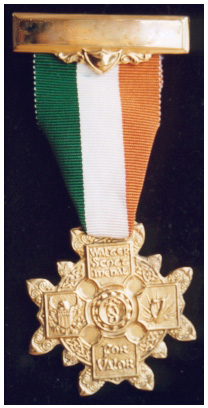
Scott Gold Medal
The stolen money was subsequently recovered. Mr Tony Eccles, Mr Patrick McPhillips and Mr Brian McShane were convicted of Detective Garda Hand’s capital murder. They all received death sentences, which were commuted to 40 years imprisonment. The three men were later released early under the provisions associated with the Belfast Agreement.
Detective Mr Frank Hand was born on August 29th 1957, the fourth of seven children from Ardmullen, Curraghboy, County Roscommon, (near Athlone). He joined An Garda Síochána on July 20th 1977. After completing his training, at the Garda Training Centre in Templemore, County Tipperary, (Today called the Garda College), he was assigned to Donnybrook Garda Station in Dublin. On April 16th 1982, he was appointed to the Central Detective Unit at Harcourt Square.
During his short but distinguished career, he also played an important part in the arrest of murderer Mr Malcolm MacArthur in 1982. Detective Hand played a key role in the August 1982 arrest of murderer Mr MacArthur at the Attorney General’s apartment in Dalkey. Detective Hand had remained stationed at the rear of the property, while other officers moved towards the front; Assistant Garda Commissioner Mr Tony Hickey later recalled that this decision had prevented MacArthur from escaping.
Detective Hand was killed just19 days before his 27th birthday. He had married Ms Breda Horgan; also a member of An Garda Síochána, only five weeks earlier. His newly married wife was then pregnant at the time of his death, and their daughter, Fiona, was born after her father was murdered.
Detective Hand gave his life while protecting his colleagues and the public. Behind the uniform was a young husband, an expectant father and a dedicated Garda whose future was taken from him in an act of criminal violence.
Today, we remember Detective Garda Frank Hand, his widow Mrs Breda Hand, his daughter Fiona, his wider family and all those affected by the attack at Drumree.
This website uses cookies to improve your experience. We'll assume you're ok with this, but you can opt-out if you wish.AcceptRead More
Privacy & Cookies Policy
Privacy Overview
This website uses cookies to improve your experience while you navigate through the website. Out of these, the cookies that are categorized as necessary are stored on your browser as they are essential for the working of basic functionalities of the website. We also use third-party cookies that help us analyze and understand how you use this website. These cookies will be stored in your browser only with your consent. You also have the option to opt-out of these cookies. But opting out of some of these cookies may affect your browsing experience.
Necessary cookies are absolutely essential for the website to function properly. This category only includes cookies that ensures basic functionalities and security features of the website. These cookies do not store any personal information.
Any cookies that may not be particularly necessary for the website to function and is used specifically to collect user personal data via analytics, ads, other embedded contents are termed as non-necessary cookies. It is mandatory to procure user consent prior to running these cookies on your website.






Recent Comments