Every time a vaccine is given, every time an anaesthetic is injected, every time a patient receives insulin, antibiotics, chemotherapy, adrenaline, morphine, or life-saving fluids through a line, there is a quiet piece of Irish history at work and it begins in Co. Dublin.
Long before modern hospitals, vaccination centres, intensive care units, emergency departments, operating theatres, and community clinics became part of everyday life, doctors faced a simple but enormous problem; how could medicine be delivered precisely into the body, beneath the skin, where it could act quickly and effectively? For much of medical history, treatments were limited by the routes available. A patient could swallow a medicine. A substance could be rubbed onto the skin. A wound could be dressed. But getting a measured treatment through the skin and into the tissues, close to the source of pain or disease, was a different challenge entirely.
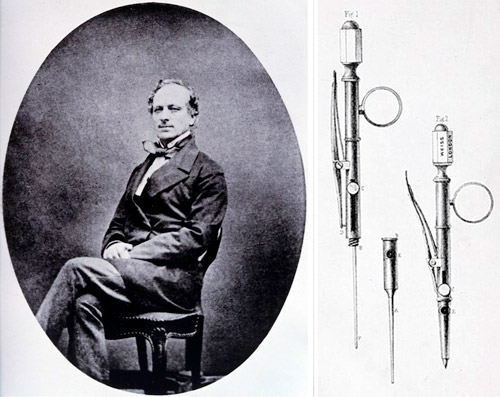
Dr Francis Rynd, (1801-1861) and his hypodermic hollow needle invention.
That challenge was answered in Ireland. The late Dr Francis Rynd, (1801-1861), an Irish physician and surgeon working at the Meath Hospital in Dublin, developed a hollow needle that made hypodermic injection possible. In 1844, Rynd used his new instrument to treat a woman suffering from severe neuralgia, a crippling nerve pain that had resisted the treatments then available. Rather than relying on medicine taken by mouth, he introduced a pain-relieving solution beneath the skin, close to the affected nerves. The effect was remarkable. A patient who had been suffering intensely finally experienced relief.
It was a small procedure by modern standards, but its consequences were vast. With that act, medicine crossed a threshold. The skin was no longer an almost impenetrable barrier between doctor and disease. The body could now be reached more directly, more precisely, and often more quickly.
Dr Rynd’s newly developed instrument was not the modern disposable syringe we know today. It was a pioneering device, developed at a time when medicine was still learning how to control pain, infection, and dosage. But the principle was revolutionary; a hollow needle could carry fluid into the human body, and from that principle came a medical transformation.
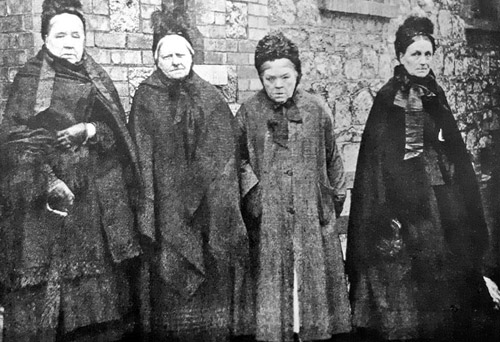
Left -Right:Meath Hospital nurses photographed in 1872 and named as Fever Nurse Ms Hodgens; Night Nurse Ms Spring; Surgical Nurse Ms Murray, and Accident Nurse Ms Brazil.
Today, the hollow needle is so familiar that we often forget how extraordinary it is. It is present at birth, in childhood immunisation, in dental surgeries, in ambulances, in cancer wards, in diabetes care, in blood tests, in epidurals, in emergency medicine, in intensive care, and in operating theatres across the world.
The story became even more powerful during our recent COVID-19 pandemic. When COVID vaccines were developed and rolled out at historic speed, the world focused on the science of messenger ribonucleic acid (mRNA), viral vectors, immune response, public health logistics, cold-chain storage, and global vaccine access. All of those mattered enormously. But the final act; the moment science became protection, depended on the needle. Billions of times, in clinics, pharmacies, sports halls, hospitals, GP surgeries, care homes, schools, airports, and temporary vaccination centres, a tiny hollow needle carried a vaccine from vial to arm. That simple delivery system helped protect people from severe illness and death on a scale almost impossible to imagine. Over 13 billion COVID-19 vaccine doses have been administered globally. Each one was a modern event, shaped by cutting-edge immunology, global manufacturing, public health systems, and data science. Yet each one also belonged to a much older story: the story of a Dublin doctor who showed that medicine could be placed directly beneath the skin.
The same is true of countless other vaccines. Measles. Polio. Tetanus. Diphtheria. Influenza. HPV. Hepatitis. Pneumococcal disease. Childhood immunisation programmes across the world depend on the ability to deliver vaccines safely and reliably into the body. The needle is not the whole story of vaccination, but without it modern vaccination would not look the way it does today, and that is why Francis Rynd deserves to be better known.
Ireland has given the world poets, revolutionaries, scientists, teachers, nurses, doctors, inventors, and reformers. Among them stands a Dublin physician whose invention became one of the most important tools in the history of medicine.
While most people know the feeling of a needle; very few know the name Francis Rynd. But his legacy is everywhere. It is in the child receiving a routine vaccine. It is in the older person receiving a seasonal COVID or flu booster. It is in the patient being prepared for surgery. It is in the diabetic injecting insulin. It is in the emergency doctor administering adrenaline. It is in the cancer patient receiving treatment. It is in the drip beside a hospital bed.
A hollow needle may look ordinary. In truth, it is one of the great medical inventions and it began in Ireland and the world should remember the name Dr Francis Rynd.
“We can rebuild him. We have the technology. We can make him better than he was. Better, stronger, faster.” Afamous introductory one-liner from the TV series “The Six Million Dollar Man”.
Thirteen men were fitted with so-called “bionic penises” in Irish public hospitals last year, according to HSE figures, same released under the Freedom of Information.
The devices, officially known as penile prostheses, are surgically implanted hydraulic systems that can be manually inflated to help men suffering from serious erectile dysfunction regain sexual function.
The number of procedures rose by more than 60% last year, with patients diagnosed with conditions including “failure of genital response” and “impotence of organic origin”.
The HSE said the procedures are carried out only where clinically indicated, but could not provide a central cost. Based on private UK pricing of around €34,800 per procedure, the total cost may have exceeded €450,000.
A previous Irish Medical Journal study found 86% of patients who received the treatment in Irish hospitals between 2008 and 2017 were satisfied with the outcome, although complications such as infection, erosion and device failure were also reported.
So there you have it; amid all the talk of health service delays within the HSE, at least one part of the system appears to be standing up to pressure. ☺☻☺☻
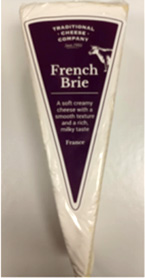
Food Safety Authority of Ireland Update recall of specific batches of various French Brie products due to the presence of Listeria monocytogenes.
Alert Summary dated Tuesday, June 23rd 2026.
Category 1: For Action Alert Notification: 2026.34 (Update 1) Product Identification: Traditional Cheese Company French Brie; pack size: 160g Batch Code Use-by Date: 10/07/2026
Message: Further to FSAI food alert 2026.34, the correct use-by date for the implicated batch of Traditional Cheese Company French Brie being recalled due to the presence of Listeria monocytogenes is 10/07/2026.
Recall notices will be displayed at point-of-sale.
Nature Of Danger: Symptoms of Listeria monocytogenes infection can include mild flu-like symptoms, or gastrointestinal symptoms such as nausea, vomiting and diarrhoea. In rare cases, the infection can be more severe, causing serious complications. Some people are more vulnerable to Listeria monocytogenes infections, including pregnant women, babies, and people with weakened immune systems, including the elderly. The incubation period (time between initial infection and first symptoms appearing) is on average 3 weeks but can range between 3 and 70 days.
Action Required: Manufacturers, wholesalers, distributors, caterers & retailers. Retailers: Same are requested to remove the implicated batch from sale and display recall notices at point-of-sale. Wholesalers/Distributors: Same are requested to contact their affected customers and recall the implicated batch and provide a point-of-sale recall notice to their retailer customers. Consumers: Consumers are advised not to eat the implicated batch.
Lyrics: American lyricist the late Gerry Goffin(1939 -2014) and former wife American singer-songwriter and musician Carole King. Vocals: English mezzo-soprano the late Mary Isobel Catherine Bernadette O’Brien (1939 – 1999), better known by her stage name as Dusty Springfield.
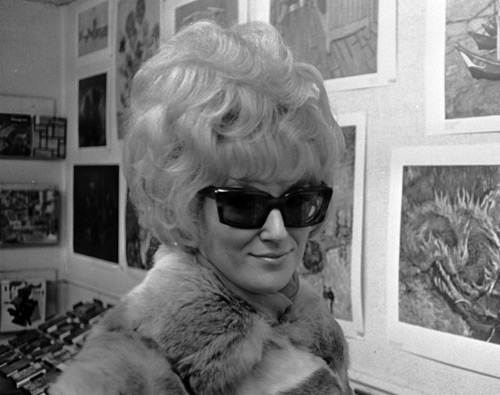
The Late Dusty Springfield.
Released in 1966, “Goin’ Back” is a beautifully wistful song about memory, innocence, and the longing to reconnect with a simpler part of ourselves. With its gentle build and aching sense of reflection, it has become one of the most beloved recordings of its era, reaching the UK Top 10 and remaining a touchstone for anyone who has ever looked back and wondered what time leaves behind.
Goin’ Back.
Goin’ Back.
I think I’m goin’ back to the things I learned so well in my youth. I think I’m returning to those days when I was young enough to know the truth. Now there are no games to only pass the time, No more coloring books, no Christmas bells to chime, But thinking young and growing older is no sin, And I can play the game of life to win. I can recall the time when I wasn’t ashamed to reach out to a friend, And now I think I’ve got a lot more than a skipping rope to lend. Now there’s more to do than watch my sailboat glide. And everyday can be my magic carpet ride, And I can play hide and seek with my fears, And live my days instead of counting my years. Let everyone debate the true reality, I’d rather see the world the way it used to be, A little bit of freedom’s all we lack, So catch me if you can I’m goin’ back.
Met Éireann has issued a ‘Moderate Weather Advisory’, for Co. Tipperary as exceptionally warm weather is forecast across Ireland this week.
Temperatures possibly reaching 30°C. Daytime temperatures are expected to rise above 27°C in many areas, with temperatures possibly reaching 30°C on Thursday. Nights will also remain very mild and humid, with temperatures generally staying above 15°C. This may lead to uncomfortable sleeping conditions, particularly for older people, young children, those with health conditions and anyone living in homes that are difficult to keep cool.
Thunderstorms. Thunderstorms are also possible, especially on Thursday, and conditions may change quickly. Residents are advised to keep an eye on the latest forecasts and official updates from Met Éireann through the met.ie website or app.
Take extra care around water. The warm weather may increase the number of people visiting lakes, rivers, beaches and other bathing areas. Please take extra care around water. Swim only where it is safe to do so, supervise children closely at all times, and never enter the water after drinking alcohol.
Check in on vulnerable neighbours, family members and friends, especially those living alone. Heat stress is another potential risk during this spell of warm weather. Drink plenty of water, avoid overexertion during the hottest part of the day, wear light clothing, use sunscreen and seek shade where possible.
Pet owners should also take precautions. Make sure animals have access to shade and fresh water, and never leave pets in parked vehicles, even for a short time. Outdoor workers and sports groups should consider breaks, cooler start times and access to drinking water throughout the day where possible.
This advisory is a reminder to enjoy the fine weather safely and responsibly. Please plan ahead, stay hydrated, avoid unnecessary risks near water, and continue to monitor official weather updates over the coming days.
This website uses cookies to improve your experience. We'll assume you're ok with this, but you can opt-out if you wish.AcceptRead More
Privacy & Cookies Policy
Privacy Overview
This website uses cookies to improve your experience while you navigate through the website. Out of these, the cookies that are categorized as necessary are stored on your browser as they are essential for the working of basic functionalities of the website. We also use third-party cookies that help us analyze and understand how you use this website. These cookies will be stored in your browser only with your consent. You also have the option to opt-out of these cookies. But opting out of some of these cookies may affect your browsing experience.
Necessary cookies are absolutely essential for the website to function properly. This category only includes cookies that ensures basic functionalities and security features of the website. These cookies do not store any personal information.
Any cookies that may not be particularly necessary for the website to function and is used specifically to collect user personal data via analytics, ads, other embedded contents are termed as non-necessary cookies. It is mandatory to procure user consent prior to running these cookies on your website.







Recent Comments