Pre-deceased by her parents Tom and Eileen and her brother Harry; Mrs Wolf passed away peacefully.
Her passing is most deeply regretted, sadly missed and lovingly remembered by her sorrowing family; loving daughters Siobhan and Kate (Wolf) and Marcia (Weldon), brothers John, Bill, Frank and Oliver, sisters-in-law, husband Lothar Wolf, nieces, nephews, extended relatives, neighbours and friends.
Rest In Peace.
Funeral Arrangements.
The remains of Mrs Wolf will repose at Aidan Walsh & Sons Funeral Home, Tallow, Co. Waterford, on Monday afternoon next, August 17th from 5:00pm until 7:00pm same evening. Funeral service will take place at mid-day on Tuesday, August 18th, at 12:00 noon, in same Funeral Home, Tallow, followed later by a private Service of Cremation.
For those persons who would wish to attend Funeral Service for Mrs Wolf, but for reasons cannot, same can be viewed streamed live online, HERE.
The extended Wolf and Lupton families wish to express their appreciation for your understanding at this difficult time, and have made arrangements for those persons wishing to send messages of condolence, to use the link shown HERE.
Nenagh Gaol Has Not Been Closed to Visitors for 100 Years – New Project Concerns a Separate Cell Block
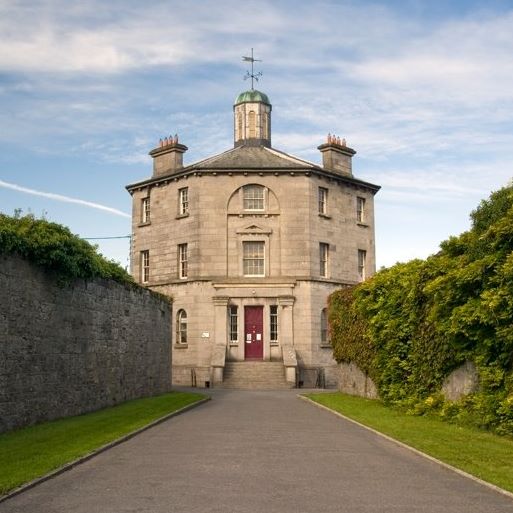
Nenagh Gaol, Co. Tipperary.
A recent press report [Irish Independent shown here] announcing a new exhibition at Nenagh Gaol could give readers the mistaken impression that the entire historic site has been closed to the public for more than a century. That is not the case.
Nenagh Heritage Centre, situated within the former gaol complex, has welcomed thousands of visitors since 1984. It occupies the former Governor’s House and Gatehouse, where visitors can already explore the site’s history and see the condemned cells associated with the 17 men executed there between 1842 and 1858.
The new proposed development relates specifically to a separate three-storey cell block that has not previously formed part of the public visitor experience. Tipperary County Council’s planning documents describe this building as a former cell block currently used as a council storage area. The project will conserve and adapt this previously inaccessible block, connect it with the existing Heritage Centre and introduce a new visitor exhibition, featuring interpretation and audio-visual displays.
Therefore, while it may be correct to say that this particular cell block is being opened to visitors for the first time in more than 100 years, it is inaccurate to suggest that Nenagh Gaol or its Heritage Centre has been closed throughout that period.
There is also a difference in the figures being reported. The official eTenders notice gives the estimated contract value as €110,000 excluding VAT, rather than just under €130,000.
Tourists in the area are encouraged to visit this historic venue, which historically housed those sentenced to death by public hanging. See link shown HERE
We learn from press reports that Ireland’s tourism agencies have spent more than €1 million paying influencers to promote holiday destinations, since the beginning of 2025.
That is a substantial amount of public money and it deserves more than impressive claims about followers, views and “audience reach.” It deserves transparent evidence that these campaigns generated additional visitors, bookings and revenue. Tourism has certainly improved. Ireland welcomed more than 3.2 million overseas visitors during the first half of 2026; 15% more than in the same period of 2025. Their spending increased by 18% to €2.6 billion.
Those are encouraging figures, but they do not prove that influencer marketing produced the recovery. Tourism is affected by airline capacity, ferry connections, weather, exchange rates, prices, consumer confidence and many other forms of advertising. An influencer reaching millions of social-media accounts is not the same as delivering millions of tourists. A view is not a booking, a “like” is not a hotel stay, and a follower is not necessarily a prospective visitor.
This distinction is particularly important for Tipperary. The county’s tourism performance during 2025 was positive but mixed. Sixty per cent of tourism businesses reported growth and 14% remained stable, while 26% experienced a decline. Attractions and activity providers performed well, with 82% growing or maintaining attendance.
However, accommodation businesses had a more difficult experience: 34% reported a decline, while shorter stays and later bookings remained significant problems. Much of Tipperary’s strength also came from domestic residents and day-trippers. An impressive 94% of attractions maintained or increased their Ireland-based visitors.
That is good news, but it does not demonstrate that paid influencer visits generated significant additional tourism. In fact, favourable weather, local engagement, repeat visitors and domestic day trips were identified as important reasons for Tipperary’s performance.
Tipperary does has a tourism product that should be capable of selling itself internationally: the Rock of Cashel, Cahir Castle, Lough Derg, the Glen of Aherlow, the Galtee Mountains, Holycross Abbey and a rich combination of history, food, outdoor recreation and authentic rural communities. The county’s challenge is not simply attracting social-media attention. It is converting interest and day trips into overnight stays, encouraging visitors to explore beyond the best-known locations and ensuring that tourism spending reaches local accommodation providers, restaurants, shops and communities.
There is a legitimate place for digital creators in modern tourism promotion. Social media influences approximately 23 – 24% of potential visitors looking for holiday inspiration. However, recommendations and online searches are even more influential.
The biggest reason people choose Ireland is not celebrity endorsement. It is the country itself. Tourism Ireland’s research shows that scenery is the leading reason for choosing Ireland, cited by 33% of potential visitors. It is followed by Culture, Sightseeing and History. Historic Sites, Food and Drink, Walking, Hiking and Nature have exceptionally broad appeal. The public should therefore be asking whether enough money is being invested directly in the things visitors actually come to experience: heritage conservation, trails, public transport, visitor facilities, signage, accessibility, accommodation capacity and effective booking systems.
The strongest criticism is not that every influencer campaign is wasteful. We do not have the evidence to make that claim. The problem is that the agencies have not publicly demonstrated the opposite.
After spending more than €1 million, reporting enormous audience reach is inadequate. The agencies should now publish, for every major campaign: The total fee and associated travel costs. The audience and markets targeted. Engagement from relevant prospective visitors. Confirmed bookings or attributable visitor spending. Cost per booking and return on public investment. Honest regional results, including overnight stays generated in counties such as Tipperary. (Remembering no establishment likes to report decline.)
If those measurements show that influencer marketing works, the agencies will have a strong case for continuing it. If they cannot produce them, taxpayers are entitled to question whether public money is supporting tourism, or merely subsidising attractive trips and highly polished social-media content.
Ireland’s tourism recovery is welcome. Tipperary’s attractions are showing real resilience. But neither development gives tourism agencies a blank cheque.
Publicity is not performance. Reach is not revenue. Public money must produce measurable public value.
Application Ref: 2660611. Applicant: Mary Hosty. Development Address: Beakstown, Thurles, Co. Tipperary. Development Description: an extension to the front of the dwelling house, extensions to the rear of the dwelling house consisting of a sunroom and two open-sided shelters, an extension and open-sided shelter to the rear of the garage, a glasshouse and all associated site works. Status: Conditional. Application Received: 22/06/2026. Decision Date: 06/08/2026. Further Details:http://www.eplanning.ie/TipperaryCC/AppFileRefDetails/2660611/0
Pre-deceased by his parents Edmond and Kitty, his brother Michael and his brothers-in-law Jimmy Arrigan and Noel McNulty; Mr Hennessy passed away peacefully, after a short illness, while in the care of staff at The Oak Ward, University Hospital Waterford
His passing is most deeply regretted, sadly missed and lovingly remembered by his sorrowing family; loving wife Bridie, sons Paul and David, grandson Evan, brother Eamon, sisters Connie, Moira, Rose and Ann, brothers-in-law, sisters-in-law, nieces, nephews, extended relatives, neighbours and a wide circle of friends.
The extended Hennessy family wish to express their appreciation for your understanding at this difficult time, and have made arrangements for those persons wishing to send messages of condolence, to use the link shown HERE.
“The extended Hennessy family would also like to express their sincere thanks and gratitude to everyone who cared for John during his illness”.
This website uses cookies to improve your experience. We'll assume you're ok with this, but you can opt-out if you wish.AcceptRead More
Privacy & Cookies Policy
Privacy Overview
This website uses cookies to improve your experience while you navigate through the website. Out of these, the cookies that are categorized as necessary are stored on your browser as they are essential for the working of basic functionalities of the website. We also use third-party cookies that help us analyze and understand how you use this website. These cookies will be stored in your browser only with your consent. You also have the option to opt-out of these cookies. But opting out of some of these cookies may affect your browsing experience.
Necessary cookies are absolutely essential for the website to function properly. This category only includes cookies that ensures basic functionalities and security features of the website. These cookies do not store any personal information.
Any cookies that may not be particularly necessary for the website to function and is used specifically to collect user personal data via analytics, ads, other embedded contents are termed as non-necessary cookies. It is mandatory to procure user consent prior to running these cookies on your website.






Recent Comments