Tarmac, Trolleys, Plastic Bags and Trampled Trees.
Double Ditch Obliterated, Then Abandoned.
Please first see the video immediately hereunder before preparing yourself to weep.
Now may I suggest you quickly grab a box of tissues.
Once upon a time, there was a place in rural Thurles, Co. Tipperary that had the cheek to be historic. They called it “The Double Ditch”; a raised path built through wet ground, faced with limestone, and rooted in the grim practicality of the once Great Famine, (1846-1849), to keep people working, to keep families alive, to keep feet dry enough to move. Yes, same was a civic scar, but an honest one, and a rare thing to be found in modern Ireland; a piece of lived history, a public walkway you could still walk on.
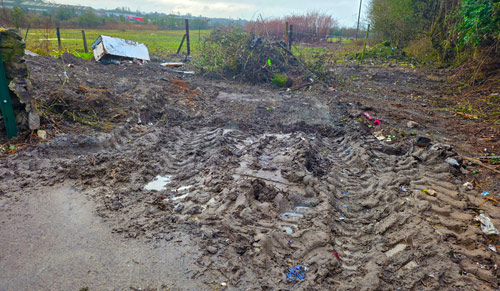
A recent abandoned attempt at cleaning the area.
Naturally, this could not be tolerated. So it became “connected”, “improved”, “enhanced”, “brought forward”, (whatever soothing verb local councillors, the local Municipal District Administrator and her officials would prefer), until all of it were “totally and wantonly obliterated”, its ancient hedgerows removed and the route flattened under heavy machinery, without so much as the courtesy of admitting what was being lost to the residents of our struggling town. Then, after much denial of its existence, with a straight face that would even shame a Victorian undertaker, it reappeared in planning language as being a “paved, pedestrian, walking route along a historical walking path”, despite being described by local councillors and politicians as not paved at all, before being levelled and left with only a temporary skin of tarmacadam.
And now we arrive at the masterpiece of their planning – “The Aftercare”.
Because nothing says “community amenity” like building a walkway and then abandoning it to rot, as if maintenance were an optional lifestyle choice, like decaf or seatbelts. The grand vision, a safe walking route on Mill Road, Thurles, tied into wider footpath plans, presented as “overdue” and “necessary”. The execution, however, appears to have followed the classic local-government model; do the ceremony; pour the tarmac; maximise the photocredit, then disappear vanishing into the mist.
So the area has now again begun its return to nature, that sacred Irish policy position otherwise known as “leaving it in a hape”. First came the willow saplings, same thrusting up through the tarmac like a botanical middle finger to uninterested municipal district officials, while rooting themselves into every crack that sheer neglect has kindly widened for them. Then arrived the briars and brambles, years of Autumn’s leaves, nettles and rank grass, all working in quiet co-operation like they’ve been awarded the contract. Soon enough, the walkway becomes less of a public route and more of a living demonstration of what happens when you build infrastructure with no real future plan to mind it, other than personal glorification.
And the litter, ah, the litter; not the dainty odd sweet-wrapper sort. No, this is the full rural-civic anthology, large plastic bags flapping like distressed flags; tyres slumped in the verge; broken wire fencing sagging like exhausted excuses. The occasional supermarket trolleys, thoughtfully dumped to ensure nobody confuses the place for cared-for land. If you’re lucky, a washing machine or two, because why wouldn’t you add white goods to a heritage corridor?
But the true flourish, the one that should make even the most hardened press-release writer blush, is how the site has been used as a stage for virtue, and then as a bin for its consequences.
In spring 2025, the area beside ‘Dun Muileann‘ on Mill Road, Thurles, became part of the One Hundred Million Trees planting push, funded locally by Allied Irish Banks’ Thurles branch, with students and the odd idle volunteer turning up to plant a dense mini-forest, using the Miyawaki Method; the whole point being fast-growing biodiversity and a carbon sink. The public reporting around it speaks of over two thousand native saplings planted at the site, a serious effort, and no small gesture of community buy-in.
And then, in the sort of anticlimax Ireland has successfully perfected; those young trees are left in a space now allowed to slide into total disorder, where over the past number of months horses are permitted to trample through the plantings that were meant to be protected long enough to establish themselves. A “green space”, promised and photographed, now reduced to a patch of scruff and horse manure, where the only thing thriving is the evidence of nobody being responsible.
That’s the moral of it, really, the fetish for the new, paired with the total inability to mind what’s then built.
Because it takes a special kind of civic arrogance to first flatten a famine-era landmark that once, literally, put bread into mouths, and then to shrug at the basic upkeep required to stop the replacement from becoming an overgrown dumping lane.
We are told, endlessly, about “heritage”, “biodiversity”, “active travel”, “community”. The words are always there; the maintenance however rarely is.
And so the Double Ditch, the real one, survives mostly as an idea: something that mattered, that was walkable, that carried memory in its stones. What’s left on the ground is the modern tribute: tarmac, blocked drains, weeds, rubbish, bent fencing, and the quiet certainty that nobody, supposedly in authority, will be held to account for any of it.
On behalf of myself, I offer my sincere apologies to Thurles Branch of AIB; (Sponsors), to MrRichard Mulcahy (Co-founder of the 100MT Project initiative) and to all those students who enthusiastically and eagerly took part in last April’s planting. Hopefully some of the trampled saplings will continue to survive, after all horse dung is a nutrient-rich organic fertilizer and soil conditioner.
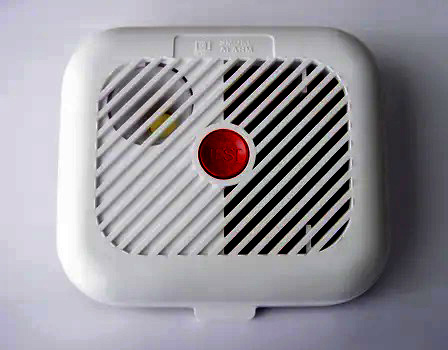
The scheme targets those at greatest risk in the event of a house fire, including older people, people living alone and residents in isolated rural areas, by providing and fitting smoke alarms where needed.
A spokesperson said: “Smoke alarms provide an early warning that can save lives. We are urging households, particularly those with older residents or anyone living alone, to apply and to make sure their alarms are working.”
National fire safety advice consistently stresses that many fatal fires occur in homes without a working smoke alarm, underlining the importance of fitting and maintaining alarms.
How to apply. Application forms: Same are available online through Tipperary County Council and can be returned by email or by post/hand delivery. Email:smokealarms@tipperarycoco.ie Post/Hand delivery: Smoke Alarms, Fire Service HQ, Nenagh Fire Station, Limerick Road, Nenagh
Simple safety checks Tipperary Fire and Rescue Service is also reminding households to:
Ensure there are at least two working smoke alarms, including one on each level of the home.
Keep exits clear and have an escape plan.
For general council contact details, see Tipperary Fire and Rescue Service information pages HERE.
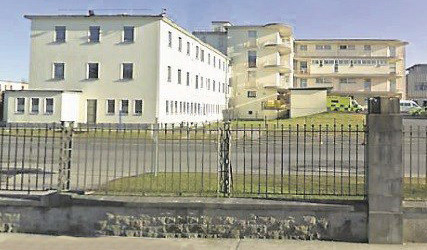
The HSE has confirmed ongoing discussions with Bon Secours Hospital Limerick on a proposal that would allow appropriate medical patients to be transferred from University Hospital Limerick (UHL) during periods of peak demand, in a bid to relieve chronic overcrowding.
Under the proposed arrangement, patients would be treated and cared for in Bon Secours Limerick as the private hospital continues the phased opening and expansion of services at its new facility, which is reported as a €213 million development.
UHL remains the region’s only 24-hour Emergency Department, serving a catchment of more than 400,000 people across North Tipperary, Limerick, Clare and parts of Cork and Kerry.
Current position In a statement, Bon Secours said: “As the new Bon Secours Hospital Limerick opens an additional ward, discussions are being finalised to support the public system in providing care for several medical patients from University Hospital Limerick.”
The HSE Mid West said it has been in discussions with Bon Secours “about transfer of appropriate patients… to alleviate pressure on UHL during periods of peak demand”, adding that it hopes an agreement will be finalised “in the coming weeks”.
Overcrowding context Latest figures, reported this week, show UHL continuing to account for the highest numbers of patients awaiting admission. On Friday, the Irish Nurses and Midwives Organisation reported 107 patients on trolleys and in other inappropriate spaces at UHL, while the HSE’s TrolleyGAR, reporting, indicated 55 admitted patients waiting on trolleys at the hospital.
Overcrowding has persisted despite recent expansion works, including the official opening of a €105 million 96-bed block at the UHL campus in October 2025.
Background and longer-term planning The current pressure on UHL is widely linked to the mid-west reconfiguration in 2009, which saw 24-hour emergency departments closed and services centralised, including in Ennis, Co. Clare and Nenagh, Co. Tipperary, as well as St John’s Hospital Limerick.
The Government has also recently indicated it will progress a “blend” of options advised by HIQA to address urgent and emergency care capacity in the region, following its review, as outlined by Minister Ms Jennifer Carroll MacNeill.
Mrs De Boer passed away while in the care of staff of St. Theresa’s Nursing Home, Thurles.
Her passing is most deeply regretted, sadly missed and lovingly remembered by her sorrowing family; nephews Sean, Mark and Paul, niece Jackie and grandniece Ciara, extended relatives neighbours and many friends.
For those persons who would wish to attend Requiem Mass for Mrs De Boer, but for reasons cannot, same can be viewed streamed live online, HERE.
The extended De Boer family wish to express their appreciation for your understanding at this difficult time, and have made arrangements for those persons wishing to send messages of condolence, to use the link shown HERE.
Danone recall specific batches of Aptamil and Cow & Gate infant formula and follow-on formula due to the possible presence of cereulide.
Alert Summary dated Friday, 6th February 2026.
Category 1: For Action. Alert Notification: 2026.05. Product Identification: Please see table below. Batch Code: Please see implicated expiry dates in the table below. Country Of Origin: Ireland.
Message: Danone is recalling the below specific batches of its Aptamil and Cow & Gate infant formula and follow-on formula sold in Ireland due to the possible presence of cereulide. Recall notices will be displayed at point-of-sale.
Please see Questions and Answers: Danone is advising customers to contact its Aptamil careline team on Tel: 1800 22 1234 (https://www.aptaclub.ie), or its Cow & Gate careline on Tel: 1800 570 570 (https://candgbabyclub.ie) if they have any queries regarding this recall.
In addition, Danone is recalling specific batches of its Aptamil and Cow & Gate infant formula and follow-on formula sold in the UK due to the possible presence of cereulide. The below batches may indirectly be distributed to Ireland from the UK.
Nature Of Danger: Cereulide toxin is produced by the bacterium Bacillus cereus. The toxin may be pre-formed in a food and is extremely heat resistant. Consumption of foods containing cereulide toxin can lead to nausea and severe vomiting. Symptoms can appear within five hours. The duration of illness is usually 6 to 24 hours.
Retailers: Same are requested to remove the implicated batches from sale and display recall notices at point-of-sale. Wholesalers/distributors: Same are requested to contact their affected customers and recall the implicated batches and provide a point-of-sale recall notice to their retailer customers. Consumers: Parents, guardians and caregivers are advised not to feed the implicated batches to infants or young children.
This website uses cookies to improve your experience. We'll assume you're ok with this, but you can opt-out if you wish.AcceptRead More
Privacy & Cookies Policy
Privacy Overview
This website uses cookies to improve your experience while you navigate through the website. Out of these, the cookies that are categorized as necessary are stored on your browser as they are essential for the working of basic functionalities of the website. We also use third-party cookies that help us analyze and understand how you use this website. These cookies will be stored in your browser only with your consent. You also have the option to opt-out of these cookies. But opting out of some of these cookies may affect your browsing experience.
Necessary cookies are absolutely essential for the website to function properly. This category only includes cookies that ensures basic functionalities and security features of the website. These cookies do not store any personal information.
Any cookies that may not be particularly necessary for the website to function and is used specifically to collect user personal data via analytics, ads, other embedded contents are termed as non-necessary cookies. It is mandatory to procure user consent prior to running these cookies on your website.







Recent Comments