Pre-deceased by her beloved parents, Vincent and Mary Rose, and her cherished sisters, Betty, Rosemary and Deirdre; Ms Bowen passed away peacefully, while in her 90th year, while at her place of ordinary residence, surrounded by her loving family.
Her passing is most deeply regretted, sadly missed and lovingly remembered by her sorrowing family; loving and devoted nephew Karl, her brother John, nieces, nephews, extended relatives, neighbours and a wide circle of friends. Ms Bowen will be remembered for her kindness, warmth and the many happy memories she leaves with all who had the privilege of knowing her.
For those persons who would wish to attend Requiem Mass for Ms Bowen, but for reasons cannot, same can be viewed streamed live online, HERE.
The extended Bowen family wish to express their appreciation for your understanding at this difficult time, and have made arrangements for those persons wishing to send messages of condolence, to use the link shown HERE.
“The Bowen family would like to express their sincere gratitude to all those who cared for Ms Bowen throughout her illness and to everyone who has shown such kindness, support and sympathy during this difficult time. Your thoughtfulness is deeply appreciated”.
Solas na bhflaitheas agus leaba i measc na n-aingeal di.
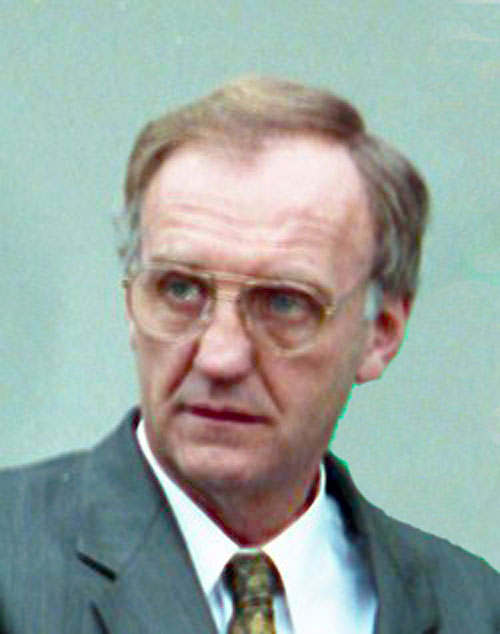
Former government minister Mr David Andrews (1935 – 2026) died on Saturday last at the age of 91, leaving behind a remarkable legacy in Irish public life, diplomacy and human rights advocacy.
A Fianna Fáil TD for almost four decades, Mr Andrews was first elected to Dáil Éireann in 1965, representing Dún Laoghaire-Rathdown and later Dún Laoghaire until his retirement from politics in 2002. Over that long career, he served as Government Chief Whip, Minister for Defence, Minister for the Marine and, on two occasions, Minister for Foreign Affairs.
His time in public office placed him at the centre of some of the most important political moments in modern Irish history. As Minister for Foreign Affairs in the late 1990s, he was closely involved in the negotiations that led to the 1998 Good Friday Agreement, a landmark achievement that helped transform relationships across these islands and bring new hope for peace in Northern Ireland.
Mr Andrews was also known as a politician of conviction. During years on the backbenches, he became an outspoken campaigner for justice and human rights, supporting the Guildford Four, the Birmingham Six and Brian Keenan, the Belfast man taken hostage in Beirut in 1986. His concern for those caught in injustice and conflict remained a defining feature of his public life.
Born into one of Ireland’s best-known political families, he was the son of Todd Andrews, a founding figure in Fianna Fáil. That tradition of public service continued through the generations, including through his son Barry Andrews, now an MEP. He was also the father of comedian David McSavage.
Following his retirement from elected politics, Mr Andrews continued to contribute to civic life, including through his work with the Irish Red Cross.
Tributes have described him as a man of principle, courage, intelligence and good humour. Taoiseach Micheál Martin said Mr Andrews had led an extraordinary life of public service, while former president Michael D Higgins remembered him as a friend and colleague who made a major contribution to Irish politics.
David Andrews will be remembered not only for the offices he held, but for the causes he championed: peace, justice, human dignity and public service. His life reflected a deep commitment to Ireland and to the belief that politics, at its best, can help change lives.
He is survived by his wife Annette and their five children. May he rest in peace.
More than a century after the destruction of the Public Record Office of Ireland at the Four Courts, another major piece of Ireland’s lost documentary heritage has been restored to public view.
The Virtual Record Treasury of Ireland has released 194,000 newly digitised historical records, bringing the total number of freely available records on the platform to 544,000. The material spans seven centuries of Irish history and now amounts to around 340 million words of searchable content.
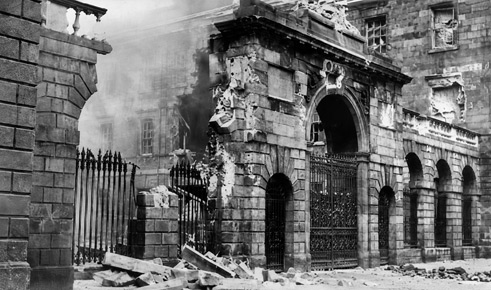
Four Courts in Dublin bombarded on this day June 30th 1922 leading to the destruction of the Public Record Office of Ireland.
The release marks the 104th anniversary of the destruction of the Public Record Office, which was lost on 30 June 1922 during the opening stages of the Irish Civil War. The building, located within the Four Courts complex in Dublin, had housed a vast archive of census material, taxation records, legal papers, land ownership documents and state records dating back to the medieval period.
For generations, the loss was regarded as one of the greatest archival disasters in Irish history. But the Virtual Record Treasury is rebuilding what was lost by tracking down copies, transcripts and related material preserved in archives, libraries and private collections across Ireland and around the world.
The 2026 release includes records ranging from medieval Ireland to the age of revolution and emancipation. Among the new material are records connected to Catholic Emancipation, Ireland’s links with the American Revolution, early local history, State Papers from 1660 to 1715, and documents from the Norman and medieval period.
The project is hosted by Trinity College Dublin and funded by the Department of Culture, Communications and Sport. It brings together more than 100 partner archives, libraries and memory institutions worldwide, including the National Archives of Ireland, the Public Record Office of Northern Ireland, The National Archives UK, the Irish Manuscripts Commission and the Library of Trinity College Dublin.
One of the most important developments is the expansion of the VRTI Knowledge Graph for Irish History. This digital research tool now includes more than 15,000 people from Irish history and 3.5 million linked historical facts, allowing users to follow connections between people, places, events and surviving records.
The latest update also adds thousands of historical individuals, including women from the early modern period and figures from the medieval and Norman eras. This gives researchers, students, family historians and the wider public new ways to explore lives that were once buried in fragile, scattered or forgotten documents.
The Virtual Record Treasury is also looking beyond Ireland. A new two-year project, “Journey to Europe: Archives of the Irish in France,” will search French archives for records connected to Irish history, including material on Wolfe Tone, the Irish Brigade, Irish colleges in France and Irish merchants along France’s Atlantic coast.
What was once thought to have vanished in smoke and fire is now being digitally reunited. More than 100 years after records fell from the sky over Dublin, Ireland’s lost archive is being pieced back together — page by page, name by name, and story by story.
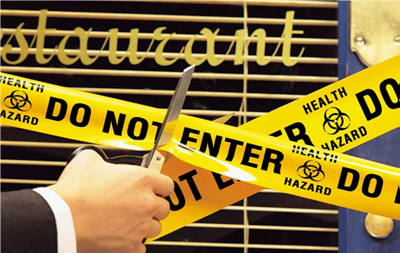
A total of 9,882 complaints and queries were handled by the Food Safety Authority of Ireland’s (FSAI) Advice Line in 2025. Announcing details today of the complaints and queries last year, the FSAI stated that there were 6,135 complaints from consumers, with 33% of complaints relating to unfit food and 28% to poor hygiene standards.
Overall, the 6,135 consumer complaints in 2025 represented a 23% increase compared to the previous year with 4,996 complaints. The figures reflect an upward trend over the past decade. All complaints received by the FSAI in 2025 were followed up and investigated by food inspectors throughout the country.
Unfit food, which is food that is not safe to eat, was the most frequently reported complaint in 2025. Unfit food also includes contamination with a foreign object. Commonly reported foreign objects in food included: plastic, a battery, insects/caterpillar, slug, and fingernail. Examples of some of the complaints include: a fingernail found in a cake; a staple found in an Indian meal; a battery found in a pack of almonds; a fly floating in a milk bottle; a slug in a noodle dish and a live moth in a bag of salad.
The second most frequently reported category related to poor hygiene standards. Common complaints included rodents spotted in food businesses; staff not wearing appropriate clothing; poor personal hygiene with staff not changing gloves often enough; staff not washing hands; staff smoking in their aprons; and food not being stored correctly with fridges and freezers not cold enough.
The third most frequently reported category related to reports of suspected food poisoning making up 26% of the total complaints in 2025. This was a decrease from 29% in 2024.
The breakdown of all complaints are as follows: Unfit food: 2,030 Hygiene standards: 1,693 Suspect food poisoning: 1,570 Labelling: 656 Allergen Information: 150 Others: 36
Mr Greg Dempsey, (Chief Executive, FSAI), stressed the importance of making complaints to the FSAI, so that any food safety issues can be addressed. “Public reporting of food safety concerns plays a vital role in supporting the work of the food safety inspectorate and is an important part of how we protect public health. We greatly value the contribution of consumers in bringing potential issues to our attention, as these reports provide essential information that complements the work of Environmental Health Officers, veterinary and agricultural inspectors, sea-fisheries officers, and laboratory services. While routine inspections and food sampling programmes remain a core part of our regulatory activity, complaints allow us to quickly identify and respond to specific risks, ensuring that any potential threats to food safety are addressed without delay. The continued increase in engagement reflects growing consumer awareness and confidence in reporting issues, as well as a strong expectation that high standards of food safety and hygiene are consistently maintained across the food chain. In particular, we have seen a significant rise in complaints relating to unfit food and poor hygiene standards, and we would like to thank the public for their continued vigilance in helping us address these issues.”
The FSAI Advice Line also offers advice and information. During 2025, there were 3,747 queries from people working in the food industry, including caterers, food manufacturers, retailers, and others. Popular topics included: how to start a food business; food labelling information; best practice in food businesses; food safety training and several others.
The FSAI Advice Line is contactable through our online complaint form ‘makeitbetter’ or through our online query form. The FSAI Instagram,Facebook and LinkedIn pages are also resources with up-to-the-minute information in relation to food safety.
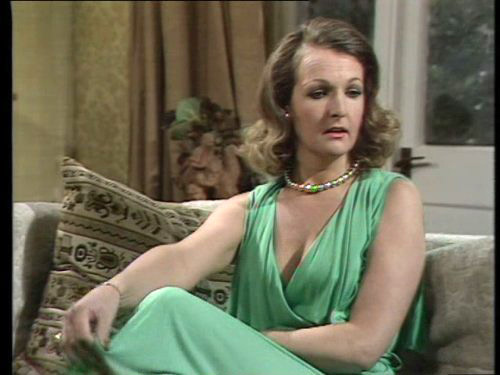
Dame Penelope Keith, one of Britain’s most cherished comic actors and a defining presence in classic television, has died at the age of 86.
The Late Penelope Anne Constance Hatfield.(1940-2026),
Best known to millions as the formidable Margo Leadbetter in The Good Life and the proud, spirited Audrey fforbes-Hamilton in “To the Manor Born”, Dame Penelope helped shape an era of British sitcoms with performances that were sharp, elegant and unmistakably her own.
A statement issued on behalf of her family said they were “deeply saddened” to announce that she had died peacefully while living with cancer at her home in Surrey, where she had lived for more than 50 years. The family expressed gratitude for the care and support she received throughout her treatment and asked that their privacy be respected.
Born Penelope Anne Constance Hatfield in 1940, she built a distinguished career across stage, television and radio. Her early work included repertory theatre and performances with the Royal Shakespeare Company, but it was television that brought her into the nation’s living rooms and secured her place in British cultural memory.
Her portrayal of ‘Margo Leadbetter‘ in “The Good Life” remains one of sitcom’s great comic creations: socially ambitious, imperious and frequently exasperated, yet played with enough warmth and precision to make her enduringly loved. The role earned Dame Penelope a BAFTA in 1977 and introduced her to a generation of viewers who never forgot her timing, poise and wonderfully expressive delivery.
She went on to further acclaim as ‘Audrey fforbes-Hamilton‘ in “To the Manor Born”, a character who combined aristocratic confidence with vulnerability and wit. The series became a major success and confirmed her as one of the most recognisable and admired performers of her time.
Beyond her most famous roles, Dame Penelope enjoyed a long and varied career, appearing in stage productions, dramas, comedies and presenting work. She was made a Dame in 2014 for services to the arts and to charity, recognition not only of her talent but of her wider contribution to public life.
Her death marks the loss of a performer whose work brought joy, laughter and sophistication to audiences for decades. Dame Penelope Keith leaves behind a legacy of unforgettable characters, impeccable comic craft and a lasting place in the story of British television.
This website uses cookies to improve your experience. We'll assume you're ok with this, but you can opt-out if you wish.AcceptRead More
Privacy & Cookies Policy
Privacy Overview
This website uses cookies to improve your experience while you navigate through the website. Out of these, the cookies that are categorized as necessary are stored on your browser as they are essential for the working of basic functionalities of the website. We also use third-party cookies that help us analyze and understand how you use this website. These cookies will be stored in your browser only with your consent. You also have the option to opt-out of these cookies. But opting out of some of these cookies may affect your browsing experience.
Necessary cookies are absolutely essential for the website to function properly. This category only includes cookies that ensures basic functionalities and security features of the website. These cookies do not store any personal information.
Any cookies that may not be particularly necessary for the website to function and is used specifically to collect user personal data via analytics, ads, other embedded contents are termed as non-necessary cookies. It is mandatory to procure user consent prior to running these cookies on your website.






Recent Comments