Local History Group Celebrates Littleton’s Bord na Móna Heritage.
The people, places and memories of Littleton’s peat industry will take centre stage at the book launch of “Bord na Móna: Littleton Story” in the Horse & Jockey Hotel, Thurles, on Friday, 25th September, at 8.00 pm.
Presented by the Moycarkey / Borris Littleton Men’s Shed and Community History Group, this local history publication celebrates the men and women whose working lives helped shape the community, preserving stories of the bogs, the machinery and a legacy that reaches far beyond the workplace. Former employees, their families and everyone with an interest in the area’s heritage are warmly invited to attend.
The Littleton Bog complex is a term used by the Moycarkey / Borris / Littleton Men’s Shed and Community History Group to outline the area of peatlands worked on an industrial scale by Bord na Móna since the company was founded in 1946. With the cessation of works at the the Littleton Briquette Factory and milled peat operations in April 2018, it brought to a close sixty-two years of peat extraction works at this area of peatlands.
This book, while not endeavouring to be an in-depth historical analysis of Bord na Móna operations in the middle of Tipperary; provides a snapshot of its impact on the parish of Moycarkey / Borris / Littleton. Other parishes in the area such as Moyne / Templetuohy; Gortnahoe / Glengoole and Killenaule also had very important roles in the growth and development of the bogs as areas of employment and add greatly to the overall story of the relevance and importance of Bord na Móna to these communities. People from Thurles and other surrounding parishes were also employed on the bog or in the briquette factory. Indeed, it must also be recognised that the site of Littleton Briquette Factory is in the townland of Killeens, which is part of Killenaule parish.
This booklet gives a brief overview of the turf cutting operations at the outset of the development of the bogs, with the main focus being on the offices and yard at Ballybeg. This new industry meant that many men were required to get operations up and running, with the result that several of these came from outside Tipperary, many of whom resided in a billet camp, which was sited across the road from the main office and yard. It is not meant to be an exhaustive account of the work which took place in the Littleton Bog complex or within the area of work associated with the briquette factory. For a comprehensive overview of the history of Bord na Móna readers are encouraged to read Brown Gold: (A History of Bord na Móna and the Irish Peat Industry by Donal Clarke).
The type of work engaged on the bogs is explored, as is a brief exploration of the various machines which were required to work the bogs on such an industrial scale. Coupled with the influx of workers and families was a need for social housing and this is also chronicled with an overview of housing schemes, school development and an associated impact on sporting and social organisations across the parish.
It is also recognised that the peatlands of mid-Tipperary have a rich and vibrant history, which have engaged all peoples across the generations. A sample overview of the flora and fauna of the bogs, its relevance as a carbon sink in the modern era and how the rich tapestry of its past can be used to educate and inform people as the impact of climate change is felt locally and globally.
Many parts of the bog were given local place names, which were readily identifiable to the Bord na Móna workers. Many of these are also recorded so that this local knowledge is not lost and can continue as part of the vibrant folklore associated with a lifetime for many of working on the bogs.
Lastly, an overview of archaeological finds in the bog, both before and during Bord na Móna operations are also recorded. These assist in demonstrating the relevance of the bogs as spiritual, votive, social, energy and recreational areas, which are all intertwined across the generations.
Acknowledgments The Moycarkey Borris Littleton Men’s Shed and Community History Group are thankful to everyone who assisted with this Bord na Móna story in the parish community. To those who supplied articles and photographs: Colm Dempsey BnM, Ray Yates, Tommy Maguire, Frank Connolly, Liam Dempsey, Fr. Tomás O’Connell, Christy Bracken, Ann Slattery, Billy Loughnane, Peggy Kirby, Billy Ryan, M. Skehan Ruddy, Tom Kelly, Ed. O’Shea, Sean Ryan, Sadie Dwyer, John O’Loughlin, Martin Cooney and members of the group who also contributed articles. A special word of thanks to Clare McNamara, Image Library Officer, National Museum of Ireland for her support and for the kind permission of the National Museum to reproduce images of some items discovered in the Littleton Bog Complex. Thanks to Dr. Charles Mount for his kind permission to reproduce a ‘Togher/Tocher’ (wooden trackway), following excavation at Longfordpass. The MBL Men’s Shed and Community History Group are Michael Dempsey, Jim Flanagan, Seamus Bourke, John Fogarty, Liam O’Donnchú, Mary Ryan, Mary and Frank O’Regan, Billy Purcell, Joe Moran and Pat Bracken. Thanks also to Tommy Britton for his support and a special word of thanks to Bernie Lonergan who co-ordinated the project at the outset.
Dedication This overview of the impact of the bogs of mid-Tipperary on the community of Moycarkey / Borris / Littleton could not have been possible without telling some of the stories of the life and times of the men and women who worked in the Littleton Bog complex under the employment of Bord na Móna. This booklet is dedicated to all these people, and to the legacy which they have left behind. To those still living, we salute and thank you. To those who have gone to their eternal reward; Ar dheis dé go raibh a n-anamacha. (Irish translation – “May their souls be on the right hand of God”).
Tipperary County Council has approved the rezoning of 161 hectares, (approximately 397 acres), for housing at its September plenary meeting.
The changes to the county development plan took immediate effect following the vote. Public consultation had attracted more than 100 submissions.
Councillors who welcomed the changes: Mr John Crosse (Fine Gael): Highlighted the urgent need for housing across Tipperary and the opportunity for landowners and developers to deliver more homes. Mr Jim Ryan (Independent, Thurles): Welcomed the restoration of residential zoning to lands in Thurles and thanked the planning team for listening to local councillors. However he felt an opportunity had been missed for the village of Littleton.
Councillors who raised concerns during the earlier June discussions: Ms Phyll Bugler (Fine Gael, Ballina): Said she had not been given enough time to raise issues during the process. Mr Seamie Morris(Former Sinn Fein and now Independent, Nenagh): Questioned the inclusion of certain lands in Nenagh, saying they should not have been considered for housing.
This agreed rezoning now makes additional land immediately available for potential housing development, although no construction timetable or confirmed number of homes has been publicly made known.
Pre-deceased by her husband Patsy, son Diarmuid and son-in-law Denis; Mrs O’Rahilly passed away peacefully, surrounded by her loving family, following a short illness, while in the care of staff at Tipperary University Hospital, Clonmel, South Co. Tipperary.
Her passing is most deeply regretted, sadly missed and lovingly remembered by her sorrowing family; loving sons Michael and Padraig, daughters Elaine, Patricia, Paula and Yvonne, daughters-in-law, Bernie and Siobhan, son-in-law John, grandchildren, great grandchildren, sisters Bridie and Betty, brothers Thomas and John, brothers-in-law Din and Trevor, sisters-in-law Ann and Bridget, nephews, nieces, extended relatives, neighbours, many friends and her loyal “fluffy” friend ‘Jakey’.
For those persons who would wish to attend Requiem Mass for Mrs O’Rahilly, but for reasons cannot, same can be viewed streamed live online, HERE.
The extended O’Rahilly and Hayes families wish to express their appreciation for your understanding at this difficult time, and have made arrangements for those persons wishing to send messages of condolence, to use the link shown HERE.
The O’Rahilly and Hayes families would like to express their deep gratitude for the exceptional kindness and care granted by the nurses and doctors of Med 1 Ward at Tipperary University Hospital, Clonmel.
Ms Esther Griffin (Research Assistant Tipperary County Council) Reports:
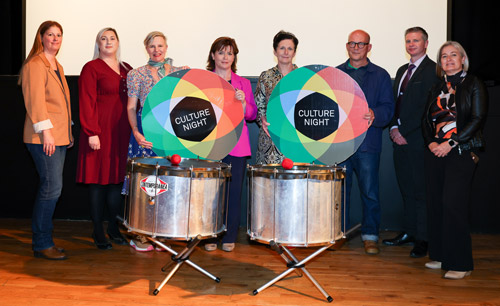
St Patrick’s Campus, Mary Immaculate College (MIC), Thurles will host ‘Culture Night‘ (Oíche Chultúir) on Friday next September 18th, between 5:30pm and 9:00pm.
The following events will be held on the night:
► From 5:30 – 7:00pm: historical tours of the campus led by librarian Ms Ruth Talbot, detailing the history and heritage of the College. ► From 7:00 – 7:30pm: a musical performance by uilleann piper Mr Muireann Meade. ► From 8:00 – 8:45pm: a musical performance by the Thurles Community Orchestra.
Note: Booking is required for Thurles Community Orchestra’s performance. Booking Phone Number: 0504 20530. Free tickets will also be available to book from the Reception in MIC St Patrick’s Campus.
For the benefit of those visiting from outside the Thurles area; you can locate the St Patrick’s Campus, MIC building, situated on Cathedral Street, Thurles Co. Tipperary,HERE, [Eircode E41 C424].
For communities across Tipperary, uncertainty over the water supply has become an exhausting part of daily life.
Between prolonged ‘Boil Water Notices’, overnight restrictions and sudden outages, residents deserve clear answers about when they can expect a dependable service.
A workshop between Tipperary councillors and representatives of Uisce Éireann (Irish Water) is scheduled for Tuesday, October 6th, at the Council offices in Thurles. With three hours of discussion divided between two sessions, there should be a clear focus on the problems affecting each district and the measures required to resolve them.
The morning session, from 11:00am to 12:30pm, will cover the Nenagh and Thurles Municipal Districts. The afternoon session, from 2:00pm until 3:30pm, will address issues in the Tipperary; Cahir; Cashel; Clonmel and Carrick-on-Suir districts.
The scale of the difficulties outlined ahead of the meeting demands serious attention. More than 47,000 people across the county are reported to be affected by ‘Boil Water Notices’, while communities, including parts of west Tipperary, face overnight restrictions. In some areas, those restrictions reportedly run from 7:00pm until 7:00am.
A twelve-hour interruption can place considerable pressure on ordinary household routines. Families, carers, older residents and people returning from work all need reliable access to water. Local businesses and farms also need sufficient notice of interruptions so they can make practical arrangements.
Alongside these restrictions, recent months have brought outages attributed to pump failures, electricity interruptions and burst mains. Uisce Éireann is reported to have told South Tipperary Oireachtas members that 85% of outages are caused by burst pipes. Councillors should seek the supporting figures, clarify the period and area covered, and establish which sections of the network are being prioritised for replacement. Residents need to know how recurring failures will be prevented and when the necessary work will happen.
The position facing those served by the Cordangan scheme, supplying more than 5,100 people in Tipperary town and the surrounding area, is particularly concerning. The current ‘Boil Water Notice’ may remain in place until October or indeed November, pending the connection of a new water source to the treatment plant. Those affected deserve a clear explanation of the remaining work, the expected completion date and the steps required, before this notice can be lifted.
The September 14th update supplied, also identifies Boil Water Notices affecting Kilcommon; Rearcross; Galtee Regional; Cashel; Thomastown; Newport; Carrick-on-Suir (Linguan) and Ardfinnan. Each affected community deserves a specific progress report.
The Thurles workshop should produce practical commitments:
A scheme-by-scheme explanation of the problems and outstanding works.
Target dates for completing repairs, upgrades and new connections.
A programme for replacing mains with a history of repeated bursts.
Clear information on measures to reduce disruption from pump and power failures.
Better advance communication about restrictions and changes to restoration times.
A published account of agreed actions, with responsibility assigned and a date for reviewing progress.
The timing of the workshop also raises a reasonable question about participation. Councillors who work in classrooms or other employment may need arrangements to attend a Tuesday daytime meeting. The Council should explain how meaningful participation will be supported, including whether remote attendance or written submissions will be available.
Residents should be able to see which concerns their representatives raised, what answers were given and what commitments followed. Three hours is a limited window in which to address problems affecting so many communities. Preparation, direct questions and documented follow-up will be essential.
Tipperary residents deserve safe water, reliable supplies and a public timetable for delivering both. October 6th should produce commitments they can measure and hold those responsible to.
This website uses cookies to improve your experience. We'll assume you're ok with this, but you can opt-out if you wish.AcceptRead More
Privacy & Cookies Policy
Privacy Overview
This website uses cookies to improve your experience while you navigate through the website. Out of these, the cookies that are categorized as necessary are stored on your browser as they are essential for the working of basic functionalities of the website. We also use third-party cookies that help us analyze and understand how you use this website. These cookies will be stored in your browser only with your consent. You also have the option to opt-out of these cookies. But opting out of some of these cookies may affect your browsing experience.
Necessary cookies are absolutely essential for the website to function properly. This category only includes cookies that ensures basic functionalities and security features of the website. These cookies do not store any personal information.
Any cookies that may not be particularly necessary for the website to function and is used specifically to collect user personal data via analytics, ads, other embedded contents are termed as non-necessary cookies. It is mandatory to procure user consent prior to running these cookies on your website.







Recent Comments