Australia’s current social media experience offers Ireland an important warning.
More than 80% of Australian children aged 10–15 were still using social media three months after its under-16 restrictions took effect. Some retained existing accounts, supplied false ages or shifted towards messaging and gaming services. Parental awareness of children’s online activity also declined.
Ireland is considering age restrictions while developing a digital age-verification mechanism. However, copying Australia’s blanket ban could reproduce the same problems: circumvention, displacement to less-regulated services, intrusive identity checks and reduced communication between teenagers and parents. Ireland should instead build upon its existing regulatory system, which combines the EU Digital Services Act, the Online Safety and Media Regulation Act 2022 and Coimisiún na Meán’s Online Safety Code.
Ireland should undertake several connected measures:
Expand digital and media literacy throughout primary and secondary education, including lessons on algorithms, misinformation, cyberbullying, privacy and reporting harmful material.
Require social-media companies to make minors’ accounts private by default and prevent unknown adults from contacting them.
Prohibit targeted advertising, location sharing and commercial profiling involving children.
Restrict addictive design features such as endless scrolling, autoplay, streaks and overnight notifications.
Give minors a chronological-feed option instead of automatically placing them under engagement-maximising recommendation systems.
Require independent audits of platforms’ algorithms, age-assurance measures and child-safety outcomes.
Introduce privacy-preserving age checks that confirm an age bracket without revealing a child’s full identity or retaining identification documents.
Provide accessible guidance for parents while involving young people directly in policy design.
Ireland already requires certain platforms serving under-16s to offer parental controls, including tools for screen time, privacy, content and contact management. The next step is to ensure that these protections are switched on automatically and independently tested, rather than leaving families to locate and configure them.
Young people should also be treated as participants in the solution. Ireland’s 2026 Youth Forum on Online Safety brought together approximately 100 people aged 10–17, offering a useful model for continuing consultation. Government of Ireland Policies developed with children are more likely to reflect how they actually use technology and how they might evade ineffective controls.
Australia currently shows that an age barrier alone cannot eliminate young people’s social-media use. Ireland’s more appropriate course is therefore regulated, progressively independent access; strong default safeguards for younger users, increasing autonomy with age, sustained education and enforceable duties placed on the companies that design and profit from these platforms.
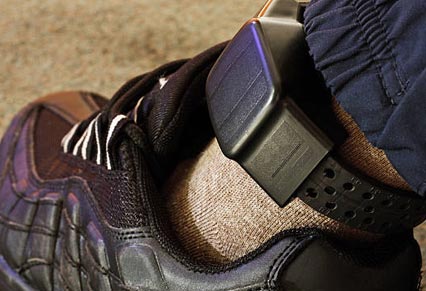
Minister for Justice, Home Affairs and Migration Mr Jim O’Callaghan has announced that a contract has been signed with Allied Universal Electronic Monitoring for Ireland’s first 12-month electronic-monitoring pilot.
The programme is expected to begin tagging selected individuals by the end of 2026. It will have the capacity to monitor approximately 90 to 150 people during the pilot period. Budget 2026 allocated €2.1 million for staffing, procurement and other establishment costs. These details are confirmed by the Department of Justice, Home Affairs and Migration.
The initiative is intended to help relieve pressure on Ireland’s prisons, while protecting the public. Decisions about suitability will reportedly take account of the individual’s risk profile and the nature, seriousness and circumstances of the alleged or proven offence.
Electronic monitoring can offer several advantages. It enables authorities to supervise compliance with curfews, movement restrictions and exclusion zones without automatically resorting to imprisonment. In appropriate cases, this may allow individuals to retain employment, accommodation and family connections; all factors that can support successful reintegration. It could also make community-based supervision more practical and provide authorities with information when restrictions are breached.
However, an electronic tag is a supervision tool, not a guarantee of public safety or rehabilitation. International evidence about its effect on reoffending remains limited and highly dependent on how, and for whom, it is used. The UK Government has acknowledged that relatively few studies reliably establish its impact on reoffending. Its assessment stresses the importance of context.
There are also legitimate concerns about privacy, location data security, equipment failures and false alerts. Wearing a tag can create stigma, discomfort and tension within a household. Overuse could also widen the reach of criminal-justice controls by imposing intensive surveillance in cases where a less restrictive condition might otherwise have been used.
For the pilot to command public confidence, monitoring must be proportionate, individually assessed and accompanied by clear data protection safeguards. Rapid procedures will be needed for responding to breaches and correcting technical errors. Electronic monitoring should also complement properly resourced probation, treatment and rehabilitation services rather than replace them.
However, the pilot is a significant development in Irish justice policy, but its success should be judged by evidence, not simply by the number of tags deployed. The eventual evaluation should examine public safety, compliance, reoffending, costs, technical reliability, privacy impacts and participants’ access to rehabilitation.
Only then will it be possible to decide whether electronic monitoring deserves a wider and permanent role in Ireland.
Large numbers of music fans from across Tipperary are preparing to make the journey to Stradbally this weekend as Electric Picnic returns with a packed programme of headline performances.
The sold-out festival takes place at Stradbally Hall, Co. Laois, from Friday, August 28th, to Sunday, August 30th, with around 80,000 people expected to attend. Organisers have now released the Main Stage timetable, allowing Tipp festival goers to plan their weekend.
Electric Picnic MAIN STAGE Times:- Friday’sMain Stage programme will see JADE open the Main Stage action at 6:00pm, followed by Zara Larsson at 7:30pm and Sombr at 9:00pm. Lewis Capaldi will bring the opening night to a close with a headline set beginning at 10:45pm.
Lewis Capaldi – Someone You Loved.
Saturday’s Main Stage programme includes Role Model at 5:30pm, The Mary Wallopers at 7:15pm and CMAT at 9:00pm. Gorillaz will headline from 11:05pm until 12:35am.
A full day of Sunday Main Stageentertainment begins with the RTÉ Céilí Mór at 1:00pm. James Marriott, Van Morrison, The Saw Doctors, Djo and Amble will follow before Fontaines D.C. close the festival with a 10:30pm headline performance.
With Stradbally located just over the county boundary, a sizeable Tipperary contingent is expected to be among the crowds arriving for one of Ireland’s biggest weekends of live music.
The schedule and festival dates shown above are confirmed by the official Electric Picnic website and the published Main Stage timetable.
Households across County Tipperary are being asked to continue conserving water after Uisce Éireann extended the Water Conservation Order until the end of September.
The nationwide hosepipe ban was introduced on 24 July following an extended period of hot, dry weather, increased demand and mounting pressure on public water supplies. Although improving conditions mean the restrictions will end in 13 counties at 11.59pm on 26 August, Tipperary is among 13 counties where supplies need additional time to recover. RTÉ News
Under the order, households in Tipperary must not use hosepipes for non-essential activities such as watering gardens, washing private vehicles or filling swimming and paddling pools.
Uisce Éireann said water sources in parts of southern and eastern Ireland remain under strain. Continuing the restrictions will help safeguard supplies for homes, businesses, farms, hospitals, vulnerable customers and other essential services.
The ban has also been extended in Carlow, Cork, Dublin, Kildare, Kilkenny, Laois, Limerick, Meath, Offaly, Waterford, Wexford and Wicklow.
Uisce Éireann thanked communities for reducing unnecessary water use, saying public cooperation has already lowered demand and helped protect essential supplies. However, customers in Tipperary are being urged to maintain those efforts, as every drop saved will support the recovery of local water sources.
A garden hose or sprinkler used for one hour can consume more water than an average family uses during an entire day. Residents can help by taking shorter showers, repairing leaks, running washing machines and dishwashers only when full, and using watering cans instead of hoses.
The Stench of Neglect: River Suir in Thurles Suffocates in Waste.
A Waterway Left to Fester: Apparent Pollution, Institutional Neglect and an Inexcusable Failure to Act.
The early images in the video immediately below are visually consistent with sewage-contaminated water, inadequately treated wastewater, detergent-bearing grey-water, or another organic effluent. The foam could indicate surfactants, while the grey colour and sludge may indicate suspended solids and decomposing organic matter. It does not resemble clean surface-water run-off.
However, a photograph alone cannot conclusively identify the slowly flowing substance in a river now almost static. Proper investigation should include samples from the suspected discharge point and locations upstream and downstream. Relevant analyses include dissolved oxygen, BOD, COD, ammonia, orthophosphate, suspended solids, E. coli, conductivity and surfactants. EPA material confirms that BOD, dissolved oxygen, ammonia, nitrate and phosphorus are central indicators of organic contamination, and that pollution-incident sampling should cover downstream, discharge-point and upstream locations.EPA sampling procedure
This slide-show above, however, presents a disgusting and deeply alarming picture; grey, foaming liquid and foul-looking sludge accumulating in what should be a living watercourse. Its exact composition must now be determined by laboratory testing, but its visible condition is wholly incompatible with the clean, healthy river environment the public is entitled to expect.
This river is neither a sewer nor a dumping ground. If analysis confirms an unlawful discharge, its source must be stopped, the damage remediated and every available enforcement power used.
Continued neglect after documented notification would be indefensible, a betrayal of the waterway, its wildlife and the community these authorities and representatives are supposed to serve.
Reminder
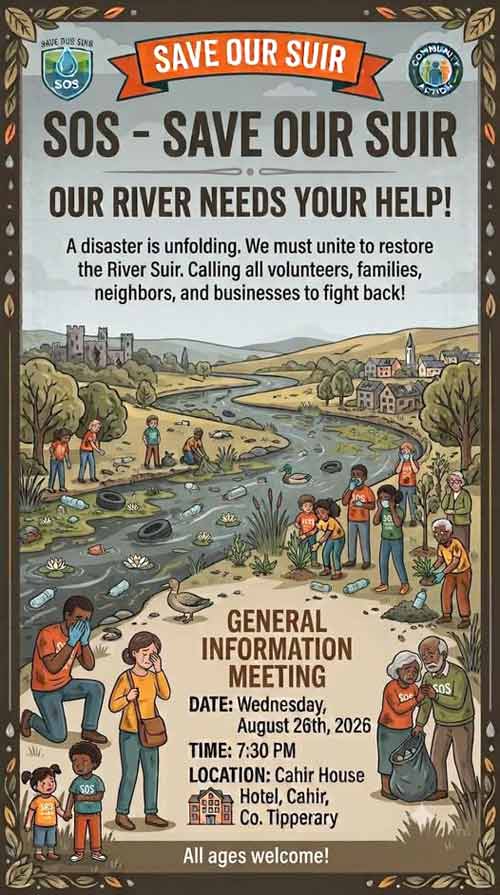
We can confirm that the above public meeting will take place, as stated above.
Thirteen years of warnings As stated in a recent post on Thurles.Info, the deterioration of the River Suir cannot credibly be described as “sudden” or “unforeseeable”. For more than a decade, residents, anglers and environmental campaigners have raised concerns about pollution, excessive vegetation, restricted flow, sediment, litter and neglect. These concerns were documented in “River Suir Crisis—Thirteen Years of Warnings, But Still No Coordinated Action”.
Now, 13 yearslater; the Minister of State Mr Kevin “Boxer” Moran recently visited sections of the Suir in Thurles and Holycross following representations from Independent TD Michael Lowry. It was stated that the Office of Public Works would support an application by Tipperary County Council under the enhanced Minor Flood Mitigation Works Scheme. However, I can confirm from recent discussions with varying responsible bodies, that they are not aware of any recent communication. Support for an application is welcome, but it is not a restoration programme. The public has not been shown the precise work proposed, the scientific evidence supporting it, the environmental assessments required, the anticipated cost and timetable or the body responsible for delivery and monitoring.
Political videos, visits and announcements by politicians and councillors cannot substitute for accountable work. Councillor Micheál Lowry, Deputy Michael Lowry and every other representative addressing the issue must be judged by measurable results. The same standard must apply to Tipperary County Council officials. [ Which begs the question; “Where were all the other local elected councillors when a recent promotional video, capturedby Mr Lowry TD, was uploaded unto social media.” ]
The missing ingredient for the River Suir is not more talk, it is delivery.We need clear answers:
► What works will be carried out? ► When will they begin? ► Who is responsible for delivery? ► Has the funding application now been submitted? ► What section of the river will be prioritised first? ► How will pollution and damaging discharges be reduced? ► How will progress be measured and reported publicly?
This website uses cookies to improve your experience. We'll assume you're ok with this, but you can opt-out if you wish.AcceptRead More
Privacy & Cookies Policy
Privacy Overview
This website uses cookies to improve your experience while you navigate through the website. Out of these, the cookies that are categorized as necessary are stored on your browser as they are essential for the working of basic functionalities of the website. We also use third-party cookies that help us analyze and understand how you use this website. These cookies will be stored in your browser only with your consent. You also have the option to opt-out of these cookies. But opting out of some of these cookies may affect your browsing experience.
Necessary cookies are absolutely essential for the website to function properly. This category only includes cookies that ensures basic functionalities and security features of the website. These cookies do not store any personal information.
Any cookies that may not be particularly necessary for the website to function and is used specifically to collect user personal data via analytics, ads, other embedded contents are termed as non-necessary cookies. It is mandatory to procure user consent prior to running these cookies on your website.






Recent Comments