|
|
 A man in his 20’s was arrested in the Tipperary area, shortly after 5.00pm yesterday, before being brought to Dungarvan Garda Station for questioning.
His questioning is understood to be with regard to the horrific murder of pensioner Mr Paddy Lyons, aged 90, who was attacked with a blunt weapon in his home in Loughreagh, Ballysaggart in Co. Waterford on Friday last.
The arrested male is being held under Section 4 of the Criminal Justice Act, which allows Gardaí to detain him, without charge, for up to 24 hours. Gardaí are understood to have also moved to examine a property on the Waterford Road, out of Clonmel, Co. Tipperary. Reports this morning state that the area remains sealed off, with a considerable Gardaí presence; searching grounds surrounding the dwelling house.
It is understood that Mr Lyons, when found, had suffered horrific injuries to his head and in particular the facial area. Unconfirmed reports believe Mr Lyons may possibly have known the killer from previous visits to his isolated dwelling, same situated just 11km (6.9mls) from the tourist area of Lismore in Co. Waterford.
It has also been suggested that a number of other people may have visited the home of Mr Lyons, also on the same day that he was savagely murdered.
Gardaí in Dungarvan continue to appeal for witnesses to contact them on Tel: 058 48600, or the Garda Confidential Line on Tel: 1800 666 111 or indeed through any Garda station.
Then was Jesus led up of the Spirit into the wilderness to be tempted of the devil. And when he had fasted forty days and forty nights, he was afterward an hungered. And when the tempter came to him, he said, “If thou be the Son of God, command that these stones be made bread.” But He answered and said, “It is written, Man shall not live by bread alone, but by every word that proceedeth out of the mouth of God.” [Account given in the gospel attributed to St Matthew, Chapter 4].
 Today is the Christian feast day best known as Shrove Tuesday. This moveable feast day, also known as Pancake Tuesday or Fat Tuesday, is traditionally observed by Christian communities here in Ireland; occurring each year between February 3rd and March 9th, to coincide with Easter.
Positioned the day before a time dedicated to fasting; 47 days before Easter Sunday, Christians continue to use Shrove Tuesday as a time to confess and be “shriven” or absolved from all their sins, by way of their confession and the undertaking of penance, before the start of Lent.
The association with Shrove Tuesday and pancakes of course is the fact that Shrove Tuesday is the last opportunity to use up your eggs and fats, before embarking on your Lenten fast, which for the most part saw meat removed from your diet over your subsequent 40 day venture.
The ingredients of pancakes or griddle-cakes were viewed as representing the four pillars of Christianity, e.g. eggs representing creation; flour signifying the mainstay of our human diet; salt expressing wholesomeness and finally milk indicative of purity.
Traditional pancakes, featured in cookery books as far back as the 15th century, are thin flat cakes served immediately on being cooked; usually with sugar, perhaps a sweet syrup or lemon juice.
Your Traditional Thurles Irish Pancake Mix:
One serving of pancakes for a family of 5 will necessitate the whisking of 8 ounces of plain flour, 2 large eggs, 1 pint milk, 1 tablespoon of melted butter and a pinch of salt. When whisked this mix should be left to stand for some 30 minutes.
Next, heat a little oil in your frying pan, before pouring or ladling in sufficient batter to thinly cover the base, (Tip: Tilt your pan so as to spread the mixture evenly; while allowing it cook until the base of the pancake has browned. Then shaking your frying pan to loosen the pancake, you can with minimum practise flip / toss your pancake over to brown the other side. Of course you can avoid spills by ‘Flipping’ your pancake over using a palette knife or fish slice.
This tradition of ‘tossing your pancake’ however goes back in time:- “And every man and maide doe take their turne, and tosse their Pancakes up for feare they burne.” (Pasquil’s Palin, 1619).
Shrove Tuesday next year, 2018, will fall earlier, on Tuesday, February 13th, meaning Ash Wednesday will fall on St Valentines Day.

Services Industrial Professional and Technical Union (SIPTU) and the National Bus and Rail Union have announced that they will commence an all out strike on Bus Éireann next Monday 6th March, if management at the company carries out a series of threatened cuts which it outlined in correspondence issued to staff this afternoon (Monday, 27th February, 2017).
Detailed in this correspondence is understood to have been a list of cost-cutting measures to be imposed by Bus Éireann management; who feel that they have no option but to implement changes to work practices with effect from March 6th, that in turn will result in immediate cost savings.
are understood to favour the closure of three routes, one of which affects Co. Tipperary; namely the Dublin-Clonmel route, scheduled to close on March 12th next.
Other routes earmarked for closure include the Athlone-Westport route on April 16th and the Dublin-Derry route from May 28th. There are also expected to be a reduction in services on the Dublin-Limerick and Dublin-Galway routes, with effect from March 12th next.
Management at Bus Éireann have also warned that there will be redundancies and an impact on future pay.
Several questions now arise re claims by Bus Éireann management that they have no option but to implement changes to work practices and workers salaries.
(1) How long did it take same Bus Éireann management to realised they were loosing €50,000 per day?
(2) Why are Bus Éireann vehicles no longer accepting company advertising, which in the past no doubt assisted greatly in supplementing bus travel shortfalls?
(3) Is their any point in rural residents paying taxes to central government into the future, when their entitlements as tax payers are being constantly removed or eroded, e.g. closure of public transport routes; lack of entitlements to equal Health Care; insufficient provision of road maintenance funding; pressures to install rural wind farms for electricity generation, which in turn leads to the wanton destruction of tourism potential ?
(4) The failure to attract even one small industry to Co. Tipperary in the past 12 years has forced massive emigration and migration from the area, which in turn has led to low public transport commuter figures.
 Plans for the proposed upgrade this autumn of the Liberty Square area of Thurles Town by Templemore / Thurles Municipal District, is being warmly welcomed by most consumers, together with commercial and residential concerns.
This 2017 planned refurbishment of this area has been muted since as far back as the late 1980’s and is now ready to commence, with the development of some 125 car parking spaces to be located on the south side behind Liberty Square; exiting unto Slieve-na-Mon Road.
On the Square itself, duel street lighting, wide footpaths, semi-mature trees and 3 x 1 courtesy crossing zones all will greatly add, not just to a more secure safety, but also to that sense of beauty which has for generation provided an aesthetic emotion amongst tourists and local & visiting shoppers. No more can world tourism brochures label us as “Liberty Square, Thurles, just one giant car park.”
From a history point of view of course Liberty Square, could have looked totally different in 2017, had planned proposed upgrading taken place back in 1896.
(View the architectural drawings hereunder, set to replace the then existing ruined Market House, which was itself eventually removed in 1901 following the erection of the 1798 memorial (Stone Man), and later replaced by a single storey tin roofed weigh house.)
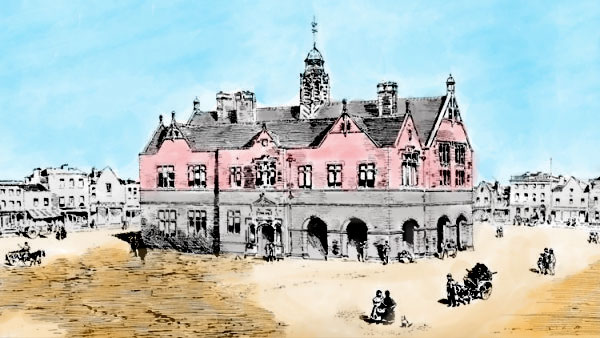 Architects drawings dated August 1st 1896 showing the winning tender for a once proposed new Thurles Town Hall & Market House on Liberty Square. [Photo colour toning G. Willoughby]
was won by one Mr Joseph F. Freeman and submitted by Mr. Walter G. Doolin, M.A., architect, Dublin.
Walter Glynn Doolin was born in Dublin circa 1850, the son of William Doolin and his wife Anne Eliza, née Glynn. He attended school at Tullabeg and Castleknock Colleges, before entering Trinity College, Dublin, where he obtained a BA degree and later a Licentiate in Engineering. He received his architectural training initially from his father before going to London where he worked first in the Architects’ Department of the School Board and then as an assistant in the office of William Burges. He returned to Dublin in early 1872, to his father’s house at 204 Great Brunswick Street.
Doolin, a keen athlete, oarsman and rifle shot, and described as being both ‘jovial’ and ‘genial’, had won many commissions here in the Catholic Diocese of Cashel, possibly because of his strong friendship with Dr. Thomas H. Kinane, Dean of Cashel. As a parish priest of Killusty, Fethard, Co. Tipperary, in 1881, Dr. Kinane had given Mr Doolin work designing a new church in the area.
Planned Exterior Arrangement:
On examining the drawings provided we discover that the exterior of the Town Hall & Market House building was to be executed in local limestone to the level only of the first floor. Above that level it was proposed to use red brick with cut stone dressings also of local limestone. In addition to the perspective view, two plans of the building were published showing the suggested interior arrangement.
Planned Interior Arrangement:
On the ground floor the drawings show a covered market area for Butter Dealers etc., with office spaces for Market Officials. In addition a second covered market area was allocated for smaller dealers, possibly Fresh Meat Sellers. The building was intended to open and trade 6 days each week.
On the upper floor was to be located an assembly-room, 72 ft. x 80 ft., together with a concert-stage, combining separate dressing-rooms for ladies and gentlemen. On this floor also is planned accommodation for the Town Commissioners office, together with a public reading-room, and lavatory accommodation.
Here also was to be provided a room for the Young Men’s Society. This latter popular social and spiritual Society, had been first founded by Father Richard Baptist O’Brien in Limerick in 1849; towards the end of the Great Famine period. Today this Society’s history confirms that Father O’Brien first met with some 24 labouring men on the 19th May of that year, in the upper room of a small two-storey cottage. The purpose of the meeting was to establish and launch the ‘Young Men’s Society of the Immaculate Heart of Mary’. Its purpose initially, to use their own words, was to foster “by mutual union and co-operation, and by priestly guidance, the spiritual, intellectual, social and physical welfare of its membership”.
 Local author Peg Hanafin will be launching her latest book “Never Give Up” in LIT Thurles, Nenagh Road this Friday, 3rd March 2017 @ 6:45pm.
This will be Peg’s third book release from this Thurles native.
Her first book release were called “Getting More Out of Life” – a collection of essays revealing the author’s curiosity, love of life and her belief that life is rarely what it seems on the surface.
Peg’s second book was called “Thoughts For Your Journey” – containing 366 thoughts, one for each day of the year, in which Peg puts forward ideas that try to simplify life in our complex and troubled world.
Peg’s latest book will be available for the special price of €13 at the launch event in LIT. Of course a signed copy makes for such a welcome gift especially if a friend or family member’s birthday or other celebration is expected in the near future. Live Music and finger food will be available until 9:30pm.
|
Support Us Help keep Thurles.info online by donating below. Thank you.
Total Donated 2026: €300.00
Thank You!
Daily Thurles Mass Livestream
|



Recent Comments