The address “Westgate”, (Irish – An Geata Thiar), here in the town of Thurles, refers today to that area which remains the small expanse one visits, as you exit Liberty Square unto Friar Street in the town.
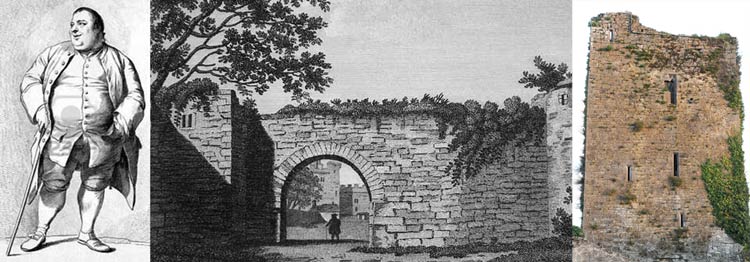
Pictured Left to Right – (A) Drawing of Francis Grose (1731-1791). (B) Grose’s Antiquities, Vol. I, showing an engraving of the “Black Castle” at the West end of Liberty Square as it appeared in 1790. (C) Thurles Castle today (March 2017) viewed from the side facing north.
Picture (A) above show us a drawing of a one-time visitor to Thurles back in the late 18th century (1790 / 1791); his name Francis Grose.(1)
His engraving, (picture (B) above), give us a valuable insight into an earlier view of this same “Westgate” area, portrayed by him for his famous and historical publication “Antiquities of Ireland.” Same work was posthumously published on his behalf by Samuel Hooper and portrays, through this ‘west gateway’, a long-forgotten view of Thurles Castle, Thurles, Co. Tipperary.
This former vista through Westgate shows the “Black Castle” viewed through an archway flanked by two towers. This archway once led into a quadrangular courtyard, at the far end of which was the castle and other, now not known, imposing buildings.
While a castle still survives, alas, the Westgate itself of 1791 no longer exists, but back then it represented the entrance to the home of Elizabeth Poyntz (1587-1673), daughter of Sir John Poyntz of Iron Acton in Gloucestershire, whom, in 1608 became Lady Thurles, following her marriage to Thomas Butler, (Viscount Thurles), son of Walter, 11th Earl of Ormond.
Prince Charles Mountbatten-Windsor, the current heir to the British throne, is a direct descendant of Viscount and Lady Thurles, through their eldest son the Duke of Ormond. The Duke’s daughter, Elizabeth, married Philip Stanhope, 2nd Earl Chesterfield, and their daughter Elizabeth Stanhope married John Lyon, 4th Earl Strathmore. Later in direct line was the 14th Earl Strathmore whose daughter, Elizabeth Bowes-Lyon married the future King George VI; the grandparents of Prince Charles.
Lady Viscountess Thurles was a staunch Catholic Royalist. During a short period between 1658-1660, while under the rule of Oliver Cromwell (1599-1658) and after the triumph of the Parliamentary army, the Cromwellian administration was to find that Lady Thurles was indeed a most difficult woman with which to deal. According to a Cromwellian edict, no Catholic who lived in the “Irish Quarters” before 1649, could be exempted from confiscation of their property followed by transplantation, “To Hell or To Connaught”.(2) An inquisition found that Lady Thurles held a life interest, in the right of her jointures in the Castle, town and lands of Thurles, Leugh, Killinan, Athlummon, Clobanna, Lahardan, Derryfadda, Longfordpass, and Garranroe, in the Barony of Eliogarty; and Kilshane, Cleghile, and Lagganstown in the Barony of Clanwilliam: also she had 80 head of cattle, and 800 sheep and lambs, all of which ought to be then forfeited to the Lord Protector and Commonwealth.
The Cromwellian “Adventurers”, as distinct from the soldiers, had, among the lands allotted to them, the Baronies of Eliogarty and Clanwilliam, and clamoured for the immediate removal of Lady Thurles. Two thousand acres, calculated to return her an income of £200 a year, were set out for her in Connaught, but by various stratagems she managed to delay her removal. She succeeded in winning over to her side, to plead her cause, among others, deep-dyed Puritans as the ‘regicides’, (Name given to Cromwell’s supporters who signed the death warrant of Charles I) Sir Hardress Waller and Colonel Robert Phaire, Governor of Cork; also Colonel Hierome Sankey, Governor of the Clonmel Precinct, a man whose reputation for savagery in dealing with the Irish was scarcely less than that of Cromwell himself.
In July 1656, the Cromwellian Council transmitted the petitions of these men on behalf of Lady Thurles to the Commissioners adjudicating on the Irish in Co. Cork, for their report on it. Their report, on 13th August, shows that they were also under the spell of Lady Thurles. It stated that the good lady had several times in 1641 harboured, entertained, and preserved from murder and famine divers English families whom the Irish had plundered, robbed, and attempted to murder; in all, 60 persons, and in particular Mr. Bullock and family, Joane Harris and family, and a minister, Mr. Price, and his family.
That also, after the fall of Archerstown Castle, Thurles, she received the wounded Major Peisley, and others of his company, into her home, entertained them for several weeks until they were cured, and then gave them money and other necessaries when they betook themselves to the English garrison at Doneraile.
This appears to have settled the matter in favour of the Adventurers, and the Council was powerless to refuse their claims. But although Lady Thurles lost her lands, it would seem that she was never ejected from her castle in Thurles.
That was in in 1658; however, the Adventurers did not long enjoy their newly acquired lands. Two years later, in 1660, Charles II was recalled to the throne, and James the son of Lady Thurles, returned to Ireland as Lord Lieutenant. He immediately ran the planters off his own lands, and those lands of his mother and their friends.
Sheela na gig
Of course, this West gateway had also another name, that of “Geata na gCailleach”, which translated from the Irish means “Hags Gate” or the “Gate of the Old Woman.” This gate most likely got its name from the fact that a carved stone ‘Sheela na gig’ made up part of this west gateway’s rock construction.
Continue reading Francis Grose Visits Thurles & Sheela na gig’s
 It is with great sadness we learned of the death, on Wednesday 5th April 2017, of

 The Oireachtas Committee examining water charges today have formally voted to scrap charges, and fund water through general taxation.



Recent Comments