|
|
 At Kilshane House, Co. Tipperary recently, attended by over 200 guests from the Multi-National and Indigenous Sectors, Enterprise Ireland, the IDA, as well as high profile figures drawn from the world of Sport and Entertainment were L – R; Tipperary Co. Council Chairperson Siobhan Ambrose, Minister for Jobs, Enterprise and Innovation Mitchell O’Connor with the very able Tipperary County Council Chief Executive (CE) Joseph MacGrath. Here in Co. Tipperary we respectfully ask the questions:
(1) Is Thurles Co. Tipperary ‘THE PLACE, ‘THE TIME’ for to encourage the government to “join other leading organisations”, to couple with our “rich culture of heritage“?
(2) “Is a purchase, by Government, of the ‘Black Castle’ here in Thurles justified, given our present economic situation nationally?
(3) Should the Minister for Arts, Heritage and the Gaeltacht, M/s Heather Humphreys or Minister for Jobs, Enterprise and Innovation M/s Mitchell O’Connor be asked, by our local politicians, to bring this ‘Black Castle’ purchase matter before Cabinet, recommending its purchase?
 History of the Black Castle
For those not familiar with the historic Black Castle in Thurles, do please read on; remembering that same building has now come up for sale as part of a commercial lot, having been previously in private ownership.
The sale of the Black Castle, which is located on the west side of Liberty Square, presents an ideal opportunity for the present government to now, through the Office of Public Works (OPW) who maintain the State’s property portfolio, bring this historic castle into public ownership.
The castle was once the home of Elizabeth Poyntz, formerly of Acton Court, Iron Acton, Gloucestershire, England,[A] known as Lady Viscountess Thurles, following her marriage to Thomas Butler, Viscount Thurles, in 1608. Thomas Butler was son of Walter Butler “Walter of the Rosaries,” latter probably the first of the Butler family to take up residence in Thurles Castle.[B] Viscount Thurles was summoned from Tipperary, to England in 1619 to answer charges of treason, but the ship, conveying him, was wrecked off the coast of Wales, in an area known as The Skerries and he was drowned on 15th December 1619. His wife Elizabeth Butler (Poyntz), the celebrated Lady Thurles was now a widow and the lone parent of three sons and four daughters.
After the death of Viscount Thurles, Lady Thurles, married again, about 1620, Captain George Mathew of Radyr and Llandaff in Glamorganshire, Wales, by whom Lady Thurles had a further two sons and a daughter.
Captain George Mathew died at Tenby in Wales in 1636. A period portrait, oil on canvas, of Lady Viscountess Thurles is in the possession of the Tipperary County Library, situated in the Source building, Cathedral Street, Thurles.
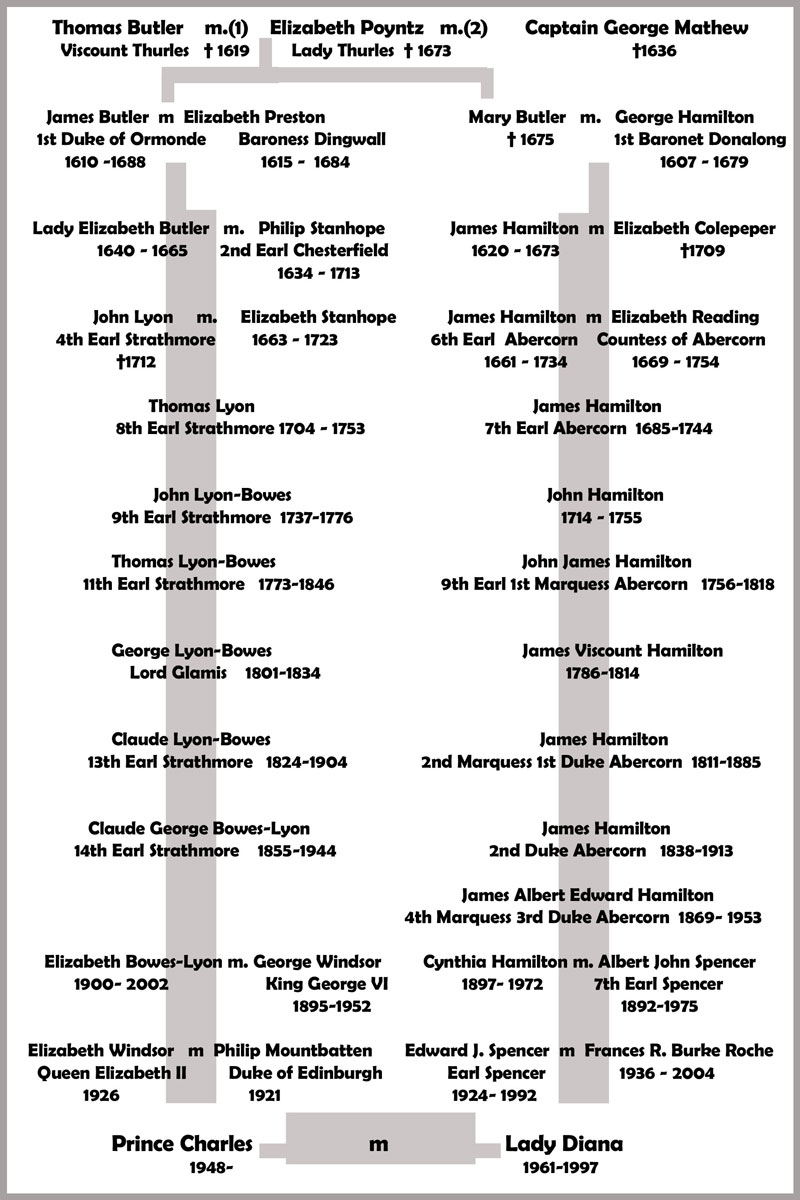
 Memorial Plaque marking the burial place of Elizabeth Butler in St. Mary’s Church Thurles. Note Elizabeth Butler (Poyntz) was also progenitor (ancestor) to Honora “Nano” Nagle (1718-1784) the “Lady with the Lantern”, founder of the “Presentation Sisters” and a pioneer of Catholic education in Ireland. The Presentation Sisters here in Thurles this year celebrate 200 years of being resident in the town (1817-2017). Nano Nagle was declared venerable in the Roman Catholic Church on 31st October 2013 by Pope Francis (Jorge Mario Bergoglio). Elizabeth and Thomas Butler (Lord & Lady Thurles), through their first son James FitzThomas Butler, 1st Duke of Ormond, is a direct progenitor (ancestor) to Charles Prince of Wales, who is the eldest child and heir apparent of the present Queen Elizabeth II.
The late Princess Diana is also connected to the history of the castle and through the daughter of Lord and Lady Thurles, (Mary Butler), and her ancestors the Hamiltons, descendants of whom married into the Spencer family. Indeed the late Princess Diana was the 12th cousin, twice removed, of Prince Charles.
Despite a visit from Oliver Cromwell’s Parliamentarian army during the period 1658 to 1660, Lady Thurles and her children resided in the castle for a great deal of her life. Following her death in 1673 she was buried, at her own earlier request, in Thurles, inside the earlier pre 1820 ‘Little Chapel of St.Mary’, now St. Mary’s C of I Church. A commemorative polished limestone plaque, within the church building, recalls this historic period.
Does Rural Ireland Receive its Fair Share of Government Funding?
Here in the Thurles half of our Templemore / Thurles Municipal District of Tipperary, our appointed fiscal executives at both Municipal District and County Council level, correctly and carefully count the cost of administration, prioritising our spend. Thurles after all is part of a forgotten rural Ireland; which the present Fine Gael government fully agree has been totally neglected for at least the past 15 years.
According to our recent 2016 Census returns, between 2011 and 2016 the Thurles Urban Electoral Division population actually dropped by 115 persons (From 6,929 to 6,814), while Thurles Rural Electoral Division increased only by 14 persons (From 2,300 to 2,314 – a miserable .61% increase). Of course the figures posted in these 2016 Census returns are not in fact actually true; instead these figures reflect the numbers of persons forced to migrate or emigrate elsewhere in order to find work; with all employment prospects in the town completely absent.
On April 27th last, we posted details of Fáilte Ireland’s recently announced €11.5m funding, to be invested in the refurbishment of ten key OPW sites in Dublin, within Ireland’s Ancient East Region. I pointed out that within a 33 miles radios of Dublin’s popular O’Connell street, went the majority of funding; yes over €8m in total. This included €3m towards a new museum and viewing platform in ‘The Record Tower,’ at Dublin Castle; €300,000 towards a Phoenix Park tourism and amenity study. While twenty-five miles’ away the Brú na Bóinne Visitor Centre got €2.58m; and thirty three miles away Newgrange got €1m with Knowth a further €1.4m.
Continue reading Is The Purchase By Government Of The Thurles ‘Black Castle’ Justified?
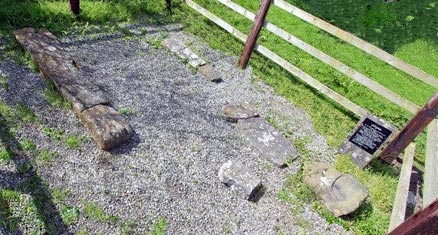 Grave of Gobán Saor, 16km (10Mls), from Thurles at Derrrynaflan, Ballinure, Co. Tipperary. Little is truly known about ‘An Gobán Saor’, pronounced Gubawn Seer, (Gobban the Builder; free smith, free mason or free carpenter), whom legend states is buried 16km (10mls), from Thurles, at Derrrynaflan, Ballinure, Co. Tipperary.
Back in the days when our present ancient stone castles, monasteries, round towers and churches (now, alas, many, for the most part, in ruins), were originally being constructed, stone-masons /smiths /architects, just like ‘An Gobán Saor’ (also spelt Gubin Saor & Gobban Saer) and other possibly lesser skilled, associates, would have assembled at prearranged building sites, in the hope of obtaining gainful employment. Non-locals selling their skills would have travelled with their whole families, setting up camp close to the area where there was a promise of construction work.
According to legend, the father of the Gobán Saor was himself a famous mason and architect. Convention states that the Gobán Saor lived sometime around the seventh century. Folklore also indicates that he married a respectable and very beautiful Sligo woman. He possibly travelled extensively, often incognito, not just in Ireland, but also in England and even on the Continent, designing splendid sturdy edifices, while working as a common stone mason.
Folklore indicates that An Gobán Saor was highly intelligent, jovial and at all times generous with his knowledge. From the many tales told we learn that the traits he finds most difficult to understand are miserliness combined with greed.
 Picture (A) Abbey Rd. area of Thurles and St. Brigid’s Graveyard (Shown circled in green), as it existed prior to 1846. Picture (B) The mason’s mark or symbol of ‘An Gobán Saor’, on a pillar beside St. Brigid’s Graveyard (Shown circled in red). The 2.4m pillar on this site was constructed in much more recent times possibly from stones relating to an older church building no longer evident on site.
To build these stone structures; these itinerant, skilled, stone masons would have remained camped in areas for many years, living, not in huts or houses, but in temporary tent-like dwellings, roofed over using bent, flexible, saplings covered in an oiled cloth to repel the weather. These nomadic skilled individuals were the past artists, designers, and architects, while also working as stone mason.
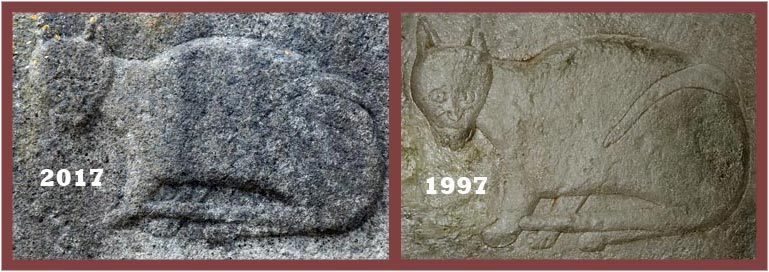 Stone carving of the cat with two tails, the mason’s mark or symbol of ‘An Gobán Saor’, in Thurles Co. Tipperary. This feline demonstrates a somewhat sad, frightened, stare at the visitor, while its set of whiskers points downwards.
Tales of An Gobán Saor‘s exploits verbally related down through the years’ state that he once applied seeking work to the master builder of a Cathedral. The master builder placed him in a work-shed by himself, and pointed to a block of stone inviting him to carve from it a cat with two tails. Next morning Gobán had disappeared, but when the master unfastened his shed and looked in, he found that the block of stone had been most beautifully carved into a cat with two tails. The Cathedral builder was heard to exclaim that this could only have been the work of An Gobán Saor himself, as no other human could have produced such superb work, and so fast.
So was born the mason’s mark or symbol, associated with An Gobán Saor; the cat with two tails, as shown above.
The story is also told that while building a monastery, the monks demanded that he lower his agreed price. To force this issue, they removed his climbing ladder from a castellated area he was building, preventing him from easy descent. Gobán began to slowly dismantle the stones structure, tossing the building materials to the ground, genially informing his employers below that this method of reaching the ground was as good as any. The monks are said to have quickly returned his ladder, and paid him his agreed price.
Because of the skilled ability of these itinerant builders, they were usually allowed, for the most part, to govern themselves. Sons inherited their skills and the trade secrets from their fathers, thus it was essential, that they would also develop their own private signs and a clandestine language, to ensure that these same trade secrets remained covert.
So also did the Tinkers; those specialising in skilled metal work, and some of this secret language, over the years, has made its way into the public domain; words like:- Kuenig (Eat), Án or Tes (Bread), Lokh or Lima (Milk), Chiman (Stick), Bós (Fist), Rístan (Prison), Krub (Foot), and a word used quite often today in conversation, which we relate to unemployment benefit; the word Dóle, which back then meant ‘Bread Trough’.
A Gobán Saor symbol can also be viewed by visitors attending at the Swiss Cottage, Cahir, Co. Tipperary, although same was possibly moved to this spot, in more recent times.
 A 28 year old Thurles native named as Mr Daniel (Danny) Whelan, previously with an address at Monakeeba, Thurles, Co. Tipperary and currently of no fixed abode, will be charged with the murder of M/s Samantha Walsh, a mother-of-four, in Waterford this morning.
The body of M/s Walsh aged 31 years, from Central Avenue in Lisduggan, was found at a flat in Thomas Court, Thomas Street, in Waterford city, at the weekend.
Detectives investigating the killing of M/s Walsh arrested the man at approximately 3.00pm on Sunday afternoon last, under Section 4 of the Criminal Justice Act, which allows for detention for up to 24 hours. Following his arrest Mr Whelan was brought to Waterford Garda station in Ballybricken for questioning.
The body of M/s Walsh, will be buried following Requiem Mass at St Paul’s Church, in Lisduggan at 10.00am on Tuesday, followed by interment afterwards in Kilbarry Cemetery.
 Global US drug manufacturers MSD are to invest €40m in their Biotechnology facility at Kilsheelan House, Ballydine, Clonmel, Co. Tipperary this year; installing new technology which it intends to use to further improve a number of its products.
The MSD plant has been in operation for over 40 years, and currently exports to some 30 countries, including destinations in Europe, Japan and the USA.
The site at Ballydine, Co Tipperary, which currently employs 600 people, (some 1,800 people employed by the company in Ireland), develops and supplies the active ingredients for a range of its medical products.
This promised investment brings MSD’s total investment; spent over a three-year period, to €75m, in upgrading this Tipperary facility.
The new technology to be installed, under the current €40m investment promised, includes a spray drying facility, which is used in the production of a number of new products; increasing their solubility and improving how they are absorbed into the human body by patients.
Mr Ger Carmody, Associate Vice President, and Plant Manager at MSD Ballydine, has stated that this current investment truly reflects the growing importance of MSD in Ireland and its overall operations in the group’s global network.
 Two Thurles brothers have appeared in court charged in relation to the seizure of more than €50,000 worth of tools and equipment, which it is alleged was stolen in the UK.
The men detained today at Dublin Port, after arriving from the UK, were originally questioned at Irishtown Garda station under Section 4 of the Criminal Justice Act.
The industrial tools and equipment, believed destined for the black market, were discovered in two vehicles, one of which was allegedly stolen, at Dublin Port on Saturday evening last.
Mr Jason O’Donoghue, aged 38 years, of Toreen, Bothar na Mona Road, Thurles, Co. Tipperary, and Mr Darren O’Donoghue, aged 29 years, of Croke Gardens, Croke Street, Thurles, Co. Tipperary, appeared before Judge John Cheatle this morning, at Dublin District Court.
Both men were charged with handling stolen property, while Mr Darren O’Donoghue was also charged with being in possession of false vehicle registration plates, and allowing himself to be carried in a vehicle known to be stolen.
Both men have been granted bail on agreed conditions that; (1) they reside at the addresses supplied and obey a curfew from 10pm to 7am: (2) that Both men must sign on daily at Thurles Garda station; (3) must not associate with each other; (4) must provide a mobile phone number to Thurles Gardaí, enabling themselves to be contacted during the 24 hours of each day.
There was an objection to Legal aid by Gardaí on the basis that each of the accused had access to large sums of cash. Each man was also ordered to pay a cash surety of €500 and must now appear before Dublin District Court on June 26th.
Investigations are now under way with UK authorities to identify the owners of the property seized at Dublin Port.
|
Support Us Help keep Thurles.info online by donating below. Thank you.
Total Donated 2026: €300.00
Thank You!
Daily Thurles Mass Livestream
|



Recent Comments