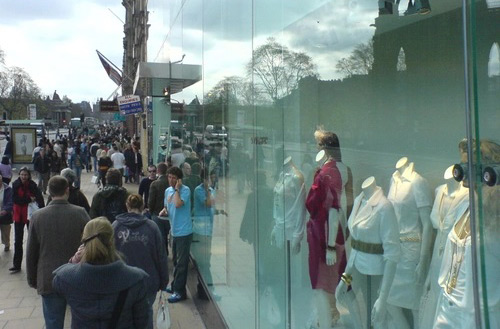
“I’m thinking of moving to Grafton Street, Dublin for peace and quiet”, writes Mr Ryan. Contrary to rumours, emanating from sinister suburban sources, life down here in the country is far from being just pothole and puddled roadways; mice in the cooker or rats in the haggard, not to mention the now returned woeful cold, wet weather being currently experienced outside.
The truth of the matter is that at this time of year, I, annually, up and make for Dublin in the hope of getting some brief respite from all the varied and ‘contraried’ activity, that is part and parcel of rural life.
So far, my services have been solicited for the darts team down at my ‘Old Rustic Inn’, latter my cross-roads boozer; by the secretary of Macra na Feirme who felt I look just villainous enough to play Lago (a character in Shakespeare’s Othello) in their local upcoming dramatic societies latest production.
It is little known, but I have this policy of my own: “Join nothing except your hands, and then only in prayer”.
However the ambassadors of the ‘Watery Mall’s Quiz Team’ and the ‘Set Combination Ceil Band’, are not impressed by this policy. Hardly a night goes by without that fearful, dreaded knock on the front door.
Of course up in Dublin one can say “no”, close the door, and get back to watching ‘Coronation Street’, but not so here, in this my rural countryside.
Down the Watery Mall one is obliged, under pain of mortal sin or worse, to be an active participant in village activity and failure to do so could mean relegation of one’s duty in the matter of honouring the little village. And for that failure, one will be made to answer; sure as water runs and grass grows.
I have even tried bribing my way out of the situation; in vain must add. I offered the secretary of the Watery Mall community fund-raising committee a fiver the other night, towards mounting the Watery Mall Tops of the Parishes competition. Thought she would plant a smacker on my cheeks in gratitude. Looking at this filthy lucre as she would have observed Judas Iscariot’s 30 pieces of sacrilegious silver, she hissed “G’way with ye”; insisting it was my time and talents she sought, in return for the honour and glory of the little village. Focusing on the positive aspects of this situation, I console myself with the belief that she was looking for my body.
Now I am a rational, reasonable and tolerant human being and I shudder and shiver at the mere thought of violence, but the next “ambassador” of a voluntary organisation (and there are 76 in the Watery Mall alone) who fails to accept NO and refuses to believe that I can survive just with a book, a bottle of wine and my partner, remaining isolated from all parish societies, will be formally introduced to ‘Twinkie’, latter our very unsociable, hostile, teeth baring, Alsatian dog. And if that fails to throw parish organisations off my scent, then there is nothing left for me to do, but rent a room off Dublin’s Grafton Street, just for that little bit of privacy and peace you understand.
Irish Government approval secured for the findings of the Review of Ireland’s opt-in Protocol on the area of freedom, security and justice (Protocol 21).
The findings of the Review, a legal mechanism that is part of the Treaties of the European Union and which uniquely provides for Ireland to be able to opt-into measures that relate to the area of freedom, security and justice on a case-by-case basis; has today been published.
Protocol 21, together with Protocol 19 and Protocol 20, provide Ireland with flexibility in its approach to European integration in potentially politically sensitive areas and allows for a pragmatic approach to its engagement with the Area of Freedom, Security and Justice (AFSJ).
The review, which is available HERE, was undertaken by the Department of Justice and informed by detailed statistical analysis of relevant legislation, internal and external consultations, and by a targeted consultation process with a range of key stakeholders, facilitated by the Institute for International and European Affairs (IIEA).
The Review recommends that Ireland continue to be covered by Protocol 21. It also recommends that greater adherence be given to the undertaking in Declaration No. 56, which was made by Ireland at the time of the negotiation of the Protocol, and which commits to Irelands participating, to the maximum extent possible, in all measure covered by the Protocol.
The Review’s headline recommendations, approved by Government, are that:
Ireland should continue to be covered by the terms of Protocol 21.
That greater adherence be given to the undertaking in Declaration No. 56 to the Treaties to exercise Ireland’s right under Article 3 of Protocol 21 to take part in JHA measures to the maximum extent possible.
The review also recommends the following additional actions that the Department of Justice should consider further:
To participate in Justice and Home Affairs(JHA) measures by default, opting out only where concrete and well-defined national interests are at stake.
To undertake a comprehensive, retrospective review of all the Protocol 21-related measures in which we do not participate and determine whether we can accede to these measures or not.
To consider, to the extent practicable, mirroring via domestic legislation those EU measures which it has not opted into due to administrative constraints.
To explore the possibility of joining the European Public Prosecutor’s Office.
To explore the creation of a specialised body to facilitate the processing of mutual assistance and mutual recognition requests in a more efficient way.
Bunratty Castle situated in the Mid-West region (latter consisting of Tipperary, Clare and Limerick), to Host First-Ever ‘Bark in the Park’ Fun Dog Show.
Bunratty Castle’s Irish Wolfhounds ‘Rían’ and ‘Míde‘.
Dog lovers across Ireland have a new date to mark into their calendar, as Bunratty Castle and Folk Park hosts its first-ever ‘Bark in the Park‘ event on Sunday, June 8th, from 12:00pm to 5:00pm. Ireland’s newest dog show is set to offer a packed programme of light-hearted competition as canines of all shapes, sizes, and temperaments take centre stage at the County Clare visitor attraction.
The inaugural event will see dogs compete across 16 categories, with prizes for the Smallest Dog, Best Biscuit Catcher, Most Handsome Dog, Waggiest Tail, Veteran Dog, and Best Fancy Dress, among others. Young dog lovers won’t be left out either. The Young Handlers category will give children a chance to showcase their connection with their four-legged companions, demonstrating both skill and confidence in the ring.
“We are thrilled to introduce Bark in the Park, which will provide a fantastic day out for families and dog lovers,” said Ms Marie Brennan, (Events Manager at Bunratty Castle & Folk Park). “Dogs have always been part of the Bunratty story—our Irish Wolfhounds are a living link to the castle’s medieval past. “Bark in the Park” carries that tradition forward in a fun, modern way.”
The popular County Clare attraction, known for its medieval castle, recreated 19th-century Irish village, Victorian Walled Garden, and 26 acres of farmland and woodland, will also use the event to shine a light on the vital role service dogs play in Irish society. Visitors will have the opportunity to meet representatives from the Clare branch of Irish Guide Dogs for the Blind, who will share stories of how their dogs support people with visual impairments and families of children with autism. Irish Dogs for the Disabled will also be on hand to showcase their work in providing trained assistance dogs to people with physical disabilities.
Can I attend ‘Bark in the Park?’ please.
Adding an extra touch of history to the day will be Bunratty’s own Irish Wolfhounds, Rían and Míde, who took up residence on the site in 2023. Rían, aged two, and Míde, aged three, continue the long-standing tradition of wolfhounds roaming Bunratty Castle, as they did during the venue’s medieval banquets in the 1960s.
2025 marks the 600th birthdayof Bunratty Castle, one of Ireland’s most authentic and complete castles. A special event marking the landmark anniversary will be held during this summer.
It was with a great sadness that we learned of the death, yesterday, Sunday 25th May 2025, of Mr William (Billy) Collins, Longorchard, Templetuohy, Thurles, Co. Tipperary.
Mr Collins passed away peacefully surrounded by his loving family, while in the care of staff at St Luke’s Hospital, Kilkenny City, Co. Kilkenny.
His passing is most deeply regretted, sadly missed and lovingly remembered by his sorrowing family; loving wife Mary, daughter Tracie, sons Tony and David, grandchildren, Michelle, Shannon, Katie, Niamh, Cailum, Meadhbh, Bróna and Clodagh, son-in-law Tim, daughters-in-law Niamh and Geraldine, brother Anthony, sister Angela, brothers-in-law, sisters-in-law, nephews, nieces, extended relatives, neighbours and friends.
The current American MAGA movement (Make America Great Again), was founded in the belief that the United States was once a great country, but it has now lost status; one factor being foreign influence via immigration.
It’s estimated that 4.5 million Irish people emigrated to the United States between 1820 and 1930; with the Irish accounting for over one-third of all emigrants to the U.S., between the years 1820 and 1860. A major wave of Irish emigration occurred especially during the Great Famine of 1845-1852.
One such emigrant was a child, from Ballingarry (South Riding), Thurles, Co. Tipperary. His name was Martin Maloney, who, with little education, would rise from rags to great riches, thus highlighting America as being a land of great promise and greatest opportunity.
His birthplace, the village of Ballingarry (South Riding), Thurles, Co. Tipperary is situated just 19.8km (12.3mls) via R691 for any tourist who might “Dwell at awhile” at the Horse & Jockey Hotel, Thurles, Co. Tipperary.
During the months of spring and early summer, the wild and romantic hilly landscape, which surrounds Ballingarry village, is awash with scented hedgerows containing Gorse; Blackthorn (Sloe) and Hawthorn bushes, each abundantly clothed in their splendid yellow and white blossoms; same worth a visit solely for this spectacle of beauty alone.
A recent visit there reminded me of an extract taken from Oliver Goldsmith’s poem ‘The Deserted Village’. “The never-failing brook, the busy mill, The decent church that topt the neighbouring hill, The hawthorn bush, with seats beneath the shade, For talking age and whispering lovers made.”
This rather wind swept, once coal mining village of Ballingarry, Co. Tipperary, has a rich history; for it was here that a rebellion took place in 1848 recorded in history as the Young Ireland Rebellion, or the Ballingarry Uprising and referred to sardonically in England history as the Battle of Widow McCormack’s Cabbage Patch. This rebellion took place, during Ireland’s Great Famine, (1845-1849), on July 29th 1848, in the townland of Farranrory, Ballingarry, latter a small settlement about 4.3km (2.6mls) north-northeast of the village; inspired by Republicanism then happening both in America and in France.
Martin Maloney. Martin Maloney was born on December 11th, 1846; the second of nine sons born to John Maloney and Catherine Maloney (née Pollard), both then natives of the townland of Lisnamrock, Ballingarry, Co. Tipperary. The following year, 1847, would become known as ‘Black 47’, the worst year of the Great Famine. The year after the Ballingarry uprising, 1849, his parents decided to leave a then God forsaken Ireland, and travelled to America, taking only the eldest of their two children, named Edward, leaving their second son, Martin, in the care of his grandmother in Lisnamrock.
In 1854, once established these Maloney parents found themselves in a position, enabling them to send money back home to transport the now 8 year old Martin to America, to join the rest of their extended family; having made a secure home at ‘Shanty Hill’, in Scranton, Lackawanna County, Pennsylvania.
By 1860, the Maloney family appear in the US Federal Census, as living in Scranton PA with their children; Edward aged 16; Martin aged 14; Thomas aged 12; Michael aged 9; William aged 5, and a baby aged two-month-old named Andrew. Martin was possibly accompanied by his grandfather in 1854, since also residing with them in 1860 was John’s father, Patrick, then aged 73 years old.
Coming from a coalmining area in Ireland at that time, Martin’s parents had chosen to set up home in Pennsylvania, aware of the possibility of quickly obtaining employment as a miner, with the demand, particularly for anthracite coal, having begun to be mined in the area, in the 1840s.
Observed as an ambitious youth, Martin Maloney left school at 12 years of age and for the next 3 years transferred his activities to working in one of the local coal mines, latter still in their infancy, before taking ownership of a grocery store. He then took on the trade of an apprentice metal worker and before he had finished his apprenticeship, had acquired a small interest in this latter business.
It is while working here that he came into the possession of a gas burner which he further developed, thus inventing the “Maloney Gasoline Lamp”, latter the first of its kind to use gasoline as a fuel and which back then, was practically a waste product of the oil refineries. With the immense fortune created by royalties from his invention, began the “Maloney Manufacturing & Lighting Company”, and the “United Gas Improvement Co.” which furnished the water, electric and gas for many public city utilities. This new street lighting business, entering a much needed market which was to become a welcome substitute for the old kerosene street lighting, then in universal use.
In December 1868, Maloney (1846-1929) married Margaret Anne Hewitson (1848-1923), latter a native of Carbondale, situated 15 miles due northeast of his adopted Scranton, in Northeastern Pennsylvania. They would go on to parent seven children. Sadly only 3 daughters; Margaret, Catharine and Helen only survived to reach adulthood. At the time of his death we learn, he was only survived by 2 daughters, [Margaret – Mrs Louis Carbery Ritchie who, similarly to her father, was made a Papal Marchioness in 1930 by Pope Pius XI in recognition of her charitable work and Helen – Mrs. Arthur H. Osborn, of Spring Lake and New York resp.] Surviving family members included; two granddaughters, Mrs. Richard L. Farrely and Miss Margaret Ritchie; one grandson, Martin Maloney Osborn, and two brothers, Thomas Maloney of Scrapton, and Andrew P. Maloney, a lay Papal dignitary of Philadelphia; a sister-in-law Mrs. Sarah Berkirt and a niece Mrs. John McCusker. In 1907, Helen eloped from Ballingarry Spring Lake, New Jersey, with Mr Samuel R. Clarkson, of London, who had been a guest of her fathers. Her father paid investigators who successfully tracked them down in Europe shortly afterwards. Then to the astonishment of their existing social scene, it transpired, that two years earlier, (1905), Helen, in secret, had already previously married a student at Princeton University, named as Mr Arthur H. Osborn. This marriage was then duly annulled, with Helen stating that she had eloped merely to escape the clutches of her father’s various aristocratic friends, whom she claimed were gold diggers and wished to marry her, solely for her money. Samuel R Clarkson died in London in 1913. The love once enjoyed between Helen and Arthur now blossomed again and in 1909, to the approval of the family, both were married a second time in New York city.
Earlier, in 1873, some five years following his marriage, at the age of just 26 years, Martin Maloney made the acquaintance of William G. Warden and William L. Elkins who, at that time, were engaged in the oil refining business and from whom he would later purchase his first supplies of naphtha and gasoline. Contracts shortly afterwards were obtained to light the streets of Philadelphia; Jersey City; Pittsburgh and Camden and 3 years later in 1876 a contract was obtained for lighting the Centennial Exposition Grounds, in Fairmount Park, Philadelphia. The Centennial Exposition Grounds overlooked the Schuylkill River, with 250 pavilions and seven miles of avenues and walkways occupying a 285 acre tract of Fairmount Park’s overall 3,160 acres. This upcoming Exposition was required to exhibit national pride and demonstrate the importance of education and progress, through American industrial innovation.
His street lighting business developed rapidly and in 1877, he organized the Penn Globe Gas Light Company, in association with the afore mentioned existing partners Mr. Warden and Mr. Elkins, together with P. A. B. Widener, Thomas Dolan and Samuel T. Bodine. Thus organized, this business soon found a nation-wide demand for their product and services, thus extending its activities to other larger progressive cities throughout the U.S. The street lighting business brought the partners into contact with the owners of other artificial gas light companies and it was not long before he and his associates were acquiring these same businesses throughout the country, which later were to became the nucleus of the United Gas Improvement Company of Philadelphia, organized in 1882.
At this time electric lighting was beginning to make its appearance, it was not long before Martin Maloney and his associates realized the great advantages and opportunities that could be offered by this new constituent, of both light and power. This new interest led to the establishment of the Pennsylvania Heat, Light and Power Company which soon absorbed other small electric companies then operating within the city. He was also instrumental in organising the Electric Company of America, an earlier holding company owning and operating power companies in several other states.
His home, situated in the cultural heart of Philadelphia, at 220 West Logan Square, Philadelphia was condemned in 1916 and demolished by the city, along with its entire block, when Logan Square was further expanded westward to 20th Street, as part of the creation of the Benjamin Franklin Parkway.
He erected three other dwellings; “Ballingarry“, built as a summer retreat near the shores of Spring Lake, known as the “Irish Riviera”, at 101 Morris Avenue, New Jersey (Latter named after the nearby village of his birth in Tipperary). His home was considered one of the great houses of the eastern seaboard. The area was observed as a resort destination for only high society during the late 19th and early 20th centuries. Designed by one of the masters of American Beaux-Arts architecture, Horace Trumbauer(1868-1938), this neo-classical mansion was partly modelled on the South Front of the White House. Sadly, it was demolished in 1953. “Cashel“, (latter meaning ‘fortress’ or ‘stone fort’ was named after a historic, nearby town also in his native Tipperary), was a summer retreat on St Lucie Boulevard, in Port Sewall, Florida. “Maloney’s Cottage“, also on Morris Avenue, Spring Lake, Monmouth County, New Jersey today remains a historic Queen Anne-style summer residence, completed in 1901. The building is now all that remains of Maloney’s ‘Ballingarry’ American Estate, and was added to the National Register of Historic Places in 1992.
Martin Maloney – Charitable Benefactor.
An ardent and devout Roman Catholic and a frequent visitor to France and Italy, Martin contributed greatly to the construction and upgrading of buildings, churches and religious institutions, e.g.the Maloney Memorial Home for the Aged at Scranton, for elderly workers left destitute after years in the mines an run by the Little Sisters of the Poor; the Maloney Chemical Laboratory at the Catholic University of America, Washington; St. Joseph’s Parochial School at Trenton; St. Martin’s Church at the Roman Catholic Seminary of St. Charles Borromeo, Overbrook, Philadelphia; the Martin Maloney Clinic then a new medical centre of the University of Pennsylvania at Philadelphia; churches at Rock Hill, South Carolina; Georgia, South-West Carolina; and Florence, South Carolina. He rehabilitated of the ancient College of the Irish Franciscans at Louvain an donated the main altar to the Church of the Nativity, in Scranton. Records show that Maloney gave $120,000 in 1917, to construct the Maloney Hall at The Catholic University of America, originally known as the Martin Maloney Chemical Laboratory and an additional $100,000 in 1923-24 for what is today the building’s 273 seat Della Ratta Auditorium. Maloney said he hoped the building would “help our Catholic young men and women rise to the level of the great opportunities, which our nation (America) offers them”. James Augustine Farrell Sr., then president of the United States Steel Corporation, was a featured speaker at that buildings dedication.
As a result of anti-clerical legislation in France in 1901, most religious orders and congregations saw their property being confiscated. A rumour began to grow that a wealthy American was buying up much of the religious orders properties to preserve it for a time when Catholic France, would return to reason. The name of this wealthy American in fact was Martin Maloney and he purchased title to a number of convent and religious institutions, in order to preserve them from such confiscation.
In recognition of Maloney’s many charity donations and philanthropies, both at home and abroad, in 1903, Pope Leo XIII made him a ‘Papal Marquis’, and in 1904, he was appointed a Papal Chamberlain by Pope Pius X. Marquis Martin Maloney was a member of the Fairmount Park Association, the Pennsylvania Academy of Fine Arts, the Union League Club and City Club of Philadelphia, the Catholic Club of New York, the Scranton Club of Scranton, the Everglades Club of Palm Beach, Florida, and others.
View, hereunder, the magnificent exterior and interior of St Catherine’s Church, Spring Lake, New Jersey, U.S.A.
St Catharine’s Church, Spring Lake, New Jersey, U.S.A. A story is told that a rich man, who grew up in ‘Shanty Hill’, offered to pay for the construction of a church in Scranton, if officials agreed to call it ‘St. Catharine’, (a Christian saint and martyr, believed to have lived in the early 4th century), but the congregation were determined that they wanted it called ‘Nativity of Our Lord’ and preferred to raise the required funding required, themselves.
Undeterred, a magnificent Church building, was then erected in Spring Lake, with Maloney naming it in memory of his daughter Catharine, latter who died of a prolonged illness on May 20th, 1900, aged just 17 years old. In grief, but as already stated, with great devotion to his Roman Catholic faith; Maloney donated both the land and the money, while exerting great personal care as to the building’s construction and overall design. Not forgetting his Tipperary and Irish heritage, the cornerstone of St Catharine’s Church was laid on Ireland’s patron Saint’s day, St Patrick’s Day, March 17th 1901, and the beautiful copper domed classical revival style building, overlooking the Spring Lake on West Lake Drive, was built over the following six years. Regarded as a mini-cathedral today, the church was built in renaissance style architecture to resemble St. Peter’s Basilica in Vatican City, Rome and today includes frescoes that depict life in both medieval and modern Ireland. Once again, the internationally known American architect Horace Trumbauer(1868-1938) designed the exterior and interior of the building, while Artists from Italy were commissioned to provide the statues, carved stonework and paintings within. The stained glass windows came from the Royal Bavarian Stained Glass Manufactory, at Munich, Bavaria, Germany, latter then a European centre of arts, architecture, culture and science.
In the Church of the Assumption, Ballingarry (SR), back here in Thurles, Co. Tipperary, today can be viewed a magnificent stained glass window, possibly also manufactured by the Royal Bavarian Stained Glass Manufactory, at Munich, in Germany. Same today faces east, directly above the main alter in the Church he once attended as a small boy.The window is dedicated to his family. The inscription states “In Memory of the Moloney (Note change in spelling of name) Family. Erected by Martin Moloney of Philadelphia 1890.” This rare window shows Mary and Joseph with a rather teenage looking son Jesus Christ, carrying a crucifix. [Same possibly can be interpreted as describing, in picture form, the writings recorded in the Gospel of St Luke, Chapter 2: Verses 46 & 49, – “Now so it was that after three days they found Him in the temple, sitting in the midst of the teachers, both listening to them and asking them questions. And he said unto them, How is it that ye sought me? Wist ye not that I must be about my Father’s business? ]
Martin and his wife Margaret Anne are both buried in the Maloney family crypt in St. Catharine’s church yard in Spring Lake. On Martin’s death in Philadelphia, Bishop John J. McMahon of Trenton paid eloquent tribute to his life and concluded by reading a cablegram from the Pope. It read: “The Holy Father mourns the death of the good and well-deserving Marquis and prays eternal rest for the departed and sends a blessing for the family.”
Marquis Martin Maloney, philanthropist left an estate valued at some $7.8 million, on his death.
His family headstone, in Ballingarry village, Thurles, Co. Tipperary remains a poignant reminder of his early humble beginnings and can be located easily today, situated on the far south-east corner of the old graveyard, on the south side of the main church building.
The headstone in Ballingarry Churchyard Reads: Erected by John Maloney of Scranton Pennsylvania U.S.A. in memory of his father Patrick Maloney, died 5th April 1863, aged 70 years. Also his mother Catherine Maloney (née Brophy), died 18th April 1873, aged 82 years. And his son Patrick Maloney, died 3rd May 1859, aged 18 years Also his brother Michael Maloney, died 2nd April 1873, aged 62 years. And his nephew John Maloney, died 17th March 1894, aged 32 years. May their souls rest in peace.
Finally, if you have managed to read this far, it is worth noting that Mr Charles Bruder, aged 27 years; a Swiss bellhop, for the Essex and Sussex Hotel, Spring Lake, NJ, was, sadly, the second of five victims of the Jersey Shore Shark Attacks. He sadly lost his life, on July 6th, 1916, while swimming approximately 120 metres (130 yards) from shore in Spring Lake. This wave of shark attacks took place between July 1st and July 12th, 1916, along the 130 km (80 miles) of the Atlantic Ocean coastline and is often attributed as having inspired the novel ‘Jaws‘ written by Peter Benchley; with the film later directed by Steven Spielberg. However, this claim has been denied by Peter Benchley.
This website uses cookies to improve your experience. We'll assume you're ok with this, but you can opt-out if you wish.AcceptRead More
Privacy & Cookies Policy
Privacy Overview
This website uses cookies to improve your experience while you navigate through the website. Out of these, the cookies that are categorized as necessary are stored on your browser as they are essential for the working of basic functionalities of the website. We also use third-party cookies that help us analyze and understand how you use this website. These cookies will be stored in your browser only with your consent. You also have the option to opt-out of these cookies. But opting out of some of these cookies may affect your browsing experience.
Necessary cookies are absolutely essential for the website to function properly. This category only includes cookies that ensures basic functionalities and security features of the website. These cookies do not store any personal information.
Any cookies that may not be particularly necessary for the website to function and is used specifically to collect user personal data via analytics, ads, other embedded contents are termed as non-necessary cookies. It is mandatory to procure user consent prior to running these cookies on your website.








Recent Comments