|
|
Yet another chunk of Thurles and Co. Tipperary’s amazing history has been sold off at an auction held in Chatsworth Street, Castlecomer, Co. Kilkenny, on Wednesday March 7th last.
Four rare works of art, once commissioned by the Archdiocese of Cashel and Emly, back in the early to mid 19th century, went under the hammer at Fonsie Mealy Auctioneers, in their recent Chatsworth Fine Art Sale.
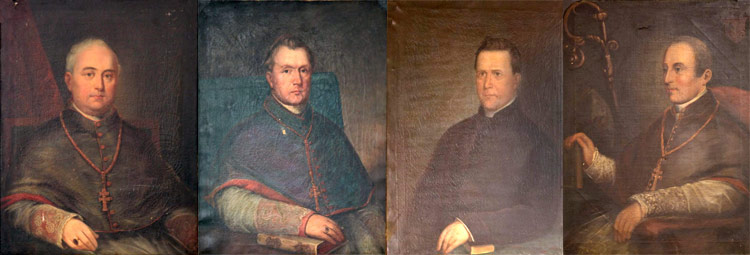 Pictured L-R: Oil painted portraits of three Cashel & Emly Archbishops & one senior Priest (1) Michael Slattery (1833-1857), (2) Patrick Leahy (1857-1875), (3) Rev Edmund Ryan (1856-1868), & (4) Patrick Everard (1820-1821). Lots numbered 268 to 271, which comprised the four oil paintings, of a former Senior Priest and three former Archbishops were sold off for between €300 to €500 each.
(1) Lot 268, estimated between €400-€600 was sold for €500, featuring Archbishop of Cashel, Michael Slattery, in a half length portrait of a gentleman seated in clerical garb, [Approx. size 89cms x 69cms (35″ x 27″)] in a heavy gilt frame.
Archbishop Slattery served as Roman Catholic Archbishop of Cashel & Emly from 1833 to 1857. Born in Tipperary Town 1783, he was educated at the Abbey School before entering Trinity College, Dublin at fifteen years of age, one of the first Roman Catholics ever to do so, eventually earning a Bachelor of Arts degree. Having decided to become a Roman Catholic priest, he was enrolled at St. Patrick’s College, Carlow, before being ordained in 1809 and continued on at the collage as a professor of Philosophy and of Moral Theology. Later he served in the parishes of Ulla, Co. Limerick for two years, and in Borrisoleigh, Thurles, Co. Tipperary for over twenty years.
In 1832 he was elected president of St. Patrick’s College, Maynooth and served for two years. A supporter of moderate Nationalism and of Daniel O’Connell (Latter responsible for Catholic Emancipation passed by Parliament in 1829), he regularly spoke out against militant nationalism.
He was elected to succeed Archbishop Robert Laffan as head of the Roman Catholic Archdiocese of Cashel and Emly later that year, and was installed at Thurles Cathedral on February 24th 1834, going on to established a foreign missions department in St. Patrick’s College, Thurles in 1842.
Archbishop Slattery passed away in Thurles on February 4th 1857.
(2) Lot 269, estimated between: €400-€600 was sold for €340, and featured Archbishop of Cashel, Patrick Leahy, in a half length portrait of a gentleman in religious attire, [Approx. size 92cms x 71cms (36″ x 28″)] in a heavy gilt frame. (This sale must surely be to our greatest shame.)
Archbishop Leahy, son of Patrick Leahy, a civil engineer and Cork county surveyor, was born near Thurles, Co. Tipperary, on May 31st 1806, before being educated at Maynooth.
Serving as a curate in the diocese of Cashel, he was soon appointed professor of Theology and Scripture in St. Patrick’s College, Thurles, and shortly afterwards became President of the same institution. On August 22nd 1850 he became one of the secretaries of the Synod of Thurles, before being appointed parish priest of Thurles and Vicar General of the Diocese of Cashel.
When the Catholic University was opened in Dublin in 1854, he was selected for the office of vice-rector, under the then rector Dr. J. H. Newman, (later Cardinal Newman), filling a professor’s chair. He was elected Archbishop of Cashel on April 27th 1857 before being consecrated on June 29th of the same year. In 1866 and 1867 he, tiogether with the Bishop of Clonfert were both deputed, to conduct the negotiations with Lord Mayo, (Styled Lord Naas between 1842 and 1867, a statesman, Viceroy of India and prominent member of the British Conservative Party from Dublin), the chief secretary for Ireland, with respect to the proposed endowment of the Roman Catholic university.
He was a strong advocate in the cause for temperance; enforcing the Sunday closing of public-houses in his Diocese. Indeed it was due to his energy that the Cathedral of The Assumption, in Thurles was constructed at a cost of £45,000 then pounds.
Archbishop Leahy died at the Bishops residence here in Thurles on January 26th 1875, and is interred (February 3rd 1875) within Thurles Cathedral.
(3)Lot 270, with a value estimated between: €400-€600 same was sold for €300, and featured Cashel and Emly Priest Rev. Edmund Ryan, in a half length Portrait of a gentleman seated, book in hand, in priests collar, [Approx. size 89cms x 69cms (35″ x 27″)] in heavy gilt frame.
(4) Lot 271, estimated between €400-€600 was sold for €300, and featured Archbishop of Cashel and Emly, Patrick Everard, in a portrait of a gentleman seated in clerical attire, with Bishop’s coat of arms in top right corner, [Approx. size 89cms x 69cms (35″ x 27″)].
Archbishop Everard was born in Fethard, Co. Tipperary, and attended a local classical school. He was educated at the University of Salamanca in Spain where he had moved in 1776. He was ordained in 1783 and obtained a doctorate of Divinity from Bordeaux University. Following his studies, he was elected President of the Irish College in Bordeaux and Vicar General to the Archbishop of Bordeaux, until the French Revolution drove him out of the country. He spent some time in England as principal of a lay academy at Ulverstone, in the South Lakeland district of Cumbria, Lancashire, North West England, which he had purchased from the Jesuits, before becoming the president of Maynooth College in Ireland.
Following the death of Archbishop Thomas Bray on December 15th 1820, Patrick Everard automatically succeeded as the metropolitan archbishop of Cashel and Emly, until his death in 1821.
All four paintings were sold for a total final hammer price of just €1,440, or if you like, less than a current TD’s weekly minimum wage of €1,800.
It would appear that no one, to our shame here in Co. Tipperary, is minding our shop.
Every person aged 66 and over, living permanently in the Irish State, are entitled to avail of the Free Travel Scheme. Some people under 66 also qualify. If you qualify for free travel, you are issued with a card that you must carry with you when using public transport. In some cases, a Free Travel Companion Card is also available which allows a person to travel with the holder (if they are unable to travel alone).
This Free Travel Scheme allows for free travel being made available on all Irish State public transport systems, e.g. Bus, Rail and Dublin’s LUAS service, with some minor exceptions.
 Left-Right: Ms Joan Farrally, Mr Vincent McNally (Group Organiser), Mrs Eilish McNally, and Mrs Brid McMenaman. Mr McNally (Pictured above) headed up a most wonderful, friendly, knowledgeable and well travelled group of 45 retired persons from Co. Dublin, on Wednesday, March 7th last, all who arrived by train to Thurles Railway Station. Answer two simple questions.
(1) “Have any of you retired persons, aged 66 and over ever visited the historic town of Thurles?”
(2) “Do you realise that you can have a most enjoyable day out in Thurles town for a maximum of €12.00?”
So what can you get for €12.00 in Thurles, Co. Tipperary, armed with a Free Travel Scheme pass card?
-
First, remember your travel is free and Thurles Town enjoys the luxury of an excellent and regular Iarnród Éireann daily train service.
-
Lunch in the historic Hayes Hotel, Liberty Square, offers a full Lunch Menu in the comfort of their attractive Carvery. [e.g. main course of Roast Beef & 3 Veg, plus Tea or Coffee will cost you just €11.00.]
-
The Davin Room in Hayes Hotel will be made available, free of charge, for groups of twenty persons or more, with a charge of just €1 per head to attend a one-hour lecture on the Great Famine (1845-1850) and to view, up close, some of the extremely rare artefacts, collected from that period; not available to see anywhere else in Ireland.
-
Other activities can also be arranged around your day trip, subject to your particular interests.
So, here is a perfect opportunity for those of you benefiting from the Free Travel Scheme, to round up a group of friends and give yourselves a well deserved day out; one to remember here in Thurles, Co. Tipperary, with an opportunity to meet the friendliest and most obliging people in the world.
Tripadvisor:
A must for anyone interested in Irish history.
It was an eye opener for all of us active retirees to learn about the famine history, from a very well spoken orator, who delivered an excellent talk about this sad period in Irish history.
Tripadvisor:
Lots of very interesting displays of what life was like during the famine. Has original “Gratuitous Relief Ration Record Book” (or the ‘Distribution Book,’ as it was also called,) for the electoral divisions of Holycross, Thurles and Ballycahill for 1847. Admission is only a nominal donation.
Further details can be had by phoning at any time, Mobile – (086) 8785859, and we will endeavour to ensure you enjoy your day trip to this most historic of Tipperary towns; Thurles.
[Please Note: All money, in total, collected from these “Great Famine” lectures goes to Thurles Lions Club, for use at their discretion, with a total of €140.00, having already been handed over to this very worthy organisation, to date this year.]
“Here’s to a long life and a merry one.
A quick death and an easy one.
A pretty girl and an honest one.
A cold beer and another one.”
An Irish Wish On St. Patrick’s Day.
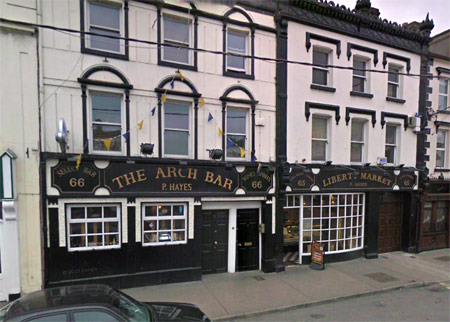
“Are you going to view the Thurles St. Patricks Day Parade tomorrow”, said I to Mikey Ryan last night, above in the Arch Bar.
“Damned if I’ll bother”, said Mikey, “When you see one you’ll have seen them all”.
“Still the marching bands can be good”, said I “Sure, you know I’ve always wondered why bagpipe players always walk when they are playing?”.
“Sure, that’s an easy one”, said Mikey, “Isn’t it the case that moving targets are much harder to hit. Now what intrigues me is how do they feckin know when their infernal bagpipes need tuning?”
“So, what will you get up to tomorrow, Saturday March 17th, if you are not watching the Parade”, said I.
“I’m thinking of hitting down to Thurles Golf Club”, said Mikey. “That’s of course if I can escape from herself.”
“And how are things at home at the moment “, said I, not wanting to appear over inquisitive.
“Eh, pour me a stiff one, there Pat and one for himself”, said Mikey pointing to me, before announcing he had just had another tiff with “the little woman”, as he affectionately calls her.
“Oh yeah”, said I. “And how did this one end?”
“Well I’ll tell you when it was over”, Mikey replied, “Herself came to me on her hands and knees, so she did”.
“You don’t say?” said I intrigued, “Now that’s a change for the books! So, what did she say?”.
“Oh, she said something like come out from under that bed, you gutless little fecker, or words similar”, replied Mikey, his tone indicating a reluctance to further discuss the matter.
“You know”, said Mikey changing the subject, “Talking about St Patrick’s Day; there used to a leprechaun living in the woodland, near to the 16th hole on Thurles Golf course”.
“Go away with you now”, said I, “Sure there are no such things as leprechauns.”
“I’ve heard for a fact, that you are very wrong”, said Mikey, who continued, while lowering his voice to a whisper.
For what it’s worth, Mikey confirmed that he had been reliably informed that on one day while on Thurles Golf course, a guy was out golfing at the 16th hole. He tees up and strikes the ball, but unfortunately, doesn’t it go into the wooded area over there on the side of the fairway. So, he goes looking for his ball, as one does. Immediately he comes across a little guy with wild red hair and a shaggy red beard, stretched on the ground, bearing a massive lump on his forehead. A golf ball lay close to his discarded green banded hat.
My Goodness, says a now worried golfer, who proceeds to attempt to revive the injured little guy, who is wearing green knee-length trousers and shoes with giant buckles. Upon awaking, this little guy says, “Well, you caught me fair and square. I am a Luchorpán, but if you let me go right now I’ll grant you three wishes.”
The golfer says ” Sure I can’t take anything from you, I’m just glad I didn’t kill you, please I would be glad if you didn’t go looking for medical compensation”, and he walked quickly away.
Watching the golfer depart, the Luchorpán says, “Well, that fellow that caught me was decent, so I’ll do something for him. I’ll give him the usual three wishes that most men would want. Sure, I’ll give him unlimited money, a great golfing future, and a long sex life.”
Just this week, and almost a month later, that same golfer was out golfing on the Thurles course and again at the 16th hole, he hits the small white ball into the same woodland and was forced to go off looking for it. When he finds the ball, on the way back he spots a small, little guy, dressed in green, tapping away with a hammer on a three-sided shoe last, in true ‘leath bhrogan’ (Shoemaker) fashion’.
“How are you doing”, the golfer asks.
“I’m fine”, the leprechaun replies, “And might I ask how your golf game is presently?”
The golfer says, “Begod it’s great! I hitting under par every time.”
The leprechaun knowingly nods his head, “I did that for you. And might I ask you now, how is your money holding out?”
The golfer looked at him, “Well, now that you mention it, every time I put my hand in my pocket, I pull out a €50 note.”
The leprechaun smiles and said, “I did that for you as well. And might I ask”, the luchorpán lowered his voice, “now that we are talking, how is your sex life?”
The golfer looks at him a little shyly and also in a low tone stated, “Well, between you and me, maybe once or twice a week.”
The leprechaun appeared disappointed, “Once or twice a week”, he queried? “Is that all?!”
The golfer looks at him in amazement, “Well, I would consider that to be something of a record for a priest residing in a very small parish”.
Mikey raised his glass, “May your thoughts be as glad as the shamrocks. May your heart be as light as a song. May each day bring you bright, happy hours that stay with you all the year long. A happy St Patrick’s Day to you.”
“You know”, said Mikey in an afterthought, “Like the man said, there are more things in heaven and Earth, Horatio, than are dreamt of in your philosophy”.
What has Thurles Railway Station, Co. Tipperary and the English Houses of Parliament got in common?
Mr Sancton Wood (1815–1886) was an English architect, born in the London Borough of Hackney. He was the son of Mr John and Mrs Harriet (née Russell) Wood, his mother being a niece of the painter and antiquarian draughtsman, Mr Richard Smirke, (1778–1815).
Back in 1845, the first year of the Great Famine here in Ireland, Mr Sancton Wood won a competition for the designing of Kingsbridge StationA. in Dublin (Built 1846). The competition, commissioned by the Great Southern & Western Railway Company, saw Wood’s designs selected unanimously by the railway company’s London Committee, despite the fact that the Dublin Committee had favoured the design of an Irish architect, Mr John Skipton Mulvany, latter a founder member of the Royal Hibernian Academy of Art, situated in our capital city of Dublin.
A. Note: Kingsbridge Station in Dublin of course is today called Heuston Station, renamed in honour of Seán Heuston, an executed leader of the 1916 Easter Rising, who had worked in the offices of Kingsbridge Station.
In that same year Mr Sancton Wood was appointed as architect to the Great Southern & Western Railway Company; designing all the railway station buildings between Monasterevin, Co. Kildare (including Thurles Railway Station) and Limerick Junction inc..
All of these station houses, with the exception of Limerick Junction station, are designed in a gabled picturesque Gothic style. Mr Wood also later became an architect to the Irish South Eastern Railway Company, which developed their railway line between Carlow and Kilkenny from 1848-1850. Six years later Mr Woods work, with reference to Ireland, appears to have ceased altogether.
 Top Pic.: Thurles in 1846, before the introduction of the Railway in 1847/48. Middle Pic.: Back entrance view of Thurles railway station. Bottom Pic.: Front entrance of Thurles railway station. Architect Mr Sancton Wood – The Early Years
Having developed a taste for drawing, Sancton Wood’s mother arranged to have him admitted to the office of his cousin, Sir Robert Smirke, RA. (Royal Academy), latter then an artist and leading London architect. From here he was transferred to Mr. Sydney Smirke, R.A., who succeeded to his brother’s practice. He remained with Mr Sydney Smirke for several years, working on the drawings of important works; which included sketches of the designs for the rebuilding of the Houses of Parliament, which Sir Robert Smirke had already prepared for Sir Robert Peel B. the Prime Minister of the then English Conservative Party government, (1834–35), following a fire on October 16th, 1834.
B. Sir Robert Peel had entered politics in 1809, at the age of just 21 years, as an MP for the Irish rotten borough of Cashel, just 14 miles from Thurles here in Co. Tipperary. The son of a wealthy textile-manufacturer and politician 1st Baronet Sir Robert Peel, would ensure that his son Robert would become Chief Secretary for Ireland and the first future Prime Minister of England, from an industrial business background. With a double first in Classics and Mathematics from Christ Church, Oxford, and law training at Lincoln’s Inn; in 1809 Peel would become known as the father of modern policing, with his forces nicknamed ‘bobbies’ in England and less affectionately known as ‘peelers’ here in Ireland. In 1829, in setting up the principles of policing in a democracy, Peel declared that, quote: “The police are the public and the public are the police.”
It was Prime Minister Sir Robert Peel who first imported, secretly, maize into Ireland for the first time, which due to the lack of knowledge on how to properly cook it; same became known as “Peel’s brimstone”. His attempt to breech a ‘Laissez-faire (or ‘Let Do’) system of economics in Ireland, saw him loose out to Lord John Russell as Whig Party Prime Minister in 1846.
Following this Houses of Parliament fireC. the immediate priority for the British government, was to provide accommodation for the next Parliament, and so the ‘Painted Chamber’ (Latter the medieval Palace of Westminster), and the ‘White Chamber’ (Latter the meeting place of the House of Lords from 1801), were both hastily re-roofed and repaired for temporary use by the Houses of Lords and Commons respectively, under the direction of the only remaining architect of the Office of Works, the said same Sir Robert Smirke.
C. Yet, one other famous artist, William Turner RA. [Joseph Mallord William Turner (1775-1851)], had watched the burning of the House of Lords and Commons in 1834, before painting several canvasses depicting the scene.
Sir Robert Smirke’s temporary repairs to House of Lords and Commons were demolished in 1851, with the House of Commons deciding in favour of an open competition for the proposed rebuild. Alas, Sir Charles Barry conceived the eventual winning design for the New Houses of Parliament; the construction of which he continued to supervise until his own death in 1860.
Mr Sancton Wood died at his home in Putney Hill, in south-west London, England SW, on April 18th 1886, and is buried in Putney Cemetery.
Today, Thurles Railway Station, which officially opened on March 13th 1848, boasts two through platforms and one terminating platform and remains a major stopping stage on the Dublin-Cork railway line, with numerous trains running hourly in both directions daily. Three times winner of the Irish Rail Best Intercity Station prize, it was also from here that on August 5th 1848 William Smith O’Brien was arrested, following his unsuccessful insurrection in Ballingarry, South Tipperary, known by the British disparagingly as the “Battle of the Widow McCormack Cabbage Patch”.
EPA welcomes increase in composting and anaerobic digestion of waste.
 The EPA welcomes the increase in composting and anaerobic digestion of biodegradable waste – the quantity recycled increased by 15% between 2015 and 2016. Kitchen and canteen food waste together with park & garden waste accounted for most of the waste accepted for treatment in 2016 (65%). Composting rather than anaerobic digestion was the dominant treatment type.
March 15, 2018: The EPA has today released data and information on composting and anaerobic digestion in Ireland for 2016. The data updates the National Waste Statistics web resource, launched by the EPA in recent months.
Commenting on the figures, Stephen Treacy, EPA, stating:
“The EPA welcomes the increase in the amount of biodegradable waste being accepted for recycling at composting and anaerobic digestion plants. Ireland’s national waste management policy “A Resource Opportunity” aims to make the most of opportunities to recover resources from waste in line with the European Commission’s Circular Economy Strategy. Segregating and separately collecting biodegradable wastes such as food and garden waste means that they can be recycled and reduces the amount disposed to landfill.”
EPA figures show that the amount of waste accepted at commercial composting and anaerobic digestion plants increased by 15% between 2015 and 2016 (from 308,000 tonnes to 353,000 tonnes). Composting was the dominant treatment activity, (79% of tonnage accepted).
Waste collectors are required to provide brown bins to ensure that waste food is collected separately. In 2016, 174,000 tonnes of brown bin waste were accepted at composting and anaerobic digestion facilities for treatment, an increase of 22 per cent on 2015. Twelve per cent more households had an organic bin in 2016 compared to 2015 and this is a positive outcome from the implementation of the 2013 household food waste regulations. The amount of brown bin waste being exported to Northern Ireland for recovery rose again in 2016, by over 80%.
Stephen Treacy concluded by explaining the co-benefits of anaerobic digestion:
“Anaerobic digestion extracts additional value from organic waste due to the possibility of using the captured biogas. This not only mitigates the effect on climate change but the biogas can displace fossil fuel use, increasing the amount of renewables being used in Ireland.”
The 2016 information on Composting and Anaerobic Digestion is now available on the EPA website.
|
Support Us Help keep Thurles.info online by donating below. Thank you.
Total Donated 2026: €300.00
Thank You!
Daily Thurles Mass Livestream
|



Recent Comments